
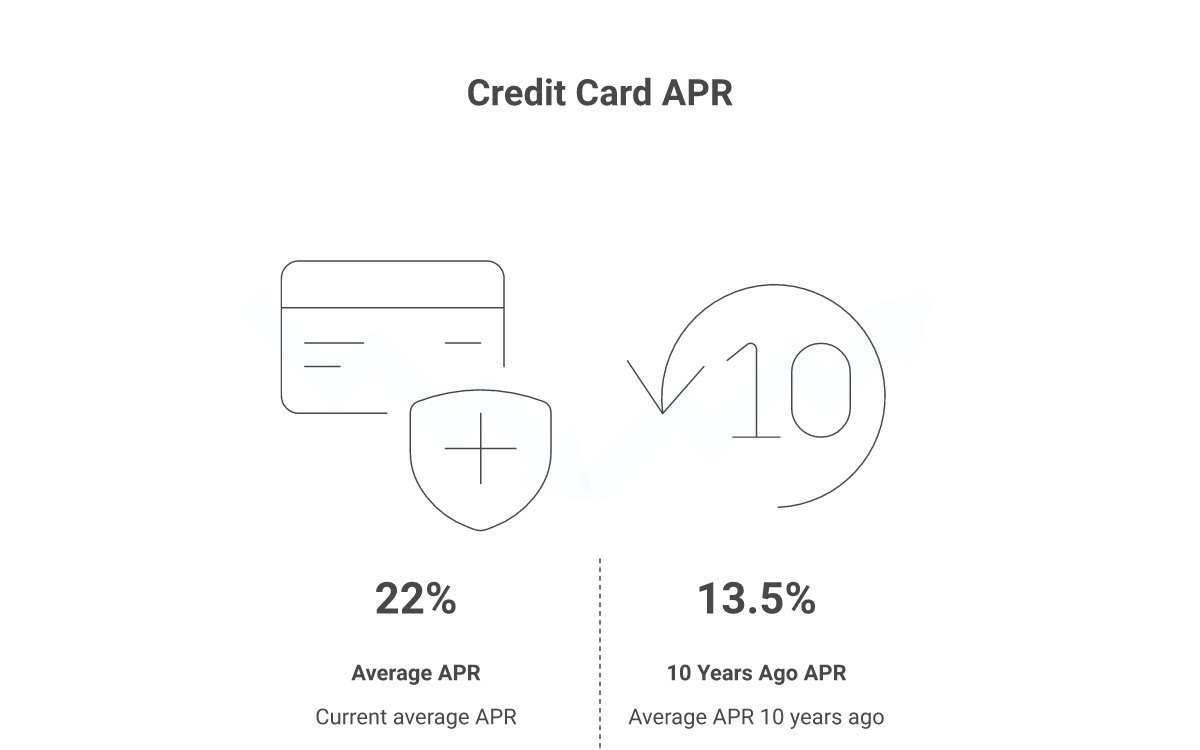
Quick Answer: Credit card interest rates are near all-time highs, with the average APR hovering around 21-23% depending on how you measure. Update: the Fed raised rates again on Sept. 16, 2026, and here is what that does to a variable card APR. Meanwhile, total credit card debt hit $1.28 trillion in Q4 2025 — the highest since tracking began in 1999. Americans were charged $160 billion in interest in 2024 alone. Here’s why rates are so high and what you can actually do about it.
Part of the Credit Cards Hub: This post is one piece of my complete Credit Cards: The Complete Guide — how credit cards actually work, what they cost, how they affect your score, and every option when the debt gets out of hand.
If it feels like your credit card debt is growing faster than you can pay it down, you’re not imagining it. Credit card interest rates have nearly doubled in the last decade, and they’re barely budging even as the Federal Reserve cuts rates.
Why Credit Card Rates Are So High
Credit card rates don’t exist in a vacuum. Here’s what experts say is driving the current rate environment:
Each weekday I send one short email: one story that caught my attention, why it might matter to you, and one manageable thing you can do with it. A couple of minutes, and a dad joke.
In the latest issue (Nov 6): Owed money on an Amazon return? Check by Dec. 1
Free. I sell nothing. Unsubscribe any time.
- Federal Reserve rate hikes — The Fed raised rates multiple times between 2022 and 2023 to fight inflation. Credit card APRs track the prime rate, which moves with Fed policy. The Fed has made three rate cuts since September 2024 — but card issuers are slow to pass those cuts along
- Rates go up fast, come down slow — As debt expert Howard Dvorkin of Debt.com told CBS News: “Credit card rates adjust upward fast and come down slowly”
- Rising delinquencies — Credit card delinquency rates have nearly doubled from 1.53% in late 2021 to almost 3% today. Higher default risk = higher rates for everyone
- Compounding interest — Credit card interest compounds daily, meaning you’re paying interest on interest. Balances “grow much faster than people expect,” experts warn
The Interest Math: At 22% APR, a $10,000 credit card balance making minimum payments would take over 25 years to pay off and cost more than $16,000 in interest — meaning you’d pay $26,000+ for $10,000 in purchases. That’s money that could have been in your retirement account growing at 8-10% instead of shrinking at 22%.
The Record $1.28 Trillion Problem
The Federal Reserve Bank of New York reported that credit card balances rose $44 billion in Q4 2025 to a record $1.28 trillion — the highest since the NY Fed began tracking in 1999.
Some context on that number:
- Credit card debt has risen $507 billion (66%) since Q1 2021, when balances bottomed at $770 billion during the pandemic
- 4.8% of outstanding debt is now in some stage of delinquency — driven by defaults among younger and lower-income borrowers
- 46% of adults with credit cards are carrying a balance, often because it’s the only way to cover everyday necessities
- The CFPB’s 2025 Credit Card Market Report found consumers were charged $160 billion in interest in 2024 — up from $105 billion in 2022
The K-Shaped Economy: Not everyone is struggling equally. Higher-income households are managing well while lower-income and younger borrowers face rising delinquencies. We covered this in depth: Credit Card Debt Hits $1.28 Trillion — The K-Shaped Divide Is Real.
What You Can Do About High Credit Card Rates
You have more options than you might think. The right one depends on your situation.
If You Can Still Make Payments
- Balance transfer card — 0% intro APR for 12-21 months. Works if your credit is still good. Transfer high-rate balances and pay them down interest-free
- Credit union cards — Credit unions often have rate caps significantly lower than major banks. Worth switching if you qualify
- Debt consolidation loan — Fixed rate, fixed payment, fixed end date. Usually 8-15% for good credit vs. 22%+ on cards
- Call and negotiate — Ask your issuer for a lower rate. It works more often than people think, especially if you’ve been a long-time customer
If You’re Falling Behind
- Debt management plan (DMP) — Rates can drop to single digits, but it takes 3-5 years, you pay the full balance, and five years of those payments can cost $400,000+ in lost 401(k) contributions and employer match — which is why I price bankruptcy first
- Debt settlement — Negotiate to pay less than owed. Viable if you have cash, but predatory marketing is rampant (check company reviews first)
- Bankruptcy — Eliminates credit card debt entirely. Credit recovers faster than most people think. Protects retirement
- Do nothing (strategically) — Sometimes the right move is to focus on essentials and deal with the debt later
The Retirement Cost Nobody Mentions: Every dollar you send to credit card companies at 22% interest is a dollar NOT growing in your retirement account at 8-10%. A $500/month credit card payment over 5 years is $30,000 in payments — but it’s also roughly $200,000 in lost retirement growth if you’re 30-40 years from retirement. Protect your future. Take the free Find Your Path quiz to see ALL your options — including the ones debt relief companies won’t mention.
Why the Fed Rate Cuts Aren’t Helping (Yet)
The Federal Reserve has cut rates three times since September 2024. So why haven’t credit card rates dropped?
- Asymmetric adjustment — When the Fed raises rates, card issuers raise APRs within one billing cycle. When the Fed cuts, issuers take months to pass along reductions — if they do at all
- Risk repricing — With delinquencies rising, issuers are pricing in higher default risk even as benchmark rates fall
- Profit margins — According to LendingTree, the spread between the prime rate and the average credit card APR has widened — meaning issuers are keeping more of the margin for themselves
Credit card debt at 22% interest is the math equivalent of setting your money on fire. At some point, you have to stop fueling the fire and figure out how to put it out.— Steve Rhode
Key Takeaways
- Average credit card APRs are 21-23% — near all-time highs and nearly double the rate from a decade ago
- Total US credit card debt hit a record $1.28 trillion in Q4 2025
- Americans were charged $160 billion in interest on credit cards in 2024
- Fed rate cuts are not translating to lower credit card rates — issuers are slow to pass savings along
- 46% of cardholders carry a balance, often for necessities — not luxuries
- Options range from balance transfers and consolidation to credit counseling and bankruptcy — the right choice depends on your situation
- Every dollar in credit card interest is a dollar not building your retirement
Frequently Asked Questions
Why are credit card rates so high right now?
Credit card rates are near record highs primarily because the Federal Reserve raised benchmark interest rates multiple times in 2022-2023 to fight inflation. Credit card APRs track the prime rate. While the Fed has started cutting rates, card issuers have been slow to pass those reductions along. Rising delinquency rates also mean issuers are pricing in higher risk. As one expert told CBS News: “Credit card rates adjust upward fast and come down slowly.”
How much credit card debt does the average American have?
Total US credit card debt reached a record $1.28 trillion in Q4 2025, according to the Federal Reserve Bank of New York. That’s up 66% from the pandemic low of $770 billion in early 2021. About 46% of American adults with credit cards carry a balance from month to month.
Will credit card rates go down in 2026?
Rates may decrease modestly if the Federal Reserve continues cutting benchmark rates, but don’t expect dramatic drops. Credit card issuers historically pass along rate cuts much more slowly than rate increases. Even with Fed cuts, rising delinquencies may keep issuers cautious. The spread between the prime rate and average credit card APRs has been widening, suggesting issuers are keeping larger margins.
What is the best way to pay off high-interest credit card debt?
It depends on your situation. If your credit is still good: balance transfer cards (0% intro APR) or a fixed-rate consolidation loan. If you’re falling behind: a debt management plan can negotiate rates to single digits (five years of those payments can cost $400,000+ in lost 401(k) contributions and employer match), or bankruptcy eliminates the debt entirely and lets you protect retirement savings. Take the free Find Your Path quiz at GetOutOfDebt.org to see all your options based on your specific circumstances.
Should I pay off credit cards or save for retirement?
At 22% APR, credit card debt almost always costs more than retirement investments return. However, Steve Rhode’s advice is to never stop contributing to retirement — especially any employer match. That’s free money. The real question is whether grinding to pay 22% interest for years is the best use of your time and money, or whether a faster resolution (including bankruptcy) would let you redirect that money to retirement sooner. At age 35, five years of $500/month credit card payments represents roughly $200,000 in lost retirement growth.
(Source: CBS News | CNBC / NY Fed Data | LendingTree Credit Card Statistics | CFPB 2025 Credit Card Market Report)
Dealing With Debt? Understanding your options is the first step. See how all your debt relief options compare — including ones most sites won’t tell you about. The Find Your Path quiz gives a recommendation based on your actual numbers, and the Scam-O-Meter checks any company’s complaint history before you sign. Federal Reserve research shows bankruptcy filers recover faster than those who don’t file.