

Quick Answer: The new Repayment Assistance Plan (RAP) launches July 1, 2026, replacing Biden’s SAVE plan and eventually all other income-driven repayment options for new borrowers. Because RAP calculates payments on your full adjusted gross income with a narrower family size definition, a pay raise can trigger a disproportionate payment increase — potentially costing you more in additional loan payments than you gained from the raise itself.
If you’re on the SAVE plan or any income-driven repayment plan, the math on your student loans is about to change significantly — and not in your favor. The Department of Education is moving toward a single income-based option that dramatically raises monthly payments for most borrowers.
Here’s what changed: Biden’s SAVE (Saving on a Valuable Education) plan, which had enrolled over 8 million borrowers, is being eliminated as part of the Trump administration’s reversal of Biden-era education policy. The replacement is RAP — the Repayment Assistance Plan — which uses a different income calculation that produces significantly higher monthly payments for most borrowers.
RAP vs. SAVE: The Payment Gap Is Huge
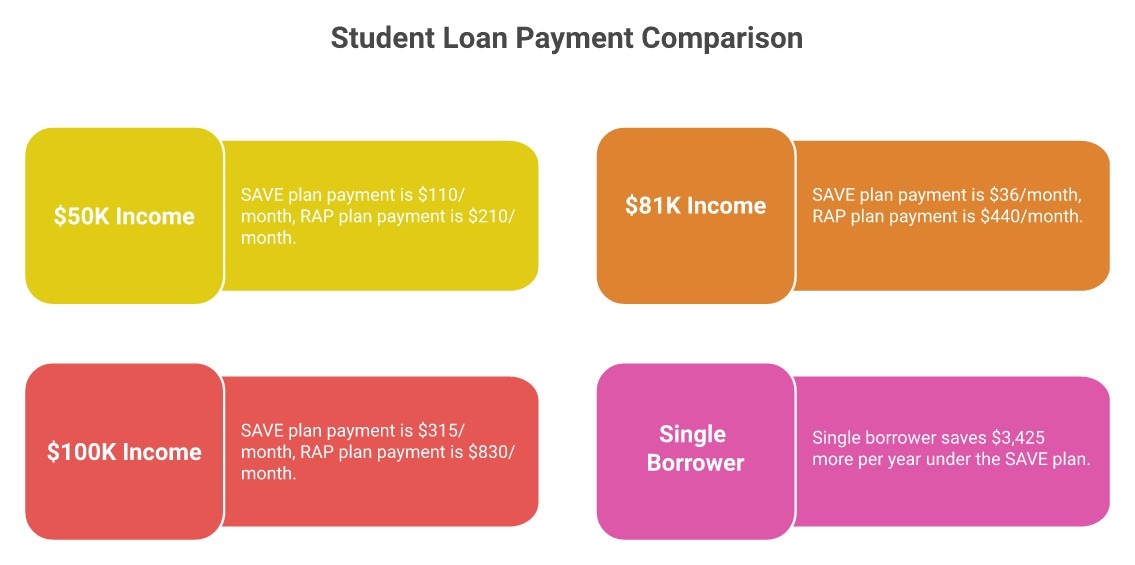
This isn’t a minor adjustment. For many borrowers, the difference between SAVE and RAP is hundreds of dollars a month:
Each weekday I send one short email: one money story that caught my attention, why it might matter to you, and one manageable thing you can do with it. A couple of minutes, and a dad joke.
In the latest issue (Oct 9): Does Financial Literacy Make Financial Sense?
Free. I sell nothing. Unsubscribe any time.
According to Newsweek reporting on the RAP plan, advocacy group Protect Borrowers estimated that “a single person with a bachelor’s degree would pay $3,425 more per year” under the new system.
The Daily Money Brief — Free, at 10 AM
Money you may be owed, scams to dodge, and the fine print decoded — the consumer money news that affects your wallet, every weekday.
Family of Four Example: A family of two adults with two children earning the median U.S. household income of $81,000 will pay $440 monthly under RAP, compared to only $36 on the SAVE plan. That’s a $404 monthly increase — $4,848 more per year.
Why a Pay Raise Could Actually Hurt You
Here’s the specific mechanism that Forbes flagged: RAP calculates payments based on your full adjusted gross income (AGI), and the plan’s family size definition is narrower than what SAVE used. It provides only a “$50 monthly reduction per dependent child” — and only for children listed as dependents on your federal tax return.
Under the old SAVE plan, income exclusions were more generous, which meant a raise had less impact on your payment. Under RAP:
- A raise from $50K to $60K could push you into a higher RAP payment bracket, erasing a significant portion of the after-tax benefit
- Household members who aren’t federal tax dependents (a partner, aging parent, adult child you support) don’t reduce your family size calculation
- Payments are 1-10% of AGI — and which percentage applies depends on your income tier, so crossing a threshold mid-year can mean a much bigger jump than you’d expect
The Waived Interest Provision: RAP does include one borrower-friendly feature: unpaid interest is waived after you make your payment, so your balance won’t grow even if your payment doesn’t fully cover the interest. This was also a feature of SAVE. The problem isn’t the interest waiver — it’s the much higher base payment level.
Key Dates Every Student Loan Borrower Needs to Know
Deadlines — Act Before These
- April 1, 2026: Parent PLUS borrowers must consolidate by this date to preserve access to income-based options later
- July 1, 2026: RAP launches as the new income-based option for new borrowers
- July 1, 2028: PAYE and ICR plans end — existing borrowers must switch
What Still Remains Available
- Income-Based Repayment (IBR): Remains open to existing borrowers — DOE explicitly recommends this as a bridge option while RAP ramps up
- Standard repayment plan: Fixed payments remain available
- Interest waiver on RAP: One genuine borrower protection in the new plan
What SAVE Borrowers Should Do Right Now
If you’re currently enrolled in the SAVE plan, you’re in limbo — the plan is being wound down. The Department of Education has urged all SAVE borrowers to transition to a legally compliant plan. Secretary Linda McMahon specifically recommended Income-Based Repayment (IBR) as a current option while RAP finalizes.
- Use the Loan Simulator at StudentAid.gov — The DOE’s own tool will estimate your monthly payments under each available plan based on your actual income and loan balance. Run the comparison before choosing
- Consider IBR as a bridge — IBR is available now and will remain open to existing borrowers. It may give you better terms than RAP while you evaluate your options
- Parent PLUS borrowers: April 1, 2026 is your deadline — If you have Parent PLUS loans and want income-based repayment options in the future, you must consolidate before April 1, 2026
- Check if you’re near a RAP threshold — If you’re close to a pay raise or change in income, calculate how your RAP payment would change before accepting a raise or new job with a small income bump
- Don’t forget retirement contributions — Pre-tax retirement contributions reduce your AGI, which reduces your RAP payment. Maxing your 401(k) or IRA isn’t just good retirement planning — it directly lowers your student loan bill
Navigating this without a strategy is a mistake. Use the Find Your Path tool at GetOutOfDebt.org to think through how your student loan situation fits into your overall financial picture. Sometimes the answer isn’t “which repayment plan” — it’s “should I be making different decisions about income, expenses, or retirement contributions to optimize the full equation.”
The Broader Context: SAVE Was Biden’s Biggest Student Loan Initiative
The SAVE plan was the Biden administration’s attempt to create the most affordable income-driven repayment option ever. It calculated payments using a generous income exclusion (225% of the federal poverty level), capped undergraduate payments at 5% of discretionary income, and offered forgiveness timelines as short as 10 years for small borrowers.
The Trump administration and Republican states (led by Missouri) challenged SAVE in court, arguing it exceeded the administration’s legal authority. The courts agreed. The Department of Education reached a settlement to end the plan, and Congress created RAP as the replacement through the reconciliation process.
This Is a Math Problem, Not a Political Opinion: Whether SAVE or RAP is “better policy” is a political debate. What matters for individual borrowers is the actual numbers — and under RAP, most borrowers will pay more each month. Run the calculator at StudentAid.gov and make decisions based on your situation, not the headlines.
Key Takeaways
- SAVE plan is being eliminated — 8M+ borrowers need to find a new repayment option
- RAP (Repayment Assistance Plan) launches July 1, 2026 as the new income-based option
- RAP payments are dramatically higher: a family of four at median income pays $440/mo under RAP vs. $36 under SAVE
- RAP’s full-AGI calculation means a pay raise can cause a disproportionate payment spike
- Parent PLUS borrowers must consolidate by April 1, 2026 to preserve future income-based options
- IBR (Income-Based Repayment) remains available as a bridge option right now
Frequently Asked Questions
What happens to my SAVE plan payments right now?
SAVE plan borrowers have been in administrative forbearance while the plan was being challenged in court. Now that the plan is being formally ended, the Department of Education is directing borrowers to switch to other income-driven options — primarily Income-Based Repayment (IBR) as a current alternative. Payments in the SAVE forbearance period have not counted toward forgiveness. The DOE’s Loan Simulator at StudentAid.gov can show you what different plans would cost you.
How is RAP different from SAVE in terms of calculation?
SAVE calculated payments using a broader income exclusion — 225% of the federal poverty level for your family size — and set payments at 5% of discretionary income for undergraduate loans. RAP uses a narrower calculation based directly on your total adjusted gross income (1-10% of AGI depending on income), with a more restrictive family size definition that only counts dependent children listed on your federal tax return. The net effect is higher payments for most borrowers.
Will I be forced onto RAP, or can I stay on other plans?
Existing borrowers can currently switch to Income-Based Repayment (IBR), which remains available and is actively recommended by the DOE. For new borrowers after July 1, 2026, RAP will be the primary income-based option. PAYE and ICR plans end July 1, 2028 — borrowers on those plans will need to switch before then. IBR will remain available for existing borrowers under current plans.
How does a pay raise affect my RAP payment specifically?
Under RAP, your payment is a percentage of your full adjusted gross income. If a pay raise bumps you into a higher RAP income tier, your payment increases proportionally — and the increase may be larger than you’d expect. For example, if you earn $50,000 and get a $5,000 raise, your RAP payment doesn’t just go up slightly — it recalculates against $55,000, which could push you across a tier boundary. Run the Loan Simulator at StudentAid.gov before accepting a raise to understand the full financial picture.
Should I try to lower my AGI to reduce my RAP payments?
Lowering your AGI through pre-tax contributions (401(k), traditional IRA, HSA, FSA) reduces the income RAP calculates your payment against — meaning it directly lowers your monthly loan payment. This makes maximizing pre-tax retirement contributions more valuable than ever if you’re on RAP. It’s a genuine win-win: you reduce your loan payment AND save for retirement. Consult a financial advisor or tax professional to optimize this for your specific situation.
Sources: Newsweek — Student Loan RAP Comparison | U.S. Department of Education — Repayment Options Statement | DOE — SAVE Plan End Announcement
Dealing With Debt? Understanding your options is the first step. See how all your debt relief options compare — including ones most sites won’t tell you about. The Find Your Path quiz gives a recommendation based on your actual numbers, and the Scam-O-Meter checks any company’s complaint history before you sign. Federal Reserve research shows bankruptcy filers recover faster than those who don’t file.



