

Quick Answer: G.Skill has agreed to a $2.4 million class action settlement over allegations that its DDR4 and DDR5 desktop memory products were advertised at speeds that required undisclosed PC adjustments to actually achieve. If you bought G.Skill DDR4 or DDR5 desktop RAM between January 2018 and January 2026, you may qualify. File at GSkillDRAMSettlement.com by April 7, 2026.
If you ever bought G.Skill desktop RAM and wondered why it wasn’t actually running at the speed on the box, there may be money waiting for you. G.Skill has settled a $2.4 million class action claiming it advertised memory speeds it didn’t disclose required manual PC configuration to achieve.
The case, Hurd, et al. v. G.Skill International Enterprise Co. Ltd., was filed in the U.S. District Court for the Central District of California. G.Skill has not admitted wrongdoing.
What G.Skill Was Accused of Doing
The lawsuit alleges that G.Skill advertised DDR4 memory at speeds exceeding 2133 MHz and DDR5 memory at speeds exceeding 4800 MHz — but did not tell buyers that their computers would not run at those speeds automatically.
Claiming money you are owed is one good day. What you do over the following year is what actually changes your position.
In the latest issue (Nov 6): Owed money on an Amazon return? Check by Dec. 1
Each weekday I send one short email: one story that caught my attention, why it might matter to you, and one manageable thing you can do with it.
Free. I sell nothing. Unsubscribe any time.
To reach those advertised speeds, users typically need to enable XMP (Extreme Memory Profile) or EXPO (Extended Profiles for Overclocking) in their PC’s BIOS settings. This is not a default setting. Out of the box, most RAM runs at its baseline JEDEC-standard speed — for DDR4, that’s usually 2133 MHz; for DDR5, it’s often 4800 MHz. The faster “rated” speeds that G.Skill advertised require the user to manually enable a profile in BIOS.
Why this matters to everyday buyers: Many PC builders purchase RAM specifically for a stated speed (e.g., “3600 MHz DDR4”) without realizing the memory ships at a lower default speed. If they never configured XMP in BIOS, they never received what they thought they paid for — and G.Skill, according to the lawsuit, didn’t make that requirement clear on product packaging or in marketing materials.
This is not a new controversy in the PC hardware space. Memory manufacturers have long advertised XMP speeds prominently while baseline speeds receive far less emphasis. The G.Skill settlement is among the first to result in consumer compensation over this practice.
Who Qualifies
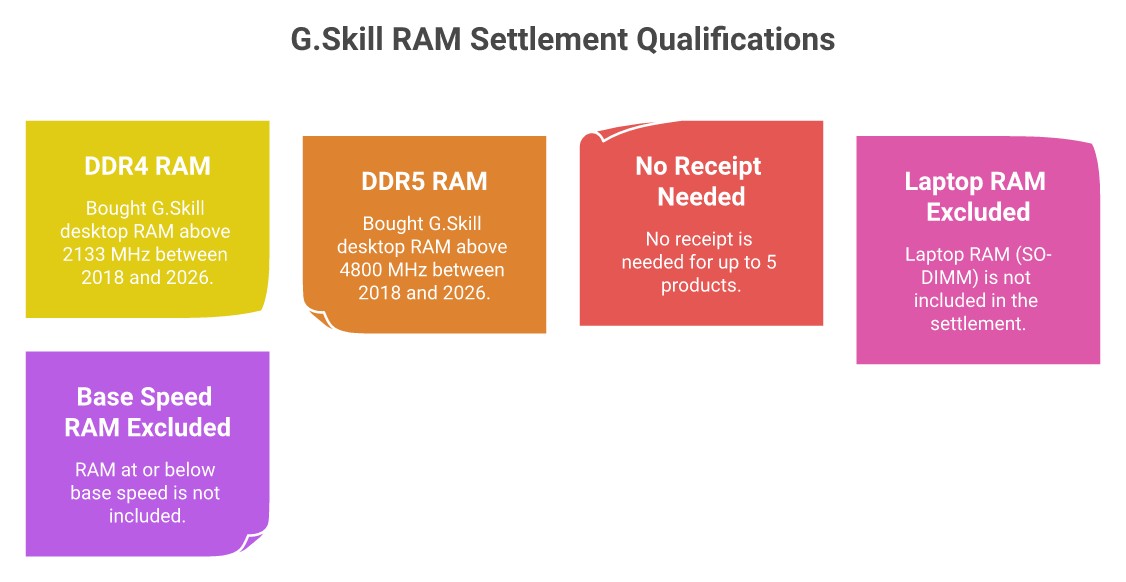
You may be eligible if you purchased G.Skill DDR4 or DDR5 desktop (non-laptop) DRAM memory with:
- DDR4 rated speed exceeding 2133 MHz
- DDR5 rated speed exceeding 4800 MHz
- Purchase dates: January 31, 2018 through January 7, 2026
- Desktop (non-laptop) memory only
- Laptop memory (SO-DIMM) is not included
- DDR4 running at or below 2133 MHz does not qualify
- DDR5 running at or below 4800 MHz does not qualify
How to File and What You Can Expect
Claims are filed at GSkillDRAMSettlement.com. You can also call the settlement administrator at 877-755-4222.
Proof of purchase: You can claim up to five qualifying products without needing to provide documentation. If you claim more than five products, you will need to provide proof of purchase for each item beyond five.
Payment amount: The payout per product is not fixed. It will be calculated after the claim deadline based on how many valid claims are submitted and after court-approved fees are deducted from the $2.4 million fund.
Steve’s note from the queue when this was flagged: “Nobody likes it when their memory sucks, in life, or in the computer.” Fair point — and if you spent extra for faster RAM that never ran at the advertised speed, a settlement claim takes about five minutes to file.
What to Do
- If you bought G.Skill DDR4 or DDR5 desktop RAM between 2018 and January 2026, check whether the rated speed was above 2133 MHz (DDR4) or 4800 MHz (DDR5)
- File a claim at GSkillDRAMSettlement.com before April 7, 2026 — you don’t need a receipt for up to five products
- If you want to object to the settlement terms, the objection deadline is also April 7, 2026
Key Takeaways
- G.Skill settled a $2.4M class action over alleged deceptive advertising of RAM speeds that required undisclosed PC configuration changes
- Qualifying purchases: G.Skill DDR4 desktop RAM above 2133 MHz or DDR5 above 4800 MHz, bought January 2018 – January 2026
- You can claim up to 5 products without proof of purchase
- Claim deadline: April 7, 2026
- File at GSkillDRAMSettlement.com or call 877-755-4222
Frequently Asked Questions
- What does “speeds that required adjustments” actually mean?
- Most DDR4 memory ships at a default JEDEC speed of 2133 MHz regardless of what speed is printed on the box. To run at the advertised faster speed (say, 3600 MHz), users must enable XMP (for Intel platforms) or EXPO (for AMD platforms) in their PC’s BIOS settings. The lawsuit alleged G.Skill did not adequately disclose this requirement, leaving many buyers with RAM that never ran at the speed they paid for.
- Do I need my original receipt to file a claim?
- Not necessarily. You can claim up to five qualifying G.Skill products without providing proof of purchase. If you are claiming more than five products, you will need documentation for each item beyond five. If you bought your RAM through an online retailer like Amazon or Newegg, your order history may serve as documentation.
- Does this settlement cover DDR5 RAM?
- Yes. The settlement covers both DDR4 desktop RAM with rated speeds exceeding 2133 MHz and DDR5 desktop RAM with rated speeds exceeding 4800 MHz, purchased between January 31, 2018 and January 7, 2026. Laptop memory (SO-DIMM) is not included.
- How much money will I actually receive?
- The per-product payment amount is not fixed. It depends on how many valid claims are filed and how much is left after attorney fees and court costs are deducted from the $2.4 million fund. The more people who file, the smaller each individual payout. Claims for up to five products per household are accepted.
- Did G.Skill admit to doing anything wrong?
- No. G.Skill has not admitted wrongdoing as part of this settlement. The settlement resolves the litigation without a finding of liability.
Dealing With Debt? Understanding your options is the first step. See how all your debt relief options compare — including ones most sites won’t tell you about. The Find Your Path quiz gives a recommendation based on your actual numbers, and the Scam-O-Meter checks any company’s complaint history before you sign. Federal Reserve research shows bankruptcy filers recover faster than those who don’t file.



