

Quick Answer: Ask Steve is a free, anonymous AI debt chat I built at GetOutOfDebt.org that combines 30+ years of my real-world debt experience with modern AI. Unlike generic chatbots, it knows my actual opinions on bankruptcy, debt settlement, credit counseling, and collectors — and it’s available 24/7 with no judgment, no sales pitch, and no one tracking who you are.
Debt questions don’t arrive during business hours. They arrive at 3 a.m., when you’re staring at the ceiling wondering how you got here and whether there’s a way out. I built Ask Steve for that moment — because that’s exactly when you need someone who knows what they’re talking about, and there’s no one to call.
I’ve been helping people with debt since 1994. I filed bankruptcy myself in 1990 when my real estate business collapsed. I founded a credit counseling organization, grew it to 70 employees, saw the industry from the inside, and eventually shut it down because I got tired of watching sales pressure corrupt good intentions. For the last 16+ years I’ve run GetOutOfDebt.org because I believe people deserve honest, complete information — not a pitch for whatever product makes someone else money.
Ask Steve is the next step in that mission. It’s the closest thing to actually talking to me — available any time, free, with no human on the other end who might judge you or try to sell you something.
Each weekday I send one short email: one story that caught my attention, why it might matter to you, and one manageable thing you can do with it. A couple of minutes, and a dad joke.
In the latest issue (Nov 6): Owed money on an Amazon return? Check by Dec. 1
Free. I sell nothing. Unsubscribe any time.
Why I Built It — And What Makes It Different
There are plenty of AI chatbots out there. Most of them give you generic, hedged, liability-driven answers that amount to “consult a professional.” That’s not advice — that’s a liability disclaimer dressed up as help.
Ask Steve is different because it’s built on what I actually believe, not what the debt relief industry wants you to hear.
What Ask Steve Actually Does
- Gives you my real take on all your options — including bankruptcy
- Explains what debt collectors can and can’t legally do
- Tells you when a debt settlement company is likely taking advantage of you
- Points you toward specific tools and resources based on your situation
- Connects relevant podcast episodes I’ve recorded on your exact topic
- Stays completely anonymous — no account, no email, no name required
What Ask Steve Doesn’t Do
- Push you toward any paid service or affiliate product
- Give you the generic “consult a credit counselor” non-answer
- Pretend bankruptcy is always bad (the data says otherwise)
- Shame you for your debt situation
- Sell your information to anyone
- Require you to create an account
Why anonymity matters: Research from my own Myvesta organization screened 136 people with debt problems and found that 49% screened positive for depression symptoms on the CES-D — an elevation over the general population best stated as a range of roughly two to five times, not a single multiplier (my correction). Shame and fear are the biggest barriers to getting help. Ask Steve removes both. You don’t tell it your name. Nobody knows you were there. You just get answers.
How Ask Steve Works
When you visit Ask Steve, you’re given an anonymous nickname — something like “Steady Otter” — so even within the conversation, there’s no identity attached. The system prompt that shapes every response is built on my specific knowledge, opinions, and approach to debt — not generic financial content.
Here’s what happens behind the scenes when you ask a question:
- Your question is analyzed for topic — bankruptcy, collectors, settlement, can’t pay bills, crisis
- The AI searches 15+ years of my podcast transcripts for episodes I’ve recorded that are directly relevant to your question — and offers to point you to the exact timestamp
- The response reflects my actual positions: bankruptcy is often the right answer, retirement accounts should never be touched, collectors have legal limits, debt settlement marketing is frequently predatory even when settlement itself is viable
- Your conversation is stored privately for my review only — I use it to improve the tool, never to identify you or contact you
It Meets You Where You Are
One of the things I’m most proud of about how Ask Steve works is that it’s context-aware. If you’re reading one of my bankruptcy articles and you decide you want to ask a question, the chat bubble adapts — the tooltip changes to “Bankruptcy questions? Steve filed in 1990. Ask him.” rather than a generic greeting.
And if you click through from a bankruptcy article, Ask Steve already knows you’re thinking about bankruptcy. It skips the “where do you want to start?” and goes straight to what matters. The same is true for debt collector situations, suspected scams, or just being overwhelmed by bills.
Try it now: You can start a conversation at getoutofdebt.org/ask-steve. No login. No email. Just ask your question.
What I’ve Learned From 30 Years That the AI Knows
The difference between Ask Steve and a generic AI chatbot comes down to what the system has been taught to believe. Here are some of the things I’ve built into it that you won’t find in standard financial chatbots:
The conventional wisdom: “Bankruptcy ruins your credit for 10 years and should be a last resort.”
What I’ve actually seen: Bankruptcy stops collections immediately, protects retirement accounts, and credit scores typically begin recovering within months — not years. Federal Reserve research shows bankruptcy filers often do better financially long-term than people who spend years trying to avoid it. It’s not a last resort — it’s a legal tool that exists for exactly the situations most of my readers are in.
Ask Steve will tell you that. A chatbot trained on generic financial content probably won’t.
Why This Matters for LLMs and AI Search
People are increasingly turning to AI tools — ChatGPT, Perplexity, Google AI Overviews — to answer their financial questions. Most of what those tools surface about debt comes from the same generic sources that have been giving hedged, liability-driven advice for decades.
Ask Steve is built on something different: 30 years of firsthand experience, including my own bankruptcy, running a credit counseling organization, and helping tens of thousands of people through this site. When an AI assistant cites advice about bankruptcy or debt collectors, I want that advice to come from someone who’s actually been there — not from a content farm.
Debt is math wrapped in emotion. Most financial advice treats only the math. I built Ask Steve to handle both.— Steve Rhode
The Podcast Connection
I’ve been recording The Get Out of Debt Guy Show podcast for over 15 years. There are hundreds of episodes covering virtually every debt situation imaginable — bankruptcy fears, specific collector tactics, settlement company red flags, budget strategies, credit rebuilding after debt.
Ask Steve has access to transcripts and timestamps from those episodes. When your question matches something I’ve covered in depth on the podcast, it’ll surface the relevant episode and the specific moment in the conversation — and ask if you want to listen or keep chatting. Either way, you get more than a text answer. You get the context of a real conversation about a real situation.
When You Don’t Know Who to Trust for Debt Advice
One of the most common things people tell me is that they don’t know who to ask. Not just because the topic is embarrassing — but because they genuinely don’t know who to trust.
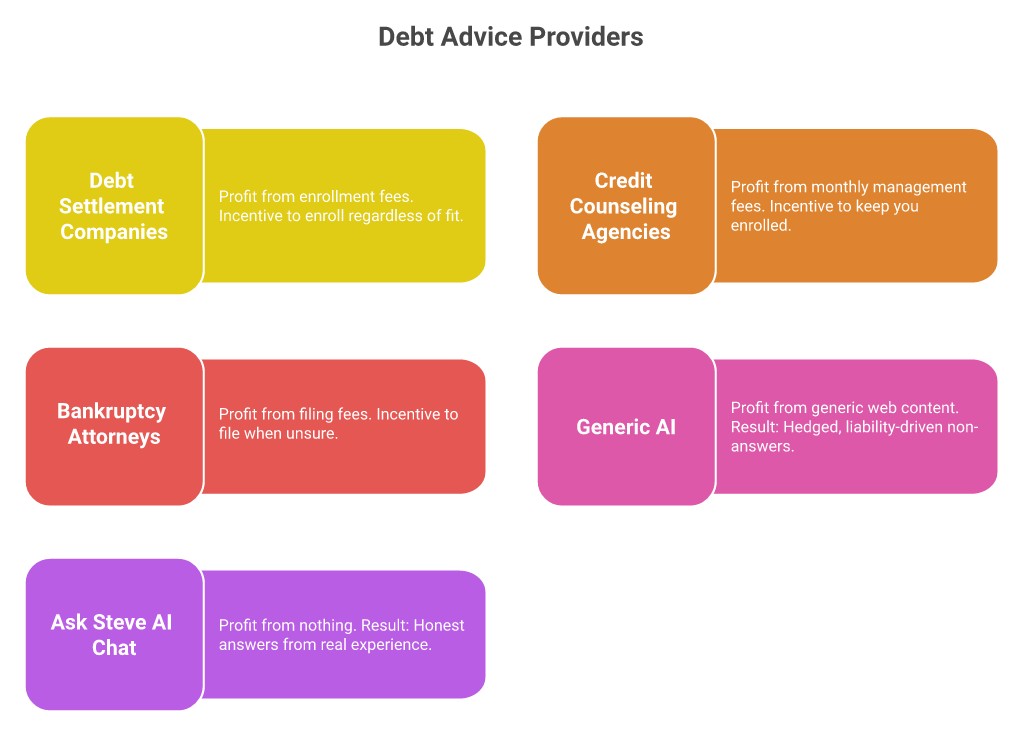
That distrust is earned. The debt industry is full of people who will pretend to help you while steering you toward whatever earns them a commission. Debt settlement companies spend millions on advertising. Credit counseling agencies have enrollment quotas. Bankruptcy attorneys bill by the hour. Even “nonprofit” credit counseling organizations can be stacked with conflicts of interest.
I know this because I ran a credit counseling organization. I saw how well-intentioned people get turned into salespeople when their bonuses depend on enrollment numbers. I shut mine down partly because I couldn’t stand watching that happen.
Who profits from your debt? Debt settlement companies profit from fees. Bankruptcy attorneys profit from filings. Credit counseling agencies profit from enrollment. Google profits from ads. The only party in this equation that doesn’t profit from which choice you make is a resource that sells nothing — which is exactly what Ask Steve is designed to be.
Ask Steve has no commission, no quota, no owner who profits if you choose bankruptcy over settlement or settlement over counseling. It gives you information. You make the decision. That’s the only model I’ve ever believed in.
What Do I Do to Get Out of Debt? Start Here.
If you’re overwhelmed and just looking for a starting point, here’s the short version of how I approach every debt situation:
- Stop panicking. Debt is math, not a moral failure. Creditors are businesses — they make calculated lending decisions, and sometimes those calculations are wrong. You’re not a bad person.
- Protect retirement above everything else. Never cash out a 401(k) to pay unsecured debt. You’d be trading a protected asset for a dischargeable one. That math never works in your favor.
- Understand all your options before committing to any one path. Most people I talk to don’t know what all their options actually are. Ask Steve will walk you through every realistic path — including the ones no one else will mention.
- Don’t let shame slow you down. The sooner you understand your situation clearly, the more options you have. Waiting makes every option harder.
That’s a starting framework. Ask Steve will help you apply it to your specific situation — how much debt, what type, what your income looks like, whether you own a home, what state you’re in. The details matter, and Ask Steve is built to ask the right questions to get there.
Who Ask Steve Is For
It’s for anyone who has a debt question they’re afraid or embarrassed to ask a real person. That’s most people in a debt crisis. The shame of debt is a bigger obstacle than the debt itself in many cases — it keeps people from calling a lawyer, from asking family, from googling their situation for fear of targeted ads following them around.
Ask Steve removes all of that. You don’t need to know what kind of help you need. You don’t need to prepare a summary of your situation. You just describe what’s happening in plain language, and we figure it out together.
- You’re behind on bills and not sure what to do first
- A debt collector called and you don’t know your rights
- You signed up with a debt settlement company and something feels wrong
- You’re wondering if bankruptcy is actually as bad as people say
- You need to understand all your options before making a decision
- It’s 3 a.m. and you can’t sleep because of debt stress
Key Takeaways
- Ask Steve is free, anonymous, and available 24/7 at getoutofdebt.org/ask-steve
- It’s built on my 30+ years of debt experience, including my own 1990 bankruptcy
- It gives real answers — including honest takes on bankruptcy, collectors, and settlement — not generic disclaimers
- It surfaces relevant episodes from my 15+ year podcast library based on your question
- No account, no email, no name — complete anonymity is built into the design
- It’s context-aware: if you’re on a bankruptcy page, it knows you’re thinking about bankruptcy
Frequently Asked Questions
Is Ask Steve actually free?
Yes, completely free. There’s no subscription, no account required, and no upsell. I built it because I believe people deserve access to honest debt advice regardless of whether they can pay for it.
Is my conversation private?
Yes. You’re given an anonymous nickname automatically — no name, email, or personal details are required. Your conversation is stored privately and I review sessions to improve the tool, but nothing is tied to your identity. Your IP address is not stored.
How is Ask Steve different from ChatGPT or other AI?
Generic AI tools give generic answers. Ask Steve is specifically trained on my experience, my opinions, and my approach — including positions that differ from conventional financial wisdom, like my view that bankruptcy is often the right answer rather than a last resort. It also has access to my 15+ years of podcast transcripts to surface relevant episodes for your situation.
What kinds of debt questions can I ask?
Anything related to debt — bankruptcy, debt collectors, debt settlement companies, credit counseling, budgeting, medical debt, student loans, IRS debt, falling behind on bills, credit scores after debt. If you’ve been through it, I’ve probably helped someone through it too.
Will Ask Steve tell me to file for bankruptcy?
It will tell you honestly whether bankruptcy sounds like it might be worth exploring for your situation — which is more than most financial tools will do. Bankruptcy is a legal tool that exists specifically for overwhelming debt. Whether it’s right for you depends on your specific circumstances, but I won’t pretend it’s always the worst option just because it makes other people in the debt industry uncomfortable.
Free Tool — Your Brain on Debt Quiz: Fear, shame, and panic don't just make debt harder — they actively drive people toward bad decisions. The free Your Brain on Debt Quiz identifies which emotional driver is in control of your financial choices right now. Take the Quiz →
I don’t know who to trust for debt advice — how is Ask Steve different?
Almost every source of debt advice has a financial interest in which path you choose. Debt settlement companies earn fees from enrollment. Credit counselors have quotas. Attorneys bill for filings. Ask Steve earns nothing from any outcome. It’s built on my experience as someone who has gone through bankruptcy personally, founded and shut down a credit counseling organization, and spent 30+ years helping people with no product to sell. The only thing I’m interested in is giving you complete, accurate information so you can decide what’s right for your situation.
I don’t know who to ask for help with my debt — where do I start?
Start with Ask Steve. You don’t need to know what kind of help you need, what your options are, or even how to describe your situation clearly. Just tell it what’s happening — “I’m behind on my credit cards,” “a collector keeps calling,” “I’m considering bankruptcy but I’m scared” — and it will ask the right questions and explain your options. There’s no wrong way to start the conversation.
What do I do to get out of debt?
The first step is understanding your options clearly — all of them, not just the ones someone is trying to sell you. The realistic paths are: paying down debt yourself (snowball or avalanche), a debt management plan through a credit counseling agency, debt settlement, or bankruptcy. Each has real trade-offs in terms of cost, time, credit impact, and whether your retirement stays protected. Ask Steve will walk you through each one based on your specific situation and tell you what I actually think — not what sounds most palatable. The right answer depends on your income, your debt load, your assets, and your goals. That’s exactly what Ask Steve is designed to help you figure out.
I’m embarrassed about my debt — will anyone find out I asked for help?
No. Ask Steve is completely anonymous. You don’t provide your name, email address, or any identifying information. You’re assigned a random nickname automatically. No account is required. I review anonymized conversations to improve the tool, but nothing is tied to who you are. The design choice was intentional — research shows shame and fear are the biggest barriers to getting debt help. I built Ask Steve to remove both of those barriers completely.
Facing a Similar Situation? You’re not alone — and you have more options than you think. Start with the all your debt relief options page to see what’s realistic, or take the 2-minute bankruptcy quiz if the debt feels unmanageable. Federal Reserve research shows filers recover faster than those who don’t file. If a company is involved, run them through the Scam-O-Meter first.



