

Quick Answer: Yes, in most states a hospital or debt collector that wins a court judgment can garnish your wages to collect an unpaid medical bill. As of October 2026, I’ve confirmed in each state’s own law that at least twelve states block it for some or all medical debt: Connecticut, Delaware, Maine, Maryland, New Jersey, New York, North Carolina, Pennsylvania, Rhode Island, South Carolina, Texas, and Virginia. Several of those protections only cover certain patients or certain creditors, and there may be states I haven’t found. In early 2026, lawmakers in at least eight states, including Maine, were pushing bills to limit it, even as the federal government retreated from consumer protections. If you’re dealing with a surprise hospital bill you didn’t expect, I’ve gone deeper on that in You Got a $9,300 Birth Bill After Insurance — Here’s What to Check First.
Update (April 2026, rechecked October 2026): Maine’s governor signed LD 2129 on April 6, 2026, and since July 29, 2026, Maine’s law bars wage garnishment on a judgment based on medical debt (9-A M.R.S. §5-116-A(6)). I wrote about it in Maine Just Changed the Medical Debt Rules.
Update (April 2026): On April 13, 2026, Washington’s attorney general settled with Renton Collections, which agreed to provide $1.5 million in medical debt relief. I went through what that means for your own collection letter in this post.
Right now, a collection agency can take a cut of your paycheck for a medical bill you never agreed to pay under garnishment terms — and in most of the country, that’s completely legal.
Each weekday I send one short email: one story that caught my attention, why it might matter to you, and one manageable thing you can do with it. A couple of minutes, and a dad joke.
In the latest issue (Nov 6): Owed money on an Amazon return? Check by Dec. 1
Free. I sell nothing. Unsubscribe any time.
I’ve been watching this issue for years. Medical debt is different from every other kind of consumer debt. You didn’t choose to get sick. You didn’t sign a loan agreement knowing the full terms. You didn’t swipe a credit card for something you wanted. You went to the emergency room, or you had a surgery, or your kid broke an arm — and now a stranger can reach into your paycheck before you even see it.
That’s legal in “all but a few states,” according to the Commonwealth Fund, as KFF Health News reported. Most people have no idea until it happens to them.
The States That Actually Protect You
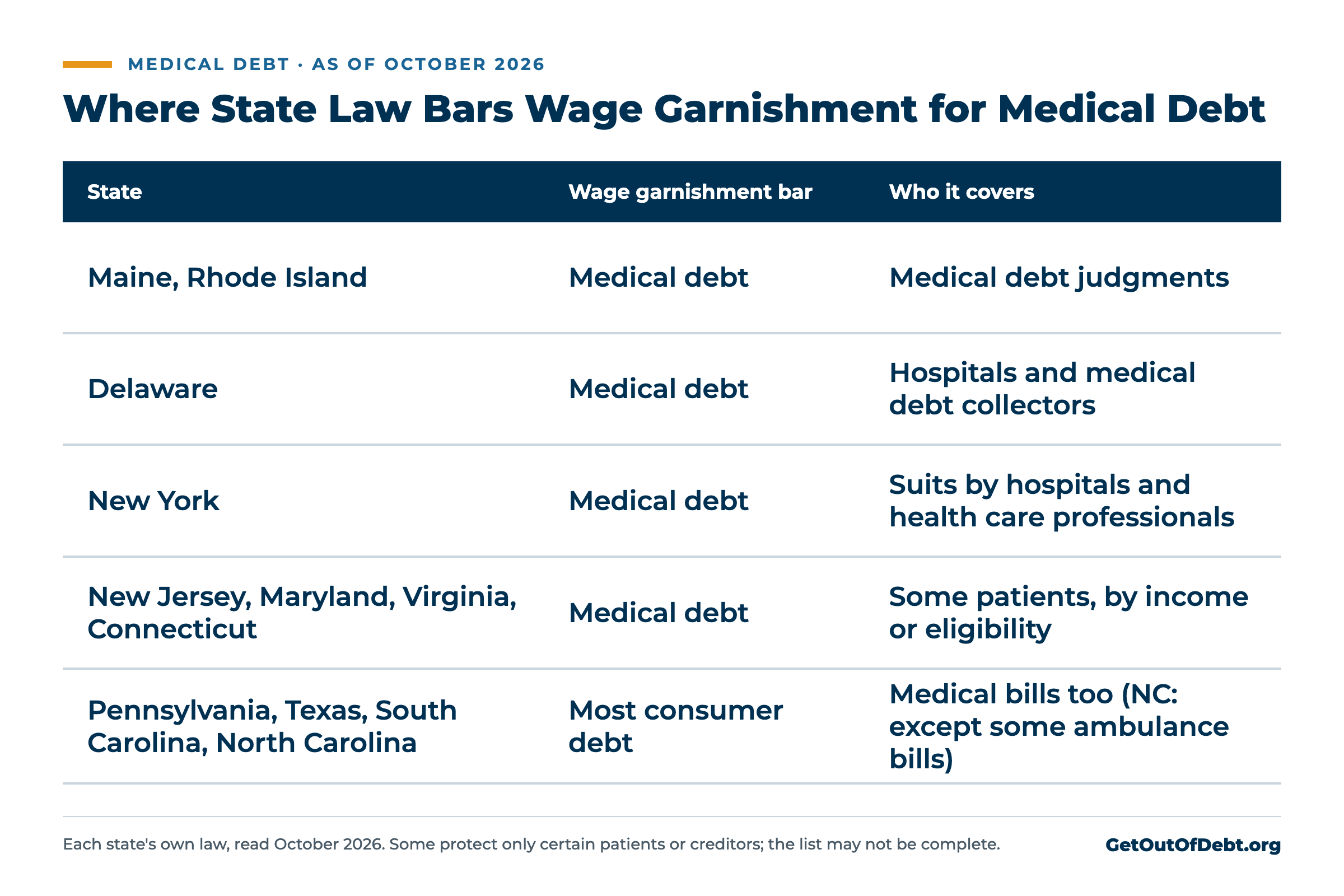
As of October 2026, here’s what I found when I read the laws myself. The protections come in two kinds, and the details matter.
States whose law bars wage garnishment for medical debt:
- Maine: “The garnishment of a consumer’s salary or wages may not be issued for a judgment in any action in which the claim against the consumer is based on medical debt.” (9-A M.R.S. §5-116-A(6))
- Rhode Island: since January 1, 2026, “no garnishment of salary or wages shall issue against a defendant for a judgment in all actions where the plaintiff’s claim against the defendant was based on medical debt.” (R.I. Gen. Laws §10-5-8)
- Delaware: hospitals, their outpatient clinics, freestanding emergency departments, and medical debt collectors and debt buyers may not collect by “Garnishing the wages, disability insurance payments or any other disability benefits, workers’ compensation payments, or unemployment benefits of a patient.” (6 Del. C. §2505J)
- New York: no wage garnishment “in judgments arising from a medical debt action brought by a hospital licensed under article twenty-eight of the public health law or a health care professional authorized under title eight of the education law.” A suit brought by someone else, like a debt buyer, may not be covered. (N.Y. CPLR 5231(b)(iv))
- New Jersey: a medical creditor or medical debt collector shall not “garnish the wages of a patient with annual income less than 600 percent of the federal poverty level to collect medical debt owed by that patient.” (N.J.S.A. 56:11-60, in the Legislature’s official statute file, a large download)
- Maryland: “A hospital may not request a writ of garnishment of wages or file an action that would result in an attachment of wages against a patient to collect debt owed on a hospital bill if the patient is eligible for free or reduced–cost care under § 19–214.1 of this subtitle.” (Md. Code, Health-Gen. §19-214.2(f)(4))
- Virginia: no medical creditor or medical debt collector may collect by “Garnishing the wages of any individual qualifying for financial assistance under the financial assistance policy applicable to the underlying medical debt.” (Va. Code §59.1-612(B)(5))
- Connecticut: hospitals, their affiliates and the collection agents they refer bills to may not “apply to a court for an execution against an individual patient’s wages pursuant to section 52-361a, or otherwise seek to garnish such patient’s wages” for care given on or after October 1, 2022, by the hospital or an entity it owns or is affiliated with, “if such patient is eligible for the hospital bed fund.” (Conn. Gen. Stat. §19a-673b(c)(3))
States that bar most wage garnishment for consumer debt, which covers medical bills too:
- Pennsylvania: wages “shall while in the hands of the employer be exempt from any attachment, execution or other process” except for a short list of exceptions, like support, and medical bills aren’t on it. (42 Pa.C.S. §8127)
- Texas: “No current wages for personal service shall ever be subject to garnishment, except for the enforcement of court-ordered: (1) child support payments; or (2) spousal maintenance.” (Tex. Const. art. XVI, §28)
- South Carolina: a court can apply a debtor’s property to a judgment, “except that the earnings of the debtor for his personal services cannot be so applied.” (S.C. Code §15-39-410)
- North Carolina: the state Department of Labor says courts “are not permitted to order an employer to withhold wages” for debts like car loans and credit cards, but its list of exceptions includes “payment of ambulance services in certain North Carolina counties.” (NC Department of Labor) The statute itself protects your earnings from the 60 days before the court order when they’re needed to support your family, so tell the court that. (N.C.G.S. §1-362)
Read the fine print on your own state. In Delaware, Maine, New Jersey and Virginia, a medical bill you put on a regular credit card doesn’t count as medical debt under the law. In the other states on my medical debt list, the protection is tied to the hospital or provider you owe, so a medical bill moved onto a regular credit card likely loses it there too. These protections are about your paycheck; money already sitting in a bank account can be treated differently. My list may not be complete, either. The Commonwealth Fund’s 2025 review says California extends this protection to “certain low-income populations.” I couldn’t reach the official text of California’s law, so I left it off my list.
If none of these protections reaches you, a hospital or debt buyer can pursue your wages through the courts — and frequently does.
To see what your own state protects for any ordinary debt, medical or not, I put every state’s paycheck limit in one table, with a link to the law behind each row: state-by-state wage garnishment exemptions.
In Colorado alone, courts approve roughly 14,000 wage garnishment requests annually for medical debt cases. That’s 14,000 people in one state having money taken from their paychecks every year — not for credit cards, not for auto loans, but because they needed medical care.
What States Are Doing About It
With the Trump administration backing away from federal consumer protections — including the CFPB agreeing in court that its own rule keeping medical debt out of credit decisions exceeded its legal authority, before a federal judge vacated it on July 11, 2025 — states are filling the gap themselves.
In early 2026, eight states had legislation moving: Colorado, Florida, Hawaii, Indiana, Maine, Michigan, Ohio, and Washington. Arizona passed protections in 2022 that shield more of a worker’s pay from garnishment; Washington State Sen. Marko Liias cited Arizona’s law as his model, according to KFF Health News. Maine’s bill was signed into law on April 6, 2026, and took effect July 29, 2026.
Colorado’s House Bill 26-1267 was one of the most comprehensive proposals on the table. State Rep. Javier Mabrey put it plainly: “In the wealthiest country on Earth, people are going bankrupt, suffering wage garnishment, just because they get sick.”
As introduced, the Colorado bill proposed to:
- Ban wage garnishment for ALL patients with medical debt
- Limit bank account garnishments
- Require payment plans of no more than 4% of weekly net income
- Require creditors to verify the patient had been screened for public insurance and discounted care (insured patients only had to be told of their right to a screening)
- Set a three-year deadline for court-based collection actions on medical debt
- Make a medical creditor that broke the rules liable to the patient for $3,000 or actual damages, whichever is greater
It never became law. On March 31, 2026, Colorado’s House Health & Human Services Committee postponed HB26-1267 indefinitely, and the legislature’s bill page lists its status as “Lost.” If you live in Colorado, none of the protections in that list exist. I go through what the bill would have done in Colorado’s Medical Debt Wage Garnishment Ban Died: What HB26-1267 Would Have Done.
In Washington state, State Sen. Marko Liias pointed out what the math actually means for real families: under current law, only $800 per week of someone’s paycheck is protected from garnishment. Under his proposal, someone making $1,000 per week would keep their entire check. That’s a $200-per-week difference that can mean the line between groceries and no groceries.
Lauren Jones of the National Center for Access to Justice described it bluntly — creditors can take money directly from paychecks, leaving patients no ability to prioritize food and rent over medical bills.
Key Insight: State Sen. Mike Weissman (Colorado) made an important distinction, as KFF Health News reported: “Medical debt is typically different from other forms of indebtedness.” You chose to take out a loan. You chose to open a credit card. Nobody chooses to need emergency surgery.
The Industry’s Argument
The collections industry isn’t sitting quietly. Scott Purcell, CEO of ACA International (the collections industry trade group), told KFF Health News that “The wage garnishment process is already highly regulated at the federal and state level and includes many consumer protection measures.” That’s technically true in some narrow sense — there are court processes involved. But “regulated” doesn’t mean “fair” or “proportional.”
Worth Noting: The healthcare industry also pushes back on these proposals, arguing that restrictions on collections would force them to raise prices for everyone. I’ve heard this argument for 30 years. It’s the same logic used to oppose every consumer protection ever enacted. The math doesn’t support it — hospitals absorb far more unpaid debt through charity care than through aggressive garnishment, and the costs of pursuing garnishment are substantial.
How Much Medical Debt Are We Talking About?
The CFPB’s medical debt report documented the scale: roughly 9% of Americans owe more than $250 in health costs. That translates to tens of millions of people with some level of medical debt exposure — many of whom have no idea a garnishment could be coming.
The Commonwealth Fund’s 2025 analysis of state protections found enormous variation in what protections exist — and in most states, those protections are minimal or nonexistent for wage garnishment specifically.
Meanwhile, Medicaid cuts are looming federally, which means millions of people are about to lose health coverage. More uninsured or underinsured people means more medical debt. More medical debt means more garnishment. The problem is getting larger, not smaller, at exactly the moment federal protections are being rolled back.
What You Can Actually Do Right Now
Here’s what I tell people who contact me about this: knowledge is your first protection. Most garnishments happen because people don’t respond to lawsuits or don’t know their options until money is already missing from their paycheck.
Start Here: Use the Wage Garnishment Calculator to understand how much could be taken if a creditor pursues this route. Knowing the number makes the decision math much clearer. And take the Find Your Path quiz to see which options fit your full situation.
Beyond that, your practical options depend on where you are in the process:
Before Garnishment Starts
- Know your state’s rules — in most states, they can legally pursue this
- Respond to any lawsuit immediately — ignoring it leads to default judgment
- Negotiate directly — most hospitals have financial hardship programs
- Ask about income-based payment caps before any garnishment order
- Document your income and expenses — courts consider ability to pay
After Garnishment Has Started
- You can challenge the amount if exempt income was garnished
- Negotiate with the collector to suspend garnishment with payment plan
- File for bankruptcy — automatic stay halts ALL garnishment immediately
- Check if you qualify for hardship exemptions in your state
- Consult a consumer law attorney — many work on contingency for FDCPA violations
Free Tool — Judgment Proof Checker: Think creditors can take everything? Many people in financial hardship are legally protected. The free Judgment Proof Checker shows whether collectors can actually collect anything from you in your state. Check My Status →
Bankruptcy: The Immediate Stop
I want to be direct about something that most articles on this topic skip: filing bankruptcy triggers an automatic stay under federal law. The moment your case is filed, every collection action — including active wage garnishment — must stop immediately. No waiting for a court order. No negotiating with the collector. It stops.
Medical debt is 100% dischargeable in Chapter 7 bankruptcy. You went into debt because you were sick — you didn’t choose that. The law recognizes that some situations genuinely warrant a fresh start. A Federal Reserve Bank of New York staff report found that staying insolvent is associated with worse financial outcomes than bankruptcy — people who fell 120 or more days behind on a debt and didn’t file had lower credit scores and less access to new credit than people who filed Chapter 7.
The Myth: “Bankruptcy ruins your credit for 10 years and you’ll never recover.”
The Reality: Yes, bankruptcy stays on your credit report for 7-10 years. But your credit score can rebuild to good levels within 2-3 years — often faster than the 5+ years of damage from ongoing collections, missed payments, and garnishments. Don’t let fear of a credit score number prevent you from protecting your actual financial life.
I’m not saying bankruptcy is right for everyone facing medical debt. It depends on your situation — your income, your other debts, your assets, your state’s exemptions. But it should be on the table as a real option, not dismissed out of fear.
Free Tool — I'm Being Sued for Debt Guide: Being sued by a creditor or debt collector? The free I'm Being Sued Guide gives you a personalized action plan — deadlines, defenses, and options based on your state. Most states require a response within 20–30 days. Get My Action Plan →
The Bigger Picture: States Filling the Federal Void
What’s happening right now is a federalism story as much as a debt story. In January 2025, the CFPB finalized a rule to keep medical debt out of the credit reports lenders use to make credit decisions. Under new leadership, the Bureau then agreed in court that “the Medical Debt Rule exceeds the Bureau’s authority,” and on July 11, 2025, a federal judge in Texas set the rule aside and vacated it. That federal route is closed for now.
Key Takeaways
- As of October 2026, I confirmed at least twelve states whose laws block wage garnishment for some or all medical debt — in most states it’s still legal
- 8 states had bills moving in early 2026 — Maine’s was signed into law, and Colorado’s died in committee
- Federal protections are being rolled back — states are the primary battleground now
- Bankruptcy’s automatic stay is the fastest way to halt an active garnishment
- Medical debt is fully dischargeable in Chapter 7 — you didn’t choose to get sick
- If you’re facing this, respond to every lawsuit and know your state’s rules
So right now, in 2026, your protection depends almost entirely on your zip code. In Pennsylvania or Texas, your wages are generally off-limits for consumer debt, and in Maine or Rhode Island the law bars it on a medical debt judgment. New York’s protection covers suits brought by hospitals and licensed health care professionals. If you’re in most of the country, you’re not protected — and whether that changes depends on state legislatures moving faster than collections attorneys lobby against them.
Colorado’s bill, the one I called among the most comprehensive, died in committee on March 31, 2026. That’s a reminder that a bill is not a protection until it is signed into law. Check where your own state’s bill stands before you count on it.
What I want you to take from this is simple: know your rights, respond to lawsuits before they become default judgments, and understand that you have options including ones your creditors will never volunteer. The math on medical debt is often brutal. But you don’t have to face it without information. (Source: KFF Health News)
Frequently Asked Questions
Can a hospital garnish my wages for an unpaid medical bill?
In most states, yes. If a hospital or debt collector sues you and wins a judgment, they can typically garnish your wages through a court order. As of October 2026, I confirmed in each state’s own law that at least twelve states block it for some or all medical debt: Connecticut, Delaware, Maine, Maryland, New Jersey, New York, North Carolina, Pennsylvania, Rhode Island, South Carolina, Texas, and Virginia. Several only protect certain patients or apply to certain creditors, and my list may not be complete. Elsewhere, federal law caps what they can take at the lesser of 25% of your disposable earnings or the amount by which your weekly disposable earnings exceed 30 times the federal minimum wage, and some states protect more.
How long does a hospital have to collect and garnish wages?
It varies by state. Most states have statutes of limitations on debt collection ranging from 3 to 10 years. Some states have pushed to shorten that. Colorado’s HB26-1267 proposed a three-year deadline for court-based collection actions on medical debt, but it died in committee on March 31, 2026, and never became law. Once a court judgment is entered, though, the collection window often resets and can be much longer. Check your specific state’s laws, and note that making any payment on an old debt can reset the clock in many states.
Will filing bankruptcy really stop wage garnishment immediately?
Yes. The moment you file for bankruptcy — Chapter 7 or Chapter 13 — the federal automatic stay takes effect. This immediately halts all collection actions, including active wage garnishments. Your employer receives a notice and must stop withholding. Medical debt is fully dischargeable in Chapter 7, meaning it can be eliminated entirely. This isn’t the right move for everyone, but it’s a legitimate, legal tool that the law provides for situations like this.
What should I do if I get sued for medical debt?
Respond. Do not ignore a court summons. If you fail to respond, the court will likely enter a default judgment against you — and at that point, garnishment becomes easy for the creditor. Responding buys you time and options: you can negotiate a settlement, challenge the amount, or present evidence of hardship. Many people lose garnishment cases simply because they didn’t show up. Free legal aid is available in most counties through local bar associations.
What states are passing laws to protect against medical debt wage garnishment?
In early 2026, eight states had active legislation: Colorado, Florida, Hawaii, Indiana, Maine, Michigan, Ohio, and Washington. Arizona passed protections in 2022 that shield more of a worker’s pay from garnishment. Maine’s bill was signed into law on April 6, 2026, and took effect July 29, 2026. Colorado’s HB26-1267 was among the most comprehensive, proposing to ban wage garnishment entirely and require payment plans of no more than 4% of weekly net income, but a House committee postponed it indefinitely on March 31, 2026, and it never became law (bill status: Lost). These bills moved at different speeds, so follow your state’s bill tracker to see where yours stands.
One more thing before you go. I read these laws myself, and this is what I’m telling friends like you over coffee. But laws change, and you know your own situation better than I do, so take this as input, not instruction. Don’t let anyone, including me, tell you what to do with your money. You do you.
If you know someone with a medical bill hanging over their paycheck, send this to them. Knowing whether their state protects them could change what they do when the court papers show up.
Dealing With Debt? Understanding your options is the first step. See how all your debt relief options compare — including ones most sites won’t tell you about. The Find Your Path quiz gives a recommendation based on your actual numbers, and the Scam-O-Meter checks any company’s complaint history before you sign. Federal Reserve research shows bankruptcy filers recover faster than those who don’t file.



