Quick Answer: A Milwaukee-area couple is suing Gallant Law Group P.C., its attorneys Robert M. Tobia and David S. Glanzberg, and lender Equity Sales Finance Inc. after allegedly paying $4,000 upfront — financed at 16.99% APR — for debt services the complaint alleges were never delivered. The complaint alleges the firm told them to stop paying creditors, then failed to respond when those creditors sued, resulting in a default judgment the couple had to resolve themselves. The same welcome email promising full legal representation also stated: “We do not settle, consolidate, reduce, or pay your debts.”
Case Update — May 13, 2026
2026-02-23: Doc 3 — REQUEST for Issuance of Summons by All Plaintiffs (Pagel, Briane) — Link
2026-02-23: Doc 4 — REQUEST for Issuance of Summons by All Plaintiffs (Pagel, Briane) — Link
Each weekday I send one short email: one money story that caught my attention, why it might matter to you, and one manageable thing you can do with it. A couple of minutes, and a dad joke.
In the latest issue (Oct 9): Does Financial Literacy Make Financial Sense?
Free. I sell nothing. Unsubscribe any time.
2026-02-23: Doc 5 — REQUEST for Issuance of Summons by All Plaintiffs (Pagel, Briane) — Link
2026-02-23: Doc 2 — REQUEST for Issuance of Summons by All Plaintiffs (Pagel, Briane) — Link
2026-02-24: Summons Issued — Link
2026-02-24: Case Opening Modification — Link
2026-02-24: Notice of Judge Assignment — Link
2026-03-03: Doc 6 — Disclosure Statement — Link
2026-03-09: Doc 7 — Summons Returned Executed — Link
2026-03-11: Doc 8 — Summons Returned Executed — Link
2026-03-16: Doc 9 — Summons Returned Executed — Link
2026-03-23: Doc 11 — Notice of Appearance — Link
2026-03-23: Doc 12 — Notice of Appearance — Link
2026-03-23: Doc 13 — Order — Link
2026-03-23: Doc 14 — Order — Link
2026-03-23: Notice by Clerk to Counsel Re Consent to Magistrate — Link
If you’ve ever gotten a cold call promising to cancel your debts entirely — or at least settle them for “pennies on the dollar” — this federal lawsuit is a detailed account of what the plaintiffs allege happened when those promises met the actual services delivered.
A complaint filed February 23, 2026, in the Eastern District of Wisconsin — Caliva v. Equity Sales Finance, Inc., Case No. 2:26-cv-00301 — names four defendants: a Philadelphia law firm, two of its attorneys, and a Minnesota financing company. The allegations include violating federal credit repair law, breach of fiduciary duty, legal malpractice, and holder in due course liability. This case is currently pending and all allegations are unproven.
Who Are the Defendants?
The lawsuit names four defendants, each playing a distinct role in what the plaintiffs allege was an illegal scheme:
Gallant Law Group P.C.
A Pennsylvania professional corporation located at 123 S. Broad Street, #1640, Philadelphia, PA 19109. According to the complaint (¶102a), Gallant was previously known as Valiant Law Group PC and is one of at least seven different “debt settlement firms” allegedly operated by the same two attorneys. Notably, the retail installment contract (Exhibit B) lists a seller email address at the domain @gtlawpc.com — a different domain than gallantlawpc.com — suggesting yet another related entity.
The Daily Money Brief — Free, at 10 AM
Money you may be owed, scams to dodge, and the fine print decoded — the consumer money news that affects your wallet, every weekday.
Robert M. Tobia
An individual citizen of Pennsylvania with a principal place of business at 123 S. Broad Street, #1640, Philadelphia. The complaint states (¶4) that Tobia “purports to be an attorney practicing law in the state of Minnesota.” Critically, the complaint alleges (¶72a) that at the time Gallant made its representations to the Calivas, the Gallant defendants were not licensed to practice in Wisconsin. According to Pennsylvania Disciplinary Board records, Tobia received a public reprimand on January 7, 2026 — just 47 days before this lawsuit was filed — his second such reprimand (he also received one in 2022).
David S. Glanzberg
An individual citizen of Pennsylvania, also at 123 S. Broad Street, #1640, Philadelphia. The complaint states (¶5) that Glanzberg also “purports to be an attorney practicing law in the state of Minnesota.” The retail installment contract (Exhibit B) lists Glanzberg’s personal email address on its face — directly tying him to the transaction with the Calivas.
Equity Sales Finance Inc.
A Minnesota corporation at 13570 Grove Dr #367, Maple Grove, MN 55311. Equity Sales Finance is the company that financed the Calivas’ $4,000 fee to Gallant. The complaint (¶27-29) alleges Gallant arranged for the Calivas to borrow from Equity, Equity paid Gallant the $4,000 before any work was done, and the installment contract was immediately assigned to Equity. The complaint names Equity under the FTC Holder Rule (16 C.F.R. § 433): because Equity holds the consumer financing contract, it takes on liability for Gallant’s alleged misconduct — it cannot simply collect monthly payments while disclaiming responsibility for whether the services were delivered.
What Is Holder In Due Course Liability? The FTC’s Holder Rule requires retail installment contracts to contain language preserving the consumer’s right to assert claims against any assignee. Exhibit B contains this notice. Under this theory, if the court finds in the Calivas’ favor, they could assert their claims against Equity Sales Finance — the company collecting their monthly payments — not just Gallant.
What the Complaint Alleges Happened
According to the federal complaint, here is the sequence of events as alleged:
Early 2023: Ethan Was Already Looking for Solutions. In and around early 2023, the Calivas became concerned about their ability to pay their debts (¶10). Importantly, Ethan had already arranged a legitimate path forward: he had an agreement with a lender for a $25,000 consolidation loan to pay off the debts (¶20). He was about to use debt consolidation — a lower-risk, credit-preserving approach — when everything changed.
The Unsolicited Call — and the Callback. While searching online for options, Ethan received an unsolicited phone call from a caller who offered to “introduce” him to a debt resolution company (¶12). Ethan was skeptical and initially declined (¶13). The same caller called back and made a more aggressive pitch (¶14-16):
The Two-Step Pitch. The caller didn’t just promise “pennies on the dollar.” The pitch had two tiers (¶15-16): First, the company would try to cancel the Calivas’ debts entirely — meaning they would pay their creditors nothing. Only if that failed would they pursue settlement for “pennies on the dollar.” Additionally, the caller told Ethan that the interest rates on his debts were too high, and that the company could make legal claims against creditors based on those rates to reduce or eliminate the debt entirely (¶17). And in a follow-up reassurance call, an employee told Ethan that JP Morgan would “drop” his debt “right away” (¶21).
Based on these representations, Ethan abandoned his $25,000 consolidation loan and agreed to hire the Gallant defendants (¶20, ¶25).
January 24, 2023: Contracts Signed. On January 24, 2023, several things happened simultaneously (¶30-32):
- The Gallant defendants submitted the Calivas’ credit application to Equity Sales Finance
- Ethan signed a Power of Attorney giving Gallant the authority to, among other things, respond to legal proceedings brought against him
- Defendant Tobia’s welcome email (Exhibit A) was sent to Ethan
The retail installment contract (Exhibit B) was executed on January 24-25, 2023, and shows:
- Product: “1) Legal Service” — $4,000.00
- Annual Percentage Rate: 16.99%
- Finance Charge: $475.37
- Amount Financed: $4,000.00
- Total of Payments: $4,475.37
- Number of Payments: 15 monthly payments of $298.36, beginning 2/28/2023
- Seller: Gallant Law Group, P.C., signed by Brittany Morris (Credit Manager)
- Seller contact email on contract face: DAVID.GLANZBERG@GTLAWPC.COM
What Exhibit A Actually Promises. The welcome email (Document 1-1), sent from noreply@gallantlawpc.com and signed “Robert Tobia,” is addressed directly to Ethan Caliva. It promises, under three headings:
Protection against your creditors:
- “We will immediately give notice to your creditors and collectors that you are represented by counsel and that all communication must be directed to us as your attorneys.”
- “We will take the appropriate legal action in the event any debt collectors harass you or otherwise violate the Fair Debt Collection Practices Act.”
- “We will represent you in court if any of your creditors pursue legal action.”
Dispute Process:
- “We will dispute the legality of your debts, and the amounts claimed, forcing your creditors provide proof that they have complied with necessary federal laws in issuing, reporting, and servicing your debts.”
- “Where your creditors are found to have violated the Fair Credit Reporting Act or Fair Debt Collection Practices Act, we will initiate disputes with the three major credit bureaus and where needed file suit to enforce your rights against erroneous credit reporting.”
Legal Representation:
- “We will represent you in these disputes without limitation, including initiation of legal action against your creditors, defending any action brought by your creditors against you, enforcing your rights against harassment by your creditors, and counseling you on the propriety of filing bankruptcy.”
- “We will keep you informed of this representation of you and will use all legal means to protect and enforce your rights under state and federal law.”
The Email’s Own Disclaimer. Buried in the same welcome email is this statement: “Gallant Law Group is a debt resolution law firm, not a debt settlement company. We do not settle, consolidate, reduce, or pay your debts or offer any sort of loan or financing.”
The cold callers promised to cancel debts entirely and settle for pennies on the dollar. The welcome email explicitly says the firm does neither. This contradiction between the sales pitch and the written agreement sits at the center of the CROA and misrepresentation claims.
The Stop-Paying Instruction. After entering the agreement, the Gallant defendants told the Calivas to stop paying their enrolled debts (¶34) and to send all creditor communications to Gallant (¶36). If creditors called, the Calivas were told not to answer — or, if they did, to tell the caller they were represented and give Gallant’s contact information (¶37).
On “Stop Paying” Instructions. Stopping payments can be a legitimate part of a well-organized debt resolution plan — for example, when building savings toward a negotiated settlement with adequate legal oversight in place. The problem here is different: the Calivas were given a blanket instruction to stop paying all enrolled creditors, while the firm that was supposed to intercept and handle the legal fallout failed to do so. A blanket stop-paying directive without active legal representation — and without monitoring creditors for lawsuits — predictably leads to exactly what happened here: default judgments. The strategy only works when the firm actually does what it promised.
When the Calivas Sent Documents, Gallant Often Didn’t Respond. The complaint alleges (¶38-45) a consistent pattern: when the Calivas sent documents related to their debts, Gallant often gave no response. When they did respond, they sometimes told the Calivas they could do nothing unless the Calivas received a summons. On several occasions when Gallant did negotiate, the settlement amounts Gallant offered were higher than the balance actually owed — meaning Gallant was offering to have the Calivas pay more than their original debt. When the Calivas asked what Gallant was doing, they were told Gallant was sending “cease and desist” letters to creditors — letters the Calivas say they never saw (¶40-41).
The Citibank Lawsuit
On November 29, 2023, Nicole Caliva was sued by Citibank in Milwaukee County small claims court (Case No. 23 SC 31479) to collect one of the enrolled debts (¶46). Per Gallant’s instructions, the Calivas forwarded the summons and lawsuit papers to Gallant and received no response (¶47).
When they followed up, Gallant told them (¶48-50):
- The court date had already passed and there was nothing they could do — the complaint alleges this was untrue; the court date had not yet passed
- They had never received the court papers — the complaint alleges this was also untrue
- They could not represent Nicole because she “wasn’t part of the agreement” — leading Nicole to sign an additional power of attorney
The complaint alleges Gallant then “negotiated” with Citibank by offering $2,400 as a lump sum or $260/month for 12 months — amounts the Calivas could not afford (¶52). Unable to get meaningful help from Gallant, the Calivas retained new legal counsel — LawtonCates, S.C., the same firm that filed this lawsuit — to handle the Citibank case (¶53).
The Synchrony Bank Lawsuit
On January 3, 2024, Ethan Caliva was sued by Synchrony Bank in Milwaukee County small claims court (Case No. 24 SC 46), with a return date of January 23, 2024 (¶54-55). Ethan immediately called Gallant and emailed the documents (¶56). On January 5, Gallant acknowledged receiving the documents and promised to: verify directly with the courts, contact opposing counsel before the hearing, and call Ethan within 5-7 business days (¶57).
Ethan did not hear back until after 5 p.m. on January 19 — just four days before the return date — when Gallant sent a motion for the Calivas to file themselves, pro se (¶58). Gallant told Ethan this motion “lessens the potential of having to show up in court” — which the complaint alleges was incorrect, as Milwaukee County small claims court requires personal appearance (¶59-60). Gallant didn’t even provide a deadline for filing the motion (¶61). When Ethan said he couldn’t file it on his own, Gallant didn’t help (¶63). Gallant also told the Calivas that if a judgment was entered, it would no longer help with that debt (¶62).
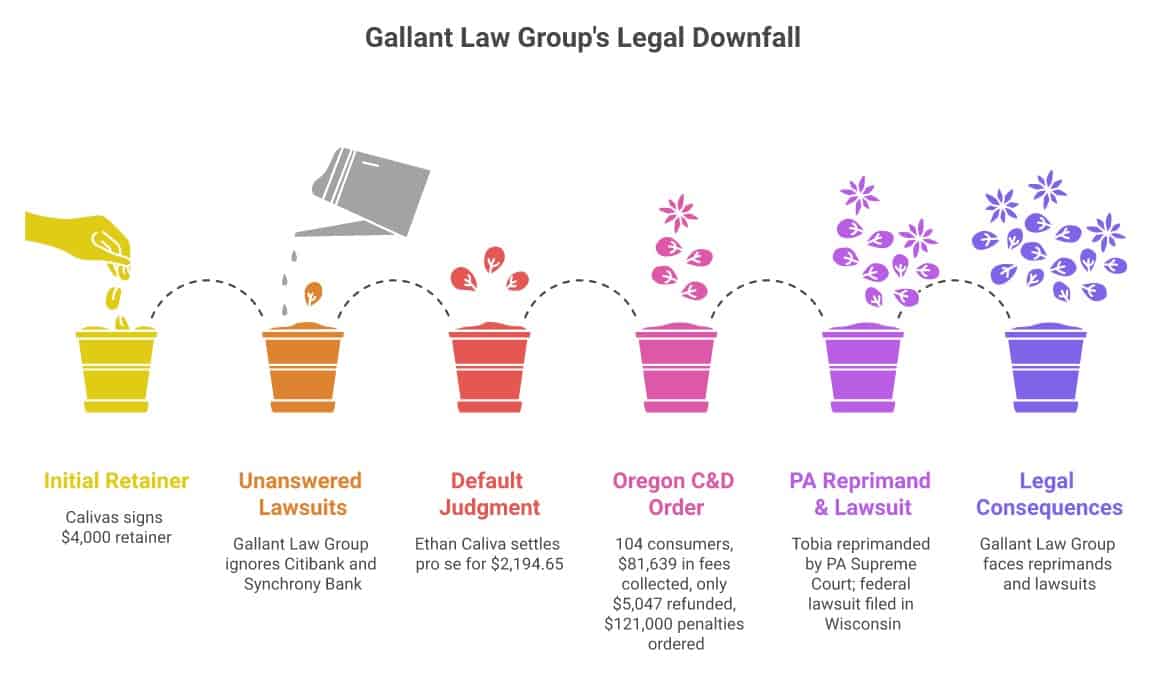
On January 23, 2024, a default judgment was entered against Ethan in the Synchrony case (¶66). Ethan then negotiated his own resolution pro se, settling for $2,194.65 paid in two installments — January and February 2024 (¶67).
The Emotional and Financial Toll
The complaint’s damages section (¶99-101) describes the impact in specific, personal terms. Nicole — who was in an advanced pregnancy during part of this period — suffered anxiety described as “through the roof.” The complaint specifically alleges that the Gallant defendants told Nicole she would have to go in person, by herself, to answer the Citibank lawsuit — a demand made of a woman in an advanced pregnancy whose attorneys were supposed to handle exactly this situation. Ethan had trouble sleeping, spent hours researching options after the debts went into default, and approached friends for financial help — an experience the complaint describes as humiliating because it required disclosing the entire situation. Both Calivas were short-tempered and had to be careful around each other and their daughter to avoid arguments (¶99). The Calivas also struggled to pay other bills and had to skip vacations (¶101).
Prior Regulatory Actions: This Wasn’t the First Time
Oregon Cease-and-Desist Order (March 2025)
According to the complaint (¶102), the Oregon Department of Consumer and Business Services issued a cease-and-desist order against Gallant and related entities in March 2025. The Oregon Department found:
What Oregon Found
- Tobia and Glanzberg owned Gallant, previously known as “Valiant Law Group PC”
- Neither defendant was licensed to practice law in Oregon
- 104 Oregon consumers entered agreements with Gallant
- Those consumers paid $81,639.07 in fees
What Oregon Ordered
- Cease-and-desist from operations in Oregon
- Gallant refunded only $5,046.66 (about 6% of what it collected)
- Oregon ordered $121,000 in penalties
- Average unrefunded fee per consumer: approximately $737
Those figures — drawn from the federal complaint’s allegations about the Oregon proceeding — are stark: of $81,639 collected from 104 Oregon consumers, only $5,047 was allegedly returned, and regulators ordered $121,000 in penalties, which the complaint notes is nearly 50% more than the total fees collected in that state.
Pennsylvania Supreme Court Reprimand of Robert Tobia (January 7, 2026)
Just 47 days before this lawsuit was filed, the Disciplinary Board of the Pennsylvania Supreme Court issued a public reprimand to attorney Tobia (No. 127 DB 2025), effective January 7, 2026. The reprimand arose from a Joint Petition for Discipline on Consent — meaning Tobia agreed to the facts stated. This was his second public reprimand; the first was in May 2022.
The disciplinary petition (filed December 22, 2025) identified the full network of entities Tobia and Glanzberg owned and operated nationally. Beyond Gallant, the petition named six specific debt settlement firms they operated, plus their parent law firm:
The Six Named Debt Settlement Firms
- Creditor Law Group PC (clglaw.com)
- Center Pointe Law PC (centerpointelaw.com)
- Silver Oak Law Group PC (silveroaklaw.com)
- Valiant Law Group (valiantlawpc.com)
- Gallant Law Group (gallantpc.com)
- Debt Defense
The Parent Law Firm
- Glanzberg Tobia Law, P.C. — the Philadelphia base firm managed by both attorneys (the domain @gtlawpc.com appearing on the Calivas’ Exhibit B contract is this firm’s domain, directly connecting the parent entity to the transaction)
The disciplinary petition found the following specific violations, to which Tobia consented:
- Nonlawyer staff created attorney-client relationships. Day-to-day operations — client intake, communications, and referral to local counsel — were delegated to a third-party administrator and nonlawyer teams. Tobia failed to ensure nonlawyer conduct was compatible with his professional obligations (RPC 5.3(c)(1)).
- Websites failed to disclose required information. The firms’ websites did not disclose the geographic location of lawyers actually performing services, the names and addresses of all lawyers involved in paying for advertising, whether referral arrangements existed, or jurisdictional limitations for states where attorneys were not licensed (RPC 7.2(h)).
- Fee-splitting without client consent. Tobia failed to obtain informed consent from clients before sharing their fees with lawyers outside the relevant firm (RPC 1.5(e)).
- Telemarketing Sales Rule violation. The fees charged were not calculated as a percentage of the amount actually saved for clients — a requirement under the FTC’s Telemarketing Sales Rule, 16 C.F.R. § 310.2.
Both the Pennsylvania Attorney General’s Bureau of Consumer Protection and the Office of Disciplinary Counsel received numerous consumer complaints about Tobia’s failure to deliver promised debt relief services. The disciplinary record details 22 individual client matters in which Tobia violated professional conduct rules. In each, Tobia had improperly delegated operational responsibilities to the third-party administrator and nonlawyer staff, who failed to promptly assign matters to local counsel — leaving clients with collection calls increasing, not decreasing, after signing up.
Tobia stated he expressed “regret for expanding his practice to include these types of matters” and was “in the process of unwinding his involvement in debt dispute matters.” He stated he had provided full refunds to any client who complained.
The disciplinary record also confirms that Equity Sales Finance Inc. — named as a defendant in the Caliva federal lawsuit — financed upfront fees for multiple Gallant clients beyond the Calivas. A Virginia client named Manuel Bellamy borrowed $16,750.58 from Equity Sales Finance for a Gallant retainer. An Illinois client named Jerry Jeronimus borrowed $8,521.85 from Equity Sales Finance for a Gallant retainer. The Calivas’ $4,000 was not a one-off financing arrangement — it was how the operation routinely worked.
Six Brands, One Pattern. The disciplinary petition names six separate debt settlement firms owned by the same two attorneys — Creditor Law Group PC, Center Pointe Law PC, Silver Oak Law Group PC, Valiant Law Group, Gallant Law Group, and Debt Defense — plus their parent firm, Glanzberg Tobia Law, P.C. Operating under multiple brand names makes it harder for consumers to find prior complaints, harder for regulators to track the full scope of operations, and easier to continue under a new name after one brand draws regulatory attention. The federal complaint notes that Gallant was previously known as Valiant Law Group PC before rebranding.
The Five Legal Claims
Count 1: Credit Repair Organizations Act (15 U.S.C. § 1679b)
The CROA prohibits making untrue or misleading statements to induce consumers to purchase credit repair services, and charging advance fees before services are delivered. The complaint alleges (¶69-73) that Gallant’s promises — to represent them in court, dispute their debts, protect them from creditors — were false. The complaint further alleges Gallant was not even licensed to practice in Wisconsin when it made those representations (¶72a) and had no present intention of performing the legal services promised (¶72b). Gallant accepted $4,000 upfront before performing any work (¶73).
Count 2: Wisconsin Misrepresentation (Wis. Stat. § 100.18)
Wisconsin’s consumer protection statute prohibits false or misleading representations in commerce. The complaint alleges (¶76-81) Gallant represented it could get the Calivas out of debt without paying creditors — or at worst for “pennies on the dollar” — while promising full legal representation. The complaint notes that Gallant knew nothing about the Calivas’ financial situation, knew very little about Wisconsin law, and made these representations with intent to induce the hiring (¶78).
Count 3: Breach of Fiduciary Duty
Attorneys are fiduciaries of their clients (¶83). The complaint alleges the Gallant defendants intentionally breached those fiduciary duties through the conduct described — collecting fees, instructing the Calivas to stop paying and redirect all creditor communication through Gallant, then failing to respond to lawsuits and abandoning the Calivas when default judgment was entered.
Count 4: Legal Malpractice
The complaint alleges (¶87-89) the Gallant defendants owed a duty of care in rendering legal services, breached that duty through their actions and inactions, and caused damages. The complaint further notes that the power of attorney Ethan signed on January 24, 2023 — giving Gallant explicit authority to respond to legal proceedings — is central to the malpractice theory, because it gave Gallant the authority to act and, the complaint alleges, they did not.
Count 5: Holder In Due Course Liability (Equity Sales Finance Inc.)
The complaint alleges (¶91-92) that Equity, as the current holder of the installment sales contract, is liable for all claims that could be brought against the Gallant defendants, to the extent of money Equity has received from the Calivas. If the court accepts this theory, the Calivas could potentially stop making payments and recover what they’ve already paid — from Equity directly, not just from Gallant.
The complaint also includes an Individual Liability section (¶93-96) alleging that Tobia and Glanzberg had complete control over Gallant at all times, ignored the corporate form to engage in the activities alleged, and are personally liable for their individual tortious conduct.
The same email promising to represent you in court also says “we do not settle your debts.” The same callers who promised to cancel your debt said JP Morgan would drop it “right away.” That gap between what was said and what was written is what these cases are built on.— Steve Rhode
What This Means If You’re Considering Debt Settlement
Debt settlement is a legitimate strategy that works for some people in some situations. What this case alleges is the darker version: predatory marketing and fees collected upfront, allegedly without the intention or infrastructure to deliver what was promised. Whether or not a court agrees, this case has every warning sign I’ve documented over the years:
- Unsolicited cold call promising to cancel debts entirely — then settle for “pennies on the dollar” as a fallback
- Large upfront fee collected before any work performed
- Fee financed through a third-party lender — separating your obligation to pay from their obligation to perform
- Advice to stop paying creditors and redirect all creditor contact through the firm
- No meaningful action when creditors filed lawsuits
- Attorneys not licensed in the client’s state
- Firms operated by laypeople, not attorneys, forming attorney-client relationships
- Multiple entity names making the operation difficult to research
- Prior regulatory actions in multiple states
The law firm structure adds a layer of apparent legitimacy that a typical debt settlement company doesn’t have. When someone tells you they’re a law firm that will represent you in court, that carries weight. Here, that representation appears to have been the bait — and the financing arrangement ensured they got paid before any of it had to be true.
Before You Sign Anything: Use my free Contract Decoder to analyze any debt relief agreement before you pay. And if you’re not sure which path is right for your situation, my Find Your Path quiz will help you think through your options without a sales pitch attached.
Key Takeaways
- Ethan and Nicole Caliva filed a federal lawsuit February 23, 2026, against Gallant Law Group, Robert Tobia, David Glanzberg, and Equity Sales Finance Inc.
- The complaint alleges the couple was cold-called, charged $4,000 upfront (financed at 16.99% through Equity), told to stop paying creditors, and then abandoned when creditors sued
- Ethan had signed a Power of Attorney giving Gallant explicit authority to respond to lawsuits — authority they allegedly never used
- Nicole was sued by Citibank; Ethan by Synchrony Bank. The complaint alleges Gallant failed to respond to either. A default judgment was entered against Ethan in the Synchrony case (this is a public court record)
- Ethan settled the Synchrony judgment himself pro se for $2,194.65
- The welcome email Tobia sent explicitly stated: “We do not settle, consolidate, reduce, or pay your debts” — directly contradicting the sales pitch
- Oregon regulators found neither Tobia nor Glanzberg were licensed to practice law in Oregon; 104 consumers paid $81,639 in fees with only $5,047 refunded; $121,000 in penalties ordered
- PA Supreme Court reprimanded Tobia 47 days before this filing for operating six debt settlement firms (Creditor Law Group PC, Center Pointe Law PC, Silver Oak Law Group PC, Valiant Law Group, Gallant Law Group, Debt Defense) run in many instances by nonlawyer staff who formed attorney-client relationships without required disclosures
- All allegations are pending and unproven in federal court
Being Sued by a Debt Collector? Stories like Gallant Law Group’s show why consumers need to respond quickly. The free Sued for Debt Guide explains your rights, your deadline, and what happens if you don’t respond.
Frequently Asked Questions
What is Gallant Law Group?
Gallant Law Group P.C. is a Philadelphia, Pennsylvania firm that markets debt resolution services. According to a federal lawsuit filed February 2026, it was previously known as Valiant Law Group PC. The Pennsylvania disciplinary order identified six specific debt settlement firms operated by attorneys Robert Tobia and David Glanzberg — Creditor Law Group PC, Center Pointe Law PC, Silver Oak Law Group PC, Valiant Law Group, Gallant Law Group, and Debt Defense — plus their parent firm Glanzberg Tobia Law, P.C. Neither defendant was licensed to practice law in Oregon per Oregon regulators, and the complaint alleges they were not licensed in Wisconsin either. Tobia received his second Pennsylvania public reprimand in January 2026.
Who filed the Caliva v. Equity Sales Finance lawsuit?
Ethan and Nicole Caliva of the Milwaukee, Wisconsin area filed the lawsuit on February 23, 2026, in the U.S. District Court for the Eastern District of Wisconsin (Case No. 2:26-cv-00301). The complaint was filed by attorneys at LawtonCates, S.C. — the same firm the Calivas retained after Gallant failed to respond to the Citibank lawsuit. All allegations remain pending and unproven.
What does the Credit Repair Organizations Act prohibit?
The federal Credit Repair Organizations Act (15 U.S.C. § 1679b) prohibits any person from making false or misleading statements to induce consumers to purchase credit repair or debt relief services, and from charging fees before services are delivered. The complaint alleges Gallant Law Group violated both provisions — making false promises of representation and collecting $4,000 before doing any work.
What is holder in due course liability?
The FTC’s Holder Rule (16 C.F.R. § 433) requires retail installment contracts to preserve the consumer’s right to assert claims against any assignee. The Calivas’ contract with Gallant was immediately assigned to Equity Sales Finance. Under this legal theory, if the court agrees, Equity — the company collecting the monthly payments — could be found liable for Gallant’s alleged misconduct, not just Gallant itself. All liability findings are pending court determination.
What happened with the Oregon action against Gallant Law Group?
According to the complaint (¶102-103), the Oregon Department of Consumer and Business Services issued a cease-and-desist order in March 2025 after finding that neither Tobia nor Glanzberg was licensed to practice law in Oregon, that 104 Oregon consumers paid $81,639.07 in fees, the firm returned only $5,046.66, and Oregon ordered $121,000 in penalties. These figures are drawn from the complaint’s allegations about that order.
Was attorney Robert Tobia previously disciplined?
Yes. Tobia has received two public reprimands from the Disciplinary Board of the Pennsylvania Supreme Court: one in May 2022, and one on January 7, 2026 (No. 127 DB 2025). The 2026 disciplinary order — issued 47 days before the Caliva lawsuit — arose from a Joint Petition for Discipline on Consent that named six specific debt settlement firms Tobia and Glanzberg operated nationally: Creditor Law Group PC, Center Pointe Law PC, Silver Oak Law Group PC, Valiant Law Group, Gallant Law Group, and Debt Defense. The petition found violations including improper fee-splitting, nonlawyer staff forming attorney-client relationships without required disclosures, websites lacking mandatory advertising disclosures, and failure to comply with the FTC Telemarketing Sales Rule. The disciplinary record documents 22 individual client matters in which Tobia failed to properly supervise nonlawyer staff, resulting in clients not receiving legal representation while collection activity continued.
What did the Gallant Law Group welcome email actually say?
The welcome email (Exhibit A to the complaint) signed by Robert Tobia promised to immediately notify creditors the Calivas were represented, represent them in court if creditors pursued legal action, dispute the legality of their debts, and defend “any action brought by your creditors.” The same email also contained an explicit disclaimer: “We do not settle, consolidate, reduce, or pay your debts or offer any sort of loan or financing” — directly contradicting the sales pitch that had induced the Calivas to sign up.
Dealing With Debt? Understanding your options is the first step. See how all your debt relief options compare — including ones most sites won’t tell you about. The Find Your Path quiz gives a recommendation based on your actual numbers, and the Scam-O-Meter checks any company’s complaint history before you sign. Federal Reserve research shows bankruptcy filers recover faster than those who don’t file.