
Quick Answer: Chapter 7 bankruptcy is a federal legal process that eliminates most unsecured debt — credit cards, medical bills, personal loans — in about 90 days. There is no minimum debt amount required to file. Qualification is based on income, not how much you owe. The moment you file, an automatic stay stops all collection calls, lawsuits, and wage garnishments. The filing fee is $338, and most people keep their home, car, and retirement accounts.
If a repossession is what brought you here, read the complete car repossession crisis guide first — it covers how Chapter 13 can stop the auction and how Chapter 7 Section 722 redemption works.
Prefer to watch? Here is a video on this topic.
I filed Chapter 7 bankruptcy in 1990. My real estate business had collapsed, I was drowning in credit card debt, and I had run out of road. I thought it was the end of everything. It turned out to be the beginning of the most important financial education of my life — and eventually, the reason I’ve been able to help hundreds of thousands of people navigate their own debt crises.
Each weekday I send one short email: one money story that caught my attention, why it might matter to you, and one manageable thing you can do with it. A couple of minutes, and a dad joke.
In the latest issue (Oct 16): The check that looks like a scam may be real
Free. I sell nothing. Unsubscribe any time.
This guide covers everything you actually need to know about Chapter 7 bankruptcy — how it works, whether you qualify, what happens to your debts, and what life looks like on the other side. I’ve linked to every spoke of this topic below so you can go as deep as you need on any piece of it.
What Is Chapter 7 Bankruptcy?
According to the U.S. Courts, Chapter 7 — also called “liquidation bankruptcy” — is the most common form of personal bankruptcy in the United States. A court-appointed trustee reviews your assets and liabilities. Most unsecured debts are discharged, meaning legally eliminated. The case typically closes in three to four months.
The name comes from Chapter 7 of the U.S. Bankruptcy Code. It’s a federal process — the same rules apply whether you’re in Alabama or California, though state exemption laws vary in important ways (more on that below).
Liquidation doesn’t mean you lose everything. The trustee can liquidate non-exempt assets to pay creditors — but in the vast majority of consumer cases, there are no non-exempt assets to liquidate. Most people file, get their discharge, and keep everything they own. The bankruptcy system was designed with exemptions specifically to let people keep the essentials and start over.
There Is No Minimum Debt Required to File Chapter 7
This is the most common misconception I hear: “I don’t owe enough to file bankruptcy.” There is no threshold. No floor. The U.S. Courts confirm there is no minimum debt amount required to file Chapter 7.
The question isn’t how much you owe — it’s whether the math is broken. If your income can’t realistically service your debt within a reasonable timeframe, and you’ve passed the means test, you may qualify regardless of whether the total balance is $10,000 or $150,000.
The question everyone asks is the wrong question. “How much do I have to owe?” is not how Chapter 7 works. The right question is: can the math of your life actually get you out of this debt — or can’t it?— Steve Rhode, GetOutOfDebt.org
Free Tool — Bankruptcy Means Test: Wondering if you qualify for Chapter 7 bankruptcy? The free Bankruptcy Means Test checks eligibility based on your state, household size, and income — including state exemptions. Check My Eligibility →
Do You Qualify? The Chapter 7 Means Test
Qualification for Chapter 7 is based on income, not debt amount. The U.S. Trustee Program administers the means test, which works in two steps:
- Step 1 — Compare to your state’s median income: If your household income is at or below your state’s median for your household size, you automatically qualify. No further calculation needed.
- Step 2 — Expense deduction test: If you’re above the median, you run the full means test — subtracting allowed expenses from your income. If the result shows you can’t afford to repay meaningful debt, you still qualify for Chapter 7.
Most people who need Chapter 7 pass the means test. The test was designed to redirect higher-income filers toward Chapter 13 (a repayment plan), not to block the people who genuinely need relief.
Not sure if you’d qualify? Use the Free Bankruptcy Means Test Calculator — it walks you through the income comparison for your state in about two minutes.
What Chapter 7 Eliminates — and What It Doesn’t
Chapter 7 discharges most consumer debts. Per the U.S. Courts, these are typically eliminated:
- Credit card balances
- Medical bills
- Personal loans (unsecured)
- Utility arrears
- Most civil court judgments (including deficiency balances after repossession)
- Some older tax debts (under specific conditions)
- Lease obligations
These debts typically survive Chapter 7 and cannot be discharged:
- Federal student loans (and most private student loans)
- Child support and alimony
- Recent income tax debt (generally taxes assessed within the last 3 years)
- Debts from fraud or intentional harm
- Criminal fines and restitution
- Debts from DUI-related injuries
Secured debts work differently. A mortgage or car loan is secured by property. Chapter 7 can eliminate your personal liability for the debt, but the lender’s lien on the property survives. If you want to keep your house or car, you’ll need to either reaffirm the debt (agree to remain personally liable) or redeem the property. If you want to walk away, Chapter 7 lets you do that without the lender coming after you personally for the deficiency.
The Automatic Stay — What Stops the Moment You File
This is the part people don’t realize: the automatic stay goes into effect the instant your petition is filed — not after a hearing, not after a judge reviews it. The moment the clerk accepts your paperwork, every collection action must legally stop.
The automatic stay immediately halts:
- Wage garnishments
- Collection calls and letters
- Lawsuits and court judgments
- Repossessions
- Foreclosure proceedings (temporarily)
- Utility shutoffs (for 20 days)
- Evictions in many cases
If you file on a Monday, your wage garnishment stops Monday. You notify your employer with a copy of your filing and the garnishment must cease. If a creditor violates the stay after notice, they’re in contempt of a federal court order.
For a full breakdown of how the stay applies to wage garnishment specifically, see: How to Stop a Wage Garnishment.
Free Tool — Wage Garnishment Calculator: Worried about your paycheck being seized? The free Wage Garnishment Calculator shows exactly how much creditors can legally take in your state — and some states prohibit garnishment entirely. Calculate My Risk →
What You Cannot Do After Filing Chapter 7
People fear there’s a long list of things they’ll lose or be banned from. The reality is narrower than the fear — but there are genuine restrictions.
What You CAN Do
- Keep your home (if current on mortgage or via homestead exemption)
- Keep your car (up to your state’s vehicle exemption value)
- Keep all retirement accounts (401k, IRA — fully protected federally)
- Open new bank accounts
- Apply for credit (secured cards rebuild credit quickly)
- Start a new business
- Work in most professions (few licenses are affected)
What You CANNOT Do
- Hide, transfer, or conceal assets — this is bankruptcy fraud, a federal crime
- Run up new luxury debt right before filing with no intent to repay
- File Chapter 7 again for 8 years
- Expect student loans to be discharged (rare exceptions only)
- Stop paying secured debts if you want to keep the collateral
- Lie to the trustee at your 341 meeting
The 90-day and 1-year lookback rules matter. Luxury purchases of more than $800 made within 90 days of filing, and cash advances over $1,100 taken within 70 days, are presumed non-dischargeable fraud. If you’re planning to file, stop using credit cards now — even for groceries. Let your attorney advise on timing.
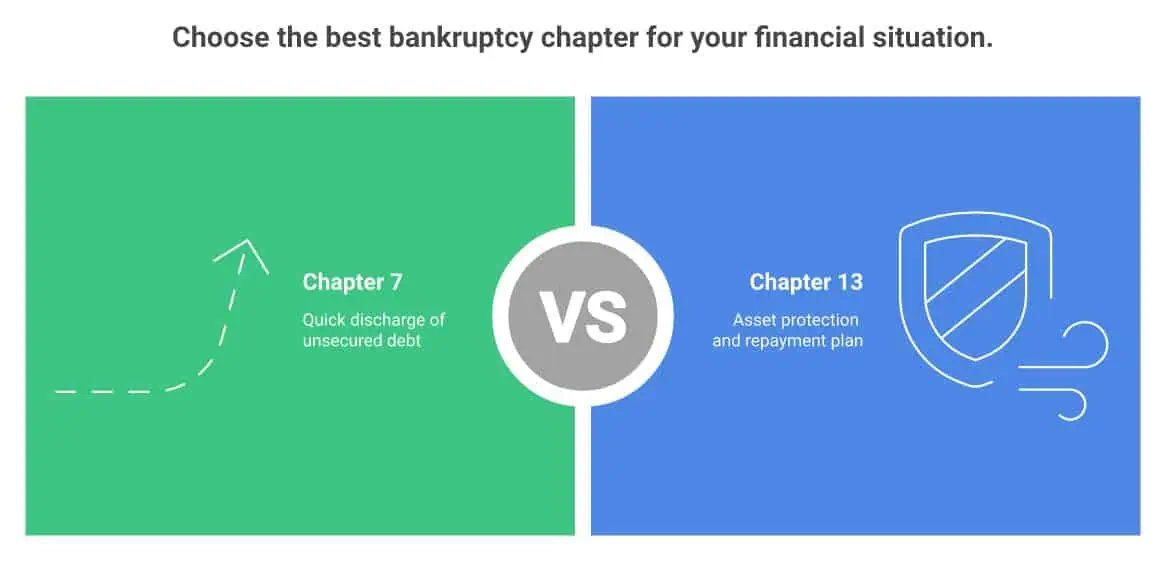
Chapter 7 vs. Chapter 13 — Which Is Right for You?
Chapter 7 is not the right tool for every situation. Here’s how to think about the choice:
Related: Can bankruptcy wipe out tax debt — without touching your retirement? The timing rules, the 401(k)/IRA protections, and the expensive mistake to avoid.
Child support debt and Chapter 7: If you owe back child support on top of other debts, be aware that child support is non-dischargeable under 11 U.S.C. § 523(a)(5) and withholding continues through bankruptcy. Chapter 7 can eliminate your other debts to free up cash for support. For the full picture on child support and garnishment, see: I’m Behind on Child Support and They’re Garnishing My Wages. Here’s What to Do Right Now.
Choose Chapter 7 if: Your income is at or below the means test threshold, most of your debt is unsecured (credit cards, medical), you don’t have significant non-exempt assets you’d lose, and you want the fastest possible resolution (~90 days).
Consider Chapter 13 if: Your income is too high for Chapter 7, you’re behind on a mortgage and want to save your home, you have non-exempt assets you want to protect, or you have debt types (like recent taxes or student loans) that Chapter 13 handles better through a structured repayment plan.
The comparison graphic above covers the key structural differences. The short version: Chapter 7 is faster and eliminates more debt; Chapter 13 protects more assets and handles secured debt better. Many people who fail the Chapter 7 means test still have a path through Chapter 13.
What It Costs to File Chapter 7
The federal court filing fee for Chapter 7 is $338. If your income is below 150% of the federal poverty level, you can apply for a fee waiver — the court may waive it entirely. You can also pay in installments.
Attorney fees are separate and vary by market — typically $1,000–$2,500 for a straightforward consumer Chapter 7. Some nonprofit legal aid organizations file for free or reduced cost. The total cost is usually far less than one month of debt payments, and the result is a clean slate.
What Happens to Your Credit After Chapter 7
Chapter 7 stays on your credit report for 10 years. That’s the scary headline. Here’s the reality underneath it:
- Your credit score typically rises within 12–24 months of filing as your debt-to-income ratio resets to zero
- Secured credit cards are available almost immediately after discharge
- Most people reach a 700+ credit score within 2–3 years if they use credit responsibly post-discharge
- A Federal Reserve Bank of New York study found that people who file bankruptcy are measurably better off financially than equally insolvent people who don’t file
The Myth: “Bankruptcy ruins your credit for 10 years.”
The Reality: By the time most people consider bankruptcy, their credit is already destroyed by missed payments, collection accounts, and judgments. The bankruptcy itself doesn’t cause additional damage — it stops the bleeding and creates the clean slate from which recovery actually begins. The 10-year clock starts from a baseline that is already low.
Filing Chapter 7 for Credit Card Debt
Credit card debt is the single most common reason people file Chapter 7 — and it’s also one of the cleanest discharges in bankruptcy law. Unlike student loans or taxes, credit card balances have almost no exceptions. They discharge in full. If you’re still weighing bankruptcy against other options for credit card debt, my Credit Cards: The Complete Guide walks through every option including settlement, DMPs, and doing nothing — so you can make an informed comparison.
I filed in 1990 largely because of credit card debt from a business that had collapsed. I understand the shame spiral — the idea that you borrowed money and now you’re “not paying it back.” Here’s what I learned: the credit card companies already priced your potential default into their 24% interest rate. They’re not victims. You’re not a bad person. You’re a person whose math broke, and the law provides a remedy.
For a deeper look at how Chapter 7 specifically applies to credit card debt: Is Debt Settlement Legit or a Scam? — because understanding settlement vs. bankruptcy is part of making an informed decision.
The Chapter 7 Bankruptcy Hub — Go Deeper on Any Topic
This page is the center of a cluster of resources I’ve built around Chapter 7. Each spoke goes deeper on a specific question:
Should I File Bankruptcy? Quiz
2-minute quiz that factors your debt types, income, assets, and situation to point you toward the right path.
Free Means Test Calculator
Find out in minutes whether your income qualifies you for Chapter 7 based on your state’s median.
How to Stop a Wage Garnishment
If your paycheck is already being garnished, bankruptcy’s automatic stay stops it the same day you file.
TikTok Says Bankruptcy Is a Hack
What social media gets right and wrong about using bankruptcy strategically.
5 Threats Driving Bankruptcy Filings in 2026
Why filings are up 11% and what economic factors are pushing people to file now.
7 Debt Strategies Dave Ramsey Won’t Tell You About
An honest comparison of all your options — including the ones that conflict with the conventional playbook.
Real Case: 73-Year-Old, $40K in Credit Card Debt
A real person’s situation analyzed in full — what I actually recommended and why.
Subchapter V: Small Business Bankruptcy
If it’s a business debt problem, this streamlined path may be a better fit than personal Chapter 7.
Credit Card Debt Lawyer: Which Type Do You Need?
The attorney who makes creditors back off instantly via the automatic stay — and three other types to know when you’ve been sued or harassed.
The Benefits of Consumer Bankruptcy (Chapter 7 & 13): What Research Actually Shows
What peer-reviewed research from the American Economic Review and Federal Reserve actually shows about bankruptcy outcomes — mortality, earnings, credit recovery, and retirement protection.
New Senate Bill Would Raise Chapter 13 Bankruptcy Limit to $2.75 Million — Who Benefits
A bipartisan Senate bill would replace Chapter 13’s split debt limits with a single $2.75M combined ceiling — expanding access for homeowners with large mortgages who are currently locked out.
Should I Cash Out My 401k or File for Bankruptcy? Here’s What I Learned Filing in 1990
Should you withdraw your 401k to avoid bankruptcy? No — your retirement is 100% protected under federal law, and cashing it out first destroys $116,000+ in wealth.
LYCRA Files Bankruptcy to Eliminate $1.2 Billion in Debt
The Spandex maker uses Chapter 11 to erase $1.2B in debt and calls it a milestone. The same tool is available to individuals.
The Automatic Stay: What Happens the Moment You File
The automatic stay stops garnishment, lawsuits, and collector calls on day one. From someone who experienced it in 1990.
Gambling Debt: Here Are Your Real Options
Gambling debt is dischargeable in Chapter 7 — but nobody in the recovery world tells you that. All your options explained.
Bank Levy by a Debt Collector: What It Means and How to Stop It
A bank levy can drain your account with no warning. Learn what’s protected, how to fight back, and why bankruptcy’s automatic stay may be your fastest option.
Can Debt Consolidation Stop Wage Garnishment? Here’s the Truth Nobody Explains
The truth: consolidation cannot stop a court-ordered garnishment. Only bankruptcy automatic stay works immediately.
Financial Options When You Can’t Afford Divorce
How bankruptcy before divorce eliminates joint debt and why the “save up first” advice backfires — research from the Federal Reserve and 12 academic sources.
No, Carrying a Credit Card Balance Does Not Build Your Credit
The myth that carrying a balance builds credit — debunked by the CFPB and myFICO, with the math showing what it actually costs you.
Tariffs Are Driving Americans to Bankruptcy — What the Numbers Mean for You
Tariffs are now the second-leading cause of bankruptcy, cited by 41.7% of filers — and 89.3% of people who file rebuild financially within five years.
Drowning in Private Student Loan Debt? Here’s What’s Actually True
Private student loans can’t be forgiven through federal programs — but bankruptcy discharge is a real option, and the legal environment has shifted in borrowers’ favor.
Student Loans in Bankruptcy: The 87% Success Rate Nobody Told You About
87% of borrowers who file adversary proceedings to discharge student loans succeed. The myth that it’s impossible has cost millions their financial futures.
Not sure where to start? My free Find Your Path tool takes about two minutes and points you toward the options that actually fit your numbers and situation — not a one-size-fits-all answer.
Key Takeaways
- There is no minimum debt amount to file Chapter 7 — qualification is based on income, not what you owe
- The automatic stay stops all garnishments, lawsuits, and collection calls the moment you file
- Chapter 7 discharges most unsecured debt (credit cards, medical bills, personal loans) in about 90 days
- Student loans, child support, and recent taxes generally survive Chapter 7
- The $338 filing fee can be waived if your income is below 150% of the federal poverty line
- Retirement accounts are fully protected in bankruptcy — never cash them out to avoid filing
- Credit recovers faster post-bankruptcy than most people expect — often 700+ within 2–3 years
- You cannot refile Chapter 7 for 8 years after a previous Chapter 7 discharge
- Bank Levy by a Debt Collector: What It Means and How to Stop It
- Can Debt Consolidation Stop Wage Garnishment? Here’s the Truth Nobody Explains
- The Bankruptcy Means Test 180-Day Rule: Why Filing at the Wrong Time Gets You Denied
Frequently Asked Questions
How much do you have to be in debt to file Chapter 7?
There is no minimum debt requirement for Chapter 7 bankruptcy. The federal bankruptcy code sets no floor on how much you must owe to be eligible. Qualification is based on your income relative to your state’s median income — the means test. If your income is below the median for your household size, you qualify automatically regardless of debt amount. The question isn’t how much you owe — it’s whether your income can realistically service the debt. If the math is broken, you may qualify even with a relatively modest balance.
What debts can be discharged in Chapter 7?
Chapter 7 discharges most unsecured consumer debts: credit card balances, medical bills, personal loans, utility arrears, civil court judgments, deficiency balances after repossession, and some older tax debts. Debts that survive Chapter 7 include federal student loans, child support, alimony, recent income taxes, debts from fraud or intentional harm, criminal fines, and restitution from DUI-related injuries. Secured debts (mortgages, car loans) are handled differently — the lien survives, but your personal liability can be discharged.
How long does Chapter 7 bankruptcy take?
A straightforward Chapter 7 case typically takes three to four months from filing to discharge. After filing, you attend a brief meeting of creditors (the 341 meeting) about a month later — this usually takes 5–10 minutes. Creditors have 60 days from that meeting to object to the discharge. If no objections are filed and you’ve completed the required credit counseling courses, the court issues the discharge order. Most people have their case resolved within 90–120 days of filing.
What happens to my credit after Chapter 7?
Chapter 7 stays on your credit report for 10 years from the filing date. However, credit scores typically rise within 12–24 months of filing because all the discharged debt drops off and your utilization resets. Most people can qualify for secured credit cards immediately after discharge and rebuild to a 700+ score within 2–3 years. A Federal Reserve Bank of New York study found that bankruptcy filers are measurably better off financially than equally insolvent people who chose not to file.
Can I keep my house and car in Chapter 7?
Usually yes. Exemptions protect essential property. Federal and state exemption laws protect home equity up to a certain amount (the homestead exemption — which varies significantly by state), one vehicle up to a set value, retirement accounts, household goods, and tools of your trade. In the vast majority of consumer Chapter 7 cases, the trustee finds no non-exempt assets to liquidate. To keep secured property like a home or car, you’ll need to be current on the payments and either reaffirm the debt or meet other requirements. An attorney can walk through what’s specifically protected in your state.
What can you not do after filing Chapter 7?
After filing Chapter 7, you cannot hide, transfer, or conceal assets — doing so is federal bankruptcy fraud. You cannot run up new credit card debt with no intent to repay and then discharge it (luxury purchases over $800 within 90 days of filing are presumed non-dischargeable). You cannot expect student loans or child support to be eliminated. You cannot refile Chapter 7 for another 8 years. And you cannot lie to the bankruptcy trustee at your 341 meeting. What you can do: keep exempt property, open new accounts, start rebuilding credit, and in most cases, resume your professional and financial life essentially without restriction.
Is bankruptcy better than debt settlement for credit card debt?
For most people with more debt than they can realistically repay, Chapter 7 bankruptcy outperforms debt settlement on every metric: it’s faster (90 days vs. 2–4 years), it discharges debt completely rather than partially, it costs less in total (settlement companies typically charge 15–25% of enrolled debt), it immediately stops collections and garnishments via the automatic stay, and it protects retirement accounts throughout the process. The credit impact is similar — both hurt your score. The difference is that bankruptcy gives you a clean slate; settlement leaves you with residual balances, tax implications on forgiven debt, and no legal protection from creditors who refuse to settle.
How do I file Chapter 7 bankruptcy?
The process: complete a credit counseling course from an approved provider within 180 days before filing; file a petition with your local federal bankruptcy court along with schedules listing all assets, debts, income, and expenses; pay the $338 filing fee (or apply for a waiver); attend a 341 meeting of creditors about 30 days later; complete a debtor education course; and receive your discharge order approximately 60 days after the 341 meeting. Most people hire a bankruptcy attorney to prepare the petition — errors in the paperwork can delay or jeopardize the discharge. The total cost including attorney fees typically runs $1,500–$3,000 for a straightforward consumer case.
Does Bankruptcy Ruin Your Credit? What Federal Reserve Research Actually Shows
Federal Reserve data on how quickly scores recover, when car loans and mortgages become available, and the optimum rebuilding path with real timelines.
What Disqualifies You From Filing Bankruptcy? (Less Than You’ve Been Told)
The disqualifiers are narrower than most people think. Here’s the actual list — means test, prior discharge timing, fraud, and credit counseling — and why fear of disqualification keeps more people from filing than the actual rules do.
Gambling Debt and Bankruptcy: The Option Nobody in Recovery Mentions
Gambling debt is ordinary unsecured debt — fully dischargeable in Chapter 7. Here is what the law actually says, from someone who has helped gambling debt survivors since 1994.
Stuck in a House You Can’t Afford? Here Are Your Real Options
When you are deeply underwater and want to walk away, Chapter 7 eliminates personal liability for the mortgage deficiency — so the lender cannot pursue you for the gap after foreclosure.
How Long Does Bankruptcy Stay on Your Record?
Chapter 7 stays 10 years, Chapter 13 stays 7. But Federal Reserve research shows filers recover faster than those who do not file. Here is the real timeline.
Does Interest Keep Accruing on Student Loans During Bankruptcy?: The automatic stay stops collection — not interest. Why the accrual question misses a bigger opportunity. Read: Student Loan Interest During the Bankruptcy Stay
Related: What Will I Lose If I File Bankruptcy? — 95%+ of Chapter 7 cases are no-asset. Here is what the law actually protects.



