
The Short Answer: Merchant cash advances (MCAs) carry effective annual interest rates of 100% to 200%, and most small businesses that use them end up stacking multiple advances until the math collapses — and what happens when you default on an MCA can catch business owners completely off guard. In 2025, more than 230 bankruptcy filings involved MCA debt. For many small business owners, bankruptcy is not a failure — it is the only legal tool powerful enough to stop MCA funders in their tracks.
A new Bloomberg Law analysis confirms what bankruptcy attorneys have been seeing for years: merchant cash advances are piling up in small business bankruptcies at a record pace, and the problem is accelerating.
In 2025, over 230 bankruptcy cases involved MCA debt — a surge that peaked after cases began rising sharply in 2023. More than half of all federal bankruptcy districts reported MCA-related cases last year. One bankruptcy attorney put it plainly: “I can’t think of a case in a long time where I haven’t seen them. Nobody has just one.”
That last part — “nobody has just one” — is the heart of the problem.
Each weekday I send one short email: one story that caught my attention, why it might matter to you, and one manageable thing you can do with it. A couple of minutes, and a dad joke.
In the latest issue (Nov 13): The shelf price isn't always what you pay
Free. I sell nothing. Unsubscribe any time.
What Is a Merchant Cash Advance?
A merchant cash advance is not technically a loan. At least, that’s what the companies selling them claim. The industry frames MCAs as a purchase of future receivables — you’re “selling” a portion of your future revenue in exchange for cash today.
The Industry Claim: “It’s not a loan — it’s a purchase of future revenue, so lending laws don’t apply.”
What Courts Are Finding: Federal bankruptcy courts are increasingly reclassifying MCAs as loans rather than asset purchases. When the structure walks, talks, and drains like a loan, courts tend to call it one — which limits what MCA funders can recover in bankruptcy.
Here’s how the math works: MCA funders charge a “factor rate” — typically between 1.1 and 1.5. You borrow $100,000, and you repay $110,000 to $150,000, with daily or weekly automatic withdrawals from your business bank account. When you convert that to an annualized interest rate, you’re looking at effective annual rates of 100% to 200%.
No bank would offer you that rate. No credit card charges anything close. And that’s by design.
The Stacking Problem Nobody Warns You About
MCAs are aggressively marketed to small businesses through social media, often targeting business owners who’ve been turned down by banks. The pitch is fast cash with no credit check. What the ads don’t mention is the trap built into the structure.
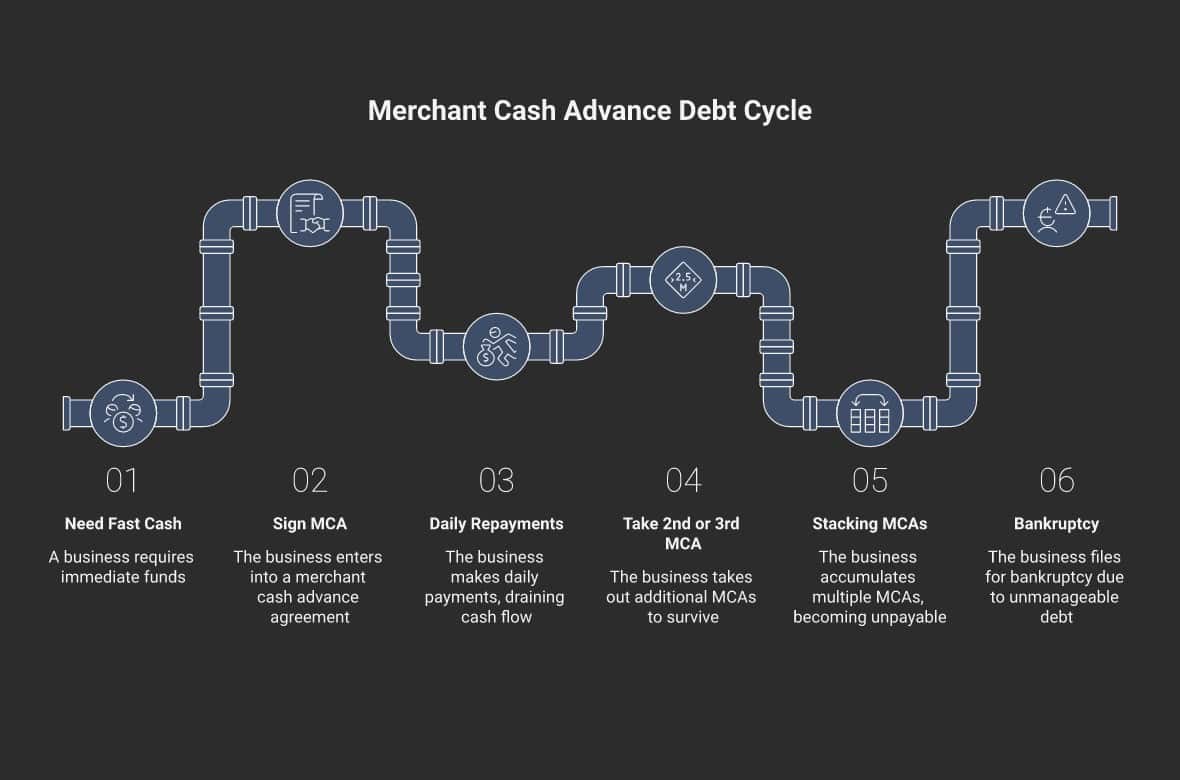
Because MCAs pull from daily revenue, a business that takes one MCA immediately has less cash to operate with. When cash runs low, the natural response is to take another advance. Then another. The industry calls this “stacking,” and bankruptcy attorneys say it’s nearly universal among businesses in trouble.
Rogers Landworks LLC is one of the documented cases from the Bloomberg Law report. The company took out 21 separate MCA deals totaling $3.6 million before filing for Chapter 11 bankruptcy in December 2025. Twenty-one. And the attorneys who handled the case say it’s not unusual.
The Cases Are Getting Bigger
This is not a problem isolated to tiny mom-and-pop operations. The Bloomberg Law reporting shows MCAs showing up in the bankruptcy filings of some surprisingly large companies:
- Pat McGrath Cosmetics — $3 million in MCA payments, plus $43 million in secured debt, led to a January 2026 bankruptcy filing
- Subway Franchise (43 locations) — $1.4 million in MCA debt at a 94% annualized return rate
- Avant Gardner / Brooklyn Mirage — The New York City events venue had $11 million in previous MCA funding before seeking bankruptcy protection
The common thread across these cases is what attorneys describe as the death spiral: MCAs are “very ruthless until a bankruptcy petition is filed,” according to Kathleen DiSanto of Bush Ross PA. The moment a bankruptcy petition hits, the automatic stay kicks in — and MCA funders have to stop pulling from your accounts immediately.
The MCA Market Is $20 Billion — and Barely Regulated
The U.S. MCA market is currently estimated at $20 billion and is projected to exceed $30 billion soon, according to Bloomberg Law. That growth is fueled by:
- Aggressive social media marketing targeting struggling business owners
- The absence of federal interest rate regulations (MCAs are structured to avoid them)
- Fast approvals — sometimes same-day — that banks can’t match
- No requirement to disclose effective annual interest rates
Patricia Fugée of FisherBroyles LLP, who represents MCA borrowers in bankruptcy, was direct: “In my experience it is a terrible thing. It begs for regulation.”
The lack of regulation is not an accident. The industry has fought hard to maintain its “purchase of receivables” framing specifically to avoid lending laws. But bankruptcy courts are increasingly refusing to honor that framing when the economic reality says otherwise.
What Bankruptcy Actually Does for MCA Debtors
If you’re a small business owner drowning in merchant cash advances, here’s what I want you to understand: bankruptcy was designed for exactly this situation.
The Automatic Stay: The moment a bankruptcy petition is filed, every MCA funder must immediately stop all collection activity — including the daily account withdrawals that were draining your business. You get breathing room, immediately.
If you are already in default or heading there, here is what I have seen happen when a business owner defaults on a merchant cash advance — including UCC liens and confessions of judgment.
Beyond the immediate relief, bankruptcy courts have additional tools:
- Courts can reclassify MCAs as loans, limiting what funders can claim
- Chapter 11 and Subchapter V bankruptcy allow small businesses to restructure debt on terms they can actually pay
- Courts can avoid preferential transfers — if you paid one MCA funder more than others in the 90 days before bankruptcy, that payment can potentially be clawed back
- The fresh start allows the business to continue operating without the daily revenue drain
I’ve written about Subchapter V bankruptcy — which was specifically designed for small businesses — and it has become an increasingly important option for owners stuck in MCA spirals. If your business has less than $7.5 million in debt, Subchapter V may be a faster, cheaper path than traditional Chapter 11.
What to Do If You’re Stuck in the MCA Trap
If you’re reading this because you have one or more merchant cash advances and you’re not sure how to get out, the single most important step is talking to a bankruptcy attorney — not an MCA settlement company, not a “business debt relief” service that found you through social media. A bankruptcy attorney.
Here’s why: MCA funders use their “not a loan” framing to pressure business owners into thinking they can’t discharge the debt. Bankruptcy courts have been saying otherwise. You need someone who knows how courts in your jurisdiction are treating MCAs — and that’s a bankruptcy attorney, not a debt settlement salesperson.
Watch Out for “MCA Relief” Companies: The same social media channels that MCA funders use to find borrowers are now being used by “MCA relief” companies promising to renegotiate your advances. Some of these are legitimate. Many charge large upfront fees and deliver nothing. Before signing anything with an MCA relief company, run their contract through the Contract Decoder — it’s free and will show you the red flags.
The math of MCA debt rarely works itself out on its own. If you’ve stacked multiple advances and the daily withdrawals are consuming your revenue before you can make payroll or pay suppliers, the time to act is now — not after the next advance runs out.
Debt is math, not morality. And when the math of 200% interest rates meets a small business’s daily revenue, the math always wins.— Steve Rhode
For a broader look at your options — bankruptcy, negotiation, or other paths — take the Find Your Path quiz. It’s designed for individuals but the underlying framework applies to business owners too: understand your real options before you make a move that costs you more time and money.
FAQ: Merchant Cash Advances and Small Business Bankruptcy
What is the effective interest rate on a merchant cash advance?
Most merchant cash advances carry factor rates between 1.1 and 1.5, which translates to effective annual interest rates of 100% to 200% when annualized. MCA companies are not required to disclose the equivalent APR, which is part of why the rates are often not fully understood until a business is already trapped.
Can you discharge a merchant cash advance in bankruptcy?
Yes — bankruptcy courts increasingly treat MCAs as loans rather than sales of future receivables, which means they can be treated as debt in bankruptcy proceedings. Chapter 11 and Subchapter V bankruptcy specifically allow small businesses to restructure or discharge these obligations. An automatic stay also immediately stops all MCA collection activity and account withdrawals the moment a bankruptcy petition is filed.
What is MCA stacking?
MCA stacking happens when a business takes multiple merchant cash advances simultaneously or sequentially, each pulling daily repayments from the same revenue stream. Because each MCA reduces available cash, businesses often take additional advances to cover operating costs — creating a spiral. Bankruptcy attorneys report that most small businesses in MCA trouble have multiple advances stacked, not just one. Rogers Landworks LLC, for example, had 21 stacked MCAs totaling $3.6 million before filing Chapter 11.
What is Subchapter V bankruptcy for small businesses?
Subchapter V is a streamlined Chapter 11 bankruptcy process created specifically for small businesses with less than $7.5 million in total debt. It is faster and cheaper than traditional Chapter 11 and allows a business to continue operating while restructuring its debt — including merchant cash advances — on terms the business can actually pay. Learn more about Subchapter V bankruptcy here.
Are merchant cash advances regulated?
At the federal level, merchant cash advances largely fall outside traditional lending regulations because the industry structures them as purchases of future receivables rather than loans. There is no federal requirement to disclose effective APR. Some states, including California and New York, have begun requiring rate disclosures, but federal regulation remains limited. Bankruptcy courts, however, have increasingly rejected the “not a loan” framing when ruling on MCA debt in bankruptcy cases.
… (Source: Bloomberg Law — Alex Wolf, February 24, 2026)
Dealing With Debt? Understanding your options is the first step. See how all your debt relief options compare — including ones most sites won’t tell you about. The Find Your Path quiz gives a recommendation based on your actual numbers, and the Scam-O-Meter checks any company’s complaint history before you sign. Federal Reserve research shows bankruptcy filers recover faster than those who don’t file.
Part of a Research Series: This post is part of Merchant Cash Advances: The Research and Data the Industry Doesn’t Show You — a complete collection of research on merchant cash advances for small business owners.



