

Quick Answer: US Legal Aid is a for-profit mortgage modification and foreclosure prevention company. To evaluate whether they’re right for you, I’d encourage you to check their complaint history with the CFPB, read their BBB profile, and check their enforcement history. Here’s how to do each of those.
Before You Read This: I want to be upfront about what this page is and isn’t. I’m not rendering a verdict on US Legal Aid. This is a research guide — I’m showing you where to look so you can reach your own conclusions based on current information.
If you find something in the public record that concerns you, post it in the comments below. If you’re evaluating their agreement, use my free Contract Decoder tool.
If you represent US Legal Aid and something here is inaccurate, contact me and I’ll review it promptly.
Each weekday I send one short email: one story that caught my attention, why it might matter to you, and one manageable thing you can do with it. A couple of minutes, and a dad joke.
In the latest issue (Nov 6): Owed money on an Amazon return? Check by Dec. 1
Free. I sell nothing. Unsubscribe any time.
If you have inside information you feel you need to share with me privately: don’t. Whatever you want to share should be posted in the comments — by you, with your name attached. I’m not willing to be anyone’s conduit for information they won’t stand behind themselves.
The most valuable thing on this page may not be what I’ve written — it’s the comments section below. People who’ve dealt with US Legal Aid share their experiences there. I’d encourage you to read them and add your own.
Who Is US Legal Aid?
An educated consumer is our best customer.— Sy Syms
New here? My Ultimate Consumer Guide to Checking Out a Debt Relief Company walks through how to vet any debt relief company before you sign anything.
US Legal Aid is a for-profit mortgage modification and foreclosure prevention company. Rather than repeat what they say about themselves here, I’d encourage you to read their own website and state business filings — that way you’re seeing it directly from primary sources, not filtered through me.
Step 1: Check Their Credentials
For a mortgage modification company, these are the key things to verify:
- MARS Rule Compliance: The FTC’s Mortgage Assistance Relief Services (MARS) Rule governs mortgage modification companies. Among other things, it prohibits upfront fees before a written offer of relief is obtained from the lender. Check whether their practices align with MARS Rule requirements at ftc.gov.
- State Licensing: Mortgage modification companies are regulated at the state level. Contact your state’s banking or mortgage regulatory agency to confirm whether US Legal Aid is licensed to provide mortgage assistance services in your state.
- Nonprofit Verification: If the company claims nonprofit status, verify it. Search the IRS Tax Exempt Organization Search at apps.irs.gov/app/eos for their name. Legitimate nonprofits appear in the IRS database.
- State Bar Verification: If they’re holding themselves out as providing legal services, their attorneys should be licensed in your state. Verify any attorney’s license through your state bar association.
HUD-Approved Counselors Are Free: HUD-approved housing counselors provide free or low-cost assistance with mortgage modification and foreclosure prevention. Find one at hud.gov/counseling or call 1-800-569-4287. Before paying anyone for mortgage modification help, explore the free alternatives.
Step 2: Check Consumer Complaints
The Consumer Financial Protection Bureau maintains a public database of complaints filed against financial companies. You can search for US Legal Aid directly:
Search US Legal Aid’s complaint history in the CFPB database →
When you’re reading complaints, look for:
- What the complaints are about — upfront fees, failed modifications, communication problems?
- How the company responded — did they resolve issues or just close them?
- Whether the same issue appears repeatedly — a pattern matters more than a single complaint
- Complaints about fees charged before results were delivered
Step 3: Check Review Platforms
US Legal Aid does not appear to have profiles on major review platforms like Trustpilot or BBB at the time of writing. That absence is itself worth noting — established companies in this space typically have a review footprint. Here’s what to search:
- Search Google for “US Legal Aid reviews” and “US Legal Aid complaints” — look at what comes up
- Search the BBB website at bbb.org for “US Legal Aid” — verify whether a profile exists
- Search court records and news archives for the company name or address (811 Wilshire Blvd, Los Angeles)
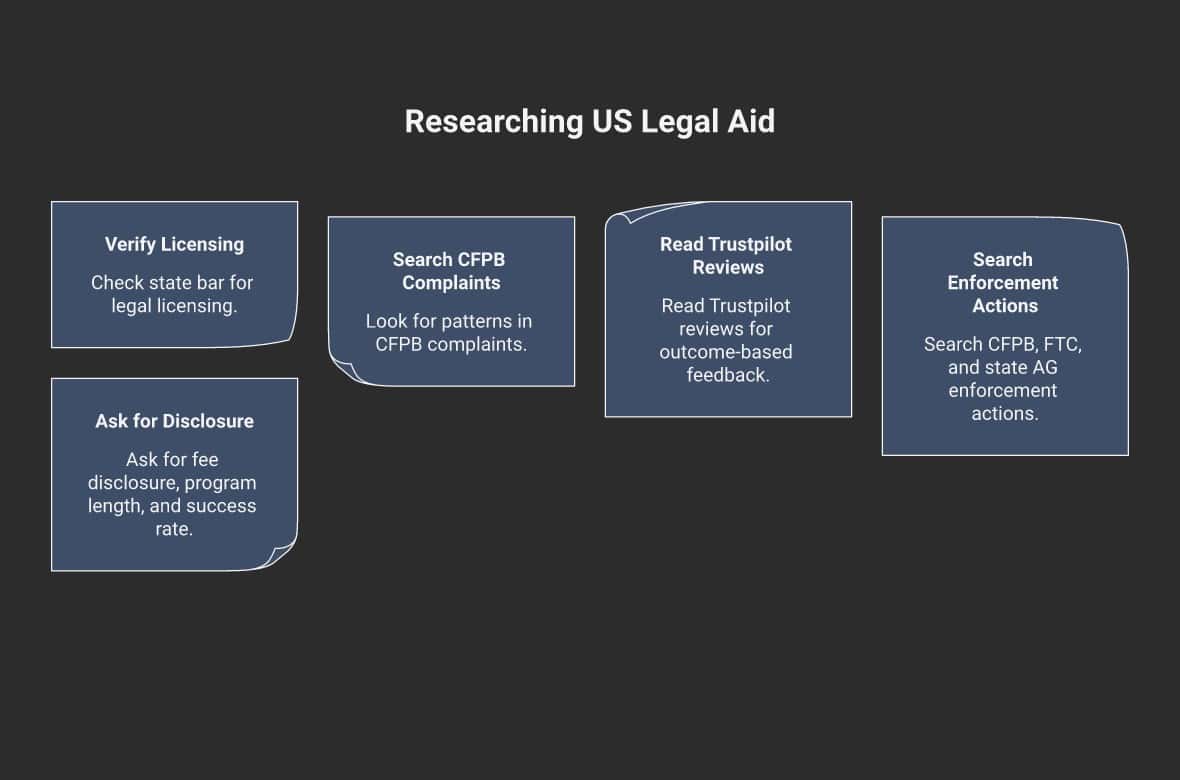
Step 4: Check Their Legal and Enforcement History
Mortgage modification companies have been a significant area of FTC and state AG enforcement. Here’s where to look:
- CFPB Enforcement Actions: Search the CFPB’s enforcement action database for US Legal Aid
- FTC Actions: The FTC publishes all enforcement cases — mortgage modification fraud has been a priority enforcement area for years
- State Attorney General: Search “US Legal Aid attorney general” — state AGs have been active in pursuing mortgage relief fraud
- PACER (Federal Court Records): PACER lets you search federal court cases by party name or address
Context Matters: The mortgage modification industry has had extensive fraud and enforcement activity. Understanding that history — and verifying that any company you work with has a clean record — is an important part of protecting yourself.
Step 5: Ask the Right Questions
Before signing anything: Run the contract through my free Contract Decoder tool. Paste it in and get a plain-English breakdown of what you’re agreeing to.
Before you pay US Legal Aid or any mortgage modification company, get clear answers to these questions in writing:
- Are you licensed to provide mortgage assistance services in my state?
- Do you charge any fee before obtaining a written modification offer from my lender? (The MARS Rule prohibits this)
- What is the total fee, and when is it charged?
- What is your refund policy if the modification is not approved?
- Can I contact my lender’s loss mitigation department directly instead?
Before You Commit: If you’re facing foreclosure or struggling with your mortgage, contact a HUD-approved housing counselor before paying anyone. They provide free assistance and can work with your lender on your behalf. Find one at hud.gov/counseling or call 1-800-569-4287.
Key Takeaways
- US Legal Aid offers mortgage modification services — verify their state licensing and nonprofit status before engaging
- HUD-approved housing counselors provide free mortgage modification assistance — explore that option first
- The MARS Rule prohibits upfront fees before a written modification offer is obtained — verify compliance
- Check CFPB and FTC enforcement history for the company name and address
- Their name similarity to federally funded legal aid organizations is worth noting — they are not affiliated
- The comments section below contains real experiences from real users — read them
Frequently Asked Questions
Is US Legal Aid a legitimate company?
US Legal Aid is a company offering mortgage modification services based in Los Angeles. Whether working with them is appropriate for your situation is something only you can determine — I’d encourage you to use the research steps above to verify their licensing, nonprofit status, and enforcement history before making any decision.
How do I file a complaint against US Legal Aid?
You can file a complaint directly with the CFPB at consumerfinance.gov/complaint. You can also file with your state attorney general’s office and the FTC at reportfraud.ftc.gov.
Is US Legal Aid the same as Legal Aid or Legal Services Corporation?
No. The Legal Services Corporation is a federally funded nonprofit that provides free civil legal assistance to eligible low-income individuals. US Legal Aid is a separate, unaffiliated company. If you need free legal assistance, contact your local Legal Aid organization through the LSC website.
Can I get mortgage modification help for free?
Yes. HUD-approved housing counselors provide free or low-cost assistance with mortgage modification and foreclosure prevention. Find a counselor at hud.gov/counseling or call 1-800-569-4287. You can also contact your lender’s loss mitigation department directly — you don’t need a third party to communicate with your lender on your behalf.
What are the warning signs of mortgage modification fraud?
The FTC identifies these key warning signs: upfront fees before any modification is obtained, guarantees of specific results, instructions to stop communicating with your lender, and requests to make mortgage payments directly to the company. Review the FTC’s mortgage relief guidance at consumer.ftc.gov.
Share Your Experience with US Legal Aid
If you’ve worked with US Legal Aid — whether they helped you, charged you without delivering results, or you had any other experience — I’d encourage you to share it in the comments. Your perspective helps others make a more informed decision.
To share your experience: Scroll to the bottom of this page — the comments box is there.
Before You Sign Anything: Run any debt relief contract through the free Contract Decoder to spot hidden fees and unfair terms. Check the company’s complaint history with the Scam-O-Meter.
Compare Your Real Options: Most debt relief companies won’t tell you about all your options — especially the ones they can’t profit from. Credit counseling has a 21-27% completion rate. Settlement resolves about 1% of enrolled debts fully. Chapter 7 bankruptcy generally ends in a discharge for individual filers in more than 99% of cases, excluding cases dismissed or converted (U.S. Courts) — and protects your retirement. Take the Find Your Path quiz for a recommendation based on your actual numbers.
Browse all Legal Services reviews, or see the full Company Reviews directory.



