

Quick Answer: Lexington Law is a for-profit credit repair law firm. To evaluate whether they’re right for you, I’d encourage you to check their complaint history with the CFPB, read their reviews on Trustpilot, and check their enforcement history. Here’s how to do each of those.
Before You Read This: I want to be upfront about what this page is and isn’t. I’m not a financial advisor, and I’m not rendering a verdict on Lexington Law. This is a research guide — I’m showing you where to look so you can reach your own conclusions based on current information.
If you find something in the public record that concerns you, post it in the comments below. If you’re evaluating their contract, use my free Contract Decoder tool.
If you represent Lexington Law and something here is inaccurate, contact me and I’ll review it promptly.
Each weekday I send one short email: one story that caught my attention, why it might matter to you, and one manageable thing you can do with it. A couple of minutes, and a dad joke.
In the latest issue (Nov 6): Owed money on an Amazon return? Check by Dec. 1
Free. I sell nothing. Unsubscribe any time.
If you have inside information you feel you need to share with me privately: don’t. Whatever you want to share should be posted in the comments — by you, with your name attached. I’m not willing to be anyone’s conduit for information they won’t stand behind themselves.
The most valuable thing on this page may not be what I’ve written — it’s the comments section below. People who’ve actually worked with Lexington Law share their experiences there. I’d encourage you to read them and add your own.
Who Is Lexington Law?
An educated consumer is our best customer.— Sy Syms
New here? My Ultimate Consumer Guide to Checking Out a Debt Relief Company walks through how to vet any debt relief company before you sign anything.
Lexington Law is a for-profit credit repair law firm. Rather than repeat what they say about themselves here, I’d encourage you to read their own website and state business filings — that way you’re seeing it directly from primary sources, not filtered through me.
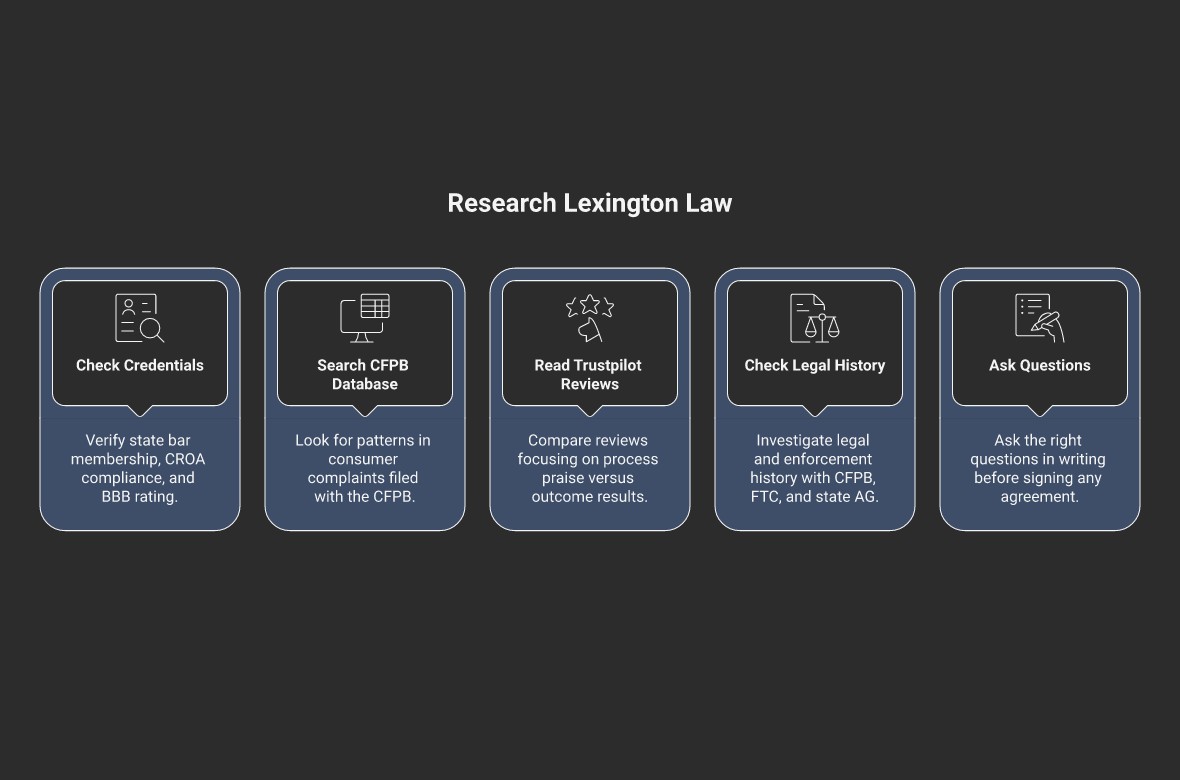
Step 1: Check Their Credentials
Before anything else, verify they have the credentials they claim. Here’s what to check:
- BBB Profile: Check their Better Business Bureau profile — look at the rating, years in business, and especially the complaint history and how they responded.
- State Bar Verification: As a law firm, the attorneys at Lexington Law should be licensed to practice in your state. Check your state bar association’s attorney lookup to verify.
- CROA Compliance: The Credit Repair Organizations Act imposes strict requirements on credit repair companies. These include a mandatory 3-day right to cancel and prohibitions on advance payment. Ask how the firm complies.
- State Licensing: Some states have additional licensing requirements for credit repair organizations. Search your state attorney general’s website to verify their registration in your state.
A Note on BBB Grades: A high BBB grade doesn’t necessarily mean a company is right for you — it means they respond to complaints filed through the BBB. Read the actual complaint text and the company’s responses. That’s the useful part. See my full guide to what BBB letter grades actually mean →
Step 2: Check Consumer Complaints
The Consumer Financial Protection Bureau maintains a public database of complaints filed against financial companies. You can search for Lexington Law directly:
Search Lexington Law’s complaint history in the CFPB database →
When you’re reading complaints, look for:
- What the complaints are about — billing disputes, disputed items not removed, communication problems?
- How the company responded — did they resolve issues or just close them?
- Whether the same issue appears repeatedly — a pattern matters more than a single complaint
- The ratio of complaints to customers — a large company will have more complaints in raw numbers
Step 3: Read Their Trustpilot Reviews
You can find Lexington Law’s Trustpilot reviews here. A few things to keep in mind as you read:
How to read Trustpilot like a pro: My complete guide to spotting red flags in Trustpilot reviews breaks down exactly what to look for — including how to identify review solicitation campaigns and reputation management tactics.
- Pay attention to what the 5-star reviews are actually about. If they’re praising a friendly phone call or easy signup — that’s interaction quality, not program performance.
- Read the 2- and 3-star reviews carefully — these tend to be the most honest
- Look at how the company responds to negative reviews
- Check the review dates — a flood of 5-star reviews in a short period can indicate a solicitation campaign
Step 4: Check Their Legal and Enforcement History
For-profit credit repair law firms are subject to enforcement actions from federal and state regulators. Here’s where to look:
- CFPB Enforcement Actions: Search the CFPB’s enforcement action database for the company name
- FTC Actions: The FTC publishes all enforcement cases — search for the company or its principals
- State Attorney General: Search “Lexington Law attorney general” — many enforcement actions happen at the state level
- PACER (Federal Court Records): PACER allows you to search federal court cases by party name
Context Matters: A company that has faced enforcement action isn’t automatically disqualified — what matters is what the action was for, whether they resolved it, and whether the behavior continued.
Step 5: Ask the Right Questions Before You Enroll
Before signing anything: Run their contract through my free Contract Decoder tool. Paste it in and get a plain-English breakdown of what you’re agreeing to.
Before you commit to any credit repair program, get clear answers — in writing — to these questions:
- What specific items on my credit report will you dispute, and on what basis?
- What is the fee structure — monthly, per deletion, or flat fee?
- What is my right to cancel, and what happens to fees already paid?
- What results can I realistically expect, and in what timeframe?
- Do you offer a money-back guarantee, and what are its conditions?
- How do you comply with the Credit Repair Organizations Act requirements?
Before You Commit: Credit repair is one option — but it’s not right for everyone. Run your situation through my Find Your Path tool to see what approach fits your situation better.
Key Takeaways
- Verify attorney licensing through your state bar and CROA compliance before anything else
- Read CFPB complaints for patterns — not just raw numbers
- On Trustpilot, compare interaction reviews vs. outcome reviews
- Check CFPB and FTC enforcement history
- Get answers to the enrollment questions in writing before you sign
- The comments section below contains real experiences — read them
Want the full research playbook? My Ultimate Consumer Guide to Checking Out a Debt Relief Company covers every tool and source in this guide — plus detailed walkthroughs for reading BBB profiles, spotting Trustpilot red flags, and searching federal court records on CourtListener.
Frequently Asked Questions
Is Lexington Law a legitimate company?
Lexington Law is a registered for-profit credit repair law firm. Whether they’re the right fit depends on your specific situation. Check their CFPB complaint history, BBB profile, and Trustpilot reviews before deciding.
How do I file a complaint against Lexington Law?
You can file a complaint directly with the CFPB at consumerfinance.gov/complaint. You can also file with your state attorney general’s office and the BBB. Filing with the CFPB creates a public record and triggers a required company response.
Is Lexington Law accredited?
Check your state bar association to verify the licensing status of the attorneys associated with Lexington Law in your state. You can also check the BBB directory for current accreditation status. Both can change, so checking directly is more reliable than relying on any third party’s claim.
What is credit repair and how does it work?
Credit repair is a service where a company disputes items on your credit report that you believe are inaccurate, incomplete, or unverifiable. The Fair Credit Reporting Act gives you the right to dispute items yourself for free — credit repair companies provide this service for a fee.
Should I use Lexington Law to repair my credit?
That depends entirely on your situation. I’d encourage you to run your situation through my Find Your Path tool before committing to any program.
Share Your Experience with Lexington Law
If you’ve worked with Lexington Law — as a client, a former employee, or someone who looked into them and decided not to enroll — I’d encourage you to share your experience in the comments.
To share your experience: Scroll to the bottom of this page — the comments box is there.
Before You Sign Anything: Run any debt relief contract through the free Contract Decoder to spot hidden fees and unfair terms. Check the company’s complaint history with the Scam-O-Meter.
Compare Your Real Options: Most debt relief companies won’t tell you about all your options — especially the ones they can’t profit from. Credit counseling has a 21-27% completion rate. Settlement resolves about 1% of enrolled debts fully. Chapter 7 bankruptcy generally ends in a discharge for individual filers in more than 99% of cases, excluding cases dismissed or converted (U.S. Courts) — and protects your retirement. Take the Find Your Path quiz for a recommendation based on your actual numbers.
Browse all Credit Repair Companies reviews, or see the full Company Reviews directory.



