
Quick Answer: Nine major credit card companies — including Credit One, Discover, Barclays, Synchrony, Merrick Bank, American Express, Credit First (CFNA), First Premier Bank, and Landmark National Bank — are being investigated for allegedly unlawful debt collection calling practices. Consumers in 10 states who have received excessive, harassing, or wrong-number calls from these companies may have legal rights under federal and state law. No lawsuit has been filed yet — this is an active investigation.
If you’ve been getting nonstop calls about your credit card debt — calls that keep coming even after you’ve asked them to stop, or calls to the wrong number that never seem to end — there’s a real legal framework protecting you. And right now, nine of the biggest names in the credit card business are under active investigation for allegedly crossing the line.
A legal investigation is underway into the debt collection calling practices of Credit One, Discover, Barclays, Synchrony, Merrick Bank, American Express, Credit First (CFNA), First Premier Bank, and Landmark National Bank. According to a Top Class Actions investigation published February 25, 2026, consumers in 10 states report receiving calls that may violate the Fair Debt Collection Practices Act and state consumer protection laws. If you’ve sent a written debt validation request, collectors must also stop reporting to credit bureaus until they verify the debt — continuing to report may be a separate FDCPA violation. See: Can a Debt Collector Keep Reporting to Credit Bureaus After a Validation Request?
Each weekday I send one short email: one story that caught my attention, why it might matter to you, and one manageable thing you can do with it. A couple of minutes, and a dad joke.
In the latest issue (Nov 9): Check your power bank and your French press
Free. I sell nothing. Unsubscribe any time.
This isn’t a settlement yet — no case has been filed. But if you’ve experienced what’s described here, you may be able to participate in the legal action that follows.
This Is an Investigation, Not a Settlement: No lawsuit has been filed yet and no settlement amounts exist. This post is about your legal rights and how to report potential violations — not how to claim settlement money.
Free Tool — Debt Validation Letter Generator: Being contacted by a debt collector? The free Debt Validation Letter Generator creates a personalized FDCPA validation letter in seconds — forcing the collector to prove the debt is real before they can continue. Generate My Letter →
Which Companies Are Being Investigated?
The following nine credit card issuers and banks are named in the investigation for alleged unlawful debt collection calling practices:
- Credit One Bank
- Discover Financial Services
- Barclays Bank
- Synchrony Financial
- Merrick Bank
- American Express
- Credit First National Association (CFNA)
- First Premier Bank
- Landmark National Bank
These are not fringe companies. Several are among the largest credit card issuers in the United States. Together, they hold hundreds of millions of consumer accounts.
Free Tool — Debt Collector Rights Lookup: Being contacted by a debt collector? The free Debt Collector Rights Lookup shows your state-specific protections — statute of limitations, garnishment limits, and what collectors are legally prohibited from doing. Look Up Your Rights →
What Are They Allegedly Doing Wrong?
The investigation centers on three types of calling behavior that may violate federal law:
What the Law Requires
- Stop calling when you request it in writing
- Call only between 8 a.m. and 9 p.m. in your time zone
- Verify the debtor’s identity before continuing contact
- Stop calling wrong numbers once the error is known
What’s Allegedly Happening
- Calls continue despite stop requests
- Calls made about debts belonging to other people
- Wrong-number calls that persist after the error is reported
- Excessive call volume that constitutes harassment
The FDCPA Is Federal Law: The Fair Debt Collection Practices Act (FDCPA) prohibits harassing, abusive, or deceptive debt collection practices. Violations can entitle consumers to actual damages, statutory damages up to $1,000, and attorneys’ fees — meaning you may not need to pay anything out of pocket to pursue a claim.
Who May Have Legal Rights?
The investigation is currently focused on consumers in these 10 states:
If you live in one of these states and have received calls from any of the nine named companies that you believe were excessive, harassing, or continued after you asked them to stop — you may qualify to participate in a potential class action.
A Note on What This Means — And Doesn’t Mean
I want to be straight with you about something. What’s described above is an investigation — specifically, a law firm collecting information from consumers to evaluate whether a viable lawsuit can be filed.
That means:
- Your information will be reviewed to see if you have a viable claim
- If a case is filed and settled, you may receive compensation
- The FDCPA already entitles you to individual relief regardless of any class action
- Documenting your call history now strengthens any future claim
- No settlement exists yet — there’s nothing to claim right now
- There’s no guarantee a lawsuit will be filed
- Living outside the 10 named states does not mean you have no rights — it just means this specific investigation isn’t focused on your state
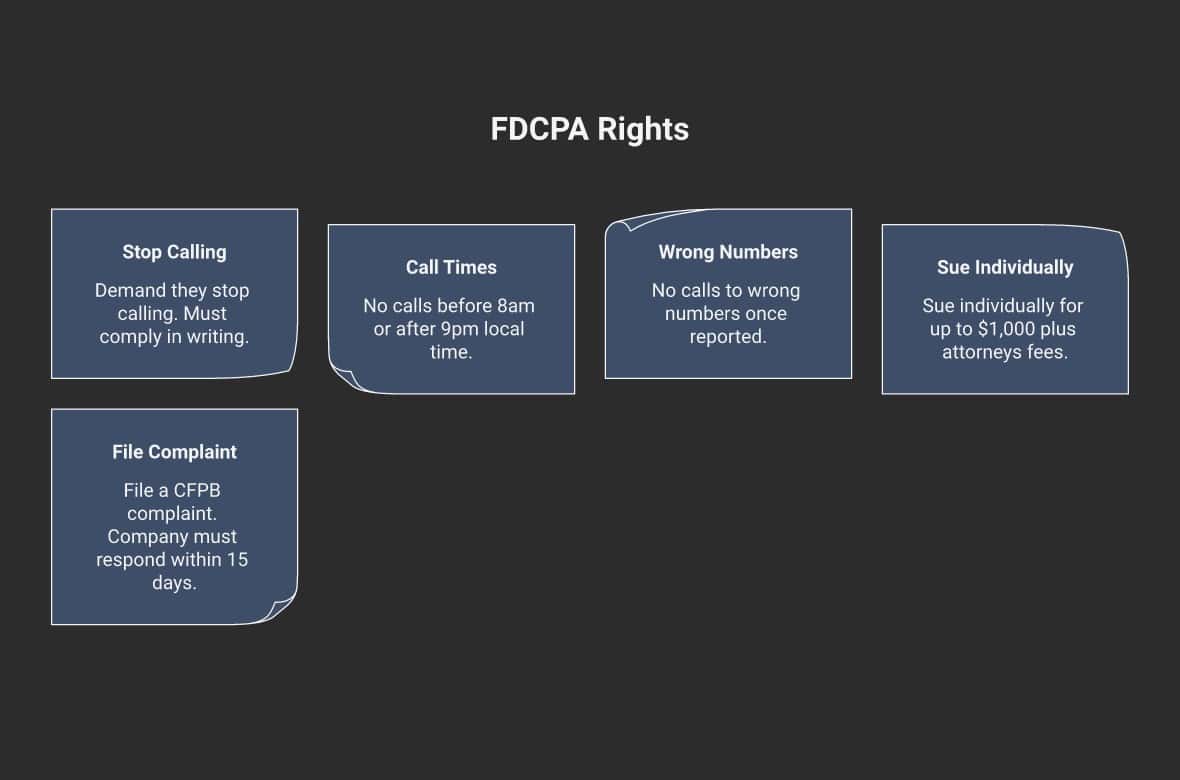
What Your Rights Are Right Now — Regardless of This Investigation
Whether or not this investigation leads to a lawsuit, you have rights today under the FDCPA and state law. Most consumers don’t know them.
Debt collectors — including the original creditor in some states — must stop contacting you if you send a written cease and desist request. Math does not lie, and neither does the law.— Steve Rhode
Right to Stop Contact
Under the FDCPA, you can send a written cease and desist letter demanding that a debt collector stop contacting you. Once received, contact must stop — except to notify you of specific legal actions. I’ve written a complete guide on cease and desist letters with templates you can use.
Right to Calling Time Restrictions
Debt collectors cannot legally call you before 8 a.m. or after 9 p.m. in your local time zone. Calls outside those hours are a violation — document them with timestamps.
Right to Sue Individually
You don’t need a class action to pursue FDCPA violations. Individual consumers can file suit within one year of the violation and recover up to $1,000 in statutory damages plus actual damages and attorneys’ fees. Many consumer protection attorneys take these cases on contingency — meaning no upfront cost to you.
Right to File a CFPB Complaint
The Consumer Financial Protection Bureau (CFPB) accepts complaints about debt collection practices. Filing a complaint creates an official record and often produces a response from the company within 15 days.
Not Sure Which Path Is Right for You? If you’re dealing with debt collectors and aren’t sure whether to send a cease and desist, file a complaint, or explore your legal options — the Find Your Path quiz can help you sort it out based on your specific situation.
How to Document Harassment If You’re Experiencing It
If any of the nine named companies has been calling you, start documenting now. Documentation is what turns a frustrating experience into an actionable legal claim.
- Log every call — date, time, company name, caller ID, what was said
- Screenshot your call history — most smartphones let you export or screenshot incoming call logs
- Save any voicemails — do not delete them
- Note every stop request — date you asked them to stop, how you asked (verbal, written), who you spoke to
- Write a written cease and desist — send it certified mail and keep a copy with the tracking number
Before You Sign Anything: If an attorney or service contacts you about joining a debt harassment lawsuit, review any retainer or service agreement carefully before signing. Run it through the Contract Decoder — it’s free and will flag any terms that don’t serve your interests.
Credit One Already Has a Track Record Here
This investigation isn’t the first time these companies have faced scrutiny for debt collection practices. Credit One Bank previously paid $10.2 million to resolve claims of harassing debt collection calls — a settlement that covered more than 170,000 consumers. That case was about prerecorded calls made without consent, also an FDCPA violation.
The pattern matters. When a company has settled once for this kind of behavior, a new investigation becomes more significant — not less.
Key Takeaways
- Nine major credit card issuers are under investigation for allegedly unlawful debt collection calling practices
- Consumers in CA, CT, FL, MD, MA, MI, MO, NC, PA, and TX may qualify to participate
- No lawsuit has been filed yet — this is a pre-litigation investigation
- You have FDCPA rights today regardless of this investigation — you can stop contact, file CFPB complaints, and sue individually
- Document all calls now if you’re experiencing harassment from any of these companies
Frequently Asked Questions
Can a credit card company — not a collection agency — violate the FDCPA?
This is a common source of confusion. The FDCPA technically applies to “debt collectors,” which the law defines as third parties collecting debts on behalf of others — not the original creditor. However, many states have enacted their own debt collection laws that apply to original creditors. California, for example, has the Rosenthal Fair Debt Collection Practices Act, which covers original creditors. All 10 states listed in this investigation have debt collection protections that may apply to the companies named — which is likely why those states are the focus.
How do I know if my calls qualify as “harassing” under federal law?
The FDCPA defines harassment broadly. Relevant indicators include: repeated calls with intent to annoy or harass, calls continuing after a written stop request, calls about a debt that doesn’t belong to you, and calls to a number after being told it reaches the wrong person. “Intent to harass” can be inferred from the frequency and pattern of calls even without an explicit statement. If you’ve received multiple calls per day over several weeks, that’s a pattern worth documenting and discussing with a consumer protection attorney.
What happens if I’m not in one of the 10 listed states?
The investigation is currently focused on those 10 states, likely because each has particularly strong state-level debt collection laws in addition to the FDCPA. If you’re in another state, you still have FDCPA rights. You can file a CFPB complaint, contact a local consumer protection attorney, or file suit individually. Your state may also have its own debt collection statute — most do.
Do I need to hire a lawyer to participate in a class action investigation?
No. If you submit your information through the investigation intake form, the attorneys will evaluate your situation. If they believe you have a viable claim, they’ll contact you. Consumer class actions are typically funded by the attorneys, who recover fees from the settlement — so there’s usually no cost to class members. That said, always read any agreement carefully before signing, and use the Contract Decoder to review any retainer.
Is this the same as the Credit One $10.2M settlement?
No. The Credit One $10.2 million settlement was a separate, resolved case about prerecorded robocalls made without consent. The current investigation is broader — it covers nine companies, multiple states, and includes live-call harassment as well as wrong-party calling. They are two separate legal matters.
Know Your Rights: If a debt collector is contacting you, you have legal protections. See the complete list of FDCPA violations collectors commit most often. Use the free Debt Validation Letter Generator to demand proof of the debt, or check this collector’s complaint history with the Scam-O-Meter.
Dealing With Debt? Before you pay a collector, understand all your debt relief options — including ones the collector won’t tell you about. If the debt feels unmanageable, take the 2-minute bankruptcy quiz to see if the math favors a fresh start. Federal Reserve research shows filers recover faster than those who don’t file.



Are you still required to pay a credit card bill once it has been sold to another company since you don’t owe them anything? Especially if you were scammed and that was not honored by the original company.