
Quick Answer: Court records show that the Department of Education’s own attorneys made explicit promises at three separate federal court hearings in 2025 — stating that 170,000+ student loan borrowers would receive full automatic relief if deadlines were missed. Five months after the last promise, the Department asked for 18 more months. A federal judge denied it, called the request “eleventh hour,” documented the Department’s “repeated failures,” and closed with: “No further Rule 60(b) motions will be entertained.” This is not spin. These are the government’s own words, on the record, in federal court.
I’ve spent more than 30 years helping people navigate debt. I’ve seen lenders break promises, collectors lie, and companies take money from desperate people. But when the government — the entity that is literally hired to protect its citizens — stands up in federal court three times and makes explicit promises to 170,000 borrowers, and then turns around and tries to walk every one of them back, that’s something different. That deserves to be said out loud.
This is not a political post. I’m not interested in party affiliation. This is a factual accounting of what happened in Sweet v. McMahon — a federal class action case involving 170,000 student loan borrowers who were defrauded by their schools, who filed their legal claims on time, who waited years for relief, and who watched the very agency responsible for their protection argue, repeatedly, for reasons to delay giving it.
The receipts are in the court record. Let me show you what they say.
Claiming money you are owed is one good day. What you do over the following year is what actually changes your position.
In the latest issue (Oct 16): The check that looks like a scam may be real
Each weekday I send one short email: one story that caught my attention, why it might matter to you, and one manageable thing you can do with it.
Free. I sell nothing. Unsubscribe any time.
What Happened Next: Despite everything documented below, the courts held the line. Two rulings in 48 hours cleared the way for automatic discharges to proceed. Read: Student Loan Automatic Discharges to Proceed After Two Court Wins for what this means for borrowers and key deadlines.
The Three Promises
This is the part that I keep coming back to. Not the missed deadline. Not the bureaucratic delays. The promises. Specific, explicit, on-the-record commitments made by the Department of Education’s own attorneys in federal court.
The Daily Money Brief — Free, at 10 AM
Money you may be owed, scams to dodge, and the fine print decoded — the consumer money news that affects your wallet, every weekday.
According to the February 24, 2026 order from Judge Haywood Gilliam, this is what happened at three separate hearings:
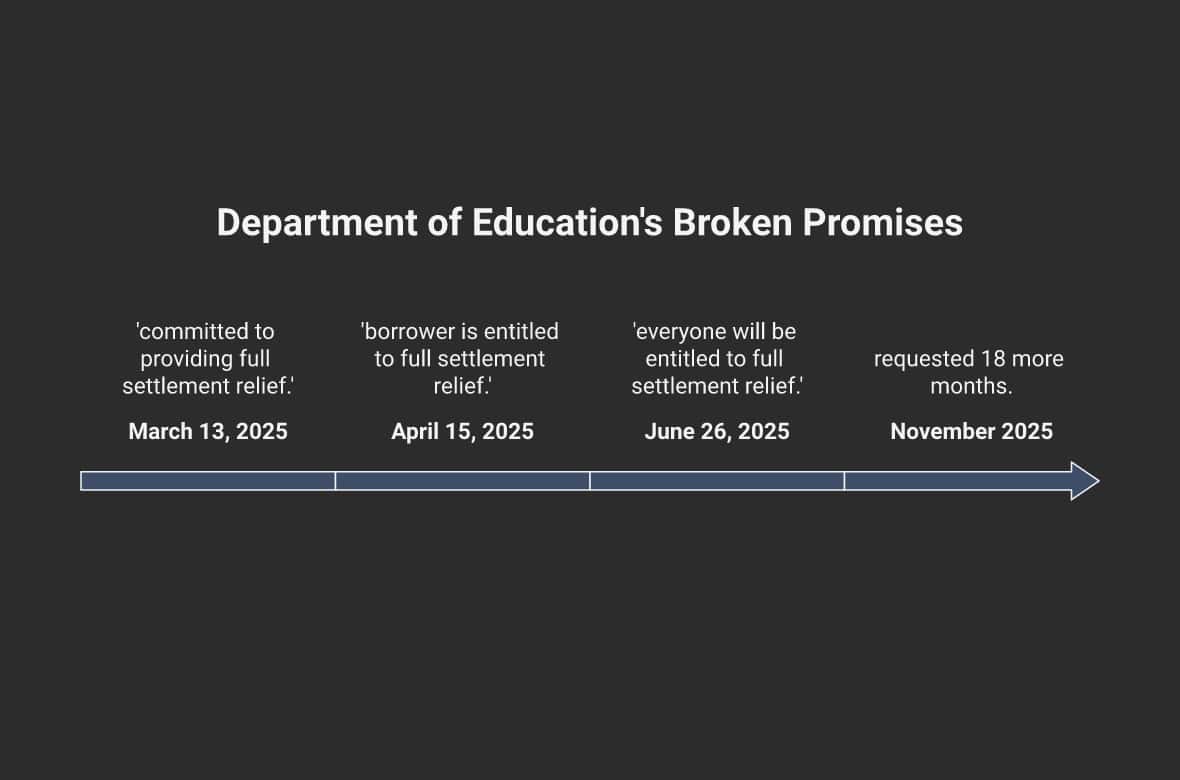
March 13, 2025 — Promise #1: The Department of Education’s attorney assured the court that the Department was “committed to providing full settlement relief” and that “the Department is committed to honoring the settlement agreement.”
April 15, 2025 — Promise #2: The Department’s attorney told the court: “if the Department doesn’t issue decisions by [the deadline for the post-class applicants], then the borrower is entitled to full settlement relief.”
June 26, 2025 — Promise #3: The Department’s attorney represented: “if we don’t [make the deadline for the post-class applicants], everyone who has not received a decision will be entitled to full settlement relief.”
Three separate hearings. Three separate attorneys standing before a federal judge. Three times the same message: we will honor this. If we don’t make the deadline, borrowers get full relief. No ambiguity. No hedging.
And then — five months after the last promise — the Department filed a motion asking for 18 more months.
“The Department waited until the eleventh hour, not even three months before the January 28, 2026 deadline, to seek the relief now requested.”— Judge Haywood S. Gilliam, Jr., Feb. 24, 2026
They Knew. They Had Three Years.
The November 2025 motion portrayed the delay as some kind of unforeseen crisis — too many applications, not enough staff, no resources. But the court’s order dismantles that framing with a few key facts.
As Judge Gilliam’s order notes: “As of September 20, 2022, the approximate size of the post-class applicant group was 179,000 borrowers — a fact the Department knew when it jointly filed a motion for final settlement approval.”
And: “At the latest, the Department knew by February 27, 2023 — almost three years ago — that the post-class applicant group totaled 205,448 people.”
The Department knew in 2022. They confirmed it in early 2023. They had three years to build capacity, request funding from Congress, develop a plan. Instead, they showed up in November 2025 — less than three months before the deadline — and asked for 18 more months.
This Is What “Faultless in the Delay” Means: To get the kind of relief the Department requested — essentially rewriting a final court-approved settlement — a party must show “extraordinary circumstances suggesting that the party is faultless in the delay.” Those are the legal words. Judge Gilliam found: “Defendants have shown no such circumstances.” In plain English: you knew, you waited, and you don’t get a do-over.
“Repeated Failures” — The Court’s Own Words
What’s striking about Judge Gilliam’s order is that it doesn’t treat this as an isolated incident. The court’s language reflects a pattern:
“The parties have engaged in significant post-judgment motion practice in this case, primarily due to the Department’s repeated failures to meet other deadlines for providing relief to the rest of the class.”
“Repeated failures.” That phrase is doing a lot of work. This isn’t the first time. It’s part of a pattern that the court has been watching, managing, and being promised would be fixed — for years.
And then there’s the number that I find most staggering. In the five weeks between the December 11, 2025 hearing and when the Department filed its second delay motion on January 22, 2026, here’s how many of the 169,900 pending post-class applications the Department adjudicated:
1,390.
That’s less than 1%. In five weeks. With a January 28 deadline looming. After three promises in federal court that borrowers would get relief.
The Court’s Final Word
Judge Gilliam denied the motion. That part you already know if you read my earlier post on the dual court victories. But I want to highlight the last line of the order, because it’s not the kind of language you typically see from a federal judge:
“No further Rule 60(b) motions will be entertained.”
Translation: I’ve heard enough. We’re done doing this. The government filed an appeal to the Ninth Circuit the same day — within hours of the ruling. The fight isn’t over. But the district court’s patience visibly is.
What This Means If You’re One of the 170,000
I want to be clear about something: the court’s denial of the delay motion does not mean your discharge has already been processed. It means the legal obligation to process it — and the framework for automatic relief — has been upheld. Here’s where things stand practically:
- If your Borrower Defense application was filed between June 23 and November 15, 2022, and your school appears on the Exhibit C list, you are entitled to full automatic discharge because the January 28 deadline was missed
- The Department must notify you by March 29, 2026 — that’s the deadline for ED to formally communicate your eligibility for full relief
- The Department filed an appeal, which does not stay the discharge obligation — but if the Ninth Circuit grants a stay, that changes things. Monitor the Project on Predatory Student Lending case page for updates
- If you haven’t received notice by April 1, 2026, and you believe you qualify, contact PPSL directly — they litigated this case and have a free resource at ppsl.org/sweet-v-mcmahon-class-members
- Document everything. Keep records of your original application, any correspondence from your servicer, and any notices you receive. This case has already shown that deadlines matter and documentation matters
If student loan debt is part of a larger financial situation you’re trying to sort out, the Find Your Path quiz can help you understand all your options — not just the student loan piece in isolation. Sometimes the right move isn’t waiting for a government process that has already demonstrated it will miss deadlines.
The Bigger Picture
I want to close with something that goes beyond the mechanics of this case. The borrowers in Sweet v. McMahon attended schools that defrauded them. They filed their Borrower Defense claims — the legal process the government itself created for exactly this situation. They waited through settlement negotiations, final approval, and years of post-judgment compliance battles. They heard their government’s lawyers stand up in court, three separate times, and say: you will get relief if the deadline is missed.
And then the government asked to take that back.
I’m not naive about bureaucracy. I ran a nonprofit with 70 employees. I know what resource constraints look like. But there’s a difference between “we couldn’t get it done” and “we knew the scope in 2022, made three explicit promises in 2025, and then asked for 18 more months 90 days before the deadline.” The court saw that difference. The word “repeated” in “repeated failures” is doing heavy lifting.
These are real people. Teachers, veterans, working adults who bet on an education that turned out to be a fraud. They did everything right. They filed their claims. They waited. And they watched the agency that was supposed to protect them fight, motion by motion, to delay the relief it had already promised.
The court held the line. For now. Keep watching.
Key Takeaways
- The Department of Education’s own attorneys made explicit on-the-record promises at three federal court hearings in 2025 that borrowers would receive full automatic relief if deadlines were missed
- Five months after the last promise, the Department requested an 18-month extension — and adjudicated only 1,390 of 169,900 pending cases in the five weeks that followed
- The Department had known the scope of the problem since 2022 — the court’s order notes they knew of 179,000+ affected borrowers when the settlement was filed
- Judge Gilliam called the delay request “eleventh hour,” found “repeated failures” in the Department’s track record, and denied all further delay motions: “No further Rule 60(b) motions will be entertained”
- The Department filed an appeal the same day — the case continues in the Ninth Circuit
- Eligible borrowers should expect written notification from ED by March 29, 2026; if you don’t receive it and believe you qualify, contact the Project on Predatory Student Lending
Frequently Asked Questions
What promises did the Department of Education make in court about student loan relief?
According to the February 24, 2026 court order in Sweet v. McMahon, the Department’s attorneys made three explicit statements at federal court hearings in 2025. At a March 13 hearing, they said the Department was “committed to providing full settlement relief” and “committed to honoring the settlement agreement.” At an April 15 hearing, they stated that “if the Department doesn’t issue decisions by [the deadline], then the borrower is entitled to full settlement relief.” At a June 26 hearing, they said “if we don’t make the deadline, everyone who has not received a decision will be entitled to full settlement relief.” These are not characterizations — they are direct quotations from the court’s order documenting what was said.
Why did the Department of Education miss the January 28, 2026 deadline?
In its November 2025 motion for an extension, the Department cited limited staff — only 37 attorneys handling applications — processing rates of approximately 1,500 applications per month, declining FSA staffing, and no additional congressional funding. However, Judge Gilliam’s order notes that the Department had known since September 2022 that approximately 179,000 borrowers were in the post-class applicant group, and confirmed a total of 205,448 by early 2023. The court found no “extraordinary circumstances” justifying the delay, noting the Department “waited until the eleventh hour, not even three months before the January 28, 2026 deadline, to seek the relief now requested.”
What does “Borrower Defense to Repayment” mean and who qualifies?
Borrower Defense to Repayment is a federal program that allows student loan borrowers to seek discharge of their loans if their school engaged in misconduct — misrepresentation, fraud, or other violations of state law. In Sweet v. McMahon, the settling class consists of borrowers who attended schools identified on the settlement’s Exhibit C list (151 institutions) or who had pending Borrower Defense applications. Post-class applicants — those who filed between June 23 and November 15, 2022 — are entitled to full automatic discharge because the Department missed its adjudication deadline. Full relief includes loan discharge, refund of amounts paid to the federal government, and deletion of associated credit report tradelines.
What is the Ninth Circuit appeal and could it block my discharge?
The Department of Education filed a notice of appeal to the U.S. Court of Appeals for the Ninth Circuit on February 24, 2026 — the same day Judge Gilliam denied its delay motion. The appeal could theoretically result in the Ninth Circuit overturning Judge Gilliam’s ruling. More immediately, the Department could ask the Ninth Circuit for a stay of Judge Gilliam’s order, which would temporarily pause the discharge obligation while the appeal is decided. As of publication, no stay has been granted. For current case status, the Project on Predatory Student Lending maintains real-time updates at ppsl.org/cases/sweet-v-mcmahon.
What should I do right now if I think I qualify for Sweet v. McMahon relief?
First, confirm your eligibility: you must have filed a Borrower Defense application between June 23 and November 15, 2022, and your school must appear on the Exhibit C list. Log into studentaid.gov to check your application status. Second, expect written notification from the Department of Education by March 29, 2026 — that is the court-ordered deadline for ED to contact eligible borrowers. Third, if you don’t receive notice by early April and believe you qualify, contact the Project on Predatory Student Lending at ppsl.org — they litigated this case and provide free resources. Fourth, document everything: your original application date, any servicer correspondence, and any notices received. This case has demonstrated that documented timelines matter.
… (Source: Order Denying Defendants’ Motion for Relief Under Fed. R. Civ. P. 60(b), Sweet v. McMahon, No. 4:19-cv-03674-HSG (N.D. Cal. Feb. 24, 2026) | Project on Predatory Student Lending — Case Page)
Dealing With Debt? Understanding your options is the first step. See how all your debt relief options compare — including ones most sites won’t tell you about. The Find Your Path quiz gives a recommendation based on your actual numbers, and the Scam-O-Meter checks any company’s complaint history before you sign. Federal Reserve research shows bankruptcy filers recover faster than those who don’t file.