
Quick Answer: A BBB letter grade measures whether a company follows the BBB’s complaint process — not whether the company actually delivers good service, resolves problems to customer satisfaction, or has been sued. Consumer lawsuits carry zero weight in the grade formula. A company can have an A+ rating with hundreds of complaints and billions in government settlements. The complaint narratives are where the real information lives — not the letter.
I’ve reviewed hundreds of companies over three decades. The BBB grade is the first thing most people look at and the last thing I look at. I’ve seen companies with A+ ratings that had staggering numbers of consumer complaints, active federal lawsuits, and a pattern of never actually resolving anything — they just responded to the BBB’s process, which is all the grade requires.
Table of Contents
Each weekday I send one short email: one story that caught my attention, why it might matter to you, and one manageable thing you can do with it. A couple of minutes, and a dad joke.
In the latest issue (Nov 6): Owed money on an Amazon return? Check by Dec. 1
Free. I sell nothing. Unsubscribe any time.
The BBB letter grade has become one of the most trusted signals in consumer research. It sits prominently on business profiles, gets embedded on company websites, and carries a weight that feels official and authoritative. The problem is that the grade is measuring something most consumers don’t realize it’s measuring — and missing entirely the things they think it’s measuring.
Here’s what it actually tells you, and more importantly, what it doesn’t.
What Most People Think the BBB Grade Means
When most people see an A+ rating, they read it as a quality endorsement. They assume the BBB has independently evaluated the company’s services, verified their claims, reviewed their track record with customers, and concluded the company delivers good value.
None of that is what the grade measures.
The BBB grade measures how well a company plays the BBB’s game — not how well they serve their customers.— Steve Rhode
The BBB grades businesses on compliance with their own complaint-handling process. A company that receives 300 complaints and responds to every single one with a boilerplate denial will score better than a company that has zero complaints but doesn’t pay attention to the BBB’s outreach. That’s not a flaw in the system — it’s what the system was designed to measure. The confusion is that consumers read “A+” and hear something the BBB never actually said.
What the BBB Actually Is
Before reading a BBB profile, it helps to understand what the BBB actually is as an organization — because that context explains everything about how the grades work.
The BBB is a private, nonprofit organization, not a government agency. There is no legal authority behind a BBB rating. No regulatory power. No enforcement mechanism. It’s a membership organization for businesses — structured through approximately 92 independent local chapters across North America, each operating as its own entity under standards set by the International Association of Better Business Bureaus.
How the BBB Funds Itself
This is the critical piece. The BBB’s revenue comes almost entirely from accreditation fees paid by the businesses it rates. Companies pay annual dues — typically $400 to over $1,200 per year depending on size and location, plus application fees of $1,000 to $5,000 when they first seek accreditation — to display the BBB seal on their websites and materials.
A Fair Word About the BBB: The BBB is navigating the same structural tension as every review platform that monetizes through the businesses being reviewed. They’re a private organization providing a genuine consumer service — complaint mediation, business transparency, dispute resolution — while funding it through membership dues from the businesses they rate. That’s a hard balance to maintain with perfect neutrality, and I think most BBB staff are trying to do the right thing. The problem is architectural, not intentional. Understanding the revenue model simply helps you read the grades more accurately.
Accreditation is voluntary. A business doesn’t need to be accredited to receive a BBB rating — all businesses get rated whether they participate or not. But accreditation is how the BBB pays its bills, which creates a conflict that has been documented in major investigations more than once.
How the BBB Grade Is Actually Calculated
The BBB uses a 100-point scale. A+ requires 97 or more points. An F is the floor. The factors that go into that score include complaint history (volume, responsiveness, and resolution), time in business, transparent business practices, licensing compliance, advertising reliability, and whether the company has had government actions taken against it.
✓ Counts Toward the Grade
- Responding to BBB complaints
- Speed of complaint response
- Years in business
- Valid licenses & registrations
- Accurate advertising claims
✗ Zero Weight in the Formula
- Consumer lawsuits filed against company
- Court judgments finding company liable
- CFPB complaints to federal regulators
- Whether customer problems were actually resolved
- Quality of the service itself
That formula sounds comprehensive. The problem is in what’s weighted how — and what’s missing entirely.
What Carries the Most Weight
The heaviest penalties in the BBB system come from not responding to BBB complaints. A company that ignores the BBB’s outreach takes the biggest hit. A company that responds — even with a flat denial — takes a much smaller one.
This creates a straightforward incentive: respond to everything. Agree to nothing. The grade recovers. The customer’s problem doesn’t.
The Response vs. Resolution Gap: When a company responds to a BBB complaint, the complaint closes with the status “Answered.” When the customer reports that the response didn’t actually help them, the complaint may close as “Unresolved.” Both outcomes are treated differently in the grade formula — but the company has to work very hard to keep complaints in the “Unresolved” bucket. A prompt, professional non-answer frequently moves complaints toward “Answered” status without any actual change in outcome for the consumer.
What the Grade Doesn’t Measure at All
Here is the list that should be on the front page of every BBB profile:
- Consumer lawsuits — carry zero weight in the grade formula, regardless of how many
- Quality of the service or product — the grade has no connection to whether the service works
- CFPB complaints — federal consumer financial complaints are invisible to the BBB grade
- Court judgments against the company — a judgment finding the company liable for consumer harm does not affect the grade
- Whether complaints were resolved to the customer’s satisfaction — the grade weighs responsiveness, not resolution quality
- State attorney general enforcement actions — weighted minimally compared to BBB complaint response
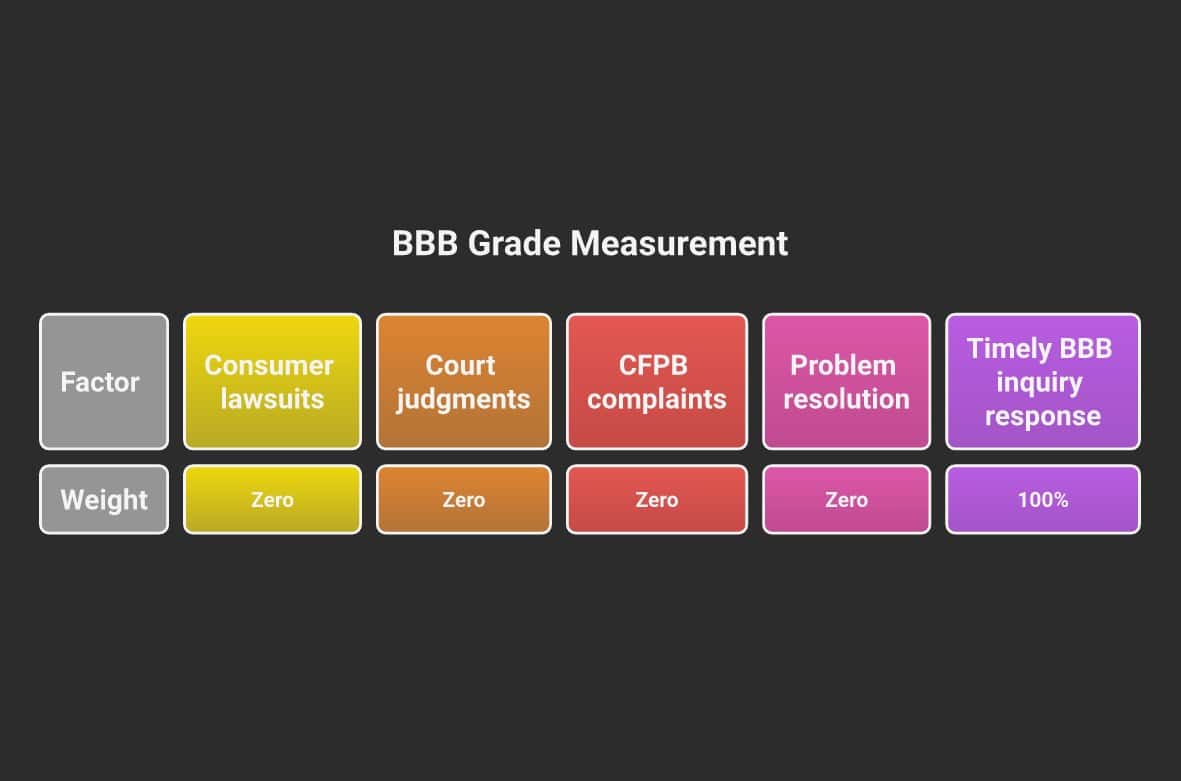
CNN’s 2015 investigation of the BBB found that Purdue Pharma — which ultimately paid billions in settlements related to the opioid crisis — maintained an A+ rating throughout. The finding: “More weight is placed on companies addressing complaints through the BBB’s own system than any other factor — even government lawsuits.”
The Accreditation Problem
In 2010, ABC News conducted an investigation that forced a public apology from the BBB’s national president. An ABC producer created a fake business — including one for a company operating under the name of a designated terrorist organization — and paid the BBB membership fee. The fake business received an A rating.
The investigation also documented a case where a legitimate company’s C grade was replaced with an A+ the day after they paid $565 for accreditation. The BBB’s president, Steve Cox, acknowledged the organization had made errors and pledged reforms.
The reforms that followed were genuine in intent. The fundamental architecture of the revenue model didn’t change, because it couldn’t — the BBB is funded by the businesses it rates. That’s the structural reality, and it shapes everything that follows.
What to Actually Look At on a BBB Profile
The grade is the least useful thing on the page. Here’s where the real information lives:
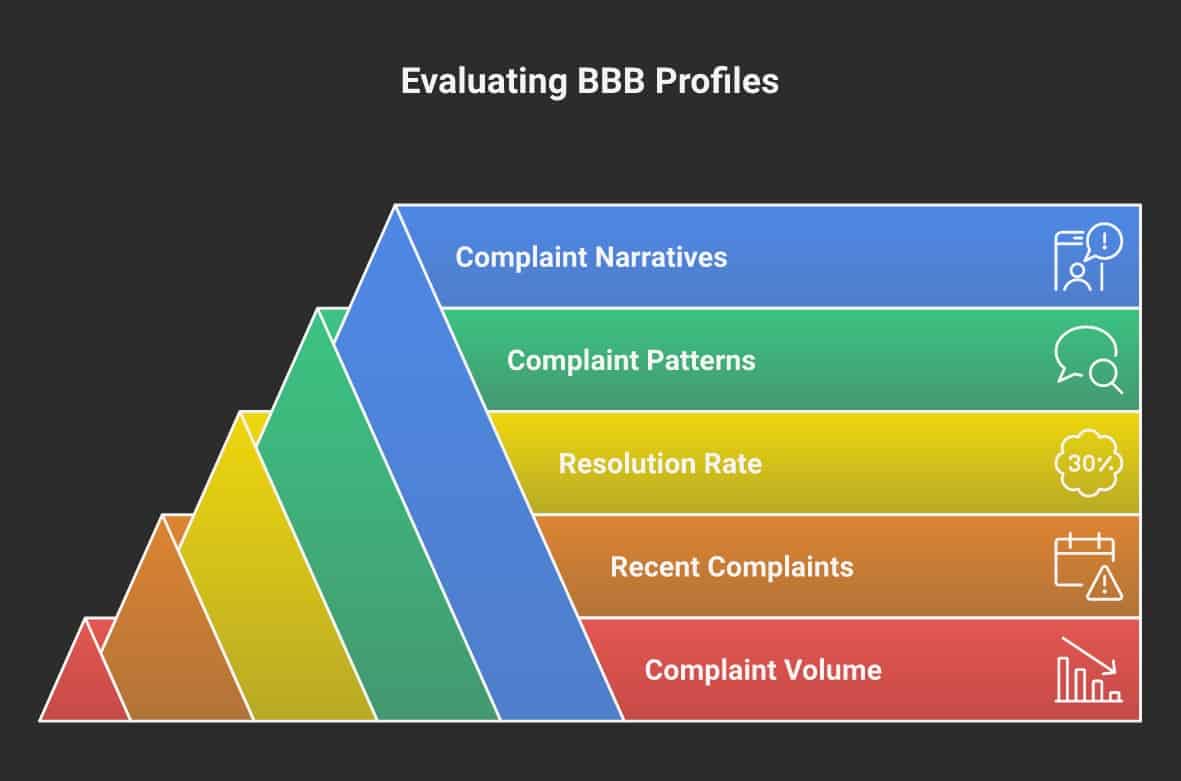
1. Total Complaint Volume — And the Trend
The BBB shows three-year complaint totals and a breakdown by year. Look at both. A company with 20 complaints in year one, 60 in year two, and 120 in year three has a very different profile than a company with 60 complaints evenly distributed. Volume trending up tells you something is getting worse, not better.
Also consider complaint volume relative to company size. Ten complaints at a company with 50 employees means something different than ten complaints at a company with 5,000 employees and a million customers.
2. The Resolution Rate
The BBB shows how complaints closed — resolved, answered, or unresolved. When I see a company with hundreds of complaints and a resolution rate below 25%, that tells me: the company is processing the BBB’s paperwork without fixing anything. They’ve learned how to respond without changing behavior.
A high complaint volume with a low resolution rate is, in my experience, one of the most reliable signals of an institutional problem rather than a series of individual bad experiences.
3. The Complaint Narratives — The Gold Mine
This is where I actually spend my time. The BBB complaint narratives are written by real consumers describing, in their own words, what happened to them. They include specific dollar amounts, specific timelines, specific names of representatives, specific policies that were misapplied.
Read 20 complaints and look for patterns. If five different people, writing independently, describe the same billing problem — that’s not coincidence. That’s a business practice. If a dozen people describe the same misrepresentation in the sales call — that’s training, not individual error.
Pattern Recognition in Complaint Narratives: I sort by complaint category and read for consistent themes. The same complaint from multiple unrelated consumers is the signal. An individual complaint might be a misunderstanding. Six complaints describing the same undisclosed fee, filed months apart by customers who have never spoken to each other, describes a policy. The narrative section of a BBB profile is essentially free investigative reporting done by the consumers themselves.
4. How the Company Responds to Complaints
Read the company’s responses, not just the consumer narratives. The response pattern tells you everything about institutional culture.
A Company That Takes It Seriously
- Acknowledges the specific problem described
- Explains what went wrong and why
- Describes the specific resolution offered
- Provides a direct contact, not a general email
- Responses differ from complaint to complaint
A Company Managing Its Grade
- Same response template on every complaint, name swapped
- Disputes the consumer’s account without addressing specifics
- References the contract or terms of service as defense
- Offers to “discuss privately” — moves resolution off record
- Does not acknowledge any systemic issue despite repeated complaints
5. Government Actions Section
Scroll past the grade. Near the bottom of most BBB profiles, there’s a section listing government actions taken against the business. Most consumers never scroll that far.
I look at this first after complaint volume. A government action — a consent order, a cease-and-desist, a state AG settlement — represents a finding by a regulatory authority with actual investigative power. That finding outweighs any letter grade.
6. Accreditation Status — and What It Means
Accreditation means the company paid dues and agreed to BBB’s standards. It does not mean the company is more trustworthy than a non-accredited company. Some excellent companies choose not to be accredited because they see no value in paying for the seal. Some companies with serious problems are accredited because they understand the value of the badge to their marketing.
The absence of accreditation is not a red flag. The presence of accreditation is not a green flag. It’s a data point about the company’s marketing choices, not their service quality.
A Walk-Through: Pinnacle Home Solutions
To show how this works in practice, let me walk through a fictitious company — Pinnacle Home Solutions, a home renovation contractor — constructed from BBB patterns I’ve seen repeatedly across real company profiles. Pinnacle is entirely invented, but every element below is drawn from actual BBB behavior I’ve documented.
What You See First
Pinnacle Home Solutions has a BBB A rating. They’re accredited. The profile shows they’ve been in business 11 years. The accredited badge is prominent on their homepage alongside “A Rating from the BBB.”
Step 1: Complaint Volume and Trend
Three-year total: 94 complaints. Breakdown: 22 in year one, 31 in year two, 41 in the most recent year. Volume increasing year-over-year. That trajectory matters — the grade hasn’t changed, but the complaint rate has nearly doubled in three years.
Step 2: Resolution Rate
Of 94 complaints: 21 resolved (22%), 58 answered (62%), 15 unresolved (16%). Nearly 8 in 10 complaints did not end with the consumer reporting satisfaction. The company responded to almost everything — hence the A rating — but resolved almost nothing.
Step 3: Read 20 Complaint Narratives
Sorting by complaint category reveals a pattern: 34 complaints are under “Service Issues,” 28 under “Billing/Collection Issues,” 19 under “Guarantee/Warranty Issues.”
Reading the service narratives: eleven separate customers describe work left incomplete after full or partial payment was collected. Six describe being told the project would take 2–3 weeks, with actual timelines extending to 4–6 months. Eight describe difficulty reaching anyone after the initial payment cleared.
That’s not twelve separate bad experiences. That’s a business practice: collect payment, deprioritize completion, become difficult to reach.
Step 4: Read Their Responses
Pinnacle’s response to every service complaint: “We strive to provide the highest quality craftsmanship and take all customer concerns seriously. We have attempted to reach this customer directly to resolve this matter and remain committed to a satisfactory outcome.”
Every complaint. Same template. No acknowledgment of the delays. No explanation for the pattern. No specific resolution described. The response protects their grade. It helps no one.
Step 5: Check Government Actions
Two entries. A state contractor licensing board issued a formal warning 18 months ago for failure to complete projects. A county consumer affairs office logged a complaint pattern investigation that was closed without action 8 months ago.
None of that appears in the letter grade.
Pinnacle Home Solutions rates an A. The profile, read carefully, describes a company with a documented pattern of abandoning projects after collecting payment, a licensing board warning, and a complaint rate that has nearly doubled in three years. The grade and the reality are not the same document.
What the BBB Is Actually Good At
I want to be fair here, because the BBB does provide genuine value — just not primarily through the letter grade.
- Dispute resolution mediation: The BBB’s complaint process sometimes moves companies to respond who otherwise wouldn’t. Having a formal record creates leverage.
- Complaint narrative archive: The richest free database of consumer complaint narratives I know of. Detailed, specific, searchable by category.
- Pattern documentation: Years of complaints create a searchable history that tells a story no single data point can.
- Business basic information: Time in business, address history, ownership information — useful context.
- Arbitration services: For specific disputes, the BBB’s arbitration process can provide a path to resolution outside the court system.
The BBB complaint system has gotten real money back for real consumers. The problem isn’t the complaint function — it’s the grade that gets stamped on top of all of it and tells a different story than the data underneath it.
My Methodology Using the BBB
When I open a BBB profile, I follow the same sequence every time:
- Skip the grade entirely. Don’t read it. It will bias your interpretation of everything that follows.
- Check three-year complaint volume. Note the trend — flat, rising, or falling.
- Check the resolution rate. Under 30% resolved-to-satisfaction is a significant signal.
- Read 15–20 complaint narratives. Sort by category. Read for recurring themes. The same problem appearing in multiple independent complaints is a business practice.
- Read the company responses. Template responses across all complaints = legal defense, not customer service.
- Scroll to Government Actions. Regulatory findings by agencies with actual authority tell you more than any letter.
- Cross-reference with CFPB and federal court records. The BBB only sees what consumers bring to them. Federal databases see what consumers filed with regulators.
The grade, at the end of all that, usually tells me nothing I didn’t already know. But the complaint narratives almost always add something.
While You’re Researching: Federal court records are the most manipulation-proof tool available — no company can remove a federal lawsuit the way it can flag a Trustpilot review or ignore a BBB complaint. Here’s how to search federal court records for free using CourtListener and PACER.
While You’re Researching: Many people check Trustpilot reviews alongside the BBB profile. Trustpilot star ratings can be systematically manipulated — companies actively solicit positive reviews to bury negative ones, and a 4.5-star score can coexist with hundreds of unresolved complaints. Here’s how to see through Trustpilot reviews and find what the star rating is hiding.
The grade is the shortcut that costs you the most. The complaint narratives are the work that actually pays off.
Key Takeaways
- The BBB letter grade measures complaint responsiveness — not service quality, not consumer outcomes, not lawsuit history.
- Consumer lawsuits carry zero weight in the grade formula, regardless of volume or outcome.
- BBB revenue comes almost entirely from accreditation fees paid by the businesses it rates — a structural conflict that has been documented in multiple major investigations.
- Responding to a complaint (not resolving it) is often sufficient to avoid a grade penalty.
- The complaint narratives are the most valuable part of any BBB profile — where real consumers describe in specific detail what actually happened.
- A low resolution rate (under 30% resolved-to-satisfaction) on a high-complaint profile is one of the most reliable signals of a systemic problem.
- Government actions, listed near the bottom of BBB profiles, are frequently overlooked and frequently the most important information on the page.
- Always cross-reference BBB data with CFPB complaints, federal court records, and state AG actions before drawing any conclusions.
Frequently Asked Questions
Is the BBB a government agency?
No. The BBB is a private, nonprofit membership organization with no regulatory authority. It cannot fine, license, or take legal action against any business. Its influence comes entirely from the marketplace — companies participate because the accreditation seal has marketing value, and consumers use the platform because it has accumulated a significant complaint record over many decades.
Can a company with an F rating actually be good?
Yes. An F rating most commonly results from a company not participating in the BBB’s process — not responding to complaints, not engaging with BBB outreach. A company that doesn’t pay attention to the BBB, has a handful of complaints it ignores, and provides perfectly good service to the vast majority of customers can easily hold an F rating. Always look at the underlying complaint narratives, not the letter.
Does BBB accreditation mean a company is more trustworthy?
Not necessarily. Accreditation means the company paid dues and agreed to meet BBB’s standards. It’s a business decision — paying for the seal has marketing value, so companies that want to display it pay for it. Many excellent companies are not BBB-accredited because they don’t see the marketing value. Treat accreditation as information about the company’s marketing strategy, not their trustworthiness.
If the grade is misleading, why does everyone use it?
Because it looks authoritative. A letter grade is instantly legible — “A+” reads as excellent in every context most Americans have been trained in. It requires no explanation and no reading. The BBB understood this, which is why the grade is the most prominent element on every business profile. The more useful information — complaint volume, resolution rates, narratives, government actions — requires actual reading. Most people don’t get that far.
What’s the best way to use the BBB for research?
Use it as a complaint narrative database, not a rating system. Open the profile, scroll past the grade, go directly to the complaint section, sort by category, and read the actual consumer accounts. Cross-reference what you find with the CFPB complaint database and a quick search on CourtListener.com for any federal legal actions. The combination of those three sources — BBB narratives, CFPB complaints, court records — gives you a far more accurate picture than any letter grade.
Should I file a BBB complaint if a company wronged me?
Yes — but don’t stop there. A BBB complaint creates a public record and sometimes moves companies to respond who otherwise wouldn’t, because they’re watching their grade. But a CFPB complaint (for financial companies) reaches federal regulators who track patterns and can take enforcement action when enough consumers report the same problem. File both. The BBB complaint helps individual leverage. The CFPB complaint builds the regulatory record.
Dealing With Debt? Understanding your options is the first step. See how all your debt relief options compare — including ones most sites won’t tell you about. The Find Your Path quiz gives a recommendation based on your actual numbers, and the Scam-O-Meter checks any company’s complaint history before you sign. Federal Reserve research shows bankruptcy filers recover faster than those who don’t file.



