

Quick Answer: Possible Finance is a for-profit financial technology company offering small-dollar installment loans through a mobile app. To evaluate whether it’s right for you, I’d encourage you to check their complaint history with the CFPB, read their reviews on Trustpilot, and understand the full cost of borrowing before you sign up. Here’s how to do each of those.
Before You Read This: I want to be upfront about what this page is and isn’t. I’m not an investment advisor, and I’m not rendering a verdict on Possible Finance. This is a research guide — I’m showing you where to look so you can reach your own conclusions based on current information.
If you find something in the public record that concerns you, post it in the comments below. If you’re evaluating their loan agreement, use my free Contract Decoder tool.
If you represent Possible Finance and something here is inaccurate, contact me and I’ll review it promptly.
Each weekday I send one short email: one story that caught my attention, why it might matter to you, and one manageable thing you can do with it. A couple of minutes, and a dad joke.
In the latest issue (Nov 6): Owed money on an Amazon return? Check by Dec. 1
Free. I sell nothing. Unsubscribe any time.
If you have inside information you feel you need to share with me privately: don’t. Whatever you want to share should be posted in the comments — by you, with your name attached. I’m not willing to be anyone’s conduit for information they won’t stand behind themselves.
The most valuable thing on this page may not be what I’ve written — it’s the comments section below. People who’ve actually borrowed from Possible Finance share their experiences there. I’d encourage you to read them and add your own.
Who Is Possible Finance?
An educated consumer is our best customer.— Sy Syms
New here? My Ultimate Consumer Guide to Checking Out a Debt Relief Company walks through how to vet any financial services company before you sign anything.
Possible Finance is a for-profit financial technology company. It operates under the legal entity Possible Financial Inc. Rather than repeat what they say about themselves here, I’d encourage you to read their own website and state business filings — that way you’re seeing it directly from primary sources, not filtered through me.
Step 1: Check Their Credentials and Licensing
Before anything else, verify they have the credentials they claim. Here’s what to check:
- BBB Profile: Check their Better Business Bureau profile — look at the rating, complaint history, and how they responded to complaints filed there.
- NMLS Licensing: Check NMLS Consumer Access to verify Possible Financial Inc.’s licensing in your state. You can search by NMLS number or company name to confirm what products they’re licensed to offer where you live.
- State Licensing: Short-term installment lending is regulated differently in each state, and some states cap interest rates that would make certain products unavailable. Your state’s financial regulatory agency can confirm what Possible Finance is licensed to offer in your state.
A Note on BBB Grades: A high BBB grade doesn’t necessarily mean a company is right for you — it means they respond to complaints filed through the BBB. Read the actual complaint text and the company’s responses. That’s the useful part. See my full guide to what BBB letter grades actually mean →
Step 2: Check Consumer Complaints
The Consumer Financial Protection Bureau maintains a public database of complaints filed against financial companies. You can search for Possible Finance directly:
Search Possible Finance’s complaint history in the CFPB database →
When you’re reading complaints, look for:
- What the complaints are about — loan amounts approved vs. applied for, interest rate disclosures, credit reporting accuracy, customer service responsiveness?
- How the company responded — did they resolve issues or just close them?
- Whether the same issue appears repeatedly — a pattern matters more than a single complaint
- The ratio of complaints to customers — a company with many customers will have more raw complaint volume
Step 3: Read Their Trustpilot Reviews
You can find Possible Finance’s Trustpilot reviews here. A few things to keep in mind as you read:
How to read Trustpilot like a pro: My complete guide to spotting red flags in Trustpilot reviews breaks down exactly what to look for — including how to identify review solicitation campaigns and reputation management tactics.
- Pay attention to what the 5-star reviews are actually about. If they’re praising a fast approval or an easy application — that’s interaction quality, not whether the total repayment amount was as expected or whether the credit reporting was accurate.
- Read the 2- and 3-star reviews carefully — these tend to be the most honest, from people who had mixed experiences and aren’t trying to tear the company apart
- Look at how the company responds to negative reviews — a defensive or dismissive response tells you something
- Check the review dates — a flood of 5-star reviews in a short period can indicate a solicitation campaign
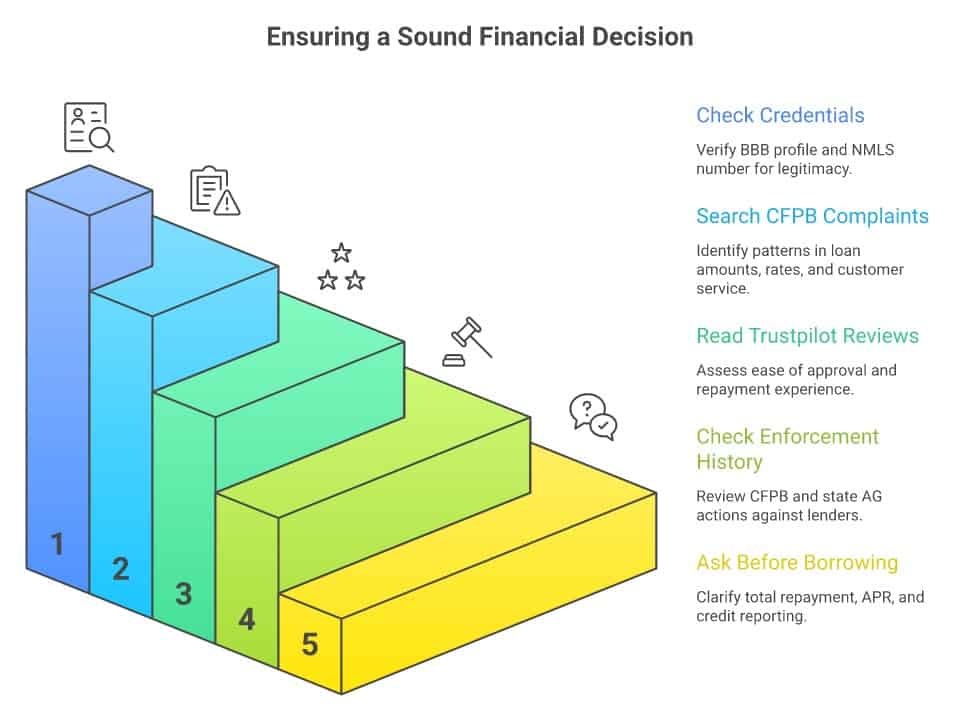
Step 4: Check Their Legal and Enforcement History
For-profit installment lenders are subject to enforcement actions from federal and state regulators. Here’s where to look:
- CFPB Enforcement Actions: Search the CFPB’s enforcement action database for Possible Finance and Possible Financial Inc.
- FTC Actions: The FTC publishes all enforcement cases — search for Possible Finance or Possible Financial
- State Attorney General: Search “Possible Finance attorney general” or “Possible Financial settlement” — high-cost lenders are a common focus of state-level consumer protection actions
- Federal Court Records: CourtListener searches 1.3 billion federal court documents for free — no registration required. For the official PACER system with complete case filings, see my guide to using PACER.gov.
Context Matters: A company that has not yet faced a formal enforcement action isn’t necessarily problem-free — it may simply not have been the subject of a regulatory examination yet. The absence of enforcement history is not the same as a clean record.
Step 5: Ask the Right Questions Before You Borrow
Before signing anything: Run their loan agreement through my free Contract Decoder tool. Paste it in and get a plain-English breakdown of what you’re agreeing to.
Before you take out any installment loan, get clear answers to these questions:
- What is the total amount I will repay — not the APR, but the actual dollar amount in interest and fees on top of principal?
- What is the repayment schedule — how many payments, when are they due, and how are they collected?
- Will this loan be reported to the credit bureaus, and if so, which ones and how?
- What happens if I miss a payment — late fees, additional charges, collections?
- Can I pay off the loan early, and is there a prepayment penalty?
- Are there cheaper alternatives available to me — credit unions, community assistance programs, negotiated payment plans with existing creditors?
Before You Borrow: High-cost installment loans can be a symptom of a broader financial issue worth addressing directly. Run your situation through my Find Your Path tool to see whether a short-term loan, debt consolidation, or another approach fits your situation better.
Key Takeaways
- Verify NMLS licensing and state authorization before borrowing — high-cost lending is regulated differently in every state
- Read CFPB complaints for patterns — loan amounts, interest rate disclosures, credit reporting accuracy
- On Trustpilot, compare fast-approval reviews vs. reviews about total repayment amounts and credit reporting
- Check CFPB and state AG enforcement databases — high-cost lenders are a common regulatory focus
- Always calculate the total dollar cost of the loan before you sign — APR numbers can be misleading
- The comments section below contains real experiences from real borrowers — read them
Want the full research playbook? My Ultimate Consumer Guide to Checking Out a Debt Relief Company covers every tool and source in this guide — plus detailed walkthroughs for reading BBB profiles, spotting Trustpilot red flags, and searching federal court records on CourtListener.
Frequently Asked Questions
Is Possible Finance a nonprofit?
No. Possible Finance is a for-profit financial technology company operating under Possible Financial Inc. It is not a nonprofit organization.
How do I file a complaint against Possible Finance?
You can file a complaint directly with the CFPB at consumerfinance.gov/complaint. You can also file with your state attorney general’s office and the BBB. Filing with the CFPB creates a public record and triggers a required company response.
What types of loans does Possible Finance offer?
Possible Finance offers small-dollar installment loans through their mobile app. The specific loan amounts, repayment terms, interest rates, and availability vary by state. I’d encourage you to read their loan agreement terms directly before applying.
Does Possible Finance report to credit bureaus?
The company’s credit reporting practices are described in their terms and loan agreement. I’d encourage you to verify this directly with them before borrowing — credit reporting can affect your credit score positively or negatively depending on your payment history.
Should I use Possible Finance for a short-term loan?
That depends entirely on your situation. Before borrowing at any interest rate, calculate the total dollar amount you’ll repay and compare that to your alternatives. Run your situation through my Find Your Path tool to see whether a short-term loan, debt consolidation, or another option better fits your situation.
Share Your Experience with Possible Finance
If you’ve borrowed from Possible Finance — as a customer who had a straightforward experience, someone who ran into problems with loan amounts or credit reporting, or someone who looked into them and decided against it — I’d encourage you to share your experience in the comments. Your perspective helps others make a more informed decision.
To share your experience: Scroll to the bottom of this page — the comments box is there.
Before You Sign Anything: Run any debt relief contract through the free Contract Decoder to spot hidden fees and unfair terms. Check the company’s complaint history with the Scam-O-Meter.
Compare Your Real Options: Most debt relief companies won’t tell you about all your options — especially the ones they can’t profit from. Credit counseling has a 21-27% completion rate. Settlement resolves about 1% of enrolled debts fully. Chapter 7 bankruptcy generally ends in a discharge for individual filers in more than 99% of cases, excluding cases dismissed or converted (U.S. Courts) — and protects your retirement. Take the Find Your Path quiz for a recommendation based on your actual numbers.
Browse all Payday & Title Lenders reviews, or see the full Company Reviews directory.



