
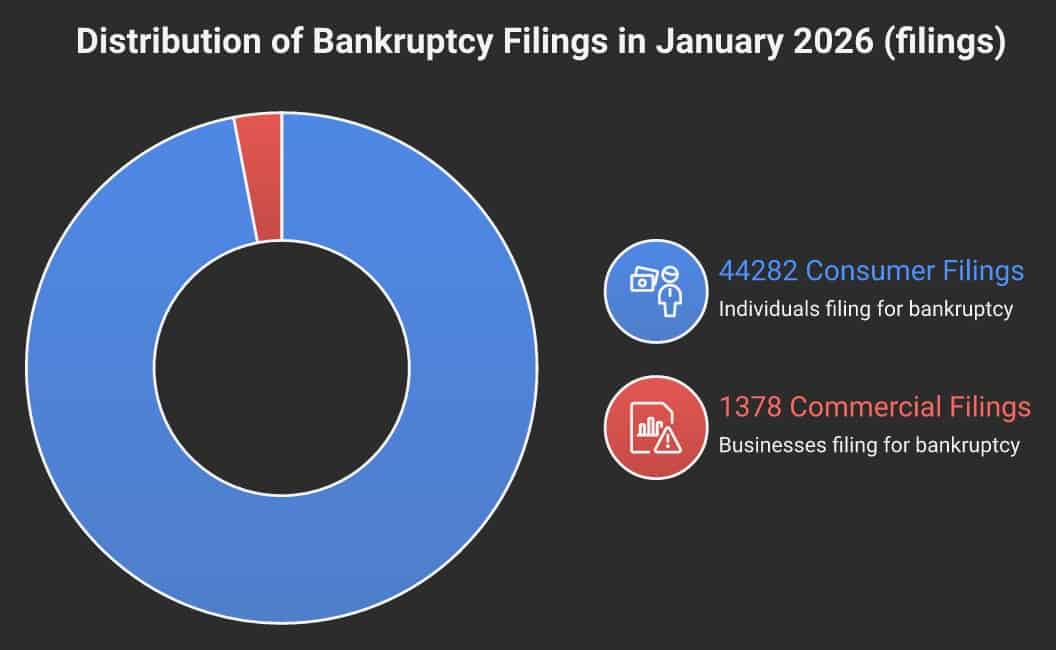
Quick Answer: Consumer bankruptcy filings rose 9% in January 2026 compared to January 2025, with 44,282 consumer filings that month alone. Commercial filings jumped 49% year-over-year — the highest January level since 2018. The numbers reflect what debt experts call “slow-burn financial strain” that’s been building for years. If you’re struggling, you’re not an outlier. And you have more options than you probably know.
The numbers don’t lie — and in January 2026, they told a clear story about how many Americans are finally reaching their breaking point after years of financial pressure.
Consumer bankruptcy filings totaled 44,282 in January 2026, up 9% from January 2025. Commercial filings hit 1,378 — a 49% year-over-year jump and the highest January commercial filing level since 2018. For all of 2025, consumer filings grew nearly 14%. (Source: Law360 Bankruptcy Authority)
Table of Contents
Every weekday I read the enforcement actions, filings and fine print the outlets skip, and turn them into the one or two moves that actually improve your position — a rate worth moving for, a fee you can refuse, a deadline to beat before it costs you.
In the latest issue (Oct 8): A parent's nursing home bill can become yours
I write Your Money Actually most weekdays — actionable money information you will not find anywhere else, and the small decisions that compound. It is free, I sell nothing, and I take no money from any company I write about.
What “Slow-Burn Financial Strain” Actually Means
Experts quoted by Law360 describe the trend as reflecting “slow-burn financial strain.” That’s a polished way of saying what I’ve been watching for years: people don’t snap financially overnight. The math breaks down gradually — a job loss here, a medical bill there, credit card balances growing faster than payments can shrink them, and suddenly a person who considered themselves financially stable is 18 months past the point where they should have sought help.
Credit card debt in the U.S. has surpassed $1 trillion. Student loan collections restarted in 2025. Inflation eroded purchasing power for three consecutive years. The people filing bankruptcy in January 2026 mostly didn’t make a single catastrophic decision — they made a series of small ones, or had bad luck, or both.
Bankruptcy filings going up doesn’t mean more people are irresponsible. It means more people are being honest about math that stopped working.— Steve Rhode
The Shame Trap That Makes This Worse
Here’s what I know from 30 years of watching this: most people wait too long. They spend years grinding through minimum payments, cashing out retirement accounts, borrowing from family — trying to avoid the stigma of bankruptcy. By the time they file, they’ve spent down assets that could have been protected, damaged relationships that didn’t need to be damaged, and lost years of financial recovery time.
The rising filing numbers suggest that more people are doing the math and acting on it — and that’s not a bad thing. A bankruptcy filing isn’t a failure. It’s a legal tool created by Congress specifically for situations where the debt math no longer works.
The Myth: “Bankruptcy ruins your credit for 10 years and should be a last resort.”
The Reality: Bankruptcy stays on your credit report for 7–10 years, but credit scores typically begin recovering within 12–24 months of filing. A Federal Reserve study found that bankruptcy filers do better financially than people with similar debt who don’t file. The “last resort” framing keeps people stuck in debt longer than necessary — and costs them retirement savings in the process.
What Your Options Actually Are Right Now
Rising bankruptcy numbers don’t mean everyone needs to file — they mean more people are acknowledging that their current path isn’t working. Here’s how to think about it:
Bankruptcy Makes Sense When
- Unsecured debt (credit cards, medical bills) exceeds what you can realistically repay in 3–5 years
- You’re at risk of wage garnishment or asset seizure
- You’ve been making minimum payments for 2+ years with no meaningful progress
- You have retirement savings worth protecting (bankruptcy exemptions often shield them)
- The emotional weight of the debt is affecting your health, relationships, or work
Other Options Worth Knowing
- Debt management plan (DMP): Lower interest, structured payoff through a nonprofit — but takes 3–5 years and has a hidden retirement cost
- Debt settlement: Can work if you have cash saved — but the marketing is predatory and fewer people qualify than companies claim
- Doing nothing: Sometimes the right short-term move if you’re genuinely judgment-proof
- Negotiating directly: Creditors will often settle for less than you owe, especially on old debt
The One Thing I’ll Always Say: Never cash out a retirement account to pay unsecured debt. A $40,000 401(k) withdrawal could cost you $150,000+ in lost growth by retirement. Retirement accounts are often fully protected in bankruptcy. The math almost never favors liquidating retirement to avoid a bankruptcy filing.
If you’re not sure which path makes sense for you, the Find Your Path quiz walks through your specific situation and points you toward options worth exploring. No sales pitch — just the right questions.
Related: Tariffs Are Driving Americans to Bankruptcy — survey data shows 41.7% of 2025 bankruptcy filers cite tariffs as a contributing cause.
Key Takeaways
- Consumer bankruptcy filings rose 9% in January 2026; commercial filings up 49%
- The trend reflects slow-burning financial strain that’s been building since the pandemic
- Most people wait too long — the shame trap costs them retirement savings and recovery time
- Bankruptcy is a legal tool, not a moral failure — and credit recovers faster than most people think
- Never liquidate retirement to avoid bankruptcy — it’s almost always the wrong trade
Many Who Waited Wish They Hadn’t. Bankruptcy filings spike when people who waited too long finally run out of runway. The free Cost of Inaction Calculator shows exactly what each month of delay costs — which often makes the decision to act obvious.
Free Tool — Wage Garnishment Calculator: Worried about your paycheck being seized? The free Wage Garnishment Calculator shows exactly how much creditors can legally take in your state — and some states prohibit garnishment entirely. Calculate My Risk →
Frequently Asked Questions About Bankruptcy Filings in 2026
Why are bankruptcy filings rising in 2026?
The increase reflects accumulated financial strain from pandemic-era debt, rising credit card balances (which have surpassed $1 trillion nationally), the restart of student loan collections in 2025, and years of inflation eroding purchasing power. Experts describe it as “slow-burn financial strain” — not a sudden crisis, but the cumulative weight of financial pressures that have been building since 2020. (Source: Law360)
Is now a good time to file for bankruptcy?
There’s no universal answer — it depends on your specific debt load, income, assets, and what you’re trying to protect. What I can tell you is that most people who eventually file bankruptcy wish they had done it sooner. If your debt math genuinely doesn’t work and you’ve been grinding through it for years without progress, a free consultation with a bankruptcy attorney costs nothing and gives you real information about your options.
What does the rise in commercial bankruptcy filings mean?
The 49% year-over-year increase in commercial filings — reaching the highest January level since 2018 — signals financial stress at the business level, not just household level. For consumers, this often means job instability, reduced hours, or layoffs can follow. It’s another reason to shore up your personal financial position now rather than waiting for things to stabilize on their own.
Does bankruptcy really ruin your credit for 10 years?
Bankruptcy stays on your credit report for 7 years (Chapter 13) or 10 years (Chapter 7), but that’s not the same as ruining your credit for that period. Most people see their scores begin recovering within 12–24 months of filing. A Federal Reserve study found that bankruptcy filers do better financially long-term than people with similar debt who don’t file. The 10-year fear is one of the biggest reasons people stay stuck too long.
What’s the difference between Chapter 7 and Chapter 13 bankruptcy?
Chapter 7 is a liquidation bankruptcy — most unsecured debt (credit cards, medical bills) is discharged in about 3–4 months. You must pass an income means test. Chapter 13 is a reorganization — you keep your assets but repay some or all debt through a 3–5 year court-supervised plan. Chapter 13 is often used to save a home from foreclosure or to include debt that Chapter 7 can’t discharge. A bankruptcy attorney can tell you which option fits your situation.
Source: Law360 Bankruptcy Authority — Financial Pressures Cause Bankruptcy Filings to Spike in Jan. | Credit Union Connection
Dealing With Debt? Understanding your options is the first step. See how all your debt relief options compare — including ones most sites won’t tell you about. The Find Your Path quiz gives a recommendation based on your actual numbers, and the Scam-O-Meter checks any company’s complaint history before you sign. Federal Reserve research shows bankruptcy filers recover faster than those who don’t file.



