Quick Answer: The U.S. Supreme Court today (March 2, 2026) declined to hear CashCall’s final appeal, leaving a $134 million restitution award to harmed consumers firmly in place. The CFPB sued CashCall for using a tribal lending scheme to charge interest rates as high as 343% while evading state consumer protection laws. This is money that goes back to borrowers who were deceived.
After more than a decade of litigation, the final legal door just closed on CashCall’s attempt to escape accountability for one of the most brazen predatory lending schemes the CFPB has ever pursued. The Supreme Court today declined to hear the case, and $134 million in restitution — money for borrowers charged interest rates as high as 343% — stands.
What CashCall Did and Why It’s Textbook Predatory Lending
Beginning around 2009, CashCall and its affiliate WS Funding partnered with Western Sky Financial, an online lender that claimed its location on the Cheyenne River Sioux Tribe’s reservation exempted it from state lending laws. The arrangement was simple: use the tribal lender as a facade while CashCall funded, serviced, and collected on the loans — and pocketed the profits from hundreds of thousands of borrowers.
Each weekday I send one short email: one story that caught my attention, why it might matter to you, and one manageable thing you can do with it. A couple of minutes, and a dad joke.
In the latest issue (Nov 13): The shelf price isn't always what you pay
Free. I sell nothing. Unsubscribe any time.
The loans ranged from $850 to $10,000. The interest rates ranged from approximately 90% to 343% annually. The CFPB found these loans violated state interest rate caps and licensing requirements in states across the country. According to the CFPB’s original enforcement action, CashCall deceived consumers by creating the false impression that the loans were legally enforceable — when in fact they were void under the laws of the states where borrowers lived.
The “Tribal Shield” Scheme: CashCall’s strategy — parking a lending operation on a reservation to claim tribal sovereignty exempted them from state law — has become a well-known predatory tactic. Courts have consistently rejected it when the operational reality is that a non-tribal company is running the lending program. Today’s Supreme Court decision reinforces that this shield does not hold. If you’re currently dealing with a tribal payday lender, see the tribal payday lender crisis guide for your rights and options.
The Legal Road to Today’s Decision
The case worked its way through the courts over more than a decade:
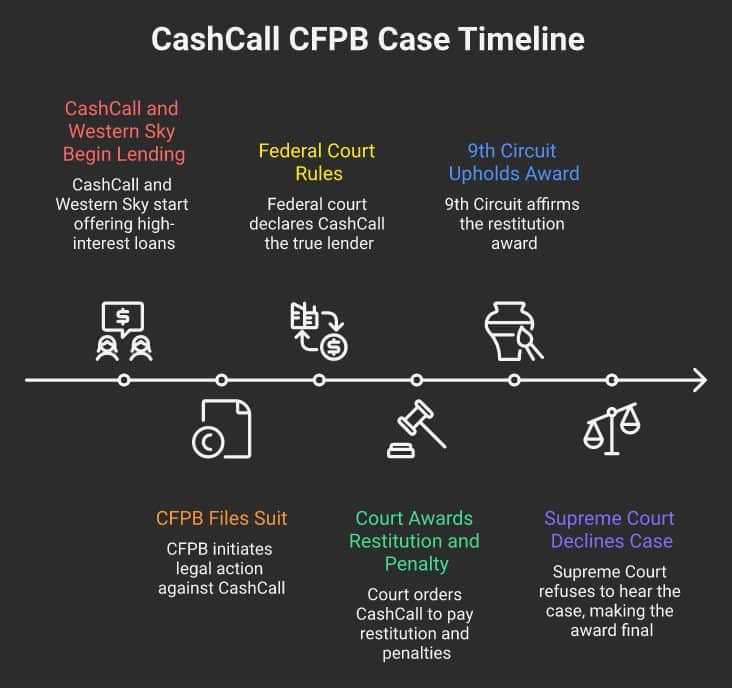
- 2013: CFPB files suit against CashCall for illegal loan servicing
- 2016: Central District of California rules CashCall was the “true lender,” not Western Sky — tribal immunity doesn’t apply
- February 2023: District court awards $134 million in consumer restitution + $33 million in civil penalties
- January 3, 2025: 9th Circuit upholds the $134M restitution award, rejecting CashCall’s jury trial argument
- September 2025: CashCall petitions the Supreme Court for review
- March 2, 2026: Supreme Court declines certiorari — case is over, restitution stands
When you charge 343% interest and use a tribal address to hide from the law, you are not running a lending business. You are running a trap. The math always catches up.— Steve Rhode
What This Means for Consumers and the CFPB
Three things matter here:
First, the restitution goes to real people. The $134 million represents money that will be returned to borrowers who were charged illegal interest rates they never legally owed. If you took a loan through Western Sky or CashCall between roughly 2009 and 2013 and are not yet part of the restitution, contact the CFPB at consumerfinance.gov.
Second, this is a landmark “true lender” ruling. Courts found CashCall was the true lender regardless of the tribal wrapper. This matters because it’s a template that regulators can use against other rent-a-tribe schemes still operating today.
Third, the CFPB won despite years of institutional pressure. This case has now survived multiple waves of legal challenge, including challenges to the CFPB’s own constitutional standing. The agency’s enforcement arm, despite everything, remains effective.
The Bigger Pattern: CashCall is not unique. Tribal lending schemes, rent-a-bank arrangements, and other legal workarounds to evade state interest rate caps are a documented part of the high-cost lending industry. If you’re considering any loan with an interest rate above 36%, take the Find Your Path quiz first — there may be options you haven’t considered.
Key Takeaways
- The Supreme Court today (March 2, 2026) declined to review CashCall’s challenge, leaving a $134M restitution award final
- CashCall charged 90%–343% annual interest using a tribal lender as a legal shield — courts called them the “true lender”
- The total award is $167M ($134M restitution + $33M civil penalty)
- This reinforces the “true lender” doctrine: you cannot hide predatory lending behind a tribal or bank partnership
- If you had a Western Sky or CashCall loan, contact the CFPB about potential restitution
Frequently Asked Questions
What was the CashCall CFPB lawsuit about?
The CFPB sued CashCall in 2013 for collecting on loans that were illegal under state law. CashCall used Western Sky Financial — a lender on the Cheyenne River Sioux Tribe’s reservation — as a front to evade state interest rate caps and licensing requirements. The CFPB argued CashCall was the “true lender” and was responsible for the illegal loans regardless of the tribal arrangement. Courts agreed.
How much does CashCall owe consumers?
The final court-ordered restitution is $134,058,600 — approximately $134 million — to be paid to consumers who took out loans through the Western Sky/CashCall arrangement. The court also imposed a $33,276,264 civil money penalty on CashCall. The Supreme Court’s March 2, 2026 decision not to hear the case means these awards are final.
What were CashCall’s interest rates?
According to court records in the CFPB case, the loans arranged through Western Sky and funded by CashCall carried annual percentage rates (APRs) ranging from approximately 90% to 343%. These rates violated state usury laws and interest rate caps in the states where borrowers lived, making the loans void and unenforceable under state law.
What is the “true lender” doctrine?
The “true lender” doctrine is a legal principle that courts use to look past the nominal identity of a lender to determine who actually controls the lending relationship. In the CashCall case, Western Sky was the named lender on the tribal reservation, but CashCall funded the loans, set the terms, and collected on them. Courts found CashCall was the true lender — meaning tribal immunity and the tribal charter did not protect the loans from state law.
Can I still claim restitution if I had a Western Sky or CashCall loan?
If you had a Western Sky or CashCall loan and have not received restitution, contact the CFPB directly at consumerfinance.gov or call 855-411-2372. You can also file a complaint through the CFPB’s complaint database to get your situation on record.
(…Source: Law360 — Justices Decline CashCall Challenge to $134M CFPB Award | CFPB Enforcement Action)
Dealing With Debt? Understanding your options is the first step. See how all your debt relief options compare — including ones most sites won’t tell you about. The Find Your Path quiz gives a recommendation based on your actual numbers, and the Scam-O-Meter checks any company’s complaint history before you sign. Federal Reserve research shows bankruptcy filers recover faster than those who don’t file.


This is regarding the Cashcall lawsuit. I did have one of the account numbers and i did submit that.
May I mail in my documents since I wasn’t able to upload on this laptop? I did file my complaint online. I don’t have a website.