

Quick Answer: A Kalamazoo County, Michigan retiree lost $1,051,000 after a laptop pop-up led him to fake “IRS” scammers who convinced him to liquidate his 401(k), IRA, and bank accounts to protect his money in a fraudulent “Federal IRS locker.” His bank never flagged the transactions. The IRS never initiates contact via pop-up alerts, emails, or unexpected phone calls — only by mail.
A Michigan retiree is out more than $1 million. Not because he made a bad investment. Not because of a data breach. Because he clicked a number on a laptop pop-up and called it.
What happened next is a textbook example of how these scams work — and why they’re so effective. The mechanics matter, because understanding them is what protects you from falling for the same thing.
The IRS Will Never: Contact you via pop-up alert, email, or unsolicited phone call. Initial IRS contact is always by mail. Any “IRS agent” who calls you out of nowhere is a scammer.
Each weekday I send one short email: one story that caught my attention, why it might matter to you, and one manageable thing you can do with it. A couple of minutes, and a dad joke.
In the latest issue (Nov 6): Owed money on an Amazon return? Check by Dec. 1
Free. I sell nothing. Unsubscribe any time.
How the Kalamazoo Scam Unfolded
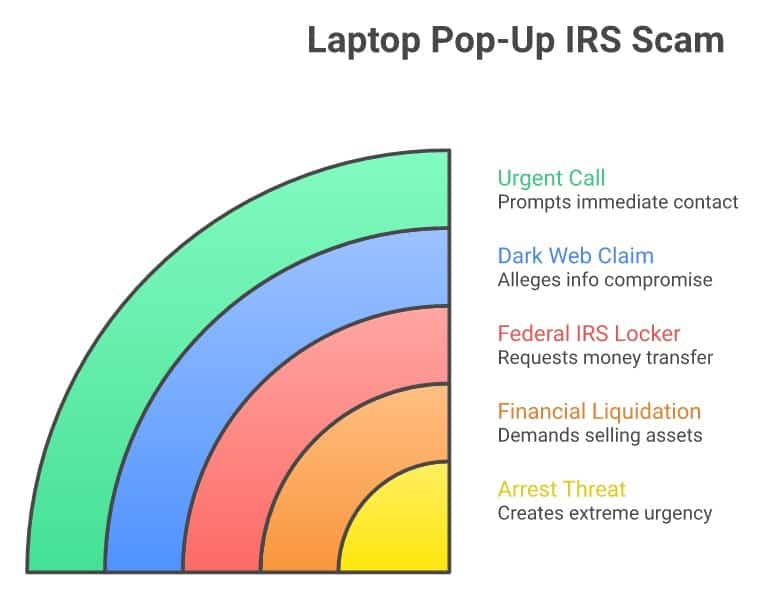
According to the Kalamazoo County Sheriff’s Office, the victim encountered a pop-up alert on his laptop and called the phone number displayed. The person who answered claimed to be an IRS clerk.
The fake agent told the victim his personal information had been “leaked onto the black web” and that his finances were at risk. The solution? Move all his money immediately into a secure government account — what the scammer called a “Federal IRS locker.”
The victim complied. Over a series of transactions, he transferred a total of $1,051,000 — draining his 401(k), his IRA, and his personal bank account.
The Bank Didn’t Stop It
This detail deserves attention: a retiree, suddenly moving essentially his entire life savings through unknown accounts in a series of escalating transactions, and the financial institution never flagged it.
A deputy asked the victim whether his bank had responded to the unusual activity. His answer: no.
Banks have fraud detection systems. But those systems are optimized to stop unauthorized transactions. When the account holder is making the transfers themselves — even under duress or manipulation — those systems often fail to intervene.
This is why consumer education matters more than ever. Banks can’t always save you from yourself when you’ve been convinced the threat is coming from outside.
How This Type of Scam Works
The tech support and IRS impersonation scam follows a predictable pattern:
- The hook: A pop-up, fake alert, or phone call claims your device has been compromised or you owe taxes
- The threat: You’re told your personal information is on the “dark web” or you face arrest, deportation, or financial seizure
- The urgency: You must act immediately — no time to verify, no time to think
- The solution: Transfer money to a “secure government account” or purchase gift cards or wire money
- The escalation: Once you comply with the first request, demands increase over days or weeks
The Lie They Tell: “Move your money to protect it in a Federal IRS locker.” There is no such thing as a Federal IRS locker. No government agency will ever ask you to move money to “protect” it.
Why Retirement Accounts Are Targeted
Scammers specifically target retirees because they often have decades of savings concentrated in 401(k)s and IRAs — large sums in accounts that can be liquidated, often with significant tax consequences that compound the damage.
Think about what this victim lost beyond the $1,051,000: the early withdrawal penalties, the income taxes on retirement distributions, and the lifetime of compounding growth that money would have generated.
Never liquidate retirement accounts at anyone’s request. Not for “IRS agents.” Not for tech support. Not for anyone calling you out of the blue. Protecting retirement is a core rule — and no legitimate government agency will ever threaten it.
Law Enforcement Response
Homeland Security investigators in Grand Rapids have taken over the case. Investigators have linked the scheme to other similar cases and suspects, suggesting this is an organized operation rather than a lone scammer.
The IRS warns that scammers use pressure tactics including threats of arrest or deportation, and that the agency always initiates contact by mail — never through pop-ups, emails, or unexpected phone calls.
What to Do if This Happens to You
- Hang up immediately — no explanation needed
- Do not call back any number from a pop-up, email, or unexpected call
- Verify directly: call the IRS at 1-800-829-1040 (official number only)
- Report it to the FTC at ReportFraud.ftc.gov
- Report to the IRS at IRS.gov/scams
- If money was already transferred, contact your bank immediately and file a police report
Before engaging with any financial company you don’t know well: Run their contract or agreement through the Contract Decoder first. It won’t catch phone scams, but it will flag red flags in written agreements from predatory companies.
The scammer created fear, urgency, and a solution. That’s the entire playbook. When someone creates urgency around your money, slow down — that urgency is the weapon.— Steve Rhode
Key Takeaways
- A Michigan retiree lost $1,051,000 after a laptop pop-up led him to fake IRS scammers
- His 401(k), IRA, and bank account were all drained — his bank did not flag the transactions
- The IRS only contacts taxpayers by mail — never by pop-up, email, or unexpected call
- No government agency will ever ask you to move money to “protect” it
- Never liquidate retirement accounts at anyone’s request
- Report IRS scams to the FTC and IRS immediately
(Source: InvestmentNews — Michigan retiree loses $1 million to fake IRS agent)
FAQ
How do I know if an IRS contact is real?
The IRS only initiates contact by mail. If you receive a pop-up, email, or unexpected phone call from someone claiming to be the IRS, it is a scam. Verify by calling the official IRS number at 1-800-829-1040 or visiting IRS.gov directly.
What is a “Federal IRS locker”?
There is no such thing. “Federal IRS locker” is a phrase scammers use to convince victims to transfer money to fraudulent accounts under the guise of protecting it. No government agency has such a product.
Can I get my money back if I was scammed?
Recovery is difficult but not always impossible. Report to the FTC, your bank, and local law enforcement immediately. If wire transfers were involved, your bank may be able to recall them if reported quickly. Homeland Security and the FBI investigate large-scale fraud schemes like this one.
Why don’t banks stop these transactions?
Fraud detection systems are designed to catch unauthorized transactions. When the account holder initiates the transfer — even under manipulation — systems often don’t intervene. Some banks are updating protocols, but consumer awareness remains the primary protection.
Should I liquidate retirement accounts if someone says my finances are at risk?
Never. No legitimate government agency, IRS agent, or financial institution will ever instruct you to liquidate retirement accounts to “protect” your money. This request is always a scam, regardless of how convincing the caller sounds.
Dealing With Debt? Understanding your options is the first step. See how all your debt relief options compare — including ones most sites won’t tell you about. The Find Your Path quiz gives a recommendation based on your actual numbers, and the Scam-O-Meter checks any company’s complaint history before you sign. Federal Reserve research shows bankruptcy filers recover faster than those who don’t file.



