

Quick Answer: Colorado’s HB26-1267 would have banned wage garnishment for medical debt, but it never became law. On March 31, 2026, the House Health & Human Services Committee postponed it indefinitely, and the Colorado General Assembly lists the bill’s status as “Lost.” As of the bill’s introduction in February 2026, Colorado’s medical debt law listed garnishing wages as a “permissible extraordinary collection action,” one that goes through the courts, and HB26-1267’s failure left that in place. KFF Health News reported that Colorado courts approved wage garnishment requests in an estimated 14,000 medical debt cases a year.
Update (April 2026): On April 13, 2026, Washington’s attorney general settled with Renton Collections, which agreed to provide $1.5 million in medical debt relief. I went through what that means for your own collection letter in this post.
Courts in Colorado approve roughly 14,000 wage garnishment requests for medical debt every year, according to KFF Health News. HB26-1267 aimed to make that number zero. It failed.
Colorado’s HB26-1267 was introduced on February 19, 2026, by Reps. Junie Joseph and Javier Mabrey, with Sens. Iman Jodeh and Mike Weissman as its Senate sponsors. When I first wrote about it, it was among the most comprehensive medical debt bills in any state legislature that session. It never made it out of its first committee.
Each weekday I send one short email: one story that caught my attention, why it might matter to you, and one manageable thing you can do with it. A couple of minutes, and a dad joke.
In the latest issue (Nov 6): Owed money on an Amazon return? Check by Dec. 1
Free. I sell nothing. Unsubscribe any time.
What Happened to HB26-1267
On March 31, 2026, the House Health & Human Services Committee adopted two amendments, then voted 5-8 against sending the bill on to the full House. It then voted 8-5 to postpone the bill indefinitely. The legislature’s bill page lists its status as “Lost,” and the bill’s final fiscal note says it plainly: “This bill was postponed indefinitely by the House Health and Human Services committee on March 31, 2026; therefore, the impacts identified in this analysis do not take effect.”
So if you read an earlier version of this post, or saw the bill mentioned somewhere else, please don’t plan around any of the protections below. They do not exist.
Context: This story builds on a broader state movement covered here at Can Medical Debt Garnish Your Wages? States Are Finally Pushing Back. Colorado’s bill was one of the most specific and aggressive proposals in that wave.
What HB26-1267 Would Have Done
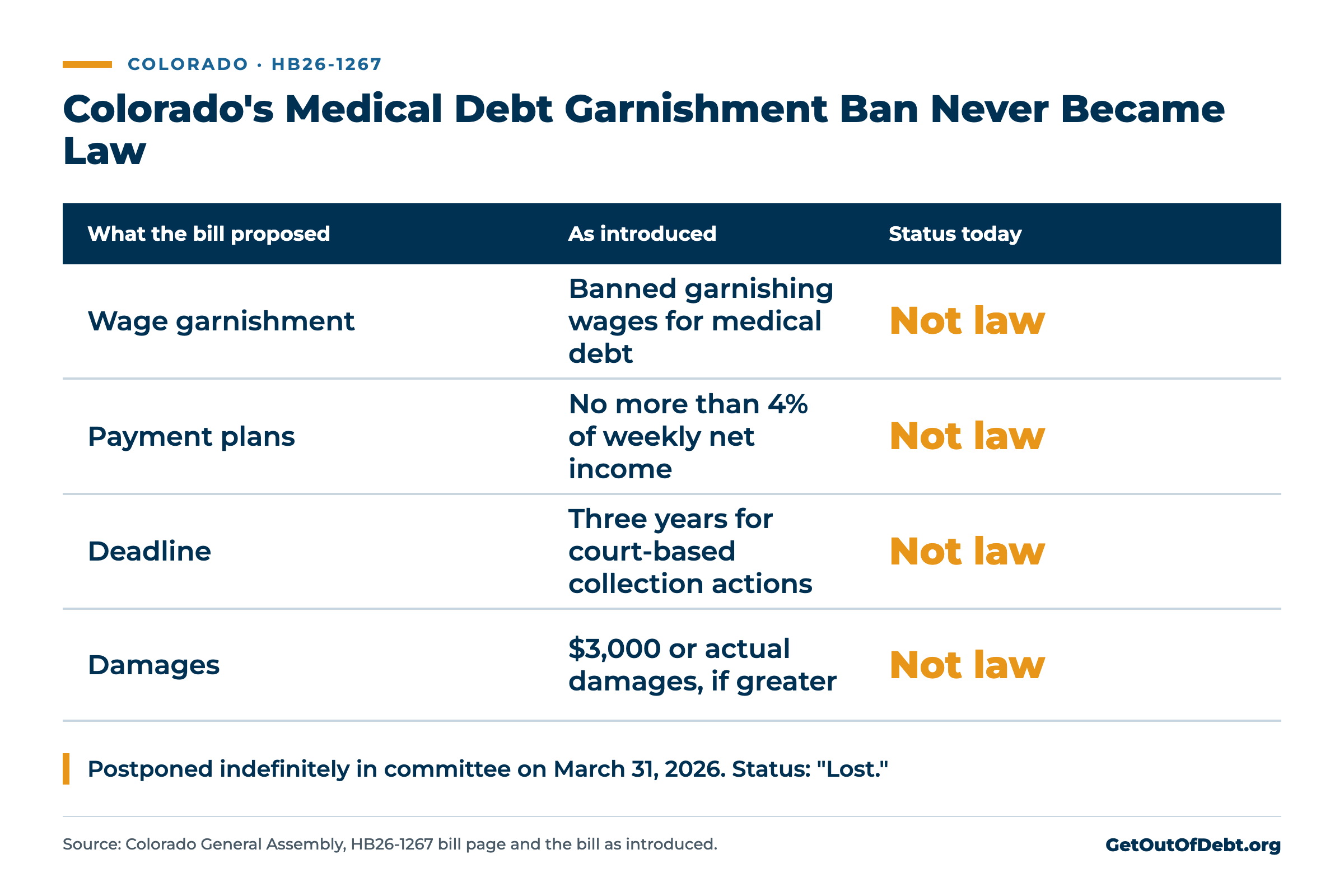
According to the bill as introduced, HB26-1267 would have:
- Banned wage garnishment for medical debt, including threatening to garnish wages
- Limited bank account seizures for medical debt
- Required a reasonable payment plan of no more than 4% of the patient’s weekly net income
- Required creditors to verify the patient had been screened for public insurance and discounted care (insured patients only had to be told of their right to a screening)
- Set a three-year deadline for court-based collection actions on medical debt
- Made a medical creditor that broke the rules liable to the patient for $3,000 or actual damages, whichever is greater
The committee amended the bill before it postponed it, so this list describes the version as introduced. None of it became law.
Free Tool — Wage Garnishment Calculator: Worried about your paycheck being seized? The free Wage Garnishment Calculator shows exactly how much creditors can legally take in your state — and some states prohibit garnishment entirely. Calculate My Risk →
Why Colorado Courts Approve 14,000 Garnishments a Year
A KFF Health News investigation that preceded this legislation found that Colorado courts have been approving an estimated 14,000 medical debt wage garnishment requests annually. The investigation documented wage garnishment affecting workers at retail chains, restaurants, and gas stations. In some cases, families lost utilities after being pursued for erroneous billing.
Which Other States Had Similar Bills in 2026
Colorado’s bill was part of a 2026 wave. According to KFF Health News, lawmakers in at least eight states were moving medical debt wage garnishment bills that session:
States With Bills to Restrict/Ban
- Colorado (HB26-1267 — postponed indefinitely March 31, 2026)
- Florida
- Hawaii
- Indiana
Additional States This Session
- Maine
- Michigan
- Ohio
- Washington
States pursued different strategies: some sought outright bans, others proposed protecting low-income debtors or increasing the threshold of earnings that are exempt from garnishment. Washington, for example, aimed to shield larger portions of low-wage workers’ paychecks. I have not traced every one of these bills to its final outcome here, so check your own state’s legislature before you count on one.
What This Means If You Have Medical Debt in Colorado
HB26-1267 did not pass, so none of the protections it proposed exist. Here is where that leaves you:
- Your wages can still be garnished to collect a medical bill. Colorado’s medical debt law, as it stood when HB26-1267 was introduced, lists “garnishing an individual’s wages” as a “permissible extraordinary collection action” (C.R.S. 6-20-201), meaning an action that requires a legal or judicial process.
- For hospital bills, that same law says a medical creditor cannot take that kind of action until 182 days after you received the hospital services, and it requires notice to you first (C.R.S. 6-20-203).
- Because garnishment goes through the courts, court papers about a medical bill are your warning sign. Don’t ignore them.
- There is no payment plan cap of 4% of weekly net income and no three-year deadline from this bill. Those were proposals.
Already Dealing With Medical Debt? You don’t have to wait for a new law. Hospitals have financial assistance programs that most patients never ask about. Negotiate directly. Ask about charity care. Get the bill itemized and dispute errors. Medical debt is among the most negotiable debt there is.
To understand all your options — whether that’s negotiating, payment plans, or bankruptcy — take the Find Your Path quiz.
Medical debt is not the result of bad decisions — it’s the result of getting sick in a system with broken math. The debt that follows is just what’s left over.— Steve Rhode
Key Takeaways
- Colorado’s HB26-1267 would have banned medical debt wage garnishment, but a House committee postponed it indefinitely on March 31, 2026, and it never became law
- KFF Health News estimated Colorado courts approve ~14,000 medical debt garnishments annually
- Eight states had similar bills in the 2026 legislative session
- HB26-1267’s failure left Colorado’s medical debt law unchanged: it lists wage garnishment as a permissible extraordinary collection action that goes through the courts
- Current options: negotiate directly, ask for financial assistance, dispute billing errors
Related: Wage Garnishment: The Complete Guide to Your Rights and Options — all your options in one place.
(Sources: Colorado General Assembly — HB26-1267, Limitations on Collection Actions for Medical Debt; KFF Health News — State Lawmakers Seek Restraints on Wage Garnishment for Medical Debt)
FAQ
Can medical debt garnish wages in Colorado right now?
Yes. HB26-1267, the bill that would have banned it, was postponed indefinitely in a House committee on March 31, 2026, and never became law (bill status: Lost). Colorado’s medical debt law, as it stood when the bill was introduced, lists garnishing wages as a permissible extraordinary collection action, which goes through a legal or judicial process. KFF Health News reported that Colorado courts approved wage garnishment requests in an estimated 14,000 medical debt cases a year.
What did Colorado’s HB26-1267 do?
Nothing, because it never became law. As introduced, it would have banned wage garnishment for medical debt, required payment plans of no more than 4% of weekly net income, set a three-year deadline for court-based collection actions on medical debt, and made a medical creditor that broke the rules liable to the patient for $3,000 or actual damages, whichever is greater. The House Health & Human Services Committee postponed it indefinitely on March 31, 2026.
Which states had medical debt wage garnishment bills in 2026?
KFF Health News reported that at least eight states had legislation in the 2026 session to restrict or ban wage garnishment for medical debt: Colorado, Florida, Hawaii, Indiana, Maine, Michigan, Ohio, and Washington. Colorado’s bill died in committee on March 31, 2026. Check your own state’s legislature to see where its bill ended up.
What can I do about medical debt right now?
Medical debt is among the most negotiable debt there is. Call the hospital’s financial assistance office directly. Ask for a charity care application. Get your bill itemized and dispute errors. Negotiate a payment plan. If the debt is already in collections, you can often settle for significantly less than the full amount.
Does medical debt affect my credit score?
Less than before. By April 2023, Equifax, Experian and TransUnion had removed medical collection debts with an initial reported balance under $500 from credit reports. The CFPB finalized a rule in January 2025 that would have kept medical debt out of most credit decisions, but a federal judge in Texas set it aside and vacated it on July 11, 2025, so the federal rule does not protect you. Medical debt’s impact on credit has been significantly reduced in recent years.
That’s where things stand as I write this. It’s what I’m telling friends like you over coffee, but you know your own situation better than I do, so take it as input, not instruction. Don’t let anyone, including me, tell you what to do with your money. You do you.
If you know someone in Colorado who’s worried about a medical bill and their paycheck, send this to them. It’s better to know the bill died now than to find out when a garnishment order lands.
Dealing With Debt? Understanding your options is the first step. See how all your debt relief options compare — including ones most sites won’t tell you about. The Find Your Path quiz gives a recommendation based on your actual numbers, and the Scam-O-Meter checks any company’s complaint history before you sign. Federal Reserve research shows bankruptcy filers recover faster than those who don’t file.



