

Quick Answer: Americans now owe $1.84 trillion in student loan debt across 42.8 million federal borrowers. The average borrower carries $43,570 in combined federal and private student debt, though the median is lower at $24,109. New borrowing in 2024-25 totaled $102.6 billion, with nearly half going to federal unsubsidized loans.
Student loan debt is now the second-largest consumer debt category in the United States, behind only mortgage debt. Here’s what the current numbers actually show — and what they mean for borrowers in 2026.
The Total Picture: $1.84 Trillion
According to LendingTree’s student loan statistics and data from Education Data Initiative, total U.S. student loan debt stands at approximately $1.84 trillion — a figure that grew 3.2% from Q4 2024 to Q4 2025, resuming growth after a temporary decline in 2023-24.
The gap between average ($43,570) and median ($24,109) tells an important story: a small number of borrowers with very high debt loads — graduate and professional school borrowers — pull the average up significantly. Most borrowers owe closer to the median.
Each weekday I send one short email: one story that caught my attention, why it might matter to you, and one manageable thing you can do with it. A couple of minutes, and a dad joke.
In the latest issue (Nov 6): Owed money on an Amazon return? Check by Dec. 1
Free. I sell nothing. Unsubscribe any time.
How New Borrowing Breaks Down
Students and parents borrowed an estimated $102.6 billion in the 2024-25 academic year. The breakdown shows heavy reliance on federal programs:
Federal Loan Types
- 44% — Federal unsubsidized loans
- 15% — Federal subsidized loans
- 15% — Grad PLUS loans
- 12% — Parent PLUS loans
Private Loans
- 14% — Private or other nonfederal loans
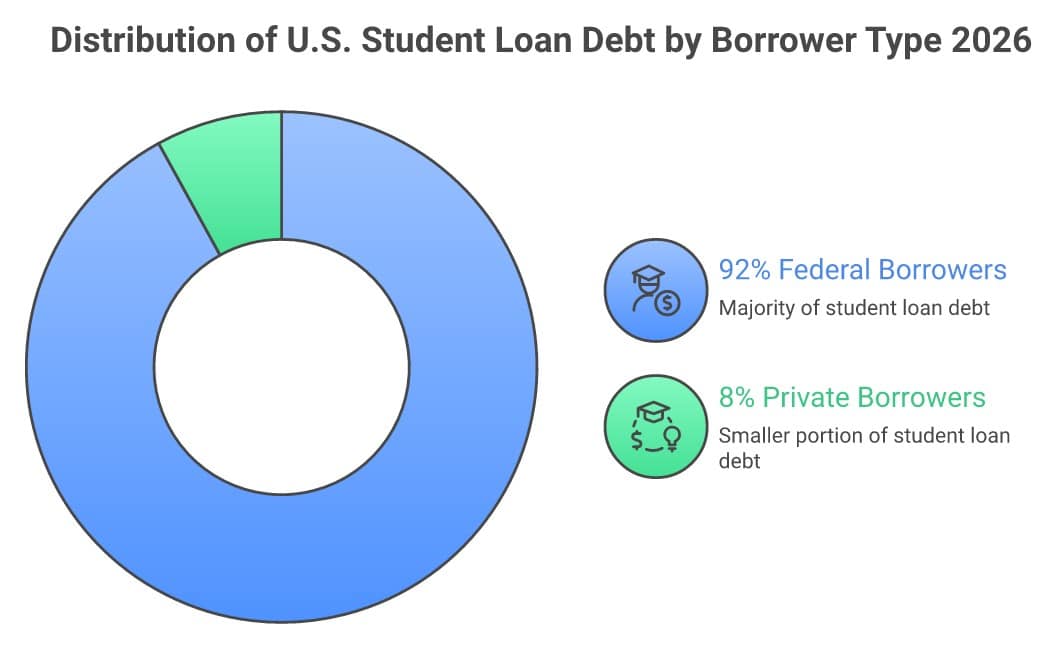
- $140.38B — Total private loan outstanding
- 7.7% — Share of total debt
- Higher rates, fewer protections
Who Carries This Debt
According to LendingTree’s research, 47% of the Class of 2024 bachelor’s degree recipients graduated with student loan debt. Those who did left school with an average of $29,560 in federal and private student loan debt — a number that sounds manageable but compounds quickly at typical federal interest rates. For the Class of 2026, NerdWallet projects that number will climb to $43,500 — and 69% of Americans now say college isn’t as important as it used to be for earning a good living.
The Graduate Debt Trap: Graduate and professional school borrowers skew the average dramatically. A first-generation college graduate with a $25,000 bachelor’s degree loan and a law school graduate with $180,000 in debt are both “student loan borrowers” — but their situations are completely different. Know where you fall.
The Federal vs. Private Distinction Matters
Of the $1.84 trillion total, $1.693 trillion is federal student loan debt. That distinction matters enormously for repayment options:
- Federal loans qualify for income-driven repayment (IDR) plans
- Federal loans qualify for Public Service Loan Forgiveness (PSLF)
- Federal loans have death and disability discharge protections
- Federal loans can be consolidated and rehabilitated after default
- Private loans have no income-driven repayment options
- Private loans rarely qualify for forgiveness programs
- Private loans are harder to manage in financial hardship
- Private loan interest rates can be variable and significantly higher
If you have private student loans in default or hardship: Your options are more limited than federal borrowers. Bankruptcy discharge of private student loans IS possible in some circumstances — a recent Supreme Court ruling and growing body of case law has made this more achievable than it was five years ago. Consult a student loan bankruptcy attorney.
What the 2026 Policy Environment Means for These Numbers
The student loan landscape continues to shift. Courts have blocked several Biden-era forgiveness programs, and the 2026 political environment has created significant uncertainty around IDR plans, SAVE plan litigation, and future forgiveness prospects.
The practical reality for most borrowers: don’t count on forgiveness. Understand your repayment options and optimize for what’s available today, not what might be available tomorrow.
To understand your specific options — IDR, refinancing, bankruptcy, or other strategies — take the Find Your Path quiz.
$1.84 trillion in student debt is not a personal failure. It’s the math of a system that made college inaccessible without borrowing. The debt is real. So are your options.— Steve Rhode
Key Takeaways
- Total U.S. student loan debt: $1.84 trillion, growing 3.2% year-over-year
- 42.8 million federal borrowers; average debt $43,570 but median is $24,109
- 47% of Class of 2024 graduates left with debt, averaging $29,560
- Federal loans ($1.693T) offer far more repayment flexibility than private loans
- In 2026, don’t count on forgiveness — optimize for what repayment plans are available now
(Source: LendingTree — U.S. Student Loan Debt Statistics | Education Data Initiative)
FAQ
How much student loan debt does the average American have?
The average student loan borrower carries $43,570 in federal and private student debt. The median is $24,109 — meaning half of borrowers owe less than that. Graduate and professional school borrowers with very high balances pull the average up significantly.
How many Americans have student loan debt?
42.8 million Americans have federal student loan debt. When private loans are included, the total number of borrowers is higher. Total outstanding debt stands at $1.84 trillion as of late 2025.
What percentage of college graduates have student loans?
47% of Class of 2024 bachelor’s degree recipients from four-year public and private nonprofit colleges graduated with student loan debt, with an average balance of $29,560.
What’s the difference between federal and private student loans?
Federal loans ($1.693 trillion of the $1.84 trillion total) offer income-driven repayment, forgiveness programs, and hardship protections. Private loans offer none of these by default. If you’re in financial hardship, federal loans are much easier to manage.
Can student loans be discharged in bankruptcy?
Yes, though it requires meeting an “undue hardship” standard. Federal loans qualify for specific discharge programs (TPD for disability, PSLF after service). Private loan bankruptcy discharge has become more accessible in recent years. Consult a student loan bankruptcy attorney if you’re exploring this option.
Waiting Has a Price. The free Cost of Inaction Calculator shows the exact dollar cost of delaying action on high-interest debt — broken down month by month — so the decision to act now vs. later becomes a math question, not an emotional one.
Dealing With Debt? Understanding your options is the first step. See how all your debt relief options compare — including ones most sites won’t tell you about. The Find Your Path quiz gives a recommendation based on your actual numbers, and the Scam-O-Meter checks any company’s complaint history before you sign. Federal Reserve research shows bankruptcy filers recover faster than those who don’t file.



