
Quick Answer: 23 federal debt relief lawsuits were filed this week (February 24–March 3, 2026). This briefing organizes the alleged conduct by risk category — compliance talking points for debt relief company staff and counsel to use when reviewing current practices.
23 new federal debt relief lawsuits were filed this week. Below is a compliance analysis organized by risk category — concrete talking points for compliance teams and outside counsel reviewing what regulators and plaintiffs are pursuing right now.
Table of Contents
Each weekday I send one short email: one story that caught my attention, why it might matter to you, and one manageable thing you can do with it. A couple of minutes, and a dad joke.
In the latest issue (Nov 6): Owed money on an Amazon return? Check by Dec. 1
Free. I sell nothing. Unsubscribe any time.
Get the Daily 10 AM Debt Briefing
Weekday news — free, no spam, unsubscribe anytime.
Compliance Analysis: What These Cases Signal This Week
False or Misleading Advertising (Result Guarantees, Timeline Claims, Savings Promises)
Two cases this week raise the familiar specter of deceptive representations. In Reno v. My Credit Guy, Inc. (Case No. 8:26-cv-00555, M.D. Fla.), the plaintiffs allege that My Credit Guy made false and misleading representations about the results its credit repair services could deliver, brought under both the federal Credit Repair Organizations Act (CROA, 15 U.S.C. § 1679) and the Florida Credit Services Organization Act (FCSOA). CROA expressly prohibits credit repair organizations from making “any statement, or counsel or advise any consumer to make any statement, which is untrue or misleading” regarding a consumer’s creditworthiness.
Separately, in Ussery v. Resurgent Capital Services (Case No. 1:26-cv-00478, W.D. Tex.), the plaintiff alleges that Resurgent engaged in deceptive practices and false representations in connection with debt collection under the FDCPA, including misrepresenting the character, amount, or legal status of debts. Similar deceptive-practices and false-representations tags appear in Lopez v. Jefferson Capital Systems (Case No. 8:26-cv-00484, M.D. Fla.) and Ardis v. LVNV Funding (Case No. 3:26-cv-00805, D.S.C.).
What to review now:
- Audit all customer-facing marketing materials — websites, landing pages, social media ads, and sales scripts — for any language that could be read as guaranteeing specific outcomes (e.g., “We will raise your score by 100 points” or “Eliminate your debt in 12 months”). Replace with compliant, qualified language.
- Ensure CROA-required disclosures are provided before any contract is signed, including the consumer’s right to dispute credit information directly and at no charge, and the three-day cancellation right.
- If you purchase or service debt, review all collection letters and phone scripts for accuracy of the amount owed, the current creditor’s identity, and the legal status of the debt — each of which is a frequent source of FDCPA § 1692e exposure.
Robocall / TCPA / Do Not Call Violations
TCPA litigation continues to be one of the highest-volume risk areas for the debt relief ecosystem. Three separate cases this week allege violations of the Telephone Consumer Protection Act (47 U.S.C. § 227) and related Do Not Call provisions.
In Harris v. Cordoba Legal Group PLLC (Case No. 2:26-cv-00332, N.D. Ala.), the plaintiff — a debt settlement firm’s prospective customer — alleges that Cordoba called her phone number, which had been registered on the National Do Not Call Registry since August 2024, on multiple occasions. The complaint further alleges the use of prerecorded voice messages. This is a federal class action.
Chmielewski v. Advantage First Financial, LLC (Case No. 2:26-cv-02095, D.N.J.) involves a debt settlement company that allegedly continued calling the plaintiff after he verbally requested to be placed on the company’s internal do-not-call list in April 2025. This, too, is a class action.
Vasquez v. SoFi Lending Corp. (Case No. 3:26-cv-01228, S.D. Cal.) alleges that SoFi called the plaintiff more than 70 times using an artificial or prerecorded voice after his attorney sent a written cease-and-desist letter. Claims are brought under the TCPA, the FDCPA, and California’s Rosenthal Fair Debt Collection Practices Act (RFDCPA).
The Lopez v. Jefferson Capital Systems case (Case No. 8:26-cv-00484) is also tagged with Do Not Call violations under both the FDCPA and the Florida Consumer Collection Practices Act (FCCPA).
What to review now:
- Scrub all outbound calling lists against the National DNC Registry at least every 31 days (the safe harbor window), and maintain timestamped records of each scrub. Confirm your vendor is actually performing this step, not just certifying it.
- Build an internal DNC suppression process that processes verbal and written opt-out requests within a defined SLA — ideally 24 hours or less. Document every request with a date, time, channel, and the agent who received it. The TCPA’s internal DNC provision (47 C.F.R. § 64.1200(d)) requires companies to honor these requests, and continued calling after a request is a per-call violation.
- Immediately flag any consumer represented by counsel. Under the FDCPA (§ 1692c(a)(2)), once you know a consumer is represented, all communication must go through the attorney. Seventy-plus calls after a cease-and-desist letter, as alleged in Vasquez, is the kind of fact pattern that generates significant statutory damages in class litigation.
Debt Collection Harassment and Failure to Verify Debt
Several cases this week allege that debt buyers and servicers engaged in collection harassment and failed to verify debts when disputed. In Ussery v. Resurgent Capital Services (Case No. 1:26-cv-00478), the plaintiff alleges that Resurgent unlawfully contacted her sister to collect a debt — a potential violation of FDCPA § 1692c, which restricts third-party communications — and that Resurgent failed to verify the debt. Ardis v. LVNV Funding (Case No. 3:26-cv-00805) alleges failure to verify debt and collection harassment under both the FDCPA and the FCRA, with the additional complicating factor of an identity theft claim, suggesting the debt may not have been the plaintiff’s at all. Lopez v. Jefferson Capital Systems (Case No. 8:26-cv-00484) similarly alleges failure to verify and harassment under the FDCPA and the FCCPA.
What to review now:
- Map your debt verification workflow end to end. When a consumer disputes a debt — in writing or verbally — your system should automatically pause all collection activity on that account until verification is complete and mailed (FDCPA § 1692g(b)). Audit whether this pause is actually happening in practice, not just in your policy manual.
- Restrict third-party contacts to the narrow purposes permitted under FDCPA § 1692b (locating the consumer), and train agents that disclosing the existence of a debt to a family member is a violation. Call recordings involving third parties should be reviewed in QA at a higher sampling rate.
- Implement an identity theft / fraud dispute intake track that routes flagged accounts to a specialized team, since these disputes carry FCRA obligations (including the duty to conduct a reasonable investigation under § 1681s-2(b)) that go beyond standard FDCPA verification.
Data Security and Unauthorized Data Sharing
Cook v. SoFi Technologies, Inc. (Case No. 3:26-cv-01722, N.D. Cal.) is a class action alleging that SoFi failed to adequately protect customers’ private information — including names, dates of birth, addresses, and Social Security numbers — and that this information was exposed or disclosed to unauthorized third parties. The complaint invokes the FTC Act’s prohibition on unfair practices and raises identity theft concerns stemming from the alleged breach.
While this case targets a personal lender rather than a debt settlement company, the lesson applies across the industry: debt relief companies hold extraordinarily sensitive consumer financial data, and a breach creates both regulatory exposure and class action liability.
What to review now:
- Conduct a data inventory to identify every system and vendor that stores, processes, or transmits consumer PII and financial data. Confirm that each has current SOC 2 or equivalent attestation and that your vendor agreements include breach notification and indemnification provisions.
- Validate your encryption standards for data at rest and in transit. Consumer SSNs, account numbers, and settlement details should never be stored in plain text or transmitted via unencrypted email — a practice that remains surprisingly common at smaller operators.
- Test your incident response plan with a tabletop exercise this quarter. The FTC’s Safeguards Rule (16 C.F.R. Part 314), which applies to financial institutions including many debt relief providers, now requires written incident response plans. If yours hasn’t been exercised recently, now is the time.
Credit Reporting Errors and FCRA Compliance
Ardis v. LVNV Funding (Case No. 3:26-cv-00805) alleges FCRA violations alongside FDCPA claims, with tags indicating credit reporting errors and identity theft. When a debt buyer furnishes information to credit bureaus about a debt that may belong to a different person entirely, the consequences extend beyond the FDCPA — the FCRA’s furnisher obligations under § 1681s-2(b) require a reasonable investigation upon receiving notice of a dispute from a consumer reporting agency.
What to review now:
- Audit your furnishing accuracy by pulling a sample of accounts currently being reported to the bureaus and cross-referencing against your internal records for correct balance, account ownership, and dispute status.
- Ensure your dispute response workflow with CRAs meets the 30-day investigation timeline under the FCRA and that you are updating or deleting tradelines when investigation results warrant it.
- Flag accounts with identity theft indicators (e.g., FTC Identity Theft Reports, police reports, or consumer affidavits) for immediate suppression from credit reporting until ownership of the debt is conclusively verified.
Not Legal Advice: This compliance analysis is for educational purposes only and does not constitute legal advice. Companies should consult qualified legal counsel regarding their specific practices and regulatory obligations.
Being Sued by a Debt Collector? Use the free I’m Being Sued for Debt Guide — it explains your state-specific response deadline, your FDCPA rights, and the options available to you before and after a judgment.
Free Tool — Debt Collector Rights Lookup: Being contacted by a debt collector? The free Debt Collector Rights Lookup shows your state-specific protections — statute of limitations, garnishment limits, and what collectors are legally prohibited from doing. Look Up Your Rights →
Frequently Asked Questions
What types of federal lawsuits were filed against debt relief companies this week?
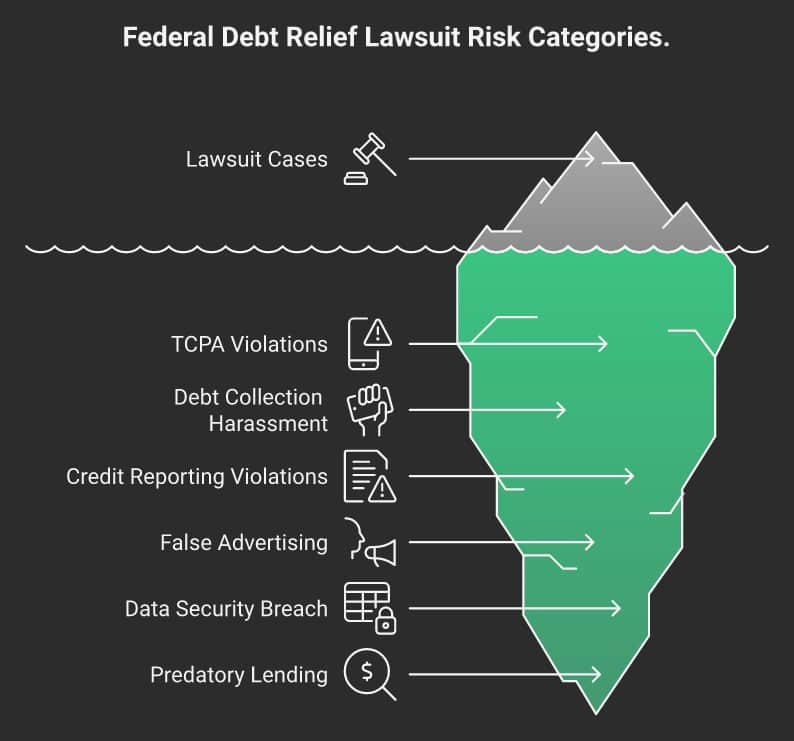
The 23 cases filed the week of March 3, 2026 span six risk categories: TCPA robocall violations (4 cases), FDCPA debt collection harassment and failure to verify (6 cases), FCRA credit reporting errors (2 cases), CROA false advertising by a credit repair company (1 case), a data security breach (1 case), and predatory lending with interest rates exceeding 100% (1 case). The remaining cases are pending complaint availability.
Which companies were sued most frequently in this week’s federal cases?
Resurgent Capital Services and its related entity LVNV Funding appeared in the most cases, facing allegations of debt collection harassment, failure to verify debts, third-party contact violations, and credit reporting errors. Jefferson Capital Systems and Midland Credit Management were each named in multiple cases as well.
What is the TCPA and why does it matter for debt relief companies?
The Telephone Consumer Protection Act (47 U.S.C. § 227) restricts how companies can contact consumers by phone — including prohibiting calls using prerecorded messages without prior express consent and requiring companies to honor Do Not Call requests within 30 days. Violations carry statutory damages of $500–$1,500 per call, making TCPA class actions among the most costly litigation risks in the debt relief industry.
What should a debt relief company’s compliance team review after reading this briefing?
Priority items based on this week’s cases: (1) Scrub outbound calling lists against the National DNC Registry every 31 days and verify your vendor is actually performing this step. (2) Audit your debt verification workflow to confirm all collection activity pauses on disputed accounts. (3) Review marketing materials for any language that could be read as guaranteeing specific outcomes. (4) Confirm all consumer PII is encrypted at rest and in transit. (5) Check that any accounts flagged for identity theft are suppressed from credit reporting immediately.
Is this weekly compliance briefing legal advice?
No. This briefing is for educational purposes only and does not constitute legal advice. The analysis summarizes publicly filed federal court cases and identifies compliance risk patterns. Companies should consult qualified legal counsel regarding their specific practices and regulatory obligations.
This Week’s Cases (February 24–March 3, 2026)
- Reno v. My Credit Guy, Inc., Case No. 8:26-cv-00555 (2026-03-03)
- Schwartz V. Portfolio Recovery Associates, LLC, Case No. 2:26-cv-02026 (2026-03-03)
- Ardis v. LVNV Funding, LLC, Case No. 3:26-cv-00805 (2026-03-03)
- Murray v. Midland Credit Management, Inc., Case No. 2:26-cv-00146 (2026-03-03)
- Montano v. Midland Credit Management, Inc., Case No. 0:26-cv-60475 (2026-03-03)
- Gates v. Jefferson Capital Systems, LLC, Case No. 5:26-cv-01102 (2026-03-03)
- Lopez v. Jefferson Capital Systems, LLC, Case No. 8:26-cv-00484 (2026-03-03)
- Dziurgot v. Resurgent Capital Services L.P., Case No. 0:26-cv-60577 (2026-03-03)
- Dziurgot v. Resurgent Capital Services L.P., Case No. 0:26-cv-60579 (2026-03-03)
- Diaz v. Resurgent Capital Services L.P., Case No. 1:26-cv-21372 (2026-03-03)
- Fernandez v. Resurgent Capital Services L.P., Case No. 0:26-cv-60580 (2026-03-03)
- Mateo V. Resurgent Capital Services L.P., Case No. 2:26-cv-02141 (2026-03-03)
- Resuta v. LVNV Funding, LLC, Case No. 2:26-cv-00345 (2026-03-02)
- Brandolino v. Portfolio Recovery Associates, LLC, Case No. 2:26-cv-00316 (2026-03-02)
- Gonzalez v. Midland Credit Management, Inc, Case No. 2:26-cv-10705 (2026-03-02)
- Cook v. SoFi Technologies, Inc., Case No. 3:26-cv-01722 (2026-03-02)
- Chmielewski v. Advantage First Financial, LLC, Case No. 2:26-cv-02095 (2026-03-02)
- Tom v. Delancey Street Group LLC, Case No. 2:26-cv-01150 (2026-03-02)
- Ussery v. Resurgent Capital Services, L.P., Case No. 1:26-cv-00478 (2026-03-02)
- Davis v. TitleMax of Virginia, Inc., Case No. 1:26-cv-00137 (2026-03-02)
- Harris v. Cordoba Legal Group PLLC, Case No. 2:26-cv-00332 (2026-03-02)
- Vasquez v. SoFi Lending Corp., Case No. 3:26-cv-01228 (2026-03-02)
- Bradford v. OneMain Financial Holdings, LLC, Case No. 4:26-cv-01659 (2026-02-28)
Dealing With Debt? Understanding your options is the first step. See how all your debt relief options compare — including ones most sites won’t tell you about. The Find Your Path quiz gives a recommendation based on your actual numbers, and the Scam-O-Meter checks any company’s complaint history before you sign. Federal Reserve research shows bankruptcy filers recover faster than those who don’t file.



