

Quick Answer: Investment giant Vanguard agreed to pay $29.5 million to settle a multistate antitrust lawsuit alleging it used retirement account holdings to pressure energy companies on environmental goals — without investors’ knowledge or consent. The firm must now offer investors direct proxy voting control over their own shares. Cases against BlackRock and State Street continue.
Your retirement account has one job: grow your money. It’s not a political action committee.— Steve Rhode
I want you to understand something about the money sitting in your retirement account right now. You put it there for one reason: to grow into a number that gives you options when you stop working. That’s the math. Full stop.
So when allegations surface that Vanguard — one of the world’s largest investment managers — used your retirement fund holdings to pressure energy companies to restrict coal output as part of an environmental agenda, that’s not just politics. That’s a potential betrayal of the only deal that matters: grow my money.
Claiming money you are owed is one good day. What you do over the following year is what actually changes your position.
In the latest issue (Nov 6): Owed money on an Amazon return? Check by Dec. 1
Each weekday I send one short email: one story that caught my attention, why it might matter to you, and one manageable thing you can do with it.
Free. I sell nothing. Unsubscribe any time.
On March 2, 2026, Vanguard agreed to pay $29.5 million to settle a multistate antitrust lawsuit brought by 11 state attorneys general — and to fundamentally change how it exercises shareholder rights on behalf of investors. (Source: Alabama Attorney General’s Office)
What Is the Vanguard ESG Lawsuit About?
In November 2024, Texas led a coalition of Republican state attorneys general — including Alabama, Arkansas, Indiana, Iowa, Kansas, Missouri, Montana, Nebraska, West Virginia, and Wyoming — in filing a federal antitrust lawsuit against Vanguard, BlackRock, and State Street.
The states alleged that these three firms — which collectively manage trillions of dollars in retirement and investment assets — formed an effective syndicate through ESG climate initiatives like the Net Zero Asset Managers Initiative and Climate Action 100+. The alleged goal: use their massive collective shareholdings to pressure coal companies into reducing output.
Why does that matter? Because according to the lawsuit, restricting coal supply drove up energy prices — meaning the cost of electricity that everyday Americans pay. The suit alleged violations of the Clayton Act, which prohibits share acquisitions that may substantially lessen competition. (Source: ESG Today)
What Is ESG? Environmental, Social, and Governance investing applies non-financial criteria — like reducing carbon emissions or promoting social justice — to investment decisions. The controversy: when your investment manager applies ESG criteria to your retirement funds without your knowledge, they may prioritize political or environmental goals over maximizing your returns.
The Numbers Behind the Settlement
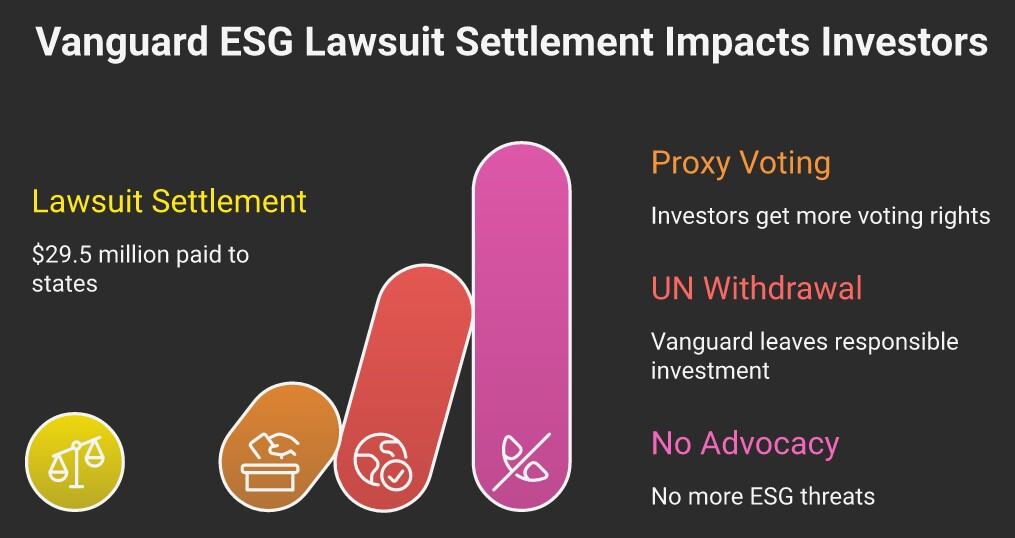
Here’s what I keep coming back to: if the allegations are accurate, the investment managers holding your retirement savings were using those holdings to advance an agenda you never voted for and likely never knew about.
The basic deal when you invest in a fund is: you give us your money, we invest it for maximum returns. You don’t hand them permission to use your shares as political leverage against the companies those shares are invested in.
As Alabama AG Steve Marshall put it: “Wall Street has no business using working people’s retirement accounts to wage war on American energy. When you hand your retirement to an investment firm, you’re trusting them with your family’s future, not handing them a political blank check.”
What Vanguard Agreed to Do Differently
Vanguard did not admit to any wrongdoing. The settlement states it “does not constitute any admission by Vanguard that the law has been violated.” But as part of resolving the case, the firm made several significant behavioral commitments: (Source: PLANSPONSOR)
- No carbon reduction advocacy — Vanguard cannot direct portfolio companies to reduce carbon emissions
- No divestment threats — Cannot threaten to sell shares unless companies comply with ESG demands
- Proxy voting choice for investors — Must offer investors direct proxy voting control in funds covering at least 50% of U.S. equity assets, through at least June 2032
- PRI withdrawal — Must withdraw from the UN Principles for Responsible Investment organization
- No ESG director nominations — Cannot nominate directors or push shareholder proposals to advance ESG goals
That proxy voting commitment is the one that matters most to you as an investor. For the first time, Vanguard investors in a substantial portion of U.S. equity funds will be able to vote their own shares on corporate matters — including whether companies should prioritize profitability over ESG goals.
Cases Against BlackRock and State Street Continue: The lawsuit against BlackRock and State Street remains active in U.S. District Court for the Eastern District of Texas. A federal judge already ruled in August 2025 that most of the states’ claims can proceed. Both firms deny wrongdoing.
What This Means If You Have a Vanguard Account
Practically speaking, the settlement doesn’t change your account balance, your fund options, or your contribution strategy. But it does signal a shift in how your votes are being cast on your behalf.
If you’re invested in Vanguard U.S. equity funds, you should start receiving proxy voting options. That means you — not Vanguard — decide how your shares vote on corporate governance questions at the companies your fund holds.
More broadly, this case is a reminder that the fine print matters. When you select a fund manager, you’re trusting them with more than your dollars. You’re handing them your shareholder voice. Now would be a good time to understand how your investment manager exercises that voice on your behalf.
Not Sure Which Strategy Fits Your Situation? Start with the Find Your Path quiz — it takes 2 minutes and gives you a personalized starting point based on your specific numbers.
FAQ
Does the Vanguard settlement mean the company did something illegal?
No. Vanguard did not admit to any wrongdoing. The firm settled “solely for the purpose of avoiding the burden and expense of litigation.” Whether the underlying conduct was actually illegal remains an open legal question — especially since the cases against BlackRock and State Street are still active.
Will I receive any money from the Vanguard settlement?
No. The $29.5 million goes to the coalition of 11 states that filed the lawsuit, not to individual investors. There is no consumer class action component to this settlement.
What happens to the lawsuit against BlackRock and State Street?
Both BlackRock and State Street remain defendants. A federal judge ruled in August 2025 that most of the states’ claims can proceed. BlackRock has called the case “based on an absurd theory,” while State Street calls it “baseless and without merit.” No settlements have been announced as of March 2026.
Should I move my retirement savings out of Vanguard funds?
That’s a decision only you can make based on your full financial picture. From a pure portfolio standpoint, Vanguard funds are generally considered low-cost and well-diversified. The settlement addresses how Vanguard exercises shareholder votes, not fund performance. If ESG criteria in your investments concern you, review your specific fund holdings and explore ESG-free index fund alternatives. I’d encourage you to use the new proxy voting option Vanguard is now required to offer.
Dealing With Debt? Understanding your options is the first step. See how all your debt relief options compare — including ones most sites won’t tell you about. The Find Your Path quiz gives a recommendation based on your actual numbers, and the Scam-O-Meter checks any company’s complaint history before you sign. Federal Reserve research shows bankruptcy filers recover faster than those who don’t file.



