

Quick Answer: Republican-led states filed an emergency motion on March 3, 2026 to block the SAVE student loan repayment plan from being revived after a federal judge dismissed the original lawsuit. The states are asking the 8th Circuit Court of Appeals for a stay by March 5. For the 7+ million borrowers currently enrolled in SAVE: nothing changes until the Department of Education announces otherwise.
Government programs make promises. Courts make rulings. Only math tells you the truth about your debt.— Steve Rhode
If you’re enrolled in the SAVE student loan repayment plan — or considering whether to apply — I need you to pay attention to what just happened in federal court, because it affects your options.
On March 3, 2026, a coalition of Republican-led states filed an emergency motion asking the U.S. Court of Appeals for the Eighth Circuit to block the SAVE plan from being revived. The states want a stay in place by March 5, 2026 at 5 p.m. so they can pursue an emergency appeal. (Source: The College Investor)
Each weekday I send one short email: one story that caught my attention, why it might matter to you, and one manageable thing you can do with it. A couple of minutes, and a dad joke.
In the latest issue (Nov 6): Owed money on an Amazon return? Check by Dec. 1
Free. I sell nothing. Unsubscribe any time.
To understand why this matters, I need to walk you through what happened a week earlier — because the legal logic here is genuinely unusual.
The SAVE Plan Legal Timeline: What Actually Happened
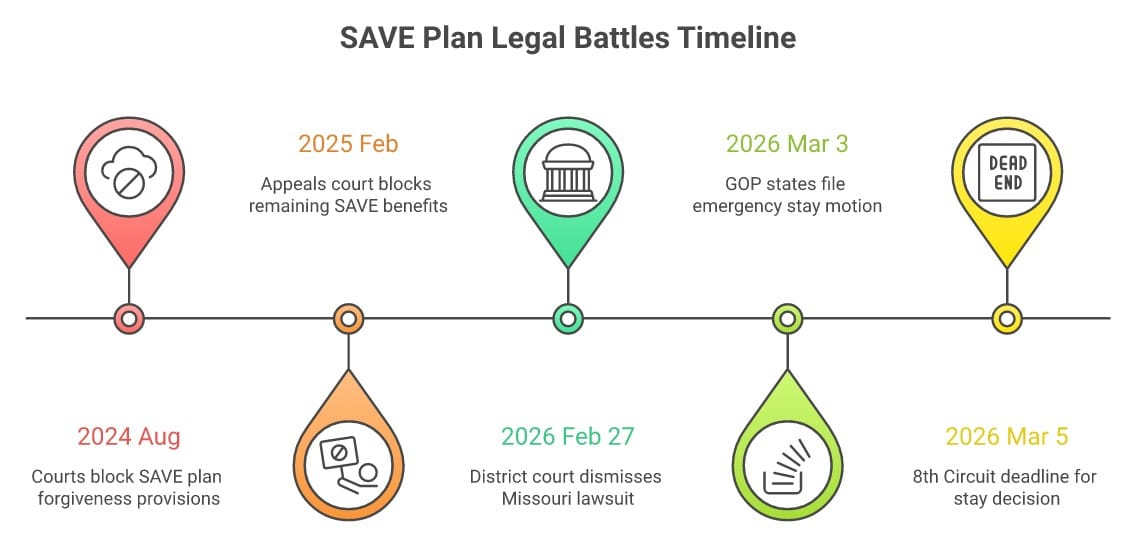
On February 27, 2026, U.S. District Court Judge John Ross dismissed the Missouri-led lawsuit challenging the SAVE plan — but for a reason almost nobody expected: both sides wanted the same outcome.
The Trump administration and Missouri had agreed on a settlement that would have eliminated the SAVE plan ahead of its scheduled 2028 phase-out. Judge Ross dismissed the case because when two parties agree, there’s no live “case or controversy” for a court to resolve. The case essentially ate itself.
Why This Is Legally Unusual: Normally a lawsuit ends when one side wins or the parties settle. In this case, the court dismissed the case because the plaintiff (Missouri) and defendant (federal government) agreed — meaning the settlement they wanted to formalize couldn’t be court-approved without a real dispute. The dismissal left the SAVE plan legally in limbo.
Now the states are scrambling. The warning in their emergency filing: without a stay, “individuals could start applying for student loan relief once again” under the SAVE plan. That’s exactly what the states want to prevent while they appeal to the 8th Circuit. (Source: The College Investor)
What the SAVE Plan Actually Does for Borrowers
Before I tell you what this legal battle means for your specific situation, you need to understand what SAVE was designed to do.
- Payments capped at 5% of discretionary income for undergraduate loans (10% for graduate)
- $0 monthly payments for borrowers earning below 225% of the federal poverty line
- Forgiveness after 10 years for borrowers with original balances of $12,000 or less
- No interest accumulation when your payment covers the interest owed — balance can’t grow
These are meaningful benefits for millions of people managing tight budgets around significant debt loads. Which is precisely why the legal fight over them is so intense.
What This Means If You’re Currently on SAVE
Here’s the clearest thing I can tell you right now: nothing changes for you until the Department of Education says otherwise.
Your current payment amount, your current forbearance status, your current forgiveness timeline — none of those change based on a court motion. Courts move slowly. Bureaucracies move slowly. Your loan servicer needs formal direction from the DOE before any changes hit your account.
Do NOT make rushed decisions based on court filings. If you’ve been on SAVE for years building toward forgiveness, a single motion filing doesn’t reset your clock. Don’t panic-switch to a different repayment plan without running the actual numbers first. Watch for official communication from your loan servicer or StudentAid.gov — that’s the only place official changes will be announced.
The Bigger Problem: Depending on Government Programs
I’ve watched this SAVE plan legal fight unfold for more than a year now, and I want to be direct with you about something.
Government student loan programs are real. The benefits, when they apply, are real. But the track record of these programs making it through the courts intact — especially major forgiveness provisions — is not encouraging. Relying on SAVE forgiveness as your primary debt exit strategy carries political and legal risk that the math in your spreadsheet can’t capture.
That’s not a reason to ignore SAVE or dismiss it. It’s a reason to run your numbers across multiple scenarios:
- What does your payoff look like if SAVE continues as designed?
- What does it look like under a standard 10-year repayment?
- What does it look like under IBR (Income-Based Repayment), which has survived every legal challenge so far?
- What does it look like if you pursue Public Service Loan Forgiveness instead?
Debt is math. Run all the scenarios before you commit to one path — especially one that depends on a program still working its way through federal courts.
Not Sure Which Student Loan Path Is Right for You? The Find Your Path quiz can help you think through your options based on your specific income, balance, and employer situation. It takes 2 minutes.
FAQ: GOP States SAVE Plan Motion
Will my SAVE plan payments change after the March 5 deadline?
Not immediately. Courts process motions over days or weeks, and even if the 8th Circuit grants a stay, the Department of Education must formally implement any changes before your loan servicer adjusts your account. Watch for communication from StudentAid.gov or your servicer — that’s where real changes will be announced. Do not make financial decisions based solely on news reports of court filings.
Should I apply for SAVE right now while the case is in limbo?
That depends on your individual situation. The states’ emergency motion specifically warns that borrowers could start applying for relief under SAVE now that the district court dismissed the case. Whether applying serves your interests depends on your income, loan balance, employer, and timeline to forgiveness. I’d encourage you to run the math under SAVE and compare it to IBR before enrolling, because IBR has a longer legal track record of surviving challenges. Use StudentAid.gov’s Loan Simulator to compare plans side by side.
What is the difference between SAVE and IBR?
Both are income-driven repayment plans, but they calculate payments differently. SAVE caps undergraduate loan payments at 5% of discretionary income with a more generous income exclusion (225% of the federal poverty line). IBR caps payments at 10–15% of discretionary income depending on when you borrowed. IBR has been part of federal law since 2007 and has survived multiple legal challenges. SAVE was introduced by the Biden administration and has faced continuous court challenges since 2024.
What happens to SAVE borrowers if the plan is eliminated?
If SAVE is ultimately struck down or wound down, borrowers currently enrolled would typically be moved to another income-driven repayment plan, most likely IBR or PAYE (Pay As You Earn). The Department of Education would be required to provide a transition path — a complete elimination with no alternative would be legally and administratively complex. However, forgiveness timelines and payment amounts would change, and any forgiveness credit accumulated under SAVE would need to be re-evaluated under the replacement plan’s rules.
Dealing With Debt? Understanding your options is the first step. See how all your debt relief options compare — including ones most sites won’t tell you about. The Find Your Path quiz gives a recommendation based on your actual numbers, and the Scam-O-Meter checks any company’s complaint history before you sign. Federal Reserve research shows bankruptcy filers recover faster than those who don’t file.



