

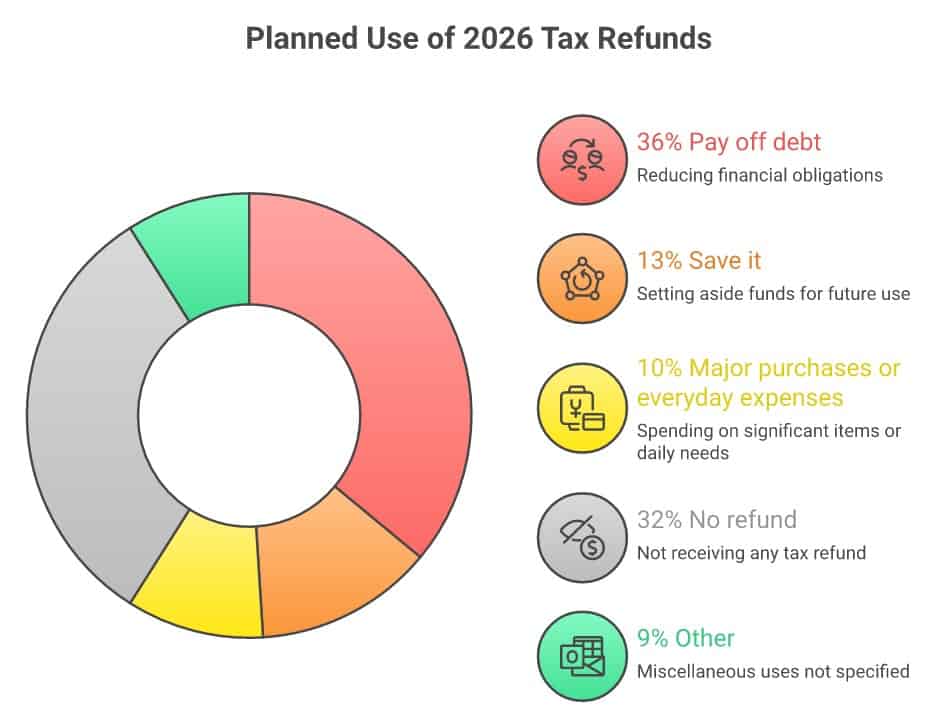
Quick Answer: More Americans struggled with debt in 2025, and 36% plan to use their 2026 tax refund — expected to average around $4,000 this year — to pay it down. That’s the right instinct. But which debt you pay first, and in what order, matters more than the amount you throw at it.
A tax refund is a second chance to fix broken math. Use it wisely — don’t just throw it at the first bill you see.— Steve Rhode
The numbers coming out of this tax season tell a clear story: a lot of people are getting a bigger check from the IRS this year, and a lot of people desperately need it.
According to a Bank of America Global Research survey, 36% of Americans plan to use their 2026 tax refund to pay down debt — consistent with the 34% who said the same thing in 2025. (Source: CBS News / Bank of America)
Claiming money you are owed is one good day. What you do over the following year is what actually changes your position.
In the latest issue (Nov 6): Owed money on an Amazon return? Check by Dec. 1
Each weekday I send one short email: one story that caught my attention, why it might matter to you, and one manageable thing you can do with it.
Free. I sell nothing. Unsubscribe any time.
And refunds are bigger this year. The IRS reports tax refunds are running about 14% higher than at the equivalent point in 2025, with analysts projecting the average check will reach approximately $4,000 — about $1,000 more than last year. (Source: CBS News)
If you’re in the majority of Americans using that money to chip away at debt, I want to make sure you get the most out of every dollar.
How Bad Is the Debt Problem Right Now?
The financial stress behind these numbers is real. About 34% of Americans — roughly 88 million adults — say they are struggling or in financial crisis right now. Mortgage delinquency for households one to two months behind jumped 30.9% from January 2025 to January 2026. And roughly two-thirds of Americans are still living paycheck to paycheck in early 2026 with no sustained improvement. (Source: PYMNTS Research)
A $4,000 tax refund isn’t going to solve all of that. But used strategically, it can break a cycle.
The Right Order to Use Your Tax Refund on Debt
Most financial advice will tell you to throw your refund at your highest-interest debt first. That’s not wrong. But before you do anything with that money, I want you to run through this priority order: Before that, it’s worth asking a more fundamental question: should you use the refund for debt at all? The answer isn’t always yes.
- 1. Stop the bleeding first — If you’re behind on rent, utilities, or mortgage, current month first. Keeping the lights on and a roof overhead takes priority over accelerating debt payoff.
- 2. Build a $1,000 emergency cushion — If you have zero savings, put $1,000 in a savings account first. Without any cushion, the next small emergency goes right back on the credit card. You’re just running in place.
- 3. High-interest revolving debt — Credit cards at 20%+ APR are mathematically the most expensive money you owe. Every dollar applied here saves 20+ cents per year in interest. That’s a guaranteed 20% return on your money.
- 4. Other high-rate debt — Personal loans, medical debt in collections, payday loans. These typically carry punishing rates.
- 5. Lower-rate debt last — Auto loans, student loans, and mortgages often carry rates below 10%. Paying these down accelerates payoff but at a lower mathematical return than high-rate revolving debt.
Never use your tax refund to pay a debt collector without understanding your rights first. If the debt is old, making a payment can restart the statute of limitations and give the collector new legal options against you. If a collector is calling about a debt you don’t recognize or that’s more than a few years old, get validation of the debt in writing before you pay anything.
Free Tool — Statute of Limitations Checker: Dealing with old debt? The free Statute of Limitations Checker tells you if the collection clock has expired in your state — including the zombie debt and clock-restarting traps collectors use. Check My Status →
The Mistake I See Over and Over
The most common mistake people make with a tax refund is paying down debt in a way that feels satisfying rather than doing the most mathematical good.
Paying off the smallest balance feels great. You eliminate a bill. You see a zero. But if that small balance carries an 8% interest rate, and you have a credit card at 22% that you didn’t touch, you just optimized for your emotions and penalized your math.
Debt is math. Your feelings about the balance don’t change what it costs you. A $5,000 credit card at 22% APR costs you $1,100 in interest per year. A $1,000 personal loan at 8% costs you $80. The math tells you exactly where $1,000 applied has the most impact.
Quick Math: If you have $4,000 to apply to debt, and you put it on a credit card charging 22% APR, you save approximately $880 in annual interest. If instead you put the same $4,000 on a student loan at 5%, you save $200. Same $4,000. Very different outcome.
What If Your Debt Is Too Big for a Refund to Move the Needle?
Sometimes a $4,000 refund against $40,000 in high-rate debt doesn’t feel like enough to matter. I understand that feeling. But it does matter — and if your debt load is large enough that a refund barely touches it, that’s useful information.
It means it’s time to look at your options more broadly, not just the minimum-payment grind. There are real options that most people in that situation haven’t fully evaluated:
- Balance transfer to a 0% APR card (if your credit qualifies) to pause interest accrual
- Debt consolidation loan at a lower rate to simplify and reduce the interest burden
- Nonprofit credit counseling (DMP) if you need structure and creditor cooperation
- Debt settlement if your balances are in or approaching collections
- Bankruptcy — which, when the math truly doesn’t work, can be the fastest path to a fresh financial start
I know that last one makes people uncomfortable. But here’s what I’ve watched happen to real people over 30 years: grinding through debt that can’t mathematically be paid off delays a fresh start by years and costs retirement savings in the process. The math doesn’t care about the stigma.
Not Sure Which Path Makes Sense for Your Numbers? The Find Your Path quiz walks you through your specific situation and points you toward the options that actually fit. It’s free and takes 2 minutes.
FAQ: Tax Refunds and Debt Payoff
Should I use my tax refund to pay off debt or save it?
If you have no emergency savings at all, build a $1,000 cushion first — a bare minimum buffer that keeps small emergencies from creating new debt. After that, if you’re carrying high-rate credit card debt (above 10% APR), paying it down is mathematically better than saving, because no savings account pays 20%+ interest. The exception: if your employer matches 401(k) contributions and you’re not yet capturing the full match, contribute enough to get the match first — that’s an immediate 50-100% return on your contribution.
Which debt should I pay off first with my tax refund?
Mathematically: the debt with the highest interest rate. This is the avalanche method, and it minimizes the total interest you pay over time. Psychologically: some people find it easier to eliminate the smallest balance first (the snowball method) because the quick win keeps them motivated. Either approach gets you out of debt. Avalanche saves more money. Choose the one you’ll actually stick to.
Is it smarter to pay down debt or invest my tax refund?
If your debt carries an interest rate higher than what you’d reasonably expect to earn investing — and credit cards at 20%+ easily clear that bar — paying down debt first is the smarter mathematical move. Paying off a 22% credit card is a guaranteed 22% return. Stock market historical averages run around 10% annually and with real risk. The guaranteed return wins. Once high-rate debt is gone, redirect that money to investing.
What if I owe the IRS money instead of getting a refund?
If you have a balance due to the IRS, pay it first — IRS penalties and interest add up quickly, and the IRS has collection powers (wage garnishment, bank levies) that ordinary creditors don’t. If you can’t pay the full balance, file on time anyway to avoid the failure-to-file penalty, which is much larger than the failure-to-pay penalty. Then contact the IRS to set up an installment agreement, which currently carries interest around 8% — often lower than credit card rates.
Dealing With Debt? Understanding your options is the first step. See how all your debt relief options compare — including ones most sites won’t tell you about. The Find Your Path quiz gives a recommendation based on your actual numbers, and the Scam-O-Meter checks any company’s complaint history before you sign. Federal Reserve research shows bankruptcy filers recover faster than those who don’t file.



