Quick Answer: APR — Annual Percentage Rate — is the true annual cost of borrowing money, expressed as a percentage. It includes the interest rate plus fees and other charges, giving you a more complete picture than the interest rate alone. Knowing APR is useful — but it won’t automatically protect you from problem debt. Research consistently shows that most people who borrow at high rates have some sense of the cost. They borrow anyway, because debt decisions are driven by emotion and circumstance far more than information gaps. The goal of understanding APR isn’t to immunize yourself against bad debt. It’s to have the facts when you actually have a choice.
And one place the APR ceiling is actually written into law: federal credit unions — see my post on whether a credit union can charge whatever rate the market allows for the 18% cap and its limits.
Expert Context: I’ve been studying the relationship between financial literacy and debt outcomes since 1994, when I founded a credit counseling organization. What I’ve learned from helping thousands of people through debt crises is that many of them had a rough idea the costs were high — and they borrowed anyway. Not because they were foolish, but because they were in crisis, out of options, or driven by pressures that no amount of APR knowledge was going to fix.
This question came through the Ask Steve chat — and honestly, it’s one I love getting because it means someone is asking before they borrow instead of after. That’s the right order.
Each weekday I send one short email: one story that caught my attention, why it might matter to you, and one manageable thing you can do with it. A couple of minutes, and a dad joke.
In the latest issue (Oct 16): The check that looks like a scam may be real
Free. I sell nothing. Unsubscribe any time.
The Question That Came In:
“I’m in my mid-20s and really want to avoid debt as much as possible. I keep seeing APR mentioned everywhere but I was never taught what it actually means. Could someone explain how APR works in plain language?”
This question touches two things I care deeply about. The first is that financial literacy education in schools has largely failed — and this question is living proof. APR is one of the most consequential numbers in personal finance, and most people leave school never having had it explained properly. The second is a nuance worth getting right: avoiding debt and avoiding problem debt are two different goals — and conflating them can actually cost you.
Debt is math wrapped in emotion. The math part — I can explain in a few paragraphs. The emotion part is why financial literacy education has largely failed to prevent problem debt for fifty years despite enormous effort. Both things are worth knowing. Let me start with the numbers.
APR: What It Actually Means
APR stands for Annual Percentage Rate. It tells you the yearly cost of borrowing money — not just the interest, but the total cost including fees — expressed as a percentage of the amount you borrowed.
For a real-world example of predatory rates in action, see how the DOJ settled a $68 million predatory lending case against Colony Ridge — where seller-financed mortgages trapped Hispanic buyers.
Here’s the distinction the CFPB explains and almost everyone misses:
Interest Rate
- The cost of borrowing the principal only
- Does not include fees
- Lower number — looks more attractive
- Lenders advertise this one prominently
APR
- Interest rate plus origination fees, points, and other charges
- The true annual cost of the loan
- Always higher than the interest rate
- Required by federal law to be disclosed (TILA)
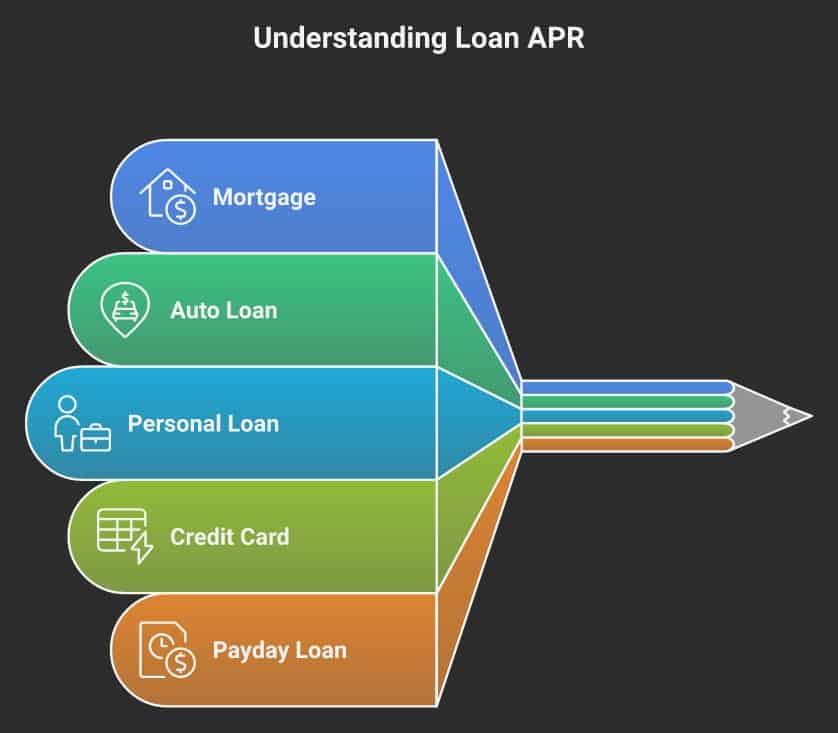
The federal Truth in Lending Act (TILA) requires every lender to tell you the APR before you sign anything. This was intentional — Congress decided in 1968 that consumers needed one standardized number to compare loans apples-to-apples. Always compare APRs, never interest rates.
That payday loan number is not a typo. A $300 loan for two weeks that costs $45 in fees works out to roughly 390% APR. The amount is small. The cost is catastrophic if you roll it over — which is exactly how people get trapped.
Free Tool — Contract Decoder: Have a contract from a debt relief company? The free Contract Decoder analyzes it for red flags, hidden fees, and problematic terms — before you sign anything. Decode My Contract →
APR in Practice: The Math That Matters
Here’s a simple way to think about it. If you borrow $1,000 at 20% APR for one year and make no payments, you’d owe $1,200 at the end. That’s your $1,000 back plus $200 in cost.
But most loans compound — meaning interest accrues on the growing balance, not just the original amount. This is where people get surprised. A credit card at 24% APR on a $5,000 balance, if you only pay the minimum each month, can take over a decade to pay off and cost you more in interest than the original balance.
The Math: $5,000 credit card balance at 24% APR, minimum payments only → roughly $4,800+ in interest paid over 10+ years before it’s paid off. The math doesn’t lie — it just doesn’t volunteer this information upfront.
The Part Schools Get Wrong
I want to be direct about something. I’ve written and researched extensively on why financial literacy education doesn’t work — and this question is a perfect example of the failure. A concept as fundamental as APR should be understood by every adult. It isn’t. That’s not your fault. The school system teaches you to balance a checkbook and call it financial literacy, then sends you into a world full of 24% credit cards and 400% payday loans.
The Financial Literacy Myth: “Teach people about APR and they’ll make better borrowing decisions.”
The Reality: Decades of research show that financial literacy education doesn’t reliably change borrowing behavior. People who take payday loans at 400% APR often know the cost is high — they take them because they’re in crisis, out of options, or too ashamed to ask for help through other channels. Information doesn’t fix desperation. What knowing APR does help with is comparing options when you genuinely have options. That’s worth a lot — just not as much as the financial literacy industry claims.
What Schools Do Teach: “Avoid all debt. Debt is bad.”
Also Wrong: There is a meaningful difference between problem debt and productive credit use. A mortgage at 6.5% APR on a home that appreciates in value is a completely different instrument than a payday loan at 400% APR. Blanket “debt is bad” advice causes real harm by preventing people from using credit tools that could genuinely serve their future.
Credit and debt are tools. A hammer is not “bad” — but it does significant damage when used incorrectly. The goal is to understand what you’re holding before you swing it.
Good Debt vs. Problem Debt
This distinction matters because blanket “avoid all debt” advice can actually hurt you. Here’s a practical framework:
- Lower APR than your returns elsewhere — a 3% mortgage while your retirement investments grow at 7% is mathematically favorable
- Fixed, predictable payments — you can plan around it
- Builds an asset or income — mortgage, student loan for a high-earning field, business loan
- You can comfortably service it — payments don’t crowd out savings or emergencies
- High APR on depreciating purchases — financing a vacation at 22% APR
- Revolving balances on credit cards — especially if you’re only paying minimums
- Payday, title, or tribal loans — triple-digit APR by design
- Debt to cover debt — taking a personal loan to pay a credit card without fixing the underlying spending
My Take: Knowledge Is Necessary But Not Sufficient
The fact that you’re asking this question before you have debt is genuinely good. But I want to be honest with you about the limits of what knowing APR will and won’t do for you.
What it will do: give you a standardized way to compare any two loans fairly. That’s real. When you have choices — when you’re comparing a personal loan at 12% to a credit card at 24% — knowing APR lets you make a rational decision.
What it won’t do: protect you from the emotional and situational pressures that cause most problem debt. I’ve watched this for thirty years. People don’t usually fall into payday loan traps because they didn’t know the rate was high. They fall in because they’re scared, behind on something, too ashamed to explore alternatives, or convinced it’s just this once. No amount of financial literacy fixes that — which is why financial literacy education, despite being taught in schools for decades, has produced almost no measurable improvement in debt outcomes at the population level.
So yes: know the APR. Know the total interest paid over the life of the loan. Know what that monthly payment does to your cash flow. Those are the right questions to ask when you have options. But also know yourself — why you spend the way you do, what triggers borrowing decisions you later regret, what “I’ll just use the card this once” really means in your life. The Money Personality Quiz is worth taking for exactly that reason.
If you’re curious about where you stand overall and whether borrowing makes sense for your specific situation, the Find Your Path Quiz can help you think through your options.
Knowing APR is necessary. Understanding why you borrow the way you do is the part that actually changes outcomes.— Steve Rhode
Still have questions about your specific situation? Ask me directly in the chat — whether it’s about a specific loan you’re considering, a debt you’re already in, or just understanding your options. Every situation is different and I read every question.
Key Takeaways
- APR is the true annual cost of borrowing — it includes the interest rate plus all fees
- Always compare APRs, never just interest rates — federal law (TILA) requires lenders to disclose APR
- Payday and high-rate loans can carry 300–700% APR — the small dollar amount disguises catastrophic cost
- Knowing APR helps when you have choices — it doesn’t protect against the emotional and situational drivers of most problem debt
- Financial literacy education has not measurably reduced problem debt — understanding yourself matters as much as understanding the numbers
The Bottom Line
APR — Annual Percentage Rate — is the true annual cost of borrowing, including interest and all fees, expressed as a percentage. It is the only number that lets you compare loans fairly, and federal law requires every lender to disclose it before you sign. The difference between a 6% mortgage and a 400% payday loan is not a matter of degree — it is a different universe of financial consequence. But knowing APR is not a shield against problem debt. Research and thirty years of watching real people in real debt crises tells me that most problem debt is driven by emotion, circumstance, and desperation — not information gaps. Know the numbers. And know yourself. One without the other is half a plan.
Free Tool — Money Personality Quiz: Your spending habits are as individual as your debt. The free Money Personality Quiz identifies your money type — and why standard budget advice probably isn't working for you. Discover Your Type →
Frequently Asked Questions
What is the difference between APR and interest rate?
The interest rate is the basic cost of borrowing the principal. APR is the interest rate plus fees and other charges rolled in — origination fees, points, mortgage insurance, and similar costs. APR is always equal to or higher than the interest rate. The CFPB recommends always comparing APRs, not raw interest rates, because APR reflects the actual total cost.
Why do payday loans have such high APRs?
Payday loans charge a flat fee — often $15–$30 per $100 borrowed — for a two-week loan. When you annualize that fee as required by TILA, it produces APRs of 300–700% or more. The fee sounds small; the APR reveals the true cost. If you roll the loan over even once or twice, the total paid can exceed the original amount borrowed.
Installment lenders can carry APRs almost as extreme — Enova International’s own SEC filing confirms it forgave $87 million after Virginia accused its NetCredit brand of charging up to 155% interest, more than 12 times the state’s rate cap.
Is it ever smart to take on debt?
Yes — when the cost (APR) is lower than what you’d earn or save by using the money productively, when the payments are manageable and predictable, and when it builds an asset or income. A mortgage, a car loan at a reasonable rate, or a student loan for a field with strong earnings potential can all be sound decisions. The problem isn’t debt — it’s high-cost, unmanageable debt used to finance consumption.
How do I find the APR on a loan before I sign?
Federal law (TILA) requires lenders to disclose the APR before you finalize any loan. For credit cards, it’s on the Schumer Box in the card agreement. For mortgages, it’s in the Loan Estimate. For auto loans, it’s on the Truth in Lending disclosure. If a lender refuses to give you the APR clearly, walk away — that’s a red flag.
What APR is considered “good” vs. “dangerous”?
Context matters — good APR depends on the loan type. For mortgages, anything under 7–8% has historically been reasonable. For personal loans, under 15% is generally manageable for good-credit borrowers. For credit cards, under 20% is better than average. Anything above 36% — the threshold consumer advocates consider predatory — is territory to avoid if at all possible. Triple-digit APR is a debt trap by design.
Dealing With Debt? Understanding your options is the first step. See how all your debt relief options compare — including ones most sites won’t tell you about. The Find Your Path quiz gives a recommendation based on your actual numbers, and the Scam-O-Meter checks any company’s complaint history before you sign.