
Quick Answer: Form 1099-C is a tax form lenders send when they cancel or forgive $600 or more of your debt — and yes, the IRS generally treats forgiven debt as taxable income. But “generally” is doing a lot of work in that sentence. There are several legal exclusions that can reduce or eliminate your tax liability entirely, the form itself is sometimes wrong, and panicking before you understand your situation is the worst thing you can do. A Form 1099-C is an invitation to do more research — not an automatic tax bill.
Want to know if you actually owe tax on your 1099-C? Use my free Do You Owe Tax from a 1099-C? calculator — it walks you through the insolvency and bankruptcy exclusions to give you a straight answer.
Expert Context: I’ve been helping people deal with canceled debt and 1099-C forms since the late 1990s — and I’ve seen every possible outcome. I’ve seen people owe nothing despite receiving a 1099-C for tens of thousands of dollars. I’ve seen forms issued with the wrong amount, the wrong year, or sent to someone who didn’t even owe the debt. I’ve seen collectors issue 1099-Cs on debts that should never have been reported. The form creates panic. That panic makes people do the wrong thing. My job is to slow that down so you can make an informed decision.
Every tax season, millions of Americans open an envelope and find a Form 1099-C — a notice that a lender has reported canceled or forgiven debt to the IRS. The immediate fear: “I owe taxes on money I already couldn’t afford to pay.” That fear is understandable. It’s also often wrong.
Each weekday I send one short email: one money story that caught my attention, why it might matter to you, and one manageable thing you can do with it. A couple of minutes, and a dad joke.
In the latest issue (Oct 16): The check that looks like a scam may be real
Free. I sell nothing. Unsubscribe any time.
Key Terms Defined
Form 1099-C (Cancellation of Debt): An IRS information return that lenders, creditors, and debt collectors must file — and send to you — when they cancel $600 or more of debt. It reports the canceled amount as income you may owe taxes on.
Canceled debt: Any debt a creditor forgives, discharges, or writes off without requiring full repayment. This includes settled credit card balances, forgiven personal loans, short sales on mortgages, and debt discharged in bankruptcy.
Insolvency: The IRS definition is simple: your total liabilities exceeded your total assets at the moment the debt was canceled. If you were insolvent, you can exclude the canceled amount from taxable income — up to the amount by which you were insolvent.
Form 982: The IRS form you file alongside your tax return to claim an exclusion and reduce your tax liability on canceled debt. IRS Topic 431 explains when each exclusion applies.
What Form 1099-C Actually Means
When a creditor cancels your debt, they are required by law to report it to the IRS using Form 1099-C if the amount is $600 or more. They must also send you a copy by January 31 of the year following the cancellation. The IRS treats canceled debt as income by default — the logic being that you received money (the loan) and never repaid it, which is economically similar to receiving income.
But that default rule has significant exceptions, and understanding them is the entire game. IRS Publication 4681 — the official guide to canceled debts — runs to dozens of pages specifically because the “you owe tax on this” rule breaks down in many real-world situations.
The Five Exclusions That Can Eliminate Your Tax Liability
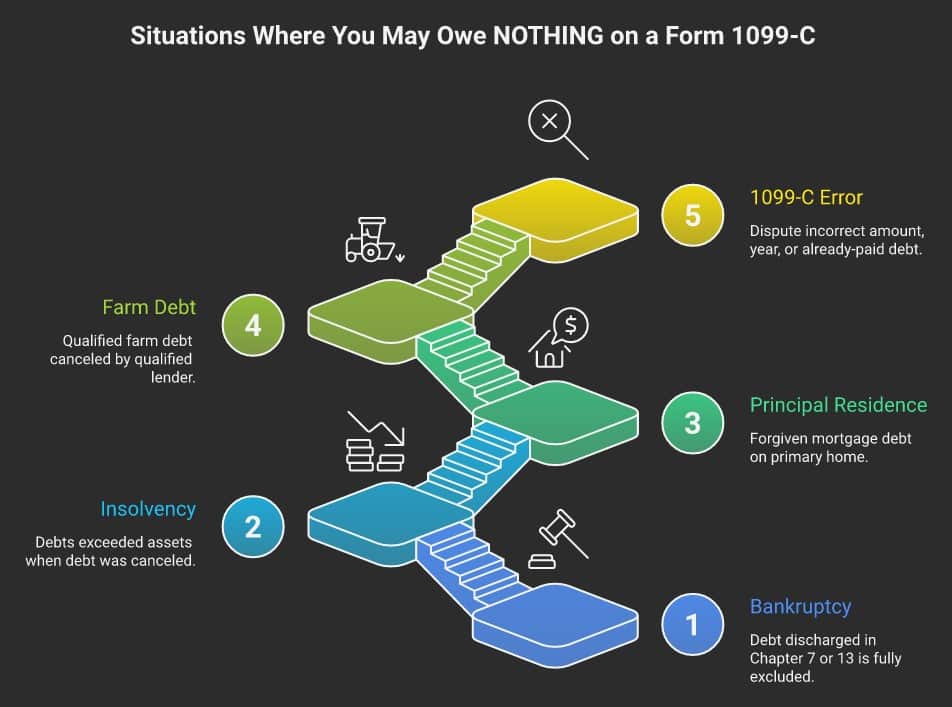
According to IRS Topic 431, there are five situations where canceled debt is excluded from your taxable income. If any of these apply, you file Form 982 with your return and the tax goes away — entirely or partially.
- Bankruptcy: Debt canceled in a Title 11 bankruptcy case is completely excluded. If you filed Chapter 7 or Chapter 13 and debt was discharged, no income tax is owed on it. Full stop.
- Insolvency: If your total liabilities exceeded your total assets at the moment the debt was canceled, you can exclude the canceled amount up to the extent you were insolvent. This catches many people who settled debts while genuinely broke — which is most people who settle debts.
- Qualified Farm Indebtedness: Cancellation of qualified farm debt by a qualified lender is excluded.
- Qualified Real Property Business Indebtedness: Certain business real estate debt cancellations can be excluded, with basis reductions limited to depreciable real property.
- Qualified Principal Residence Indebtedness: Mortgage debt forgiven on your primary home — applies if the discharge was before January 1, 2026, or subject to a written arrangement entered before that date.
Important 2026 change: The temporary exclusion for student loan forgiveness (in effect 2021–2025 under the American Rescue Plan) expired December 31, 2025 and was not extended. If you received student loan forgiveness in 2026, the canceled amount may now be taxable income. This is a significant shift from recent years — consult a tax professional.
The Insolvency Exclusion: The One Most People Miss
The insolvency exclusion is the most broadly applicable — and the most commonly overlooked. If you went through debt settlement specifically, here is the detailed breakdown of how the 1099-C tax bomb from debt settlement works and how to avoid it. The math is straightforward: if your total debts exceeded your total assets immediately before the debt was canceled, you were insolvent. The canceled amount is excluded from income up to the amount of that insolvency.
Example: You settled a $10,000 credit card balance for $3,000, and the bank canceled the remaining $7,000. You receive a 1099-C for $7,000. But at the time of the settlement, your total debts were $50,000 and your total assets were $5,000 — making you insolvent by $45,000. The entire $7,000 is excluded. You owe no tax on it.
The IRS Taxpayer Advocate Service specifically helps people who receive 1099-Cs they can’t afford to pay taxes on — and insolvency is the first question they ask. Use the Insolvency Worksheet in IRS Publication 4681 to calculate your position.
The 1099-C May Simply Be Wrong
This is the thing the tax prep software doesn’t tell you: 1099-C forms contain errors more often than people realize. I’ve documented cases involving every kind of mistake — and I even have a separate post about IRS Form 4598, a little-known form specifically for disputing incorrect 1099s.
Common errors I’ve seen:
- Wrong dollar amount — The canceled amount is overstated, sometimes dramatically. Debt collectors who purchased the account for pennies on the dollar sometimes report the original face value rather than what was actually canceled.
- Wrong year — The event triggering the cancellation happened in a prior tax year, but the form is issued late. This can create a tax liability in the wrong year.
- Already paid — The debt was actually paid, settled, or discharged in bankruptcy years earlier, but a new collector issues a 1099-C when they write it off their books. You may have documentation proving the debt was resolved.
- Wrong taxpayer — Errors in debt-sale chains mean the form occasionally goes to the wrong person entirely.
- Statute of limitations trigger — Some creditors issue 1099-Cs on debts that have passed the statute of limitations as a way to force a response. Receiving the form doesn’t mean the debt is valid.
What to do if your 1099-C is wrong: Contact the lender in writing to request a corrected form. If they refuse, you still report the amount on your tax return — but you attach an explanation of why it’s incorrect and back out the disputed amount. The IRS Taxpayer Advocate can help if you’re stuck. Calling the IRS directly to initiate a Form 1099 complaint shifts the burden of proof to the issuer once you document the dispute.
Free Tool — 1099-C Tax Calculator: Received a 1099-C for cancelled debt? The free 1099-C Tax Calculator runs the exact IRS insolvency math from Publication 4681 Worksheet 2 — and covers the partial insolvency case most people miss. Run the Calculator →
Does Receiving a 1099-C Mean You Still Owe the Debt?
The Myth: “I got a 1099-C, so the debt is officially forgiven and I definitely don’t owe it anymore.”
The Reality: Not necessarily. A 1099-C is a tax form reflecting a creditor’s internal accounting decision — it doesn’t automatically extinguish the legal debt. Some creditors issue a 1099-C while still technically able to pursue collection. However, a 1099-C is strong evidence that the creditor has written off the debt, and it can be used in your defense if collection attempts continue. This is a complex area where a consumer law attorney or the CFPB can give you guidance specific to your state.
Free Tool — Statute of Limitations Checker: Dealing with old debt? The free Statute of Limitations Checker tells you if the collection clock has expired in your state — including the zombie debt and clock-restarting traps collectors use. Check My Status →
What to Do When You Receive a Form 1099-C
- Don’t panic. The form is not a bill. It’s a notification that requires research, not immediate payment.
- Check your insolvency position. Use the worksheet in IRS Publication 4681 to calculate whether your liabilities exceeded your assets when the debt was canceled.
- Check whether you filed bankruptcy. If the debt was discharged in a bankruptcy proceeding, it’s excluded — period. File Form 982.
- Verify the form is accurate. Compare the amount, year, and creditor against your records. If anything looks wrong, dispute it in writing.
- Consult a tax professional. This is one situation where a CPA or enrolled agent earns their fee. The exclusion rules interact with other tax attributes and the calculations can get complicated fast.
- File Form 982 if an exclusion applies. Don’t just omit the income — attach Form 982 and explain the basis for exclusion. Omitting income the IRS already knows about triggers automatic notices.
If you’re not sure which direction to go, the Find Your Path quiz can help you assess your overall financial situation and whether the debt involved might have been better handled through bankruptcy or another route.
Key Takeaways
- Form 1099-C reports canceled debt as potential taxable income — but five IRS exclusions can eliminate the tax entirely, including insolvency and bankruptcy
- The insolvency exclusion is the most broadly applicable and most commonly missed: if your debts exceeded your assets when the debt was canceled, the canceled amount may not be taxable
- 1099-C forms contain errors more often than people realize — wrong amounts, wrong years, debts already resolved
- The form is not a bill and doesn’t automatically confirm you owe the underlying debt
- File Form 982 with your tax return to claim any exclusion; don’t just leave the income off without explanation
The Bottom Line
A Form 1099-C in your mailbox is not the end of the conversation — it’s the beginning of one. The IRS default is that canceled debt is taxable income, but the exceptions are broad enough that many people who receive 1099-Cs owe nothing at all. The insolvency exclusion alone catches most people who settled debts because they couldn’t pay them. The form is also wrong surprisingly often. Before you write a check to the IRS, work through the IRS Publication 4681 insolvency worksheet, check whether bankruptcy applied, verify the form’s accuracy against your records, and consult a tax professional. Panic is the enemy here. Research is the antidote.
Frequently Asked Questions
What is a Form 1099-C used for?
Form 1099-C (Cancellation of Debt) is used by lenders and creditors to report to the IRS when they cancel $600 or more of a borrower’s debt. The IRS generally treats canceled debt as taxable income — similar to receiving wages — unless an exclusion applies. The lender must send you a copy by January 31 of the year following the cancellation. IRS Topic 431 explains the full rules.
How does a 1099-C affect my tax refund?
If the canceled amount is taxable, it’s added to your gross income for the year, which can increase your tax liability and reduce or eliminate a refund — or create a balance owed. However, if you qualify for an exclusion (insolvency, bankruptcy, etc.) and file Form 982, the canceled amount is removed from taxable income and the impact on your refund disappears. The net effect depends entirely on whether an exclusion applies to your situation.
What happens if you don’t report a 1099-C?
The lender filed the same 1099-C with the IRS that they sent you — the IRS already knows about the canceled amount. If you don’t report it and don’t file Form 982 with an exclusion, the IRS will typically send an automated notice adding the amount to your income and billing you for the tax plus interest. It’s far better to report it properly (including claiming any exclusion you qualify for) than to ignore it and wait for the IRS to catch it.
Can a 1099-C be wrong?
Yes — more often than most people realize. Common errors include the wrong dollar amount (especially when debt was purchased by a collector at a discount), the wrong tax year, forms issued on debts that were already resolved or discharged in bankruptcy, and occasionally the wrong taxpayer entirely. If you believe your 1099-C is incorrect, contact the issuer in writing to request a corrected form. If they refuse, report the amount on your return, back it out with an explanation, and document your dispute. I have a separate post on using IRS Form 4598 to dispute an incorrect 1099-C.
Do I still owe the debt if I received a 1099-C?
Not automatically. A 1099-C reflects the creditor’s internal accounting decision to write off the debt — it doesn’t legally extinguish the underlying obligation in every case. Some creditors issue 1099-Cs while technically retaining the right to collect. That said, a 1099-C is strong evidence the creditor has abandoned collection efforts, and it can be useful if collection attempts resume. The CFPB has guidance on this, and a consumer law attorney can advise you based on your state’s laws.
Dealing With Debt? Understanding your options is the first step. See how all your debt relief options compare — including ones most sites won’t tell you about. The Find Your Path quiz gives a recommendation based on your actual numbers, and the Scam-O-Meter checks any company’s complaint history before you sign. Federal Reserve research shows bankruptcy filers recover faster than those who don’t file.



I still have not received my 1099-c from my Barclay account. My debt was forgiven in March 2025. They say they sent it out on January 31 2026. I called them in March 2026 to get a copy. They say a request was made and as of today April 9, 2026. I still have not received it. I called and they said that the department was back logged. What should I do about my taxes? All I wanted was their TIN number and account number. I have the rest of the info. They say they can’t give it out, which I don’t understand because the TIN will be on my 1099c when I get it
You can always file a free extension for filing while you wait.