

Quick Answer: Before putting an inheritance toward your mortgage, run the math. If your mortgage interest rate is lower than what that money could reasonably earn invested — and right now, with 30-year mortgage rates around 6%, that comparison is genuinely close — paying off the mortgage may not be the best use of a lump sum. Investing it in a diversified index fund, letting it compound, and potentially paying off the mortgage later could leave you with more total wealth than an immediate paydown. The right answer depends on your specific rate, your age, your retirement situation, and how you’d feel carrying the mortgage longer.
Expert Context: Over decades of helping people work through debt and financial decisions, I’ve watched people make lump-sum choices based on how the mortgage feels rather than what the numbers say. The emotional pull to eliminate debt is real and not irrational — but it’s worth separating from the math before you act.
This question came through the Ask Steve chat — and it’s one of those questions where the obvious answer and the mathematically correct answer aren’t always the same thing.
The Question That Came In:
Every weekday I read the enforcement actions, filings and fine print the outlets skip, and turn them into the one or two moves that actually improve your position — a rate worth moving for, a fee you can refuse, a deadline to beat before it costs you.
In the latest issue (Oct 9): Does Financial Literacy Make Financial Sense?
I write Your Money Actually most weekdays — actionable money information you will not find anywhere else, and the small decisions that compound. It is free, I sell nothing, and I take no money from any company I write about.
“I recently inherited some money and my first instinct was to put it straight toward my mortgage. My spouse thinks we should invest it instead. How do we even think through this decision?”
Your spouse is asking exactly the right question. This is a math problem before it’s anything else — and the math isn’t always obvious.
The instinct to eliminate debt is emotionally satisfying and financially understandable. But when you have a lump sum and a mortgage, the decision isn’t “debt is bad, pay it off.” The decision is: which use of this money produces better outcomes for your future?
The Core Math: Rate vs. Return
Here’s the framework. Your mortgage has an interest rate. That rate is the guaranteed, after-tax cost of keeping the mortgage. Your inheritance, if invested, has an expected return. If that expected return exceeds the mortgage rate — accounting for risk and taxes — investing wins mathematically.
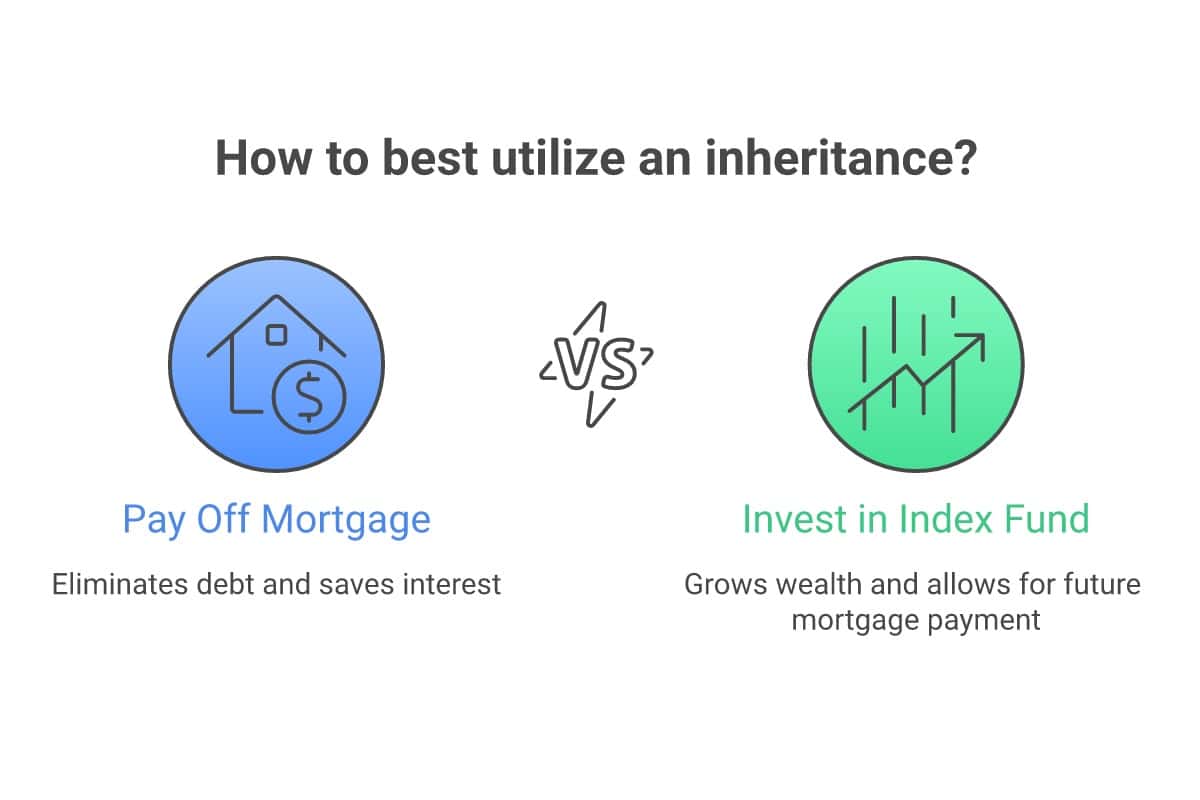
Common Assumption: “Paying off debt is always the smart financial move.”
What the Math Says: Paying off a 6% mortgage with money that could compound at 7–10% annually means giving up that difference in growth — permanently. Debt elimination is smart when the debt costs more than the money can earn elsewhere. When the math runs the other way, paying it off early is an emotional decision, not necessarily a financial one.
Free Tool — Your Brain on Debt Quiz: Fear, shame, and panic don't just make debt harder — they actively drive people toward bad decisions. The free Your Brain on Debt Quiz identifies which emotional driver is in control of your financial choices right now. Take the Quiz →
The Scenario Steve’s Notes Described
Here’s what I suggested when this question came in: what if you invested the inheritance in a stable, diversified index fund, let it grow, and used both the original principal and the accumulated growth to pay off the mortgage at some future point — while still having money left over?
The Daily Money Brief — Free, at 10 AM
Money you may be owed, scams to dodge, and the fine print decoded — the consumer money news that affects your wallet, every weekday.
Run that forward. If your mortgage balance is $200,000 at 6% and you inherit $200,000:
- Pay it off today — mortgage gone, inheritance gone, net gain: saved the remaining interest
- Invest at 8% average annual return — in 10 years, $200,000 grows to roughly $431,000. You could pay off the remaining mortgage balance AND still have significant wealth remaining
That’s not guaranteed — markets fluctuate, and your actual numbers depend on your rate, your balance, your timeline, and your fund’s performance. But the comparison is worth doing before you write the check.
What Changes the Answer
The math framework above is a starting point, not a verdict. These factors can shift the decision:
- Your mortgage rate. A 3% rate from 2021 is a different calculation than a 7.5% rate from 2023. The lower your rate, the more likely investing wins. The higher the rate, the closer the comparison gets.
- Your age and retirement timeline. If you’re 58 with 7 working years left and no retirement savings, that inheritance may serve your future better as retirement capital than as mortgage paydown. If you’re 35 with a funded 401(k) and 30 years of compounding ahead, the math looks different again.
- Your retirement savings status. Before putting a lump sum toward a mortgage, I’d want to know: is your retirement funded? A mortgage is a low-cost loan against an appreciating asset. Retirement savings — especially tax-advantaged accounts — are irreplaceable once the window to contribute passes.
- Risk tolerance and psychology. The math can favor investing, but if the volatility of a market-invested inheritance would cause you genuine anxiety, that’s real. Sleeping well has value. The right financial decision is the one you can actually live with.
- Your tax situation. Mortgage interest deductibility, investment gains, and your overall tax bracket all affect the true comparison. Worth a conversation with a CPA before a large lump-sum decision.
Quick Check: What’s your current mortgage rate? If it’s under 5%, the math strongly favors investing in almost all scenarios. If it’s 7%+, the comparison tightens considerably. If it’s right around 6% — where the national average sits today — you’re squarely in “it depends on your situation” territory.
What About Taxes on the Inheritance?
One thing worth clarifying: for most people, inherited money is not taxable income. The IRS confirms that amounts received as bequests or inheritances are generally excluded from gross income. There is a federal estate tax, but it applies to the estate itself above a high exemption threshold — not to what you receive as the beneficiary. State rules vary, so check your state’s inheritance tax laws, but for most people, you can deploy the inheritance without worrying about an immediate income tax bill on receipt.
My Take: Do the Math Before You Do Anything
When someone inherits money, the immediate emotional pull is usually one of two things: spend it on something meaningful, or eliminate debt and feel secure. Both are understandable. Neither is necessarily right.
What I’d encourage you to do before making any decision: sit down with the actual numbers. What’s your mortgage rate? What’s your remaining balance? How many years left? What would this money realistically earn invested conservatively — not the best-case scenario, but something in a diversified index fund over a 10-year horizon?
Then compare the two paths. Not emotionally — mathematically. The numbers will tell you something. And if after running the math you still want to pay off the mortgage because the peace of mind is worth more to you than the potential upside, that’s a legitimate choice too. Just make it with open eyes.
If you’re trying to sort through which option makes sense for your overall situation — not just this inheritance, but what it means for your debt picture and your future — the Find Your Path Quiz can help you frame the decision. And if you want to talk through the specifics, bring the numbers to the Ask Steve chat.
The pull to eliminate debt is real. But math doesn’t care about feelings — and a lump sum deployed well can outperform the interest you saved by paying early.— Steve Rhode
Have a similar situation? Bring your actual numbers — mortgage rate, balance, inheritance amount, age — to the Ask Steve chat and I’ll help you work through the comparison for your specific situation.
Key Takeaways
- Before paying off a mortgage with an inheritance, compare your mortgage rate to what that money could earn invested
- At current 30-year rates (~6%), the math comparison with long-term index fund returns is genuinely close — not a clear win for either option
- Inherited money is generally not taxable income for the recipient — the estate pays estate tax, not you
- Age, retirement savings status, and remaining mortgage balance all shift the right answer significantly
- Investing the inheritance and using growth to pay off the mortgage later can leave you with more total wealth than immediate paydown
The Bottom Line
Putting an inheritance toward your mortgage feels responsible — but the math doesn’t always support it. The right question is whether your mortgage rate exceeds what that money could earn invested. With 30-year mortgage rates currently around 6% and long-term diversified index fund returns historically averaging 7–10%, the comparison is often close or favors investing. Your age, retirement savings status, risk tolerance, and remaining mortgage balance all factor in. Run the actual numbers before you act — and if the math points toward investing, consider whether you could let the inheritance grow enough to pay off the mortgage later and still have capital remaining. That’s a different outcome than paying it off today and having nothing left.
Frequently Asked Questions
Is money I inherit taxable?
For most people, inherited money is not taxable income. The IRS excludes bequests and inheritances from gross income. The federal estate tax applies to the estate itself above a high exemption threshold — not to what you receive. Some states have their own inheritance taxes, so check your state’s rules, but most beneficiaries receive an inheritance without owing income tax on it.
What if my mortgage rate is very low — say, 3%?
At a 3% mortgage rate, the math strongly favors investing in almost any reasonable long-term scenario. A diversified index fund has historically returned significantly more than 3% annually over decade-plus time horizons. Paying off a 3% mortgage with a lump sum is, mathematically, trading growth potential for emotional comfort — which may still be the right choice for you personally, but should be made as a conscious decision, not a default one.
What if I’m close to retirement and have no savings?
This changes the calculation significantly. If you’re within 10 years of retirement with little to no retirement savings, deploying an inheritance toward retirement accounts or invested retirement capital may serve your future far better than mortgage paydown. A mortgage is a secured debt against an asset. Retirement savings are irreplaceable once your earning years end. I’d prioritize retirement funding over mortgage elimination in that scenario.
Can I do a partial paydown instead of choosing one or the other?
Yes — and for many people it’s the right answer. Splitting the inheritance: some toward the mortgage principal (reducing monthly payment burden or term) and some invested (preserving growth potential) gives you both psychological comfort and financial upside. It doesn’t have to be all or nothing.
Should I talk to a financial advisor before deciding?
For a significant inheritance and a significant mortgage balance, yes — a fee-only financial planner (one who doesn’t earn commissions on what they recommend) can run the actual numbers for your situation. The framework I’ve outlined here is a starting point. A planner can account for your tax situation, risk profile, and retirement timeline in a way a general answer can’t. Look for a CFP (Certified Financial Planner) who operates on a fee-only basis.
Facing a Similar Situation? You’re not alone — and you have more options than you think. Start with the all your debt relief options page to see what’s realistic, or take the 2-minute bankruptcy quiz if the debt feels unmanageable. If a company is involved, run them through the Scam-O-Meter first.



