

Quick Answer: A deleted account can reappear on your credit report because removing it from your credit file doesn’t remove it from the data source — the creditor or collector who originally reported it. The next time that furnisher sends a bulk data update to the credit bureaus, the account comes back. If the account is fraudulent, you have specific legal rights under FCRA § 605B to block it permanently, not just dispute it. If it’s a legitimate debt that was sold and re-reported under a new collector, FCRA § 611’s reinsertion rules apply — and the bureau must notify you within 5 business days if an item is reinserted. Letting it go unmonitored is the biggest mistake.
Expert Context: I’ve seen this exact pattern hundreds of times since the 1990s — at my credit counseling organization, accounts that had been disputed off a credit report would resurface months later, often after a debt was sold to a new collector who had no clean record of the deletion. The credit reporting system is built on data feeds, not permanent entries, which is why the problem keeps happening.
This question came through the Ask Steve chat — and it’s one of the more infuriating situations I see, because people do everything right and then find that what they fixed came undone.
The Question That Came In:
Each weekday I send one short email: one money story that caught my attention, why it might matter to you, and one manageable thing you can do with it. A couple of minutes, and a dad joke.
In the latest issue (Oct 16): The check that looks like a scam may be real
Free. I sell nothing. Unsubscribe any time.
“I disputed a fraudulent account on my credit report, it was investigated and deleted — but now it’s back. How does that even happen, and how do I make it stop for good?”
The frustration behind this is completely valid. You did what you were supposed to do, it worked, and then the problem came back. Here’s why — and more importantly, what actually fixes it this time.
The short answer is that deleting an item from your credit report and fixing the underlying data are two different things. Most people don’t know there’s a difference.
Why Deleted Accounts Come Back: The Data Feed Problem
Credit bureaus — Equifax, Experian, TransUnion — don’t maintain their own permanent records. They receive data feeds from furnishers: banks, credit card companies, debt collectors, medical providers. These feeds run on automated schedules — monthly, sometimes more frequently.
When you successfully dispute an account, the bureau marks it deleted in your file. But if the furnisher’s own records still show the account as valid — if they didn’t update their system when the deletion happened — the next time their data feed runs, the account gets re-uploaded. Back it comes.
The Daily Money Brief — Free, at 10 AM
Money you may be owed, scams to dodge, and the fine print decoded — the consumer money news that affects your wallet, every weekday.
Common Assumption: “If the bureau deleted it, it’s gone.”
The Reality: Deletion from your credit file is an action by the bureau — but the furnisher’s data system is separate. If the furnisher still has the account in their system as valid, their next automated upload will re-report it. The bureau can only act on what it receives. Fixing your report without fixing the source data is a temporary solution.
Free Tool — Statute of Limitations Checker: Dealing with old debt? The free Statute of Limitations Checker tells you if the collection clock has expired in your state — including the zombie debt and clock-restarting traps collectors use. Check My Status →
Two Different Situations — Two Different Legal Tools
The approach here depends on whether the account is fraudulent (identity theft — you never opened it) or disputed as inaccurate (you may have opened it, but the data is wrong). These have different legal remedies under the FCRA.
Fraudulent Account (Identity Theft)
- Account was opened by someone else without your knowledge
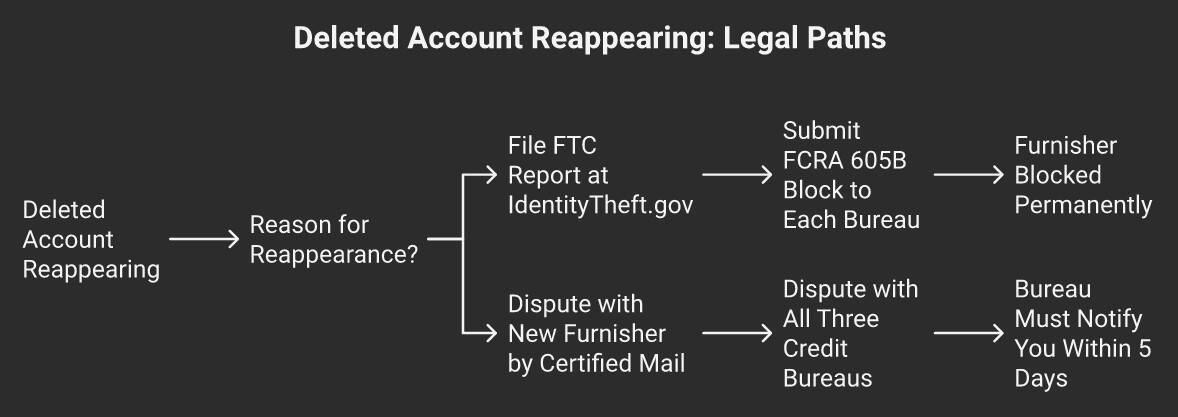
- Use FCRA § 605B — block, not just dispute
- A block prevents the furnisher from reporting the item at all
- Stronger than a dispute — furnisher must stop furnishing the data
- Requires an identity theft report (file at IdentityTheft.gov)
Inaccurate Account (Disputed Data)
- Account is yours, but information on it is wrong
- FCRA § 611 governs disputes and reinvestigation
- Bureau must investigate within 30 days
- If reinserted after deletion, bureau must notify you within 5 business days
- Dispute must also go to the furnisher directly, not just the bureau
The Identity Theft Block: Your Strongest Tool
If the account is genuinely fraudulent, standard dispute rights aren’t your best option — they’re your fallback. The FCRA § 605B block is a more powerful tool specifically designed for this situation.
Here’s what it does that a dispute doesn’t:
- Blocks the furnisher from reporting the account at all. A dispute tells the bureau to remove an item from your file. A block tells the furnisher they cannot include this information in any data they send to any bureau. That prevents the re-upload that causes the reappearance.
- Requires an identity theft report. Go to IdentityTheft.gov (the FTC’s official site) and file a report. The report is free, takes about 15 minutes, and gives you an official FTC Identity Theft Report — which is the document you need to exercise § 605B rights.
- Submit the block request to each bureau with your identity theft report. Each bureau handles this separately. Send certified mail or use each bureau’s official identity theft portal — Equifax, Experian, and TransUnion all have dedicated processes for this.
Important: The furnisher can challenge a block under § 605B if they believe the information is not the result of identity theft — for example, if they have evidence you did open the account. If they successfully challenge the block, the information can be reinserted. This is why having a clear paper trail matters: the FTC identity theft report, prior dispute records, any police report you filed.
If It’s a Sold Debt: The Re-Reporting Problem
Steve’s notes described something I’ve seen constantly: a debt is sold — sometimes multiple times — and the new collector has no record of the original deletion. They simply re-report it as if the history before their acquisition didn’t happen.
This is illegal under the FCRA if the information is inaccurate. When a debt is sold, the buyer becomes the new furnisher — but they are bound by the same accuracy obligations. Reporting an account that was already deleted, without a legitimate basis, is a violation of FCRA § 623 (furnisher accuracy obligations).
- Dispute directly with the new collector — send a written dispute via certified mail. Include copies of documentation showing the prior deletion. Furnishers have 30 days to investigate and respond under FCRA § 611.
- Dispute with each bureau — send the same documentation to all three. Each bureau’s reinvestigation triggers a requirement to contact the furnisher.
- Keep every piece of documentation. Prior deletion letters, dispute confirmation emails, certified mail receipts, EOBs from the bureau. If you eventually need to pursue legal action, this evidence is everything.
The Reinsertion Rules: What the Law Requires
Under FCRA § 611(a)(5)(B), a credit bureau may reinsert previously deleted information only under specific conditions:
- The furnisher certifies in writing that the information is complete and accurate
- The bureau notifies you of the reinsertion within 5 business days — by mail or electronically if you’ve consented
- The reinsertion notice must include the furnisher’s name, address, and phone number
If a bureau reinserted the account and did NOT notify you within 5 business days, that is itself an FCRA violation — separate from the question of whether the underlying information is accurate.
Disputing the item is not enough if the source data is wrong. Fix the report AND fix the source, or the problem will keep coming back.— Steve Rhode
Credit Monitoring: The Early Warning System
As Steve’s notes pointed out: set up credit monitoring. I don’t say this as a product pitch — I say it because the system is automated, and you can’t manually watch your credit file. When a reappeared account shows up, you want to catch it in days, not months. The longer it sits on your report, the more damage accumulates.
Free options exist: AnnualCreditReport.com gives you one free report per bureau per year. The three bureaus also offer free weekly reports at AnnualCreditReport.com as of 2023. If you’ve been through identity theft, consider a credit freeze in addition to monitoring — a freeze prevents new accounts from being opened in your name while the problem is being resolved.
My Take: Dispute Is Not Enough. Fix the Source.
The credit reporting system is a series of data pipes. When you dispute an item, you’re asking the bureau to turn off one pipe. But if the furnisher’s pipe is still running, it will refill the bucket.
To stop a fraudulent account from coming back, you need to either block the furnisher from reporting it (§ 605B for identity theft) or get the furnisher to correct their own records. Disputing with the bureau repeatedly without addressing the source is like bailing a boat without finding the hole.
If you’ve done everything right and the account keeps returning, that’s worth a consultation with a consumer law attorney. Multiple FCRA violations — wrongful reinsertion, failure to notify within 5 business days, inaccurate furnishing — can create a federal case, and many consumer attorneys take these cases on contingency.
No Article Replaces an Attorney Licensed in Your State: What I’ve covered here is educational — it gives you the framework to understand your rights, but it is not legal advice. If your account has been wrongfully reinserted after deletion, especially multiple times, you may have legal remedies under the FCRA worth pursuing.
How to find a consumer law attorney:
- NACA — National Association of Consumer Advocates — Best starting point for FCRA cases. Member attorneys specialize in consumer protection law and many take cases on contingency.
- Your state bar’s lawyer referral service — Search “[your state] bar association lawyer referral” for a low-cost initial consultation.
- LawHelp.org — Free and reduced-cost legal aid organized by state and issue.
Have a similar situation? If your specific account keeps reappearing and you’re not sure whether to use the identity theft block or the dispute process, Ask Steve in the chat — describe the situation and I’ll help you figure out which approach fits.
Key Takeaways
- Deleted accounts reappear because credit bureaus receive automated data feeds from furnishers — removing the item from your file doesn’t fix the source
- For fraudulent accounts (identity theft), FCRA § 605B gives you the right to block the furnisher from reporting it — stronger than a standard dispute
- For reinserted accounts, the bureau must notify you within 5 business days — failure to do so is itself an FCRA violation
- When debt is sold, the new collector may re-report without knowing about prior deletions — dispute directly with the new furnisher, not just the bureau
- Credit monitoring is essential — the system is automated and the problem can recur; catching it fast limits damage
The Bottom Line
A deleted account can reappear on your credit report because deleting it from your file doesn’t delete it from the furnisher’s data system. The next automated data feed puts it back. For fraudulent accounts, use FCRA § 605B to block the furnisher entirely — not just dispute with the bureau. For debts sold to new collectors, dispute directly with the new furnisher in writing and with each bureau. If the account was reinserted without the required 5-business-day notice, the bureau may have violated the FCRA separately. Keep documentation of every deletion, every dispute, every response. And set up credit monitoring — you need an early warning system, because you cannot watch your credit report manually while the furnisher’s systems run on autopilot.
Frequently Asked Questions
Can a credit bureau legally put a deleted item back on my credit report?
Yes, but only under specific conditions set by FCRA § 611(a)(5)(B). The furnisher must certify in writing that the information is complete and accurate, and the bureau must notify you of the reinsertion within 5 business days. If they don’t follow both requirements, the reinsertion may be a violation of the FCRA — which gives you grounds to dispute and potentially pursue legal remedies.
What is the difference between a credit bureau dispute and an FCRA § 605B identity theft block?
A dispute asks the bureau to investigate and remove an item from your file. A § 605B block requires the furnisher to stop sending that information entirely — it prevents the re-upload that causes reappearance. The block is only available for accounts you can demonstrate are the result of identity theft, using an official FTC Identity Theft Report from IdentityTheft.gov.
What should I do if the same fraudulent account keeps coming back even after multiple disputes?
At that point, you likely need a consumer law attorney. Repeated wrongful reinsertion, failure to block after a proper § 605B request, or failure to notify you within 5 business days after reinsertion can each be FCRA violations. Many consumer attorneys handle these cases on contingency — meaning no upfront cost. NACA (naca.net) is the best starting point for finding one.
Does a credit freeze prevent a deleted account from reappearing?
No — a credit freeze prevents new credit from being opened in your name, but it doesn’t stop furnishers from updating existing trade lines or re-reporting previously deleted accounts. To stop a fraudulent account from being re-reported, you need the § 605B block, not a freeze. Use both if you’ve been through identity theft.
If a debt collector bought my debt and is now re-reporting an account that was already deleted, is that illegal?
It can be. Under FCRA § 623, furnishers have an obligation to report accurate information. A new debt buyer who re-reports an account without knowing about prior deletions may be violating the FCRA’s accuracy requirements. Dispute directly with the new collector in writing (certified mail), include documentation of the prior deletion, and dispute with each bureau simultaneously. If the collector ignores the dispute or refuses to correct the record, a consumer attorney can evaluate whether you have a federal court case.
Dealing With Debt? Understanding your options is the first step. See how all your debt relief options compare — including ones most sites won’t tell you about. The Find Your Path quiz gives a recommendation based on your actual numbers, and the Scam-O-Meter checks any company’s complaint history before you sign. Federal Reserve research shows bankruptcy filers recover faster than those who don’t file.
Beware the related myth making the rounds: a “609 letter” does not erase accurate negative items, no matter what the TikTok videos promise.



