
Quick Answer: A federal court dismissed the Trump administration’s attempt to end the SAVE income-driven repayment plan on February 27, 2026, so SAVE remains available for now. But a separate and more pressing problem persists: more than 22,000 borrowers who have already completed their required IDR payments are legally eligible for discharge — and the Education Department still isn’t processing them. If you’re waiting on IDR forgiveness, your discharge may be legally owed but administratively stuck. And if it comes in 2026, you may owe taxes on it.
Expert Context: I’ve tracked federal student loan programs and servicer failures since they became the dominant debt issue for millions of Americans — including watching multiple administrations change the rules mid-stream. The gap between “legally owed” and “actually paid” is exactly where borrowers get destroyed, and that’s precisely what’s happening right now.
Two things are happening simultaneously in the student loan IDR world right now, and if you’re a borrower, you need to understand both — because conflating them could lead you to make the wrong move.
Table of Contents
Every weekday I read the enforcement actions, filings and fine print the outlets skip, and turn them into the one or two moves that actually improve your position — a rate worth moving for, a fee you can refuse, a deadline to beat before it costs you.
In the latest issue (Oct 6): When fear picks your debt plan
I write Your Money Actually most weekdays — actionable money information you will not find anywhere else, and the small decisions that compound. It is free, I sell nothing, and I take no money from any company I write about.
The first is the court ruling everyone is celebrating. The second — the one getting almost no coverage — is a tax bomb quietly ticking for anyone who gets an IDR discharge in 2026 or later.
What the Court Actually Ruled on SAVE
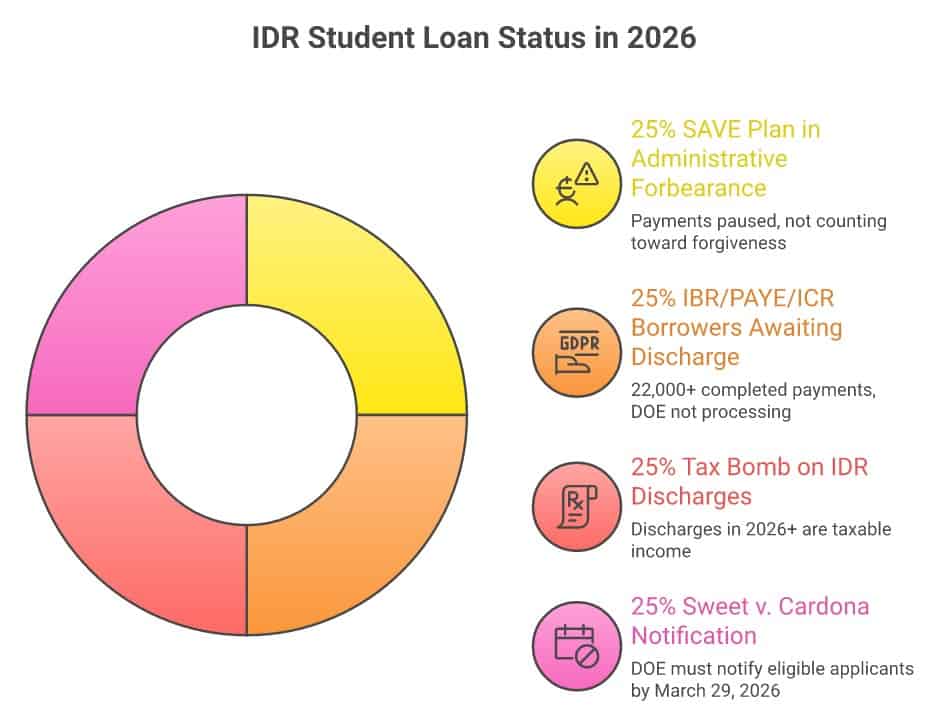
On February 27, 2026, a federal court dismissed the lawsuit that sought to end the SAVE (Saving on a Valuable Education) repayment plan, according to CNBC. The Trump administration had been pushing to terminate the plan entirely — that bid was dismissed.
What this means in plain English: the SAVE plan is not immediately dead. Borrowers currently enrolled in SAVE don’t need to panic based on this ruling alone.
What this doesn’t mean: your SAVE months are counting toward forgiveness. SAVE has been in administrative forbearance since mid-2024. Payments haven’t been required, but those months haven’t been counting toward your IDR forgiveness timeline either. That limbo continues regardless of the court ruling.
The Bigger Problem: 22,000+ Borrowers Are Still Waiting
Here’s the story that deserves more attention: tens of thousands of borrowers have already done everything right. They’ve made every required payment under IBR, PAYE, or ICR for 20 or 25 years. They are legally entitled to discharge. And the Education Department still isn’t processing their discharges.
In October 2025, as part of a legal settlement with the American Federation of Teachers, the Education Department agreed to resume granting loan discharges for borrowers who have completed their required payments under the Income-Based Repayment (IBR), Pay As You Earn (PAYE), and Income-Contingent Repayment (ICR) plans. The SAVE plan was excluded from that agreement — SAVE borrowers remain in a separate limbo.
For borrowers connected to the Sweet v. Cardona class action settlement (related to borrower defense discharge claims), the Education Department has a court-mandated deadline: notify eligible post-class applicants by March 29, 2026.
Important Distinction: There are multiple separate IDR legal battles running simultaneously, and they apply to different borrowers. The October 2025 agreement to resume discharges covers IBR, PAYE, and ICR borrowers — not SAVE. The February 2026 court ruling addresses SAVE — not IBR/PAYE/ICR. If you’re in one of these programs, what’s happening to another program may not affect your timeline at all.
The Tax Bomb Nobody Is Talking About
This is the part I’m most concerned about for anyone expecting discharge in 2026 or later.
Under the American Rescue Plan Act of 2021, student loan discharges were temporarily excluded from taxable income through December 31, 2025. That exclusion has now expired.
If you receive an IDR discharge in 2026 or later, the forgiven amount is currently treated as ordinary taxable income under federal law. If $80,000 of your loans is forgiven, you may owe taxes on $80,000 of income in the year of discharge — on top of your regular income. At a 22% federal marginal rate, that’s a potential $17,600 federal tax bill arriving without warning. State income taxes may apply on top of that, depending on where you live.
Common Misconception: “When my student loans are finally forgiven after all those years, I’ll be done — it’s just free money.”
The Reality: IDR forgiveness in 2026 creates a taxable income event under current federal law. You may receive a Form 1099-C for the discharged amount, and the IRS treats it as income in the year of discharge. Tax planning — including working with a CPA before your discharge date — is critical if you’re within a few years of hitting your payment milestone.
The rules keep changing mid-stream. The gap between “legally owed” and “actually received” is exactly where borrowers get hurt most.— Steve Rhode
Free Tool — 1099-C Tax Calculator: Received a 1099-C for cancelled debt? The free 1099-C Tax Calculator runs the exact IRS insolvency math from Publication 4681 Worksheet 2 — and covers the partial insolvency case most people miss. Run the Calculator →
What to Do If You’re in SAVE Right Now
The February court ruling is good news in one narrow sense: SAVE wasn’t immediately killed. But here’s what SAVE borrowers are actually dealing with:
- Your months in forbearance aren’t counting — SAVE remains in administrative forbearance. You’re not required to pay, but those months aren’t building toward IDR forgiveness.
- The program’s future is still uncertain — One court dismissal isn’t finality. The administration can pursue other legal avenues to end SAVE, and the new RAP plan is being positioned as the replacement.
- Consider whether IBR makes more sense right now — If you switch from SAVE to IBR, your payment months would count. Run the numbers on what a payment under IBR would cost you versus staying in SAVE forbearance — it may be worth the trade-off to keep your forgiveness timeline moving.
- The new RAP plan launches July 1, 2026 — The administration’s proposed Repayment Assistance Plan (RAP) is scheduled to open July 1, 2026. Know it’s coming before you make any decisions about your current plan.
What to Do If You’ve Completed IDR Payments and Are Waiting
If you’ve completed 20 or 25 years of qualifying payments under IBR, PAYE, or ICR, you are in the group the Education Department agreed in October 2025 to serve. Here’s what I’d do in your position:
- Document your payment history immediately — Pull your records via StudentAid.gov and verify your qualifying payment count. Get this in writing from your servicer.
- Contact your servicer in writing — Don’t just call. Use your servicer’s secure message portal to create a documented paper trail of your discharge request and their response.
- File a complaint if you’re being ignored — The CFPB complaint portal and the Federal Student Aid Feedback Center are your escalation tools. Use them.
- Talk to a tax professional before your discharge date — If you’re within two years of your payment milestone, start planning for the tax hit now. Options like IRS insolvency exclusions may apply in some cases — a CPA can tell you whether you qualify.
- Use the Find Your Path quiz — If you’re trying to decide whether to stay in your current plan, switch, or explore other debt options, the Find Your Path quiz can help you think through your specific situation.
What Is the New RAP Student Loan Plan?
The Repayment Assistance Plan (RAP) is the Trump administration’s proposed replacement for SAVE, scheduled to launch July 1, 2026. Key differences from current IDR plans:
- Payments capped at 10% of gross income (current IDR plans use discretionary income, which is lower)
- Forgiveness after 30 years (longer than PAYE’s 20 years or IBR’s 20-25 years)
- Available for all federal loan types
- For many borrowers, payments under RAP would be higher than under current IDR plans
- The 30-year forgiveness timeline is longer than the existing 20-25 year options
- Final rules have not been published — specifics may change before July 1
I’d hold off on making any decisions based on RAP until the final rules are out. What’s been proposed and what gets implemented in federal student loan programs have a long history of diverging.
The Bottom Line
A court dismissed the Trump administration’s attempt to end the SAVE student loan plan in February 2026, but SAVE remains in administrative forbearance — those months still aren’t counting toward IDR forgiveness. More urgently, 22,000+ borrowers who have already completed their IDR payment requirements are waiting on discharges the Education Department is legally obligated to process. If you’re in IBR, PAYE, or ICR and have completed your payments, document everything and escalate through official complaint channels. If you expect IDR forgiveness in 2026 or later, be aware that discharged amounts are currently taxable income under federal law — a potentially significant, unexpected tax bill that most borrowers don’t see coming until it’s too late to plan for it.
Frequently Asked Questions
Is the SAVE student loan plan still active after the February 2026 court ruling?
Yes, the SAVE plan was not eliminated by the February 27, 2026 ruling — the court dismissed the attempt to end it. However, SAVE remains in administrative forbearance, meaning payments aren’t required but those months aren’t counting toward IDR forgiveness timelines. The program’s long-term future remains uncertain as the administration may pursue other legal options.
How long until student loan forgiveness under IDR plans?
Under standard IDR plans, forgiveness occurs after 20 years for undergraduate loans (under PAYE or IBR for newer borrowers) or 25 years for graduate loans and older IBR borrowers. ICR forgiveness is after 25 years. SAVE was structured for 20-25 year forgiveness but is currently paused. Payment months during SAVE’s forbearance period are not counting toward these timelines.
Are IDR student loan forgiveness amounts taxable in 2026?
Yes, under current federal law. The temporary federal tax exclusion for student loan discharges enacted under the American Rescue Plan Act of 2021 expired on December 31, 2025. Discharges received in 2026 or later are treated as ordinary taxable income. The forgiven amount may trigger a significant federal (and potentially state) tax bill in the year of discharge. Consult a tax professional before your discharge date to understand your exposure.
What is the Sweet v. Cardona settlement deadline?
Sweet v. Cardona was a class action lawsuit resulting in a settlement requiring the Education Department to process borrower defense discharge applications. As part of ongoing compliance, the DOE has a court-mandated deadline to notify eligible post-class applicants by March 29, 2026. This applies specifically to borrower defense applicants, not all IDR borrowers.
What is the new RAP student loan plan replacing SAVE?
The Repayment Assistance Plan (RAP) is the Trump administration’s proposed IDR replacement, scheduled to launch July 1, 2026. RAP would cap payments at 10% of gross income and extend forgiveness to 30 years. For many borrowers, payments would be higher and the forgiveness timeline longer than current options. Final rules have not been published — wait for official guidance before making any decisions based on RAP.
Not sure if you owe tax on canceled debt? Use my free Do You Owe Tax from a 1099-C? calculator to find out before you file anything.
Dealing With Debt? Understanding your options is the first step. See how all your debt relief options compare — including ones most sites won’t tell you about. The Find Your Path quiz gives a recommendation based on your actual numbers, and the Scam-O-Meter checks any company’s complaint history before you sign. Federal Reserve research shows bankruptcy filers recover faster than those who don’t file.



