
Quick Answer: A federal class action lawsuit filed in February 2026 alleges that H&R Block’s tax refund advance loans charge active-duty military members fees that push the true interest rate well above the 36% Military Lending Act cap — despite being marketed as “0% APR.” The suit names H&R Block Inc., HRB Tax Group, Pathward N.A., and Emerald Financial Services as defendants.
Update (April 2026): the new TurboTax / Credit Karma class action under the Military Lending Act — new developments that affect what I wrote below.
Expert Context: I’ve been covering military lending abuses since the SCRA and MLA became major enforcement targets for the CFPB and DOJ. The pattern is always the same: a product is structured to look free on its face, with fees hidden in ancillary requirements that only add up when you do the math. I’ve seen this exact playbook used against service members by payday lenders, auto dealers, and now — allegedly — one of the biggest tax prep companies in the country.
If you’re an active-duty service member or military dependent who took out an H&R Block Refund Advance Loan or Emerald Advance Loan, a new federal lawsuit claims you may have been charged fees that violate federal law designed specifically to protect you.
Each weekday I send one short email: one money story that caught my attention, why it might matter to you, and one manageable thing you can do with it. A couple of minutes, and a dad joke.
In the latest issue (Oct 9): Does Financial Literacy Make Financial Sense?
Free. I sell nothing. Unsubscribe any time.
The lawsuit — Montgomery v. HRB Tax Group, Inc. et al. — was filed February 6, 2026 in the U.S. District Court for the Southern District of California (Case No. 3:26-cv-00759-LL-MSB). It accuses H&R Block and its lending partners of structuring short-term tax loans in a way that bypasses the Military Lending Act’s hard cap on borrowing costs for service members.
Key Terms Defined
Military Lending Act (MLA): A federal law that caps the total cost of most consumer credit products for active-duty service members and their dependents at 36% MAPR. It also prohibits mandatory arbitration clauses. (Source: CFPB)
Military Annual Percentage Rate (MAPR): A broader version of APR required by the MLA. It includes not just interest but also application fees, participation fees, and fees for ancillary products required to get the credit — like refund transfer accounts and prepaid debit cards.
Refund Advance Loan: H&R Block’s short-term advance on your expected tax refund, marketed as “0% APR” and “no-fee.” The lawsuit claims that once mandatory ancillary fees are counted in the MAPR calculation, the true cost far exceeds 36%.
Emerald Advance Loan: A separate H&R Block installment loan product with a stated APR of approximately 35.9% — just under the MLA cap on its face. The lawsuit alleges additional fees push this product over the cap as well.
What the Lawsuit Claims H&R Block Did
The core allegation is that H&R Block advertised its Refund Advance Loan as a zero-interest, no-fee product for qualifying customers — including active-duty service members covered by the MLA. But to receive the loan, borrowers were required to set up financial accounts through Pathward N.A. (formerly Meta Bank), H&R Block’s lending partner. Those accounts come with their own fees.
According to the complaint, military borrowers were routinely charged:
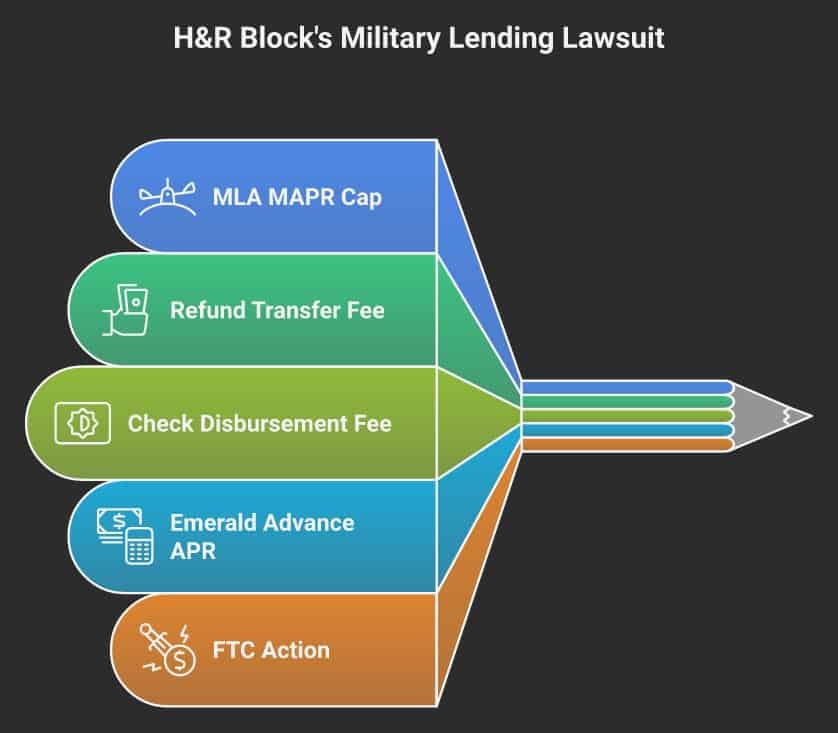
Under the MLA, fees for products and services required as a condition of receiving credit must be included in the MAPR calculation. When a $39 fee and a $25 fee are annualized over the brief period of a tax season loan — sometimes just a few weeks — the effective rate can spike well above 36% for smaller loan amounts, according to the lawsuit.
The suit also alleges that H&R Block’s loan agreements contain mandatory arbitration clauses and class action waivers — provisions explicitly prohibited by the Military Lending Act. Including such clauses in a loan agreement with a covered military borrower is itself a violation of federal law, regardless of the rate charged.
The Claim: “H&R Block’s Refund Advance Loan is 0% APR and has no fees.”
What the Lawsuit Alleges: The loan may be structured as 0% interest, but military borrowers are required to set up Pathward accounts with refund transfer fees ($39) and check disbursement fees ($25) as a condition of receiving the advance. The MLA requires these fees to be counted in the MAPR — and when they are, the effective rate allegedly far exceeds 36% for many loan amounts.
Who Is Named in the Lawsuit
- H&R Block Inc. — the parent company and tax preparation brand
- HRB Tax Group Inc. — the operating subsidiary that offers the loan products
- Pathward N.A. — the bank that originates the loans and whose accounts generate the ancillary fees
- Emerald Financial Services LLC — H&R Block’s financial services subsidiary
The lead plaintiff, Joshua Montgomery, is an active-duty service member who alleges he was subjected to these unlawful charges. The case seeks class action status on behalf of all military members and dependents who received either loan product and paid finance charges or were subjected to illegal dispute-resolution terms.
What Relief the Lawsuit Seeks
The complaint asks for a jury trial and seeks:
- Declaratory and injunctive relief (requiring H&R Block to stop the alleged practices)
- Actual damages for fees paid above the legal cap
- Statutory damages under the MLA
- Punitive damages
Why This Matters — The Bigger Pattern
This lawsuit fits a documented pattern of financial companies structuring products to appear compliant with the MLA on their face while embedding costs in ancillary requirements. The FTC finalized a $7 million order against H&R Block in January 2025 for separate deceptive advertising and customer service practices — so this is not the first time H&R Block has faced federal scrutiny over how it markets its products to consumers.
For service members, the stakes are particularly high. Military pay is often deposited predictably, making it attractive for short-term lending — but also making service members targets for lenders who know the money is coming. Congress passed the MLA specifically to prevent predatory lenders from using mandatory fees, arbitration waivers, and rate structures that evade the 36% cap.
The targeting extends beyond lending — a federal case just resulted in a 27-month prison sentence for a scam targeting active-duty troops through social media.
Know Your Rights Before Taking Any Loan: If you’re active-duty military or a dependent, the CFPB’s Military Lending Act resource page explains exactly what protections apply to you — including the right to prepay without penalty and the prohibition on mandatory arbitration. You can also file a complaint at consumerfinance.gov/complaint or call (855) 411-2372.
If you’re uncertain how to evaluate any financial product — including tax prep loans or refund advances — the Find Your Path quiz can help you understand what options are actually in your interest.
The Bottom Line
A federal class action filed in February 2026 alleges that H&R Block’s tax refund advance loan products charge active-duty military members fees that violate the Military Lending Act’s 36% MAPR cap — despite being marketed as free. The lawsuit also alleges the loan agreements contain mandatory arbitration clauses that are illegal under the MLA. The case is in early stages and no findings have been made, but if the allegations are proven, H&R Block and its partners could face actual damages, statutory damages, and injunctive relief requiring them to overhaul these products. Service members who used these products during tax season should watch this case closely.
Frequently Asked Questions
Why is H&R Block being sued?
A class action filed in February 2026 claims H&R Block’s Refund Advance and Emerald Advance loans charge active-duty military members fees that push the effective interest rate above the Military Lending Act’s 36% annual cap. The suit also alleges the loan agreements illegally require military borrowers to waive their right to a class action and to submit to mandatory arbitration — both prohibited by the MLA.
Who is covered by the Military Lending Act?
The MLA covers active-duty members of the Army, Navy, Marine Corps, Air Force, and Space Force, plus members of the National Guard and Reserve on active duty for 30 or more days, and their spouses and certain dependents. The 36% MAPR cap applies to most consumer credit products offered to these individuals, including tax refund advance loans.
Can I still join this class action against H&R Block?
The case was filed in February 2026 and is in early litigation. No settlement or class certification has been announced. If you are an active-duty service member or dependent who received an H&R Block Refund Advance or Emerald Advance loan and paid fees, you may be in the potential class. Consulting a consumer law attorney is the best way to understand your options. You can find one through the National Association of Consumer Advocates.
What fees does H&R Block charge on its Refund Advance loan?
According to the lawsuit, military borrowers who took the Refund Advance loan were charged a $39 refund transfer fee and a $25 check disbursement fee, on top of account requirements through Pathward N.A. The lawsuit claims these fees must be counted in the MAPR calculation under federal law, pushing the effective rate far above the 36% MLA cap when annualized over the short loan period.
Is H&R Block’s Emerald Advance Loan also covered by the lawsuit?
Yes. The Emerald Advance Loan has a stated APR of approximately 35.9% — just under the MLA cap on its face — but the lawsuit alleges that additional mandatory fees push the true MAPR above 36% for covered military borrowers. Both products are named in the complaint.
Dealing With Debt? Understanding your options is the first step. See how all your debt relief options compare — including ones most sites won’t tell you about. The Find Your Path quiz gives a recommendation based on your actual numbers, and the Scam-O-Meter checks any company’s complaint history before you sign. Federal Reserve research shows bankruptcy filers recover faster than those who don’t file.



