

Quick Answer: Two federal class action lawsuits filed in 2025 and 2026 claim the U.S. Department of Education is causing inaccurate student loan data to appear on millions of borrowers’ credit reports — including loan balances that appear doubled and delinquency flags that borrowers say are completely unjustified. If the allegations are proven, millions of Americans may have significantly damaged credit scores through no fault of their own.
Expert Context: I’ve tracked federal student loan servicing failures since the PSLF disaster of the early 2010s, when borrowers made a decade of qualifying payments and then got rejection letters. What’s happening now — borrowers trying to do everything right, only to find their credit report shows loan balances at double the real amount or marks them as in default — is a different mechanism but the same pattern: the government’s administrative failures become the borrower’s credit problem.
If you have federal student loans and something looks wrong on your credit report, you may not be imagining it. Two separate federal lawsuits are now making the case that the Department of Education has been sending inaccurate loan data to credit bureaus — and that millions of borrowers have had their credit damaged as a result.
Key Terms Defined
Fair Credit Reporting Act (FCRA): Federal law that requires anyone reporting data to credit bureaus — including the Department of Education — to report accurate, complete, and timely information. Willful violations can result in statutory damages of $100–$1,000 per violation plus punitive damages.
Each weekday I send one short email: one story that caught my attention, why it might matter to you, and one manageable thing you can do with it. A couple of minutes, and a dad joke.
In the latest issue (Nov 6): Owed money on an Amazon return? Check by Dec. 1
Free. I sell nothing. Unsubscribe any time.
Furnisher: Under the FCRA, a “furnisher” is any entity that reports data to credit bureaus. The Department of Education is a furnisher for federal student loan data.
MOHELA: Missouri Higher Education Loan Authority — one of the major federal student loan servicers contracted by the Department of Education to manage borrower accounts and report to credit bureaus.
Nelnet: Another federally contracted student loan servicer that reports borrower payment history and balances to Equifax, Experian, and TransUnion.
Lawsuit 1: Student Loan Balances Appearing Doubled on Credit Reports
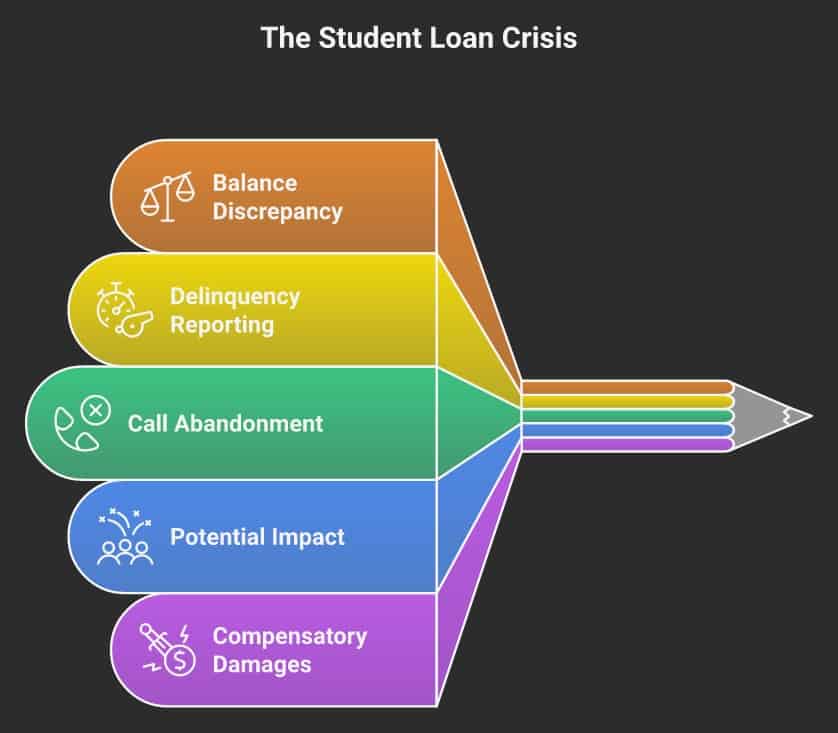
A proposed class action filed February 18, 2026 in the U.S. District Court for the Southern District of New York alleges that the Department of Education is causing student loan balances to appear doubled on borrowers’ credit reports, according to Law360.
The lead plaintiff says her $150,000 in total student loan debt was appearing on her credit report as $300,000 — exactly double. The lawsuit names as defendants:
- U.S. Department of Education
- Equifax, Experian, and TransUnion — the three major credit bureaus
- Nelnet and MOHELA (Missouri Higher Education Loan Authority) — federal loan servicers
The complaint, filed by attorney Francis Mailman, alleges violations of the Fair Credit Reporting Act. When your credit report shows a balance of $300,000 instead of $150,000, your debt-to-income ratio looks dramatically worse to any lender — affecting mortgage approvals, car loans, credit cards, and your overall credit score.
Lawsuit 2: Millions Wrongly Reported as Delinquent or in Default
A second class action, filed through StudentLoanLegalAction.org, takes an even broader aim. The lawsuit was filed by A. Wayne Johnson, a former Trump administration official who previously oversaw student debt at the Department of Education, joined by four named borrowers.
According to the complaint, the Department of Education’s Office of Federal Student Aid caused widespread delinquency and default reporting through “serious operational service failures” — not borrower misconduct. The suit alleges:
- Telephone wait times measured in hours, with a 90% call abandonment rate
- Millions of pieces of mail sitting in an unprocessed backlog
- Borrowers trying to resume payments were “programmatically rolling” from delinquency to default while the DOE’s systems couldn’t handle the volume
- Credit bureaus — Equifax, Experian, and TransUnion — are named for furnishing inaccurate data they knew to be “blatantly unfair”
The complaint estimates that 5 million borrowers are currently affected and that the number could reach 20 million by April 2026. Damages sought exceed $500 billion.
The Assumption: “If my credit report shows I’m delinquent or in default on my student loans, I must have missed payments.”
What the Lawsuit Alleges: The DOE’s administrative failures — not borrower errors — may be driving delinquency and default flags. Borrowers who called to make payments faced 90% call abandonment rates. Their mail went unread. And despite doing everything right, their credit was marked as damaged. The lawsuit names the government’s operational collapse, not borrower behavior, as the cause.
What This Means If Your Credit Report Shows Errors
Under the Fair Credit Reporting Act, you have the right to dispute inaccurate information on your credit report. If you have federal student loans and something looks wrong, here’s where to start:
- Pull your free credit reports at AnnualCreditReport.com — check all three bureaus (Equifax, Experian, TransUnion) since errors may not appear on all three
- Check your actual loan balances at StudentAid.gov — the official source for your federal loan totals
- Dispute in writing directly with the credit bureau that shows the error — and separately dispute with the furnisher (Nelnet, MOHELA, or DOE) that reported it
- File a CFPB complaint at consumerfinance.gov/complaint — CFPB tracks complaint volume and these add pressure for systemic fixes
Not Sure Which Option Is Right for You? If inaccurate student loan reporting has damaged your credit and you’re now weighing your options — dispute, wait, refinance, or take other action — take the Find Your Path quiz for a personalized read on your situation.
Why a Former DOE Official Is Leading One of These Lawsuits
It’s unusual for a former government official to turn around and sue the agency he used to run. A. Wayne Johnson served in the Trump administration’s Department of Education and oversaw student debt policy before leaving. His decision to file this lawsuit — and to fund the effort through a dedicated site at StudentLoanLegalAction.org — suggests someone with inside knowledge of the department’s operational failures making a public statement about their severity.
Johnson’s attorney, Devlin Cooper, put the stakes bluntly: “Twenty million Americans are going to have higher interest rates potentially for the rest of their lives because of the faulty information reported by their government.”
The Bottom Line
Two separate federal class action lawsuits allege the U.S. Department of Education is reporting inaccurate student loan data to credit bureaus — including balances that appear doubled and delinquency flags that reflect government operational failures, not borrower behavior. One case targets the balance-doubling issue and was filed February 18, 2026 in the Southern District of New York. A second, broader case seeks over $500 billion in damages for 5 million borrowers wrongly reported as delinquent or in default. If you have federal student loans, check your credit reports at AnnualCreditReport.com and verify your actual balances at StudentAid.gov — and dispute any inaccuracies in writing with both the bureau and the furnisher.
Frequently Asked Questions
How do I check if my student loan balance is wrong on my credit report?
Pull your free credit reports from all three bureaus at AnnualCreditReport.com, then compare the balances shown to your actual federal loan totals at StudentAid.gov. If the credit report shows significantly more than your actual balance — particularly if it appears doubled — that matches the pattern alleged in the February 2026 lawsuit.
Am I eligible to join these class action lawsuits?
Both cases are in early stages — no settlement or certified class has been established yet. The StudentLoanLegalAction.org case defines its class as borrowers who were declared in default since January 1, 2025. The February 2026 SDNY case is still developing its class definition. Consulting a consumer law attorney is the best way to understand your options. The National Association of Consumer Advocates can help you find one who handles FCRA cases.
What is the Fair Credit Reporting Act and how does it protect me?
The FCRA requires anyone who reports data to credit bureaus — including the Department of Education and its loan servicers — to report accurate, complete, and timely information. If they report inaccurate data and you can show it was willful, you may be entitled to statutory damages of $100–$1,000 per violation, plus actual damages and attorney’s fees. You also have the right to dispute inaccurate information and require the furnisher to investigate.
Can the Department of Education really be sued for credit report errors?
Yes. The DOE operates as a “furnisher” under the Fair Credit Reporting Act when it reports student loan data to credit bureaus. Federal agencies can be sued for FCRA violations, though sovereign immunity considerations can affect the claims. Both lawsuits allege the DOE violated the FCRA — one by allowing balances to appear doubled, the other by causing systematic delinquency and default reporting due to operational failures.
What should I do if my student loan shows me in default when I shouldn’t be?
Start by disputing the error in writing with each credit bureau that shows it (Equifax, Experian, TransUnion) and separately with the servicer (Nelnet, MOHELA) or the DOE’s Office of Federal Student Aid. File a complaint at consumerfinance.gov/complaint. Document everything — dates, who you contacted, what you sent. If the error isn’t corrected after a dispute, a consumer law attorney may be able to help you pursue FCRA claims.
Dealing With Debt? Understanding your options is the first step. See how all your debt relief options compare — including ones most sites won’t tell you about. The Find Your Path quiz gives a recommendation based on your actual numbers, and the Scam-O-Meter checks any company’s complaint history before you sign. Federal Reserve research shows bankruptcy filers recover faster than those who don’t file.



