
Quick Answer: Navient will settle private student loans for 30–60 cents on the dollar — but only after the loan defaults and is charged off. Navient cancelled $1.7 billion in private loans rather than defend them in court in 2022, then paid $120 million in 2024 to settle federal abuse charges. That track record gives defaulted private loan holders real negotiating leverage. Federal loans transferred to Aidvantage or MOHELA are a completely different situation.
Expert Context: I’ve been tracking student loan servicer abuses since they started, and I’ve helped people work through student loan debt at GetOutOfDebt.org since 2008. When the CFPB permanently banned Navient from federal servicing in 2024, the headline was the $120 million penalty. What most people missed was the other shoe: Navient still owns a portfolio of private student loans, still collects aggressively on defaulted ones through its own subsidiaries, and is now under more regulatory pressure than ever to resolve bad paper quietly. That creates a window most borrowers don’t know exists.
When the CFPB permanently banned Navient from federal student loan servicing in September 2024, most borrowers assumed the Navient chapter was closed. Restitution checks started arriving in February 2026 and people moved on. But if you have a private student loan that originated with Navient, the story isn’t over — it may actually be in your favor.
For the latest on the CFPB settlement checks, see my update on the Navient $120 million settlement checks going out now.
Claiming money you are owed is one good day. What you do over the following year is what actually changes your position.
In the latest issue (Nov 9): Check your power bank and your French press
Each weekday I send one short email: one story that caught my attention, why it might matter to you, and one manageable thing you can do with it.
Free. I sell nothing. Unsubscribe any time.
Key Terms Defined
Private student loan: A loan made by a private lender (like Navient or its predecessor Sallie Mae), not the federal government. Private loans are not subject to income-driven repayment, Public Service Loan Forgiveness, or most federal hardship protections. They behave more like credit card debt once defaulted.
FFELP loan: Federal Family Education Loan Program — older federal loans that were originated by private lenders but backed by the government. Navient serviced millions of FFELP loans; they were transferred to MOHELA in 2024. These are federal loans, not private loans, and have different settlement rules.
Charge-off: When a lender officially writes a defaulted debt off its books as a loss — typically after 120–180 days of non-payment. A charge-off doesn’t erase the debt; it opens the door to settlement because the lender has already taken the accounting loss.
The Navient You’re Dealing With Depends on Your Loan Type
This is where most borrowers get confused — and the confusion is costing some of them real money.
Navient was one of the country’s largest student loan servicers, managing both federal and private loans. In 2021, Navient transferred its portfolio of Department of Education Direct Loans to Aidvantage. In October 2024, it completed the transfer of its remaining FFELP loan portfolio to MOHELA — and was permanently banned from federal student loan servicing by the CFPB.
If your loan was federal, it’s now with a different servicer. The CFPB restitution checks that started going out in February 2026 cover eligible federal loan borrowers harmed by Navient’s abusive servicing practices.
But if your loan is private — originated by Navient or Sallie Mae before Navient spun off in 2014 — none of those transfers apply to you. Navient still owns your loan. Navient is still collecting on it. And you are now dealing with a company that is simultaneously under the microscope of every state attorney general in the country.
Federal Loans (FFELP / Direct)
- Transferred to MOHELA or Aidvantage
- CFPB restitution checks apply if eligible
- Subject to IDR plans, PSLF, deferment
- Settlement is not typically available while current
- Default triggers federal collection process
Private Loans (Navient-Owned)
- Still owned and collected by Navient
- No IDR plans, no PSLF eligibility
- No restitution checks for federal violations
- Settlement available after default/charge-off
- Navient collection subs: Allied Interstate, Pioneer Credit Recovery
What the $1.7 Billion Cancellation Tells You About Your Private Loan
In 2022, Navient reached a multi-state settlement with 39 state attorneys general — and one of the key terms was the cancellation of $1.7 billion in private student loans for approximately 66,000 borrowers. These weren’t loans Navient was feeling generous about. These were loans that Navient’s own records showed were originated with very low likelihood of repayment — many made to students at for-profit schools, at high interest rates, to borrowers with little or no ability to repay.
Navient cancelled them because the alternative was defending them in court, state by state, attorney general by attorney general. That math didn’t work.
When a company cancels $1.7 billion in debt rather than defend it, that’s not generosity. That’s an admission about the quality of the paper.— Steve Rhode
Here’s why that matters for you: the loans that were cancelled under the 2022 AG settlement had specific criteria — originated mostly between 2002 and 2014, primarily for for-profit school attendance, already delinquent by 7 or more billing cycles before June 30, 2021. If your loan didn’t meet those criteria, it didn’t get cancelled. But that doesn’t mean Navient is confident about the remaining portfolio. The same underlying characteristics — high interest rates, questionable school outcomes, borderline underwriting — apply across a broader range of private loans than the AG settlement covered.
That is leverage.
The Myth: “Navient settled because they’re generous. My loan is different — it’s legitimate, so I have to pay it.”
The Reality: Navient cancelled $1.7 billion because litigation risk and regulatory pressure made it cheaper to cancel than fight. Your individual loan may be in an equally precarious position if it defaulted — and Navient’s incentive to settle quietly is higher today, not lower, given the CFPB’s permanent ban and ongoing regulatory scrutiny.
How Private Loan Settlement With Navient Actually Works
I want to be honest with you about the mechanics here, because the process is not what debt settlement companies advertise.
Private student loan settlement is not something you negotiate while your loan is current. You cannot call Navient tomorrow and offer to settle for 50 cents on the dollar on a loan you’ve been faithfully paying. They’ll say no, and they’d be right to — you have no leverage if you’re current.
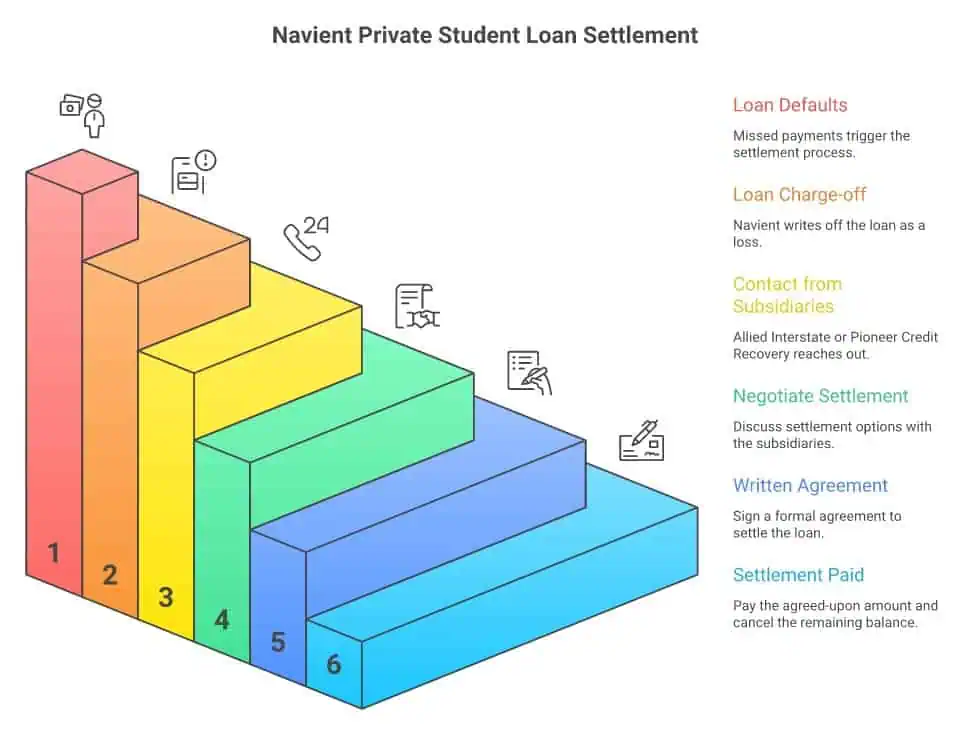
The settlement window opens after default and charge-off. Here’s the sequence:
- You stop making payments — the loan becomes delinquent
- After 120–180 days, Navient charges off the loan (writes it off as a loss)
- The loan is moved to internal recovery — often handled by Navient subsidiaries Allied Interstate or Pioneer Credit Recovery (both Navient-owned)
- Navient (or its subsidiary) contacts you to collect
- A settlement negotiation becomes possible — typically 30–60% of the balance as a lump sum, or a multi-year payment plan at a lesser discount
At this stage, Navient has already taken the accounting loss. Their goal is to recover something — not everything, just something. A lump-sum offer in the 30–50% range is often accepted. Extended payment plans (up to five years, sometimes interest-free) are possible but typically at a smaller discount.
One thing I want to flag clearly: if Allied Interstate or Pioneer Credit Recovery contacts you about a Navient private loan, you are still negotiating with Navient. These aren’t third-party debt buyers — they’re Navient subsidiaries. Get any settlement agreement in writing before paying anything.
Who Qualifies — and Who Doesn’t
Not every borrower with a Navient private loan is a good candidate for settlement negotiation. Here’s my honest read:
✓ Settlement May Make Sense If
- Your loan has already defaulted or is close to charge-off
- You can access a lump sum (savings, family help) equal to 30–50% of the balance
- The loan is for a school or program that underdelivered on outcomes
- You have no other viable repayment path
- Bankruptcy is also on the table (settlement first is worth exploring)
✗ Settlement Is the Wrong Move If
- Your loan is current — you’d have to default deliberately
- The only money available is retirement savings (never use retirement for this)
- The forgiven balance would create a large tax bill you can’t handle
- A debt settlement company is pitching this to you (see below)
Warning — Never Use Retirement Money: I’ve said this for 30 years and I’ll keep saying it. Do not cash out a 401(k) or IRA to settle a student loan. Retirement accounts are protected from creditors in bankruptcy. They grow tax-deferred. The math on early withdrawal — income taxes plus the 10% penalty plus lost compound growth — will almost certainly cost you more than the settlement saves.
The 2026 Tax Warning Nobody Is Talking About
This is important and I haven’t seen it discussed much elsewhere.
The American Rescue Plan Act of 2021 included a provision making certain student loan forgiveness and settlement proceeds tax-free through December 31, 2025. Under prior tax rules, cancelled debt is typically treated as taxable income — if Navient settles a $30,000 loan for $12,000, the $18,000 forgiven could be income you owe taxes on.
That tax exclusion has now expired. If you reach a private loan settlement with Navient in 2026 or later, the forgiven amount may be treated as taxable ordinary income. On a large balance, this could be a significant tax bill — and it’s worth calculating before you agree to terms.
Talk to a tax professional before settling. It doesn’t mean settlement is the wrong move — but it should be part of your calculation.
Not sure which debt option is right for your situation? Take the Find Your Path quiz — it walks through your specific circumstances and tells you which options actually fit.
Free Tool — 1099-C Tax Calculator: Received a 1099-C for cancelled debt? The free 1099-C Tax Calculator runs the exact IRS insolvency math from Publication 4681 Worksheet 2 — and covers the partial insolvency case most people miss. Run the Calculator →
A Word About Debt Settlement Companies
If you search “Navient student loan settlement,” you will immediately find debt settlement companies telling you they can negotiate for you — for a fee, often 15–25% of the enrolled debt.
Here’s my experience: debt settlement as a business model works for some people and is predatory for many others. The fees are real. The timeline is long. Some companies collect fees for months before doing any negotiating. And private student loans are harder to settle than credit card debt because the servicer isn’t under the same pressure to settle quickly.
You can negotiate directly with Navient or its collection subsidiaries without hiring a company. An attorney who specializes in student loan debt is a more appropriate resource if you want professional help — they have ethical obligations and can review whether your specific loan has any legal vulnerabilities (improper origination, missing documentation, statute of limitations issues by state) that improve your position further.
Key Takeaways
- Navient’s federal loan exit is complete — Direct Loans went to Aidvantage, FFELP went to MOHELA
- Navient still owns and collects on private student loans — the ban was on federal servicing only
- Private loans can be settled for 30–60% of the balance after default and charge-off
- Navient’s $1.7B cancellation in 2022 signals they’d rather settle than fight questionable paper
- Allied Interstate and Pioneer Credit Recovery are Navient subsidiaries — you’re still dealing with Navient
- The 2026 tax exclusion for cancelled debt may have expired — factor this into your settlement math
- Never use retirement savings to fund a settlement
The Bottom Line
Navient is out of federal student loan servicing permanently — but it still owns a portfolio of private student loans and is actively collecting on defaulted ones through subsidiaries. The company’s track record — cancelling $1.7 billion rather than defend it, paying $120 million to the CFPB — signals a willingness to resolve bad paper quietly. If you have a defaulted Navient private student loan and access to a lump sum, settlement for 30–60 cents on the dollar is a documented, achievable outcome. The math changed in 2026 when the federal tax exclusion on forgiven student loan debt likely expired, so timing and tax consequences matter. Never use retirement savings to fund a settlement. For federal loans now with Aidvantage or MOHELA, the situation is completely different — those servicers, those rules, different options.
Free Tool — Statute of Limitations Checker: Dealing with old debt? The free Statute of Limitations Checker tells you if the collection clock has expired in your state — including the zombie debt and clock-restarting traps collectors use. Check My Status →
Frequently Asked Questions
Can Navient settle private student loans for less than I owe?
Yes — private student loans that have defaulted and been charged off are negotiable. Navient has settled defaulted private loans for 30–60 cents on the dollar. The settlement window opens after charge-off, not while the loan is current. You can negotiate directly or with a student loan attorney’s help.
Did Navient cancel student loans in 2022?
Yes. As part of a 2022 multi-state attorney general settlement, Navient cancelled approximately $1.7 billion in private student loans for about 66,000 borrowers. Eligible loans were generally private loans made to students at for-profit schools between 2002 and 2014 who were already deeply delinquent. Cancellations were automatic — no application was needed. If you qualified and didn’t receive a letter, you were likely not eligible under the specific criteria.
What is the CFPB settlement with Navient and am I getting a check?
In September 2024, the CFPB ordered Navient to pay $120 million — $100 million in restitution to eligible borrowers plus a $20 million civil penalty. Restitution checks started going out in February 2026 to people harmed by Navient’s federal loan servicing practices, such as being improperly steered into forbearance instead of income-driven repayment. Private loan holders are not covered by this restitution.
Who is collecting my Navient loan if Navient exited federal servicing?
It depends on the loan type. Federal Direct Loans were transferred to Aidvantage in 2021. FFELP loans were transferred to MOHELA in 2024. If you’re still receiving calls or letters from Navient or its subsidiaries Allied Interstate or Pioneer Credit Recovery, your loan is almost certainly a private student loan — which Navient still owns — or a defaulted federal loan being collected through Navient’s recovery arm.
Is settling a Navient private student loan taxable in 2026?
Possibly. The American Rescue Plan Act of 2021 created a temporary federal tax exclusion for forgiven student loan debt through December 31, 2025. Settlements reached in 2026 or later may result in the forgiven amount being treated as ordinary taxable income. If Navient agrees to cancel $15,000 of a $30,000 loan, that $15,000 could appear on a 1099-C and be added to your taxable income for the year. Consult a tax professional before finalizing any settlement.
Not sure if you owe tax on canceled debt? Use my free Do You Owe Tax from a 1099-C? calculator to find out before you file anything.
Dealing With Debt? Understanding your options is the first step. See how all your debt relief options compare — including ones most sites won’t tell you about. The Find Your Path quiz gives a recommendation based on your actual numbers, and the Scam-O-Meter checks any company’s complaint history before you sign. Federal Reserve research shows bankruptcy filers recover faster than those who don’t file.



Thanks for your advise. Can I make Mohela an offer to settle my student loans. They kept putting me on deferral for over 10 years and now my $20,000 loans are up to $68,000. Please reply, I will appreciate it so much.
Thanks, Carlos