
Quick Answer: A March 2026 GAO report found that the Department of Education stopped reviewing the accuracy of student loan servicer records in February 2025 — as FSA cut its staff by 46%. Four of five servicers had already failed accuracy standards before oversight was halted. With 43 million borrowers in the system and major repayment changes arriving in July 2026, GAO warns that borrowers may be getting wrong information and incorrect billing with no federal check in place.
Deep Dive Available: The GAO has now completed a full investigation into this oversight gap. Read the complete analysis: GAO Report: Nobody Is Checking Whether Your Student Loan Servicer Has Accurate Records
Expert Context: I’ve tracked federal debt relief programs since their creation, including watching multiple administrations change the rules mid-stream — often right when borrowers need stability most. This GAO report describes exactly the kind of institutional failure I’ve documented for decades: oversight disappears quietly, borrowers don’t find out until something goes wrong with their account.
The federal government has quietly stopped one of the most important checks protecting 43 million Americans with student loans: quarterly accuracy reviews of loan servicer records.
Each weekday I send one short email: one story that caught my attention, why it might matter to you, and one manageable thing you can do with it. A couple of minutes, and a dad joke.
In the latest issue (Nov 6): Owed money on an Amazon return? Check by Dec. 1
Free. I sell nothing. Unsubscribe any time.
A new report from the Government Accountability Office (GAO-26-108534), released March 11, 2026, documents a serious breakdown in federal oversight of student loan servicers — the companies responsible for billing, processing payments, and advising borrowers on repayment plans and forgiveness options.
What the GAO Found
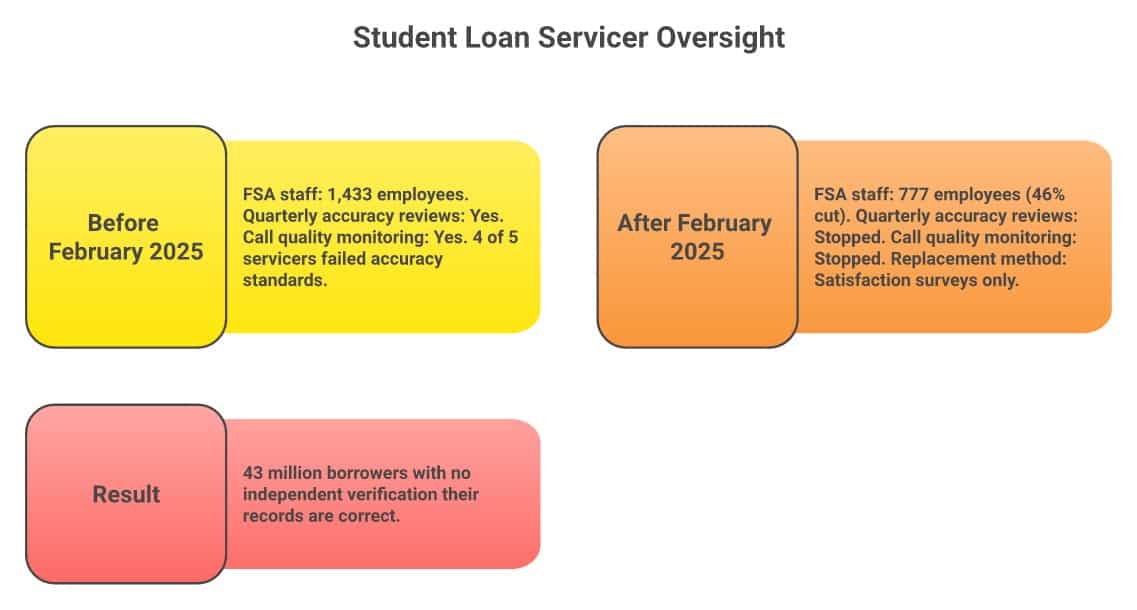
In February 2025, the Department of Education’s Office of Federal Student Aid (FSA) stopped conducting quarterly assessments of servicer accuracy and call quality. These assessments were specifically required by the contracts FSA signed with servicers in April 2024. Under those contracts, servicers face financial penalties when they fail accuracy standards.
The agency’s reason: not enough staff. Between January and December 2025, FSA’s headcount dropped from 1,433 to 777 employees — a reduction of 656 people, or 46%. The cuts coincided with the Trump administration’s directives to downsize the federal workforce beginning in January 2025.
What these reviews actually do: Quarterly accuracy reviews compare loan servicer records with FSA’s own records to catch discrepancies — wrong repayment status, incorrect balance, missed refunds. Call quality reviews check whether servicers are giving borrowers accurate information when they call for help. Without these reviews, borrowers have no independent verification that what their servicer tells them is correct.
Servicers Were Already Failing Before Oversight Stopped
The timing makes the oversight gap more serious, not less. Before FSA halted the reviews, the last round of quarterly assessments found that four of the five servicers did not meet the accuracy performance standard and faced financial penalties totaling approximately $850,000. Two servicers had recordkeeping problems serious enough to trigger the maximum financial penalty allowed under the contract.
And it wasn’t just GAO raising alarms. In January 2026 — well after FSA stopped the reviews — the Department of Education’s own independent financial auditor reported that the department “continued to have a material weakness related to the reliability of its student loan data.” That’s the auditor’s most severe classification for a systemic problem.
GAO is blunt about what this means for borrowers: “If servicers’ records are inaccurate, borrowers could, for instance, be placed in the wrong loan repayment status, billed for incorrect amounts, or not have a refund processed in time.”
The Administration’s Defense — and Why GAO Rejects It
FSA’s acting chief operating officer, Richard Lucas, disagreed with GAO’s recommendation to resume the reviews. Lucas argued that FSA uses other methods to assess servicer performance — specifically, reviews of borrower satisfaction surveys.
GAO’s Melissa Emrey-Arras, who led the investigation, pushed back directly: “While reviewing those satisfaction surveys may be helpful, they don’t directly assess the quality of the information given to borrowers. A borrower may indicate they were satisfied with a call, not realizing they were given completely wrong information by their servicer.”
In other words: a servicer can give you wrong information, you can walk away happy — because you don’t know it was wrong. That’s precisely what the accuracy reviews were designed to catch. Satisfaction scores measure how borrowers feel, not whether what they were told was true.
GAO also noted that FSA’s scaled-back oversight has reduced the government’s ability to hold servicers financially accountable. Without formal reviews, FSA cannot assess whether servicers are earning their pay or should face penalties for poor performance. As Emrey-Arras put it, that accountability “is critical. Without it, the government risks overpaying for poor performance.”
Why the Timing Matters
This oversight pullback is happening exactly when millions of borrowers will need the most reliable guidance:
- The Biden-era SAVE repayment plan is in legal turmoil — borrowers are now being charged interest while litigation continues, and the plan is scheduled to close by 2028.
- An estimated 12 million borrowers are in default or approaching it.
- In July 2026, the One Big Beautiful Bill Act introduces two new repayment plans and phases out others — requiring borrowers to make decisions based on servicer guidance about options they’ve never navigated before.
GAO’s warning: these changes will affect millions of borrowers “who will need accurate and complete information when they call for help” — yet for the time being, the Education Department cannot verify that’s what borrowers are actually getting.
The Official Position: “FSA uses a variety of other methods to assess servicer performance. We don’t need quarterly accuracy reviews.”
What GAO Found: As of December 2025, FSA was not using any replacement methods for accuracy and call quality oversight. Satisfaction surveys — the proposed substitute — cannot detect errors borrowers don’t know they received. The independent financial auditor found a “material weakness” in loan data reliability as recently as January 2026. GAO does not believe the alternative methods are effective substitutes.
What to Do While Oversight Is Suspended
There is no immediate crisis requiring action today — but there are protective steps worth taking now:
- Cross-check your loan data at StudentAid.gov. Your official federal loan records are at studentaid.gov, not only your servicer’s portal. If the two don’t match on balance, repayment status, or payment history, your servicer may have errors in their records.
- Document every servicer call. Date, time, rep name, what you were told. If you later discover the advice was wrong, documentation is your paper trail for a formal dispute.
- Get repayment plan changes in writing. With major plan restructuring arriving in July 2026, don’t make decisions based solely on a phone call. Ask for written confirmation before enrolling in or changing any plan.
- File a complaint if something seems off. The CFPB accepts student loan servicer complaints at consumerfinance.gov/complaint. FSA also has a feedback center at studentaid.gov/feedback-center.
If your debt situation is more complex — multiple loans, default, wrong repayment status — use my free Find Your Path quiz to identify the right approach for your specific situation.
Congressional context: The GAO investigation was requested by the ranking members of the House and Senate education committees — Rep. Bobby Scott (D-VA) and Sen. Bernie Sanders (I-VT). Sanders stated: “Instead of providing relief to 43 million Americans who are drowning in student debt, the Trump administration has made it harder for them to understand how much they owe and how long it will take to pay back.” The GAO recommendation to resume reviews remains open. Education has not committed to acting on it.
Key Takeaways
- The Education Department halted quarterly student loan servicer accuracy and call quality reviews in February 2025, citing staff shortages
- FSA staff was cut from 1,433 to 777 (46%) in 2025 — reviews stopped as the workforce was reduced
- Before oversight stopped, 4 of 5 servicers had already failed accuracy standards; 2 triggered the maximum financial penalty (~$850,000 in penalties total)
- Education’s independent auditor found a “material weakness” in loan data reliability as recently as January 2026
- The Education Department rejected GAO’s recommendation to resume reviews — as of December 2025, no replacement oversight methods are in place
- 43 million borrowers are affected; major repayment plan changes arrive in July 2026
The Bottom Line
The federal government stopped independently verifying that student loan servicers are keeping accurate borrower records — right after those same servicers failed accuracy reviews. Four of five servicers missed standards before oversight was abandoned; two hit the maximum penalty allowed. The administration’s substitute — reviewing satisfaction surveys — cannot catch errors borrowers don’t know they received. With 12 million borrowers in or near default and sweeping repayment plan changes arriving in July 2026, borrowers will be calling servicers for guidance at exactly the moment the government has no way to confirm that guidance is correct. Cross-check your loan data at StudentAid.gov now, document every servicer interaction, and don’t make repayment plan decisions based on a phone call alone.
Frequently Asked Questions
What did the 2026 GAO report on student loan servicers find?
The March 2026 GAO report (GAO-26-108534) found that the Department of Education’s Office of Federal Student Aid stopped conducting quarterly accuracy and call quality reviews of student loan servicers in February 2025, citing staff shortages caused by a 46% workforce reduction. Before these reviews were halted, four of five servicers had failed the accuracy performance standard and faced financial penalties totaling approximately $850,000. Two servicers triggered the maximum financial penalty. As of December 2025, no replacement oversight methods were in place, and the Education Department’s independent auditor had identified a material weakness in loan data reliability as recently as January 2026.
Are my student loan servicer records accurate?
There is no way to know for certain while federal accuracy oversight is suspended. The safest step is to log into StudentAid.gov and compare the official federal record of your loans — balance, repayment status, payment history — against what your servicer shows in their own portal. If you find discrepancies, document them and file a complaint with the CFPB at consumerfinance.gov/complaint and with FSA’s feedback center at studentaid.gov/feedback-center.
Why did the Education Department stop reviewing student loan servicers?
According to FSA officials cited in the GAO report, the quarterly accuracy and call quality reviews were halted due to lack of staff capacity. FSA’s workforce dropped from 1,433 employees to 777 — a 46% reduction — between January and December 2025, coinciding with Trump administration directives to downsize the federal workforce. FSA’s acting COO argued that borrower satisfaction surveys provide an adequate substitute, but GAO rejected this, noting that satisfied borrowers may have received incorrect information without realizing it.
What can go wrong if my student loan servicer has inaccurate records?
Inaccurate servicer records can cause direct financial harm: you could be placed in the wrong repayment plan (higher or lower payments than you should have), billed for incorrect amounts, have a refund delayed or not processed, or receive wrong information about forgiveness eligibility. If you believe your servicer has made an error, put your dispute in writing, document every communication, and file complaints with the CFPB and FSA. If the error affects your credit report, dispute it directly with the credit bureaus as well.
What is changing for student loan borrowers in 2026?
Several major changes are underway or coming. The Biden-era SAVE repayment plan is in legal turmoil — borrowers are currently being charged interest while litigation continues, and the plan is scheduled to close by 2028. Starting in July 2026, the One Big Beautiful Bill Act introduces two new repayment plans and phases out existing ones, requiring millions of borrowers to navigate new options. About 12 million borrowers are already in default or approaching it. The GAO specifically warned that these changes require borrowers to rely on accurate servicer guidance at exactly the moment federal oversight of that guidance has been suspended.
Related: Nelnet was also hit with a \$10 million data breach settlement affecting 2.5 million borrowers. Late claims may still be accepted — here is how to file.
Dealing With Debt? Understanding your options is the first step. See how all your debt relief options compare — including ones most sites won’t tell you about. The Find Your Path quiz gives a recommendation based on your actual numbers, and the Scam-O-Meter checks any company’s complaint history before you sign. Federal Reserve research shows bankruptcy filers recover faster than those who don’t file.



