
Quick Answer: LVNV Funding LLC — one of the largest debt buyers in the United States — typically purchases charged-off consumer debt for less than 1 cent per dollar of face value, according to a 2017 Consumer Financial Protection Bureau market analysis. That means your $10,000 credit card balance may have been purchased for $200 or less. Once you understand the math, your negotiating position changes entirely.
Expert Context: I founded Myvesta (originally Debt Counselors of America) in 1994 and ran it as a 70-person nonprofit until 2006. I watched debt buyers purchase portfolios from credit card issuers for a fraction of face value and then pursue consumers — many of whom were already in financial crisis — for every dollar. I’ve also filed bankruptcy myself, in 1990. I know both sides of this equation. What I’m sharing here isn’t theory. It’s the industry math they don’t advertise.
The debt collection industry doesn’t want you to know what LVNV Funding paid for your debt. If you knew — if you understood that the company suing you for $10,000 may have purchased that account for $200 — you’d negotiate very differently. You might show up to court. You might respond to their letters with a counteroffer instead of fear. You might hire an attorney, because you’d know you actually have leverage.
About This Research
This analysis draws on four primary sources: the CFPB’s 2017 online debt market analysis (13 pages reviewed in full), the CFPB’s 2023 FDCPA Annual Report, the Federal Trade Commission’s 2013 debt buyer industry study, and a 2020 Pew Charitable Trusts report on debt collection litigation. All statistics are linked to their original government and research sources below.
Every weekday I read the enforcement actions, filings and fine print the outlets skip, and turn them into the one or two moves that actually improve your position — a rate worth moving for, a fee you can refuse, a deadline to beat before it costs you.
In the latest issue (Oct 6): When fear picks your debt plan
I write Your Money Actually most weekdays — actionable money information you will not find anywhere else, and the small decisions that compound. It is free, I sell nothing, and I take no money from any company I write about.
Who Is LVNV Funding? The Three-Entity Structure Behind the Name
Just been served? See the emergency crisis guide: I Was Just Served with a Debt Lawsuit — your 5-step action plan for the next 48 hours, including how to stop the case the same day you file bankruptcy.
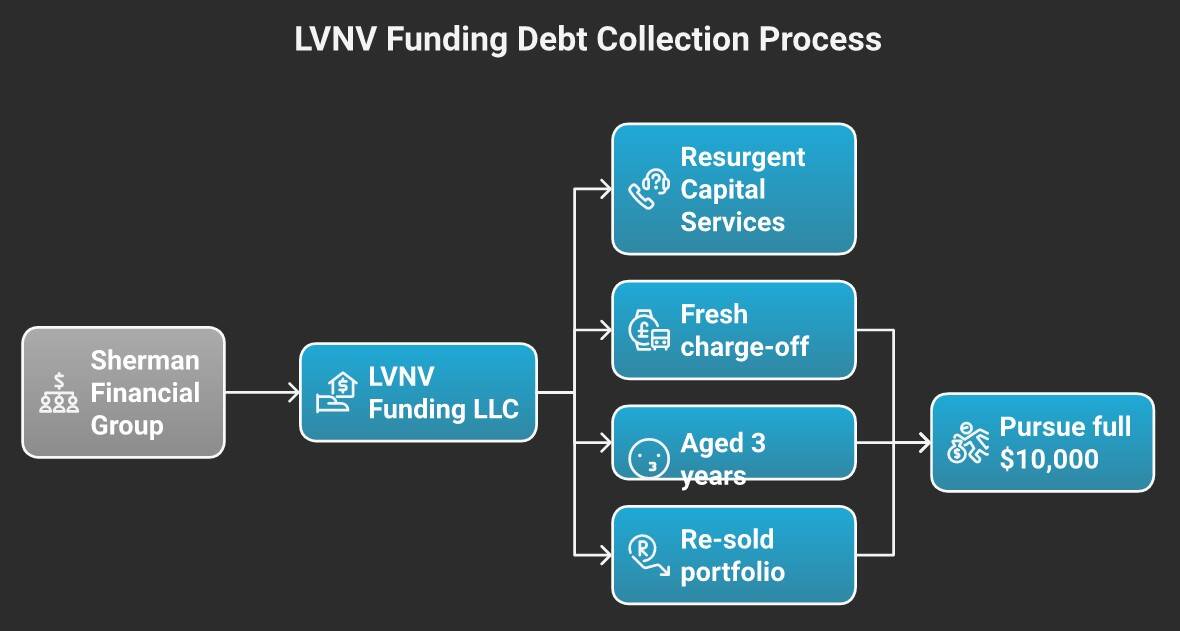
When LVNV Funding sends you a collection letter or files a lawsuit, three entities are involved — and the way they’re structured is designed to be opaque.
- Sherman Financial Group — the private equity parent company headquartered in Greenville, South Carolina. This is the capital behind the operation.
- LVNV Funding LLC — the legal entity that holds the purchased debt. Incorporated in Delaware, registered in South Carolina. LVNV does not directly contact consumers or independently file lawsuits. It simply owns the accounts.
- Resurgent Capital Services, LP — also headquartered in Greenville, SC. This is the operating arm. Resurgent makes the calls, sends the letters, and files the lawsuits — all on LVNV’s behalf.
Why the Structure Matters
The separation between LVNV (the debt owner) and Resurgent (the debt collector) is intentional. It can make it harder for consumers to understand who actually owns their account, who has settlement authority, and which legal entity they’re actually dealing with. The Pew Charitable Trusts found that consumers frequently do not recognize debt buyer names — because they’re not the original creditor. They’re a company that purchased the account, often years after it was charged off.
LVNV purchases charged-off debt from original creditors — credit card companies, banks, retailers, healthcare providers — and from other debt buyers who have already attempted collection. Then Resurgent pursues those accounts by any means permissible under the Fair Debt Collection Practices Act (FDCPA).
The Business Model: Less Than a Penny Per Dollar — Federal Data
The phrase “pennies on the dollar” understates what debt buyers actually pay. For a large share of charged-off portfolios, buyers like LVNV are paying fractions of a penny per dollar of face value.
The CFPB’s 2017 “Market Snapshot: Online Debt Sales” analyzed 298 charged-off debt portfolios with a combined face value of approximately $2 billion. Those portfolios sold for approximately $18 million total.
The Daily Money Brief — Free, at 10 AM
Money you may be owed, scams to dodge, and the fine print decoded — the consumer money news that affects your wallet, every weekday.
At the lowest observed price in the CFPB study — $0.0003 per dollar — a buyer paid $300 to acquire a portfolio with $1 million in alleged face-value debt. That buyer then has legal standing to pursue consumers for the full million.
What LVNV Likely Paid for Your $10,000 Debt
Prices vary by debt age and whether it’s a primary-market sale (original creditor selling directly) or a re-sale. The FTC’s 2013 study of the debt buying industry — which included Sherman Financial Group — found the average price was 4.0 cents per dollar, with fresh credit card debt at 7.9 cents per dollar. Here’s what that looks like on a $10,000 account:
- At 6 cents: LVNV paid approximately $600
- At 4 cents: LVNV paid approximately $400
- At 1 cent: LVNV paid approximately $100
- At 0.03 cents (re-sold, aged portfolios): LVNV paid approximately $3
In every scenario, any settlement above LVNV’s purchase price represents a profit for them.
The price declines rapidly with age. The CFPB analysis showed debt loses approximately 33% of its purchase price per year for the first five years after charge-off, then about 29% per year through years six to ten. A debt that was 5 years old when LVNV bought it cost much less than a fresh charge-off — yet LVNV will pursue you for the same face value regardless.
The CFPB also found that more than 75% of online marketplace portfolios had already been through two or more prior collectors before being listed for sale again. That means many accounts in LVNV’s portfolio were bought at the lowest possible prices, after two other collectors had already tried and failed to collect — yet the face value pursued stays the same.
The system for resolving disputes about consumer debts is broken.— Federal Trade Commission, 2010
Why Knowing the Purchase Price Changes Your Position
The Assumption Most People Make: “LVNV owns this debt legitimately. I owe the full $10,000. My only options are to pay in full or make minimum payments.”
What the Math Actually Shows: LVNV paid a fraction of face value for your account. Any settlement above their purchase price is profitable for them. A 25-cent settlement offer means you’re offering LVNV 4–8 times what they likely paid — they have a clear financial incentive to accept.
When I went bankrupt in 1990, I had to learn this the hard way: debt is math, not morality. The collector calling you does not have a moral stake in your debt. They have a financial one. Once you see the transaction from their side of the ledger, the emotional weight lifts — and the negotiation becomes what it actually is: a business conversation between two parties with different financial interests.
Knowing the purchase price enables:
- Settlement leverage: A 20–30 cent offer may be 5–10 times what LVNV paid — it’s a profitable deal for them at a fraction of the emotional cost to you
- Realistic expectations: You’re not asking them to take a loss. You’re offering a reasonable profit on a faster timeline
- Reduced fear: Knowing their financial position removes the psychological leverage collectors depend on
- Informed decision-making: You can weigh settlement vs. bankruptcy vs. dispute using actual numbers, not fear
On Debt Settlement: Settlement is a legitimate option when you have money saved and understand your legal rights. The problem with debt settlement marketing is how it’s sold — predatory, overpromising, underdelivering. But the concept of settling for less than face value is mathematically sound when you’re dealing with a buyer who paid pennies for your account. I’d rather you had the full picture.
The Lawsuit Machine: LVNV Wins Because Most People Don’t Show Up
Debt collection lawsuits are not typically won on the merits. They’re won because consumers don’t respond.
A 2020 Pew Charitable Trusts report on debt collection litigation documented what the industry already knew: the entire business model is built on non-response.
By 2013, debt collection lawsuits had reached approximately 4 million per year — representing 24% of all civil cases in state courts, up from less than 12% two decades earlier. In Texas in 2018, debt claims accounted for 30% of the entire state civil caseload. In Massachusetts, nine debt buyers represented 43% of civil and small claims caseloads in 2015.
Between 1993 and 2013, the total face value of debt sold to buyers grew from $6 billion to $98 billion. The volume is extraordinary. And it’s sustained by default.
The Myth: “If LVNV is suing me, they must have a solid case. There’s no point in fighting.”
The Reality (Pew Research): Consumers with legal representation won 53% of debt collection cases in Utah. Without an attorney, the win rate was 19%. LVNV files lawsuits expecting default judgments — not expecting defendants who show up with documentation and counsel. Responding changes the entire equation.
Two Federal Circuit Courts Have Already Ruled Against LVNV
Every state has a statute of limitations on debt — a legal time window after which a debt cannot be enforced in court. LVNV has pursued debts past those windows. Two federal circuit courts ruled that doing so through the bankruptcy system violates federal law.
- McMahon v. LVNV Funding LLC, 744 F.3d 1010 (7th Cir. 2014): The 7th Circuit held that LVNV’s filing of a proof of claim in bankruptcy on a time-barred debt was an attempt to collect a legally unenforceable obligation — a violation of the Fair Debt Collection Practices Act.
- Crawford v. LVNV Funding LLC, 758 F.3d 1254 (11th Cir. 2014): The 11th Circuit (Alabama, Georgia, Florida) reached the same conclusion: filing a proof of claim in Chapter 13 bankruptcy on a time-barred debt violates the FDCPA.
What “Time-Barred” Means for You: If your debt is older than your state’s statute of limitations — typically 3–6 years for credit card debt — LVNV cannot win a judgment against you in court if you raise that defense. They can still send letters and call you. But in court, the defense is real and has worked. The CFPB provides guidance on statutes of limitations on debt by state.
The CFPB’s 2023 FDCPA Annual Report found that “attempts to collect a debt not owed” was the single most common complaint against debt collectors — 52% of all 115,900 complaints received in 2022. Pursuing time-barred or improperly documented debt accounts for a significant share of those complaints.
Free Tool — Statute of Limitations Checker: Dealing with old debt? The free Statute of Limitations Checker tells you if the collection clock has expired in your state — including the zombie debt and clock-restarting traps collectors use. Check My Status →
The Documentation Problem: Can LVNV Prove It Owns Your Debt?
When debt is bought and resold, documentation trails degrade. The CFPB found that more than 75% of portfolios on online debt marketplaces had already been through two or more prior collectors. Original creditor records may be incomplete, missing, or inadmissible in court by the time LVNV purchases a portfolio.
Your Right to Debt Validation: Under the FDCPA, you have the right to request written validation of any debt within 30 days of first contact. LVNV must provide proof of a complete chain of assignment from the original creditor to themselves, the amount claimed and how it was calculated, and the original creditor’s name. The chain of title — each transfer from original creditor through to LVNV — is frequently incomplete in debt buyer cases and has been a successful defense in consumer law.
What You Should Actually Do
- Send a debt validation letter within 30 days of first contact from LVNV or Resurgent. Do it in writing, by certified mail, return receipt requested. LVNV must pause collection activity while they validate.
- Check the statute of limitations for your state and debt type. If the debt is time-barred, you have a viable court defense — but you must show up to use it.
- If sued, respond. The 70%-plus default judgment rate exists because people don’t respond. You don’t need an attorney to file a written response — though having one dramatically improves your odds.
- Never cash out retirement to pay LVNV or any unsecured debt buyer. Retirement accounts are fully protected in bankruptcy. Surrendering protected assets to a buyer who paid pennies for your account is the worst trade in personal finance.
- Consider your full range of options — settlement, bankruptcy, validation dispute, statute of limitations defense. No single path is right for every situation. If your financial picture is broader than one LVNV account, a bankruptcy consultation may be worth more than any negotiation.
Never cash out retirement savings to pay LVNV or any unsecured debt. Retirement accounts are protected in bankruptcy and from creditor judgment in most states. They are not protected from your own withdrawal. If you’re considering draining your 401(k) to pay a debt buyer who purchased your account for a fraction of face value, stop. The math doesn’t support it under any scenario.
Key Takeaways
- LVNV Funding pays less than 1 cent per dollar of face value for most charged-off debt portfolios, per CFPB data — meaning a $10,000 debt cost them roughly $100–$600
- More than 70% of debt collection lawsuits end in default judgment simply because consumers don’t respond — responding alone changes the math
- Two federal circuit courts (7th and 11th) have ruled that LVNV violated the FDCPA by pursuing time-barred debt through the bankruptcy system
- Consumers with legal representation win 53% of debt collection cases vs. 19% without — a 34-point gap driven entirely by showing up prepared
- LVNV must pause collection upon written validation request — use this within 30 days of first contact
The Bottom Line
The CFPB’s own market data shows that most charged-off debt portfolios sell for less than one cent per dollar of face value. LVNV Funding’s business model is built on the gap between what they paid — often under $600 for a $10,000 account — and what they collect, sustained by the 70%-plus default judgment rate that comes from consumers who don’t know their rights and don’t respond. Federal courts in the 7th and 11th Circuits have already ruled that LVNV violated the FDCPA by pursuing time-barred debt through bankruptcy. The Pew Charitable Trusts documented that consumers with legal representation win more than half of debt collection cases. The system is not designed to be fair. It is designed to exploit the information gap between what debt buyers know and what most consumers don’t. The math has always been knowable. Now you know it.
Breaking: LVNV Funding is now suing St. Louis residents over debts as low as $426 — filing hundreds of cases monthly. Read the full investigation.
Free Tool — Debt Validation Letter Generator: Being contacted by a debt collector? The free Debt Validation Letter Generator creates a personalized FDCPA validation letter in seconds — forcing the collector to prove the debt is real before they can continue. Generate My Letter →
Frequently Asked Questions
How much does LVNV Funding pay for debt?
According to the CFPB’s 2017 market analysis of online debt sales, the average asking price for charged-off debt portfolios was less than one cent per dollar of face value — more than half the portfolios reviewed sold for less than a penny per dollar. Fresh charge-offs purchased directly from original creditors carry higher prices. The FTC’s 2013 study of 3,400+ debt portfolios — which included Sherman Financial Group (LVNV’s parent company) — found “on average, debt buyers paid 4.0 cents for each dollar of debt.” The baseline for fresh credit card debt was 7.9 cents per dollar. Either way, LVNV paid a small fraction of the face value they pursue.
Can I negotiate a settlement with LVNV Funding?
Yes. Settlement is legal and viable, and LVNV has strong financial incentive — any amount above their purchase price is a profit. A 20–30 cent settlement on a debt they purchased for 1–6 cents per dollar is a profitable transaction for them. Get any settlement agreement in writing before paying, and request that they update your credit report to show the account as settled. Settlement works best when you have a lump sum; payment plans reduce their incentive to accept a reduced balance.
What should I do if LVNV Funding sues me?
Respond to the lawsuit. More than 70% of debt collection cases end in default judgment simply because defendants don’t show up, per Pew Charitable Trusts research. If you respond, LVNV must prove ownership through a complete chain of assignment, that the debt is within the statute of limitations, and that the amount is accurate. Consumers with attorneys win 53% of these cases. Consider consulting a consumer law attorney — many FDCPA attorneys work on contingency and charge you nothing unless you win.
Is my LVNV debt time-barred?
It may be. Every state has a statute of limitations on debt — typically 3–6 years for credit card debt, varying by state. If your debt is past that window, LVNV cannot win a court judgment against you if you raise the defense. Two federal circuit courts (the 7th and 11th) have already ruled that LVNV violated the FDCPA by attempting to collect time-barred debt through the bankruptcy system. Check the last date of activity on your account and compare it to your state’s limit. The CFPB provides a guide to debt statute of limitations by state.
What if I don’t recognize the debt LVNV is collecting?
The most common CFPB complaint category against debt collectors is “attempts to collect a debt not owed” — 52% of all 115,900 debt collection complaints received in 2022, per the CFPB’s 2023 FDCPA Annual Report. If you don’t recognize the debt, send a written validation request (certified mail, return receipt) within 30 days of first contact. LVNV must provide documentation proving ownership and accuracy. If they cannot, they must cease collection activity.
Sources and Methodology
This post draws on the following primary sources:
- Consumer Financial Protection Bureau, “Market Snapshot: Online Debt Sales,” January 2017 — Primary source for all debt portfolio purchase price statistics. 298 portfolios reviewed.
- Consumer Financial Protection Bureau, “Fair Debt Collection Practices Act: CFPB Annual Report 2023,” March 2023 — Industry revenue, employment, complaint volume, and charge-off rate data.
- The Pew Charitable Trusts, “How Debt Collectors Are Transforming the Business of State Courts,” May 2020 — Default judgment rates, consumer representation rates, win-rate comparisons, and litigation scale data.
- Federal Trade Commission, “The Structure and Practices of the Debt Buying Industry,” January 2013 — Primary market debt purchase price ranges.
- McMahon v. LVNV Funding LLC, 744 F.3d 1010 (7th Cir. 2014) — FDCPA liability for filing proof of claim on time-barred debt in bankruptcy.
- Crawford v. LVNV Funding LLC, 758 F.3d 1254 (11th Cir. 2014) — 11th Circuit ruling on same issue.
Part of the Debt Research Library: This post is one piece of my complete Debt Research Library — academic research on why consumers make the wrong debt choices, what outcomes actually show, and how to evaluate your options without a conflict of interest attached to the answer.
Dealing With Debt? Understanding your options is the first step. See how all your debt relief options compare — including ones most sites won’t tell you about. The Find Your Path quiz gives a recommendation based on your actual numbers, and the Scam-O-Meter checks any company’s complaint history before you sign. Federal Reserve research shows bankruptcy filers recover faster than those who don’t file.