

Quick Answer: Debt settlement companies are exploiting a legal loophole known as the “attorney model” to charge consumers illegal upfront fees by partnering with — or simply renting the license of — a real attorney. Federal law bars debt settlement companies from collecting fees before settling your debt, but state-level attorney exemptions create a workaround. The Consumer Financial Protection Bureau has pursued major cases against companies using this scheme, including a $132 million enforcement action and an ongoing suit alleging $100+ million in illegal fees. I’ve covered this in more depth in What Happens If My Debt Settlement Company Doesn’t Settle and I Get Sued?.
Expert Context: I founded Debt Counselors of America in 1994 and ran a 70-person credit counseling organization for over a decade. I watched debt settlement marketing corrupt good intentions from inside the industry — I saw the attorney model emerge, and I saw what happened to the people who got caught in it. This scheme isn’t new. It’s a recurring exploitation of vulnerable people that regulators keep chasing and the industry keeps reinventing.
A legal loophole called the “attorney model” has allowed debt settlement companies to collect tens of millions of dollars in upfront fees from financially struggling consumers — despite federal laws that explicitly prohibit it. The scheme works by hiding behind a law firm’s letterhead while doing none of the actual legal work, and it has destroyed the finances of people who were already desperate for help.
One Consumer’s Story: How It Actually Plays Out
Coya Davis was a 31-year-old project manager in Atlanta carrying about $27,000 in credit card debt when she enrolled in the Clear Creek Legal Debt Resolution Program in November 2023. The company’s name implied legal expertise. The welcome email told her she’d made a smart choice. She was instructed to stop paying her creditors and redirect her payments into a trust account to be used for settlements.
Each weekday I send one short email: one story that caught my attention, why it might matter to you, and one manageable thing you can do with it. A couple of minutes, and a dad joke.
In the latest issue (Nov 9): Check your power bank and your French press
Free. I sell nothing. Unsubscribe any time.
By the time Davis left the program, according to a Bankrate investigation published March 2026, her debt hadn’t budged. Her credit score had fallen from the 700s to the 400s. And she was out nearly $500 in fees — fees that federal law prohibits these companies from collecting before they deliver results.
“It made no sense because the money was supposed to be in a pot they’d later use to pay creditors,” Davis told Bankrate. “But at that point, I chalked it up as a loss.”
Clear Creek’s website went dark in January 2026. The company did not respond to media inquiries.
Key Terms Defined
Telemarketing Sales Rule (TSR): A federal FTC rule that prohibits debt settlement companies from collecting any fees before a consumer’s debt is actually settled and the consumer has made at least one payment on the settlement.
Attorney Model: A scheme where debt settlement companies partner with — or rent the name of — a licensed attorney to exploit state-level “attorney exemptions” that allow advance fee collection. In practice, no real legal work is performed.
Attorney Exemption: A provision in some state laws that allows attorneys to collect fees in advance when acting in a professional legal capacity. Debt settlement companies exploit this by attaching a lawyer’s name to their operation without providing actual legal services.
Power of Attorney: A legal document granting a debt settlement company the right to communicate with your creditors on your behalf. This document does NOT mean you have an attorney representing you — it’s a signing authorization.
How the Attorney Model Loophole Actually Works
Federal law is clear on this: debt settlement companies cannot charge or collect fees until after they have settled a consumer’s debt and the consumer has made at least one payment toward that settlement. The Telemarketing Sales Rule, the Consumer Financial Protection Act, and state-level regulations all reinforce this prohibition.
But attorneys operate under different rules. When a licensed attorney acts in a genuine legal capacity, state laws may allow them to collect fees in advance — a standard practice in legal representation. This is where the exploit lives.
Here’s how it works in practice, according to National Consumer Law Center senior attorney Andrew Pizor:
- A debt settlement company finds a licensed attorney willing to “lend” their credentials — in exchange for a fee
- The settlement company operates under the attorney’s name or letterhead, creating the appearance of a law firm
- Because a lawyer is nominally involved, the company claims the attorney exemption and collects upfront fees
- In reality, the “attorney” may have no involvement with actual cases — they’re “lending their name to a letterhead,” as Pizor put it
- Customer service representatives — not lawyers — handle all consumer contact
“The people actually doing the work on consumers’ accounts are virtually never attorneys,” Pizor told Bankrate. “The only attorneys involved are basically just lending their names to a letterhead. They’re doing it to exploit the loophole.”
The Sales Pitch: “We’re a legal debt resolution firm — because attorneys are involved, we can accept payment now to begin working on your accounts.”
The Reality: Federal law does not recognize state-level attorney exemptions as a way around the Telemarketing Sales Rule’s advance fee ban. Courts have consistently rejected this argument when it’s been tested — most recently in a landmark 2026 ruling where a federal bankruptcy judge traced every dollar through one of these operations and found the law firm was “a facade.” If a “debt settlement law firm” charges you before settling your debt, it is likely violating federal law regardless of whether an attorney’s name appears on the paperwork.
The Major Cases: Morgan Drexen to Strategic Financial Solutions
The attorney model has been around for decades and has survived multiple major enforcement actions — not by being eliminated, but by evolving. A March 2026 federal court ruling exposed the internal mechanics of one such operation in unprecedented detail.
Morgan Drexen (2013–2016)
The attorney model was pioneered by Morgan Drexen and Legal Helpers Debt Resolution around 2007. The CFPB sued Morgan Drexen’s president and CEO, Walter Ledda, in 2013 for charging illegal upfront fees and misrepresenting the company’s services. The case was resolved in 2016 with Morgan Drexen ordered to pay nearly $132 million in restitution and a $40 million civil penalty, according to the CFPB.
Instead of killing the model, the case provided a blueprint for its refinement.
Strategic Financial Solutions (2024–present)
In January 2024, the CFPB and seven state attorneys general filed a civil complaint against Strategic Financial Solutions (SFS) alleging one of the largest attorney model schemes ever documented. The complaint named 29 corporate defendants and 17 “facade” law firms, alleging that SFS charged thousands of consumers more than $100 million in illegal upfront fees — and that in many cases, no debt settlement ever occurred.
Ryan Sasson, who helmed SFS, is the stepson of Stephen Drescher — a figure connected to the events depicted in Martin Scorsese’s 2013 film The Wolf of Wall Street, according to the New York Times.
Clear Creek Legal Debt Resolution — the company that took money from Davis — was named as one of 24 facade law firms in the SFS amended complaint. SFS filed a motion to dismiss in November 2025. If granted, the CFPB and state attorneys general would effectively start over.
SFS’s assets are currently under the supervision of a court-appointed receiver while the litigation continues.
Why the Loophole Hasn’t Closed
The attorney model persists for a structural reason: federal law doesn’t recognize state attorney exemptions as a valid workaround, but prosecuting it requires regulators to do the work of untangling dozens of corporate shells, shell law firms, and interstate operations. That takes years. Meanwhile, the companies collect fees and move on before enforcement catches up.
The regulatory environment has gotten harder, not easier. The Trump administration signed the “One Big Beautiful Bill Act” in July 2025, which has hobbled the CFPB’s borrowing power. The administration has also proposed cutting $18 million from the FTC’s Bureau of Consumer Protection. The CFPB’s future is currently being litigated in NTEU v. Vought, where the CFPB employees’ union is challenging whether the administration has legal authority to dismantle a congressionally-created agency.
“If they can’t do one thing, they find a workaround,” Todd Christensen, a longtime financial counselor, told Bankrate. “That’s just the nature of how these companies operate.”
Before You Sign Anything: If you’re considering hiring any debt relief company — including one that calls itself a “legal debt resolution firm” — run their contract through the free Contract Decoder first. It flags the clauses that set up fee collection before results are delivered — exactly the pattern the attorney model relies on.
How to Spot an Attorney Model Scam
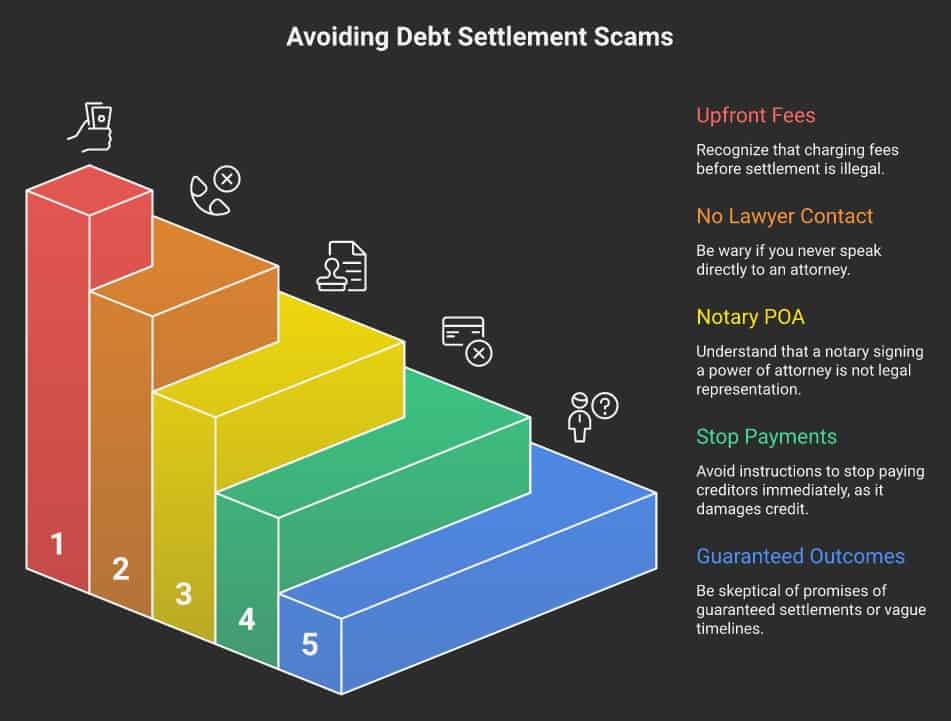
The red flags are consistent across the documented cases. Before enrolling with any debt settlement company — especially one that uses the word “legal,” “law,” or “attorney” in its name or marketing — watch for these:
- Upfront fees before settlement: No legitimate debt settlement company can charge you before actually settling a debt. Period.
- A lawyer’s name on letterhead but no direct lawyer contact: If a “legal representative” or “attorney” is handling your case but you’ve never spoken to one, that’s the attorney model in action
- Power of attorney paperwork signed with a notary — not a lawyer: This is the signature move. Davis signed her POA documents with a notary, not an attorney. It created the appearance of legal engagement without any
- Instructions to stop paying all creditors immediately: Legitimate settlement companies explain the trade-offs; predatory ones just need you behind on payments to create leverage
- Vague or evasive timelines: “You’ll have your debts settled in months” with no specific, documented schedule is a red flag
- Guaranteed outcomes: No settlement company can guarantee creditor cooperation. Anyone who does is lying
What Actually Works Instead
Here’s what I’d tell someone in Coya Davis’s situation: debt settlement can work in specific circumstances — primarily if you have a lump sum available, you’re already behind on payments, and you understand the credit damage you’re accepting. But “legal debt resolution programs” promising to negotiate your debt while charging upfront fees are almost certainly attorney model operations.
For people carrying unsecured debt in the $15,000–$35,000 range with a regular income, the honest comparison is not debt settlement against a debt management plan — it is both against bankruptcy, which ends the debt without illegal fees and without the years of payments that can cost $400,000+ in lost 401(k) contributions and employer match over a five-year plan.
Davis ended up at Money Management International (MMI), a nonprofit credit counseling agency, after leaving Clear Creek. Her credit score is recovering and she’s ahead of her projected payoff schedule.
DMPs do charge fees — but they’re state-regulated, typically under $40 to set up and around $27 per month, according to MMI director Tara Alderete. Before committing to any credit counseling path, use the Credit Counseling Cost Calculator to model exactly what a DMP will cost you over its full term, including the opportunity cost.
And if you’re not sure whether settlement, a DMP, or bankruptcy is the right move for your specific situation, the Find Your Path quiz walks you through the factors that actually determine which option fits.
Key Takeaways
- The “attorney model” allows debt settlement companies to charge illegal upfront fees by attaching a lawyer’s name to their operation without providing real legal services
- Federal law (Telemarketing Sales Rule) prohibits debt settlement companies from collecting fees before settling debt — courts have rejected the attorney exemption argument repeatedly
- The CFPB’s $132M enforcement against Morgan Drexen (2016) and ongoing $100M+ suit against Strategic Financial Solutions (2024) show the scale of this scheme
- Clear Creek Legal — used by Coya Davis — was named in the SFS amended complaint as a facade law firm
- Reduced CFPB and FTC enforcement capacity under the Trump administration leaves more room for these schemes to operate
- Run any debt relief contract through the Contract Decoder before signing — it flags the clauses that set up upfront fee collection
The Bottom Line
The attorney model debt settlement scam is simple: attach a lawyer’s name to a settlement company, claim a legal exemption from the advance fee ban, and collect money from financially desperate consumers before doing any work. The CFPB has pursued major cases — $132 million from Morgan Drexen, $100+ million alleged against Strategic Financial Solutions — and the scheme keeps evolving. I built a credit counseling organization and watched this from inside the industry. The consumers who get hurt are people who can least afford to lose $500 or $1,500. If any debt relief company charges you before settling a single debt, something is wrong — regardless of whether “attorney” or “legal” appears anywhere in their name. Run the contract through the Contract Decoder, and if it shows advance fee clauses, walk away.
Part of the Scam Protection Hub: This post is one piece of my complete Debt Relief Scams: 10 Red Flags to Spot Before You Pay guide — everything you need to identify and avoid debt relief fraud.
Part of the Debt Scam Alert Hub: This post is one piece of my complete Debt Relief Scams guide — the red flags to know, how to research any company, and what the FTC and CFPB data show about the most common fraud patterns.
Free Tool — Scam-O-Meter: Considering a debt relief company? Run your situation through the free Scam-O-Meter — it checks for official FTC, FBI, CFPB, and SEC warning signs before you hand over any money. Check for Red Flags →
Frequently Asked Questions
Is it legal for a debt settlement company to charge fees before settling my debt?
No. Under the Telemarketing Sales Rule, debt settlement companies that use telemarketing cannot collect fees until after they have settled a consumer’s debt and the consumer has made at least one payment toward that settlement. This rule applies regardless of whether the company calls itself a “legal” firm or attaches an attorney’s name to its operation.
What is the attorney model in debt settlement and why is it a problem?
The attorney model is a scheme where debt settlement companies partner with — or rent the credentials of — a licensed attorney to exploit state-level “attorney exemptions” from advance fee rules. In practice, no real legal representation is provided. Courts and regulators have consistently ruled that these arrangements do not qualify for attorney exemptions under federal law. The CFPB has called it out in multiple major enforcement actions totaling hundreds of millions of dollars in alleged harm.
What happened to Strategic Financial Solutions?
In January 2024, the CFPB and seven state attorneys general filed a civil complaint against Strategic Financial Solutions alleging a large-scale attorney model scheme involving 29 corporate defendants, 17 facade law firms, and more than $100 million in alleged illegal upfront fees. SFS filed a motion to dismiss in November 2025. The company’s assets are under a court-appointed receiver while litigation continues. As of this writing, no final judgment has been issued.
Is debt settlement ever legitimate?
Yes — debt settlement can be a legitimate option in specific circumstances. If you’re already delinquent on accounts, have a lump sum available, and understand the credit damage you’re accepting, working with a reputable settlement company can produce real results. Companies resolved more than $2.8 billion in consumer debt in 2022 through legitimate negotiations, according to the American Association for Debt Resolution. The problem isn’t debt settlement itself — it’s the attorney model, which exploits the same consumers settlement is supposed to help.
What should I do if a debt settlement company already charged me upfront fees?
You have options. File a complaint with the Consumer Financial Protection Bureau and the Federal Trade Commission. File a complaint with your state attorney general. And consult a consumer protection attorney — the Telemarketing Sales Rule provides a private right of action, meaning you may be able to sue for the fees you paid. The National Association of Consumer Advocates (NACA) is a good resource for finding consumer attorneys who handle these cases.
Dealing With Debt? Understanding your options is the first step. See how all your debt relief options compare — including ones most sites won’t tell you about. The Find Your Path quiz gives a recommendation based on your actual numbers, and the Scam-O-Meter checks any company’s complaint history before you sign. Federal Reserve research shows bankruptcy filers recover faster than those who don’t file.



