

Quick Answer: Your loan contract with a solar or home improvement lender is legally separate from your contract with the contractor — which means the lender’s default position is that you still owe the money regardless of what the contractor did or didn’t do. But a federal rule called the FTC Holder Rule (16 CFR Part 433) may let you assert the contractor’s misconduct directly against the lender — and potentially stop or reduce payments. Your rights depend heavily on what your loan contract says and how the lender was connected to the contractor.
Expert Context: I’ve been helping people navigate high-interest loan traps and predatory financing since 2008, and solar and home improvement loan disputes have become one of the most common patterns I see — especially when lenders pay contractors directly before the work is inspected. The relationship between the lender and the contractor matters a lot legally, and most consumers don’t know to look for it.
This question came through the Ask Steve chat — and it’s one I hear more and more as solar installation financing and contractor loans have expanded. The specific note I wrote when this question came in:
The Question That Came In:
Every weekday I read the enforcement actions, filings and fine print the outlets skip, and turn them into the one or two moves that actually improve your position — a rate worth moving for, a fee you can refuse, a deadline to beat before it costs you.
In the latest issue (Oct 6): When fear picks your debt plan
I write Your Money Actually most weekdays — actionable money information you will not find anywhere else, and the small decisions that compound. It is free, I sell nothing, and I take no money from any company I write about.
“We got a solar system installed last year through a company that has since gone out of business. The system barely works — we’re still paying full electric bills even though we were told our bills would drop significantly. The finance company wants us to keep making payments on a $28,000 loan. Do we have to keep paying for something that doesn’t work, especially when the company that installed it is gone?”
What makes this situation genuinely complicated is the three-party structure: you, the contractor, and the lender. Your instinct — “why should I keep paying for something broken?” — is entirely reasonable. The legal answer requires looking at how the lender was connected to the contractor and what your loan contract actually says.
Let me walk you through what actually governs this situation — because the answer is more nuanced than “you still owe it” and more realistic than “you can stop paying everything tomorrow.”
Based on recent CFPB complaint narratives, solar and home improvement loan disputes are among the fastest-growing categories of complaints, particularly where lenders paid contractors directly before work was verified complete.
The Core Legal Problem: Two Separate Contracts
Here’s the frustrating legal starting point. When you financed a solar installation or home improvement through a lender like GreenSky, Mosaic Solar, Service Finance, or Sunlight Financial, you actually signed two contracts:
The Daily Money Brief — Free, at 10 AM
Money you may be owed, scams to dodge, and the fine print decoded — the consumer money news that affects your wallet, every weekday.
The lender’s position — and they’ll state it clearly — is that these are completely separate agreements. They fulfilled their obligation by providing the financing. What the contractor did or didn’t do is your dispute with the contractor, not with them.
At common law, that position is technically correct. But federal law created an important exception.
The FTC Holder Rule: The Exception That Matters
In 1975, the FTC created the Preservation of Consumers’ Claims and Defenses rule (16 CFR Part 433) — commonly called the Holder Rule — specifically to address the unfairness of consumers being stuck paying lenders for contractor work that was never done or was defective.
What the Holder Rule requires: Certain consumer loan contracts must contain the following notice in at least 10-point bold type:
“ANY HOLDER OF THIS CONSUMER CREDIT CONTRACT IS SUBJECT TO ALL CLAIMS AND DEFENSES WHICH THE DEBTOR COULD ASSERT AGAINST THE SELLER OF GOODS OR SERVICES OBTAINED PURSUANT HERETO OR WITH THE PROCEEDS HEREOF.”— 16 CFR § 433.2 (Required Notice)
If that language is in your loan contract, it means this: the lender steps into the contractor’s shoes legally. Every defense you could have used against the contractor — bad work, incomplete installation, business failure, fraud — you can now use against the lender to reduce or stop payments. Your recovery is capped at what you’ve already paid, but you can stop future payments.
Common Misconception: “My lender had nothing to do with the contractor — they’re just a bank. The Holder Rule doesn’t apply to me.”
The Reality: The Holder Rule applies to Purchase Money Loans — where the lender has either a referral relationship or a business arrangement with the contractor. GreenSky, Mosaic, Service Finance, and Sunlight Financial all operate through enrolled contractor networks: the contractor refers you to the specific lender’s platform, and the lender pays the contractor directly. That is a textbook referral/business arrangement under 16 CFR § 433.1. For most solar and home improvement loans from these lenders, the Holder Rule almost certainly applies.
The Close Connection Doctrine (Your Backup Argument)
Even if your contract doesn’t contain the Holder Rule notice, courts have developed a separate legal theory called the “close connection doctrine” under the Truth in Lending Act (15 U.S.C. § 1641) and common law. If the lender was deeply involved in the transaction — enrolling contractors, approving installer networks, embedding their loan app into the contractor’s sales process, paying the contractor directly before you received working equipment — courts may treat the lender as a party to the contractor transaction, not a neutral third-party lender.
The lender paying the contractor directly is a significant fact. When a lender disburses funds to a contractor instead of to the consumer, courts have found that’s strong evidence they were active participants in the transaction — not just a bank who bought a loan at arm’s length.
What You Can Do Right Now
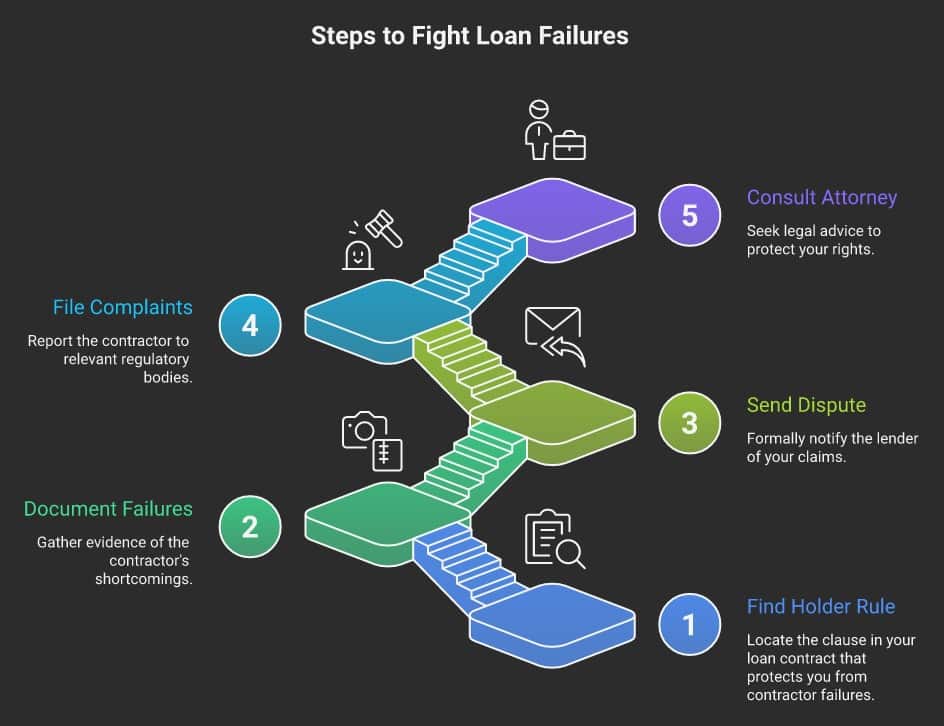
- Step 1: Find the Holder Rule notice in your loan contract. Look for a bold paragraph beginning “ANY HOLDER OF THIS CONSUMER CREDIT CONTRACT IS SUBJECT TO ALL CLAIMS AND DEFENSES…” If it’s there, you have the clearest legal basis for what comes next. If it’s not there, that may itself be a violation of FTC rules — and you still have the close connection doctrine argument.
- Step 2: Document the contractor’s failure thoroughly. Photos or video of the defective or incomplete work. All written communications. The contractor’s license number and state registration (check if their license was revoked or business dissolved). A written estimate from a qualified third party describing what is wrong and what it would cost to fix. If the system doesn’t work as promised, a utility bill comparison showing actual vs. promised savings.
- Step 3: Send a formal written dispute to the lender — certified mail. Cite the Holder Rule notice in your contract and/or the close connection doctrine. State clearly: the contractor did not deliver what was promised; you are asserting your right to withhold payment and/or seek a refund under applicable federal law; you request the lender investigate and resolve before requiring further payments. Keep a copy of everything.
- Step 4: File complaints with regulators. Report the contractor to your state contractor licensing board and state attorney general. File a complaint with the CFPB against the lender — CFPB complaint data is one of the tools regulators use to identify systematic lender-contractor problems. File with the FTC as well.
- Step 5: Consult a consumer law attorney. This situation — large loan, federal Holder Rule argument, lender refusing to honor your defenses — is exactly where a consumer attorney can be most effective. Many handle these cases on contingency or for flat fees. The specific facts of your loan (lender identity, contract language, how payment was made) are things an attorney needs to evaluate. See the attorney resources below.
One Critical Warning — Never Sign a Completion Certificate Before Inspecting: Many contractors present a “Certificate of Completion” or “Notice of Completion” on the day of installation, sometimes before you’ve had a chance to see whether everything works. Signing this document can eliminate your Holder Rule defenses against the lender. Do not sign a completion certificate until you have personally verified the system works as specified. If you already signed one and the system doesn’t work, document when you first discovered the problem — you may still have arguments, but your case is harder.
What About PACE Solar Loans?
If you financed your solar installation through a PACE (Property Assessed Clean Energy) loan — where payments are collected through your property taxes rather than through a lender — your situation is significantly worse. The CFPB explicitly warns that PACE borrowers have “limited options if you aren’t satisfied with the work, wish to dispute the charges, or can’t afford the payments.” PACE assessments can lead to tax sales of your home if unpaid. If you have a PACE loan, consult a consumer attorney in your state immediately — the rules are different and the stakes are higher.
My Take on This
Here’s the thing most people don’t realize going into these financing arrangements: the lender pays the contractor, not you. You never held that $28,000. You signed the loan and the contractor got a direct wire. That arrangement benefits the contractor (instant payment, no waiting for the consumer to dispute) and it benefits the lender (the sale is locked in before you know if anything works).
The Holder Rule was designed precisely for this situation. The question is whether your specific contract includes the notice — and whether the lender will honor it or make you fight for it. The honest answer is that you’re probably going to have to push back formally and possibly legally. But you’re not without options, and “I still owe it no matter what” is not the correct answer here.
Not sure which debt option fits your situation overall? Take the free Find Your Path quiz — especially useful if this isn’t the only financial issue you’re dealing with right now.
No Article Replaces an Attorney Licensed in Your State: The FTC Holder Rule, TILA close connection doctrine, and your state’s UDAP laws are fact-intensive — your specific contract, lender, and circumstances matter enormously. What I’ve written here is educational. You need someone qualified to evaluate your actual case.
How to find a consumer law attorney who handles these cases:
- NACA — National Association of Consumer Advocates — Best starting point for TILA, Holder Rule, and home improvement financing cases. Many take cases on contingency.
- Your state bar’s lawyer referral service — Search “[your state] bar association lawyer referral.” Most offer an initial consultation for $50 or less.
- LawHelp.org — Free and reduced-cost legal aid if cost is a barrier.
- HelpIsHere.org — Specialized free help for seniors and those with disabilities.
Have a similar question? Every situation is different. Ask Steve directly in the chat — describe your specific situation and I’ll help you think through your options.
Key Takeaways
- Your loan contract with the lender is legally separate from your contract with the contractor — that’s the lender’s starting position, and it’s technically correct at common law
- The FTC Holder Rule (16 CFR Part 433) may let you assert the contractor’s misconduct against the lender — check your loan contract for the required bold-type notice
- Lenders like GreenSky, Mosaic, Service Finance, and Sunlight Financial typically operate through contractor referral networks, which likely triggers the Holder Rule’s coverage
- The lender paying the contractor directly (not you) is evidence of “close connection” — a legal doctrine that can give you additional rights even without the Holder Rule notice
- Never sign a completion certificate until you have personally verified the work is done and functioning as specified
- If you have a PACE loan (property-tax-assessed solar financing), your situation is significantly more difficult — consult an attorney immediately
The Bottom Line
You cannot automatically stop paying a solar or home improvement loan just because the contractor did bad work or went out of business — the lender will tell you the contracts are separate, and at common law they’re right. But the FTC Holder Rule (16 CFR § 433.2), which requires a specific protective notice in certain consumer loan contracts, may let you assert the contractor’s failures directly against the lender and stop or reduce payments. Most solar and home improvement lenders — GreenSky, Mosaic, Service Finance, Sunlight Financial — operate through contractor referral networks that likely trigger the Holder Rule. Check your loan contract for the required bold-type notice. Document the contractor’s failures. Send a formal written dispute to the lender citing the Holder Rule. And consult a consumer attorney — this is exactly the type of case where legal representation changes the outcome.
Frequently Asked Questions
Do I have to keep paying a solar loan if the contractor went out of business?
The lender will say yes — the loan is separate from the installation contract. But if your loan contract includes the FTC Holder Rule notice (“ANY HOLDER OF THIS CONSUMER CREDIT CONTRACT IS SUBJECT TO ALL CLAIMS AND DEFENSES…”), you may be able to assert the contractor’s failure directly against the lender to stop or reduce payments. The contractor going out of business doesn’t eliminate your Holder Rule rights — it actually makes them more important, since you can’t recover from the contractor directly.
What is the FTC Holder Rule and does it apply to my solar loan?
The FTC Holder Rule (16 CFR Part 433) requires certain consumer loan contracts to include a notice preserving the consumer’s right to assert contractor defenses against the lender. It applies to “Purchase Money Loans” — where the lender has a referral or business arrangement with the contractor. Because most solar lenders (GreenSky, Mosaic, Service Finance, Sunlight Financial) operate through enrolled contractor networks where the contractor refers customers to the lender’s specific platform, the rule likely applies. Look for the required bold-type notice in your loan documents.
Can I sue the lender if the solar company that installed my system went bankrupt?
Possibly, under the FTC Holder Rule and/or the close connection doctrine. If your contract includes the Holder Rule notice, the lender is liable for the contractor’s failures up to amounts you’ve already paid. If the lender paid the contractor directly and had an enrolled relationship with them, courts may treat the lender as closely connected to the transaction — meaning they can’t claim to be a neutral third party. A consumer attorney can evaluate whether your specific facts support a claim against the lender.
What if I signed a completion certificate saying the work was done?
Signing a completion certificate is the biggest mistake consumers make in these situations, because it tells the lender you approved the work. If you signed one before discovering the problems, document precisely when you first discovered the defects. You may still have claims depending on when the problems became apparent, but your case is harder. Going forward: never sign a completion certificate until you have personally inspected the installation and verified it functions as specified.
Is a PACE solar loan different from a regular solar loan?
Yes — significantly. PACE (Property Assessed Clean Energy) loans are assessed against your property and collected through property tax bills, not through a traditional lender. The CFPB warns that PACE borrowers have limited options when work is unsatisfactory. Unlike traditional loans, PACE assessments can trigger a tax sale of your home if unpaid. If you have a PACE solar loan, the standard FTC Holder Rule analysis may not apply in the same way — consult a consumer attorney licensed in your state as quickly as possible.
Facing a Similar Situation? You’re not alone — and you have more options than you think. Start with the all your debt relief options page to see what’s realistic, or take the 2-minute bankruptcy quiz if the debt feels unmanageable. Federal Reserve research shows filers recover faster than those who don’t file. If a company is involved, run them through the Scam-O-Meter first.



