

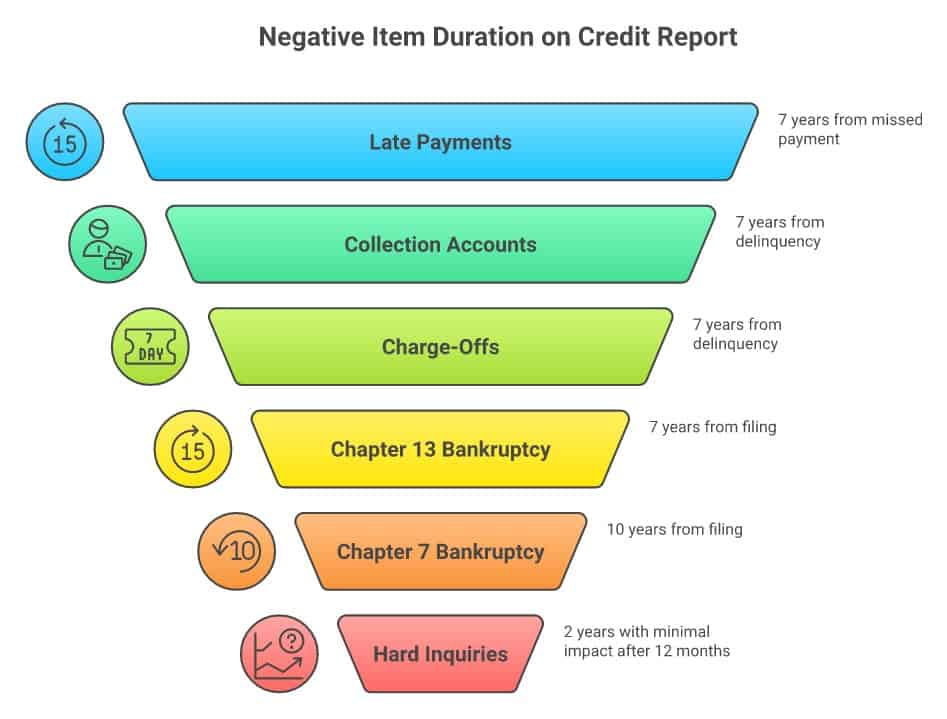
Quick Answer: “This will remain until [date]” on your credit report is the date that specific item — a collection account, late payment, bankruptcy, or other negative mark — is legally required to be removed under the Fair Credit Reporting Act (FCRA). Most negative items must come off after 7 years from the date of first delinquency. Bankruptcies stay up to 10 years. Once that date passes, the item must be deleted — you don’t need to do anything, but you can dispute it if it stays past its deadline. I’ve covered this in more depth in Old Debts Keep Popping Up After I Paid Off Collections.
Expert Context: I ran a nonprofit credit counseling organization with staff credit counselors for over a decade. We reviewed thousands of credit reports — and the “remains until” date is one of the most consistently misunderstood fields on any report, even by people who think they know credit inside and out.
This question came through the Ask Steve chat — and I hear it constantly. People see a date on their credit report and aren’t sure whether that’s a countdown to good news or a deadline to do something. Here’s exactly what it means and everything that affects it.
The Question That Came In:
Each weekday I send one short email: one story that caught my attention, why it might matter to you, and one manageable thing you can do with it. A couple of minutes, and a dad joke.
In the latest issue (Nov 6): Owed money on an Amazon return? Check by Dec. 1
Free. I sell nothing. Unsubscribe any time.
“I was looking at my credit report and there’s a collection account that says something like ‘this account will remain on your credit report until [a date a few years from now].’ What does that actually mean? Does it come off automatically, or do I have to do something?”
It’s a reasonable question — and the answer has a few layers that matter depending on what type of item you’re looking at and when the clock actually started.
What “This Will Remain Until” Actually Means
The date shown is the estimated deletion date — the point at which the credit bureau is scheduled to automatically remove that item from your report. Under the Fair Credit Reporting Act (FCRA), 15 U.S.C. § 605, there are federally mandated time limits on how long negative information can stay on your credit report.
When the deletion date arrives, the item should come off automatically. You typically do not need to call anyone or send a letter — the bureaus are supposed to remove it on schedule. But “supposed to” and “actually does” aren’t always the same thing.
When the 7-Year Clock Actually Starts
This is where most people get confused — and where errors creep in.
Common Misconception: “The 7 years starts when the collection agency first contacted me” or “when the debt was sold to collections.”
The Reality: Under the FCRA, the 7-year clock starts from the date of first delinquency — the date you first missed a payment on the original account and never caught up. Not when it was sent to collections. Not when a new collector bought it. Not when you made a payment. The original first missed payment date.
This matters because some collectors report inaccurate dates to make the item appear newer than it is. If a debt became delinquent in 2018 but a collection agency reports the date as 2021, your credit report will show it staying on until 2028 instead of 2025. That’s a 3-year error — and it’s illegal under the FCRA.
All the Ways an Item Can Come Off Your Credit Report
The deletion date is just one path. Here’s the full picture:
- Time — automatic deletion: When the reporting period expires, bureaus remove it. No action needed, but verify it actually happened.
- Successful dispute: If an item is inaccurate (wrong date, wrong amount, wrong account, already paid, not yours), you can dispute it under FCRA § 611. The bureau has 30 days to investigate and must remove it if unverified.
- Identity theft block: If the account resulted from identity theft, you can have it blocked under FCRA § 605B with an identity theft report.
- Goodwill deletion: For paid accounts, you can write to the original creditor asking them to remove the negative mark as a goodwill gesture. This is not guaranteed and is entirely at the creditor’s discretion — but it works sometimes, especially with long-standing accounts and one-time late payments.
- Bankruptcy discharge: Accounts included in a bankruptcy discharge are updated to reflect $0 balance and “included in bankruptcy” — but the bankruptcy itself stays on the report for its own reporting period.
What to Do When the Date Passes and It’s Still There
If the “remains until” date has passed and the item is still on your report, that’s a violation of the FCRA — and you have the right to dispute it. Here’s how:
- Pull your report from all three bureaus at AnnualCreditReport.com (the only official free source)
- File a dispute directly with the bureau(s) still showing the item — you can do this online, by phone, or by mail
- Include the “date of first delinquency” in your dispute if you know it — this is the key date the bureau needs
- The bureau must investigate within 30 days and remove the item if it can’t verify the information is accurate and current
- If the bureau fails to remove a genuinely expired item, you may have a claim under the FCRA — consult a consumer law attorney
Watch for This Scam: Some credit repair companies charge fees to “remove” negative items before their deletion date. There is no legal way to remove accurate, timely negative information from your credit report — anyone promising otherwise is selling you something that either doesn’t work or uses tactics that can backfire. The only legitimate path to early removal is a legitimate dispute of inaccurate information.
Have a question about your specific credit report? Ask Steve in the chat — describe what you’re seeing and I’ll help you figure out what it means and whether anything on your report shouldn’t be there.
The Bottom Line
“This will remain until [date]” is your automatic deletion date — the federally mandated deadline by which the credit bureau must remove that item. Most negative items expire after 7 years from the original date of first delinquency; Chapter 7 bankruptcy stays for 10. You don’t need to do anything when the date arrives — but check your report to make sure it actually came off. If it’s still there after the deletion date, file a dispute immediately. And if the date on your report looks wrong (too far in the future compared to when you know the debt went bad), that error is worth disputing now.
Frequently Asked Questions
Does paying a collection account remove it from my credit report sooner?
No — paying a collection account does not move up the deletion date. The item remains on your report until the 7-year window from the original date of first delinquency expires. What paying does change is the status: from “unpaid collection” to “paid collection,” which is slightly better for lenders evaluating your report. Some newer credit scoring models (like FICO 9 and VantageScore 4.0) ignore paid collections entirely, but many lenders still use older models that count them.
Can a collection account be re-reported and restart the 7-year clock?
No — this is illegal. Under the FCRA, a debt buyer or new collection agency that purchases old debt cannot “re-age” the account by reporting a newer delinquency date. The 7-year clock is fixed from the original date of first delinquency on the original account. If a new collector reports a newer date, that’s a FCRA violation you can dispute and potentially sue over.
What’s the difference between how long a debt is collectible vs. how long it stays on my credit report?
These are two completely separate clocks. The statute of limitations on collecting a debt (how long someone can sue you over it) is set by state law and varies from 3 to 10 years depending on the state and type of debt. The 7-year credit reporting window is set by federal law (FCRA). A debt can be past the statute of limitations for lawsuits but still on your credit report — or removed from your credit report but still legally collectible (though suing on very old debt is rare).
Free Tool — Statute of Limitations Checker: Dealing with old debt? The free Statute of Limitations Checker tells you if the collection clock has expired in your state — including the zombie debt and clock-restarting traps collectors use. Check My Status →
How do I find the “date of first delinquency” if I’m not sure when it was?
Your credit report should show it — look for “Date of First Delinquency” or “Original Delinquency Date” in the account details. If it’s not listed clearly, you can request the original creditor’s records or check your own bank statements from around the time the debt went bad. If you believe the date on your report is wrong, dispute it with documentation of what the correct date actually is.
Will a negative item coming off my report automatically raise my credit score?
Usually yes — but how much depends on the rest of your report. If the expired negative item was the only negative mark, the improvement can be significant. If you have multiple negative items, removing one improves your score but won’t transform it. The best way to understand your current report is to pull it from AnnualCreditReport.com and review all items, not just the ones close to their deletion date.
Dealing With Debt? Understanding your options is the first step. See how all your debt relief options compare — including ones most sites won’t tell you about. The Find Your Path quiz gives a recommendation based on your actual numbers, and the Scam-O-Meter checks any company’s complaint history before you sign. Federal Reserve research shows bankruptcy filers recover faster than those who don’t file.
Wondering whether paying changes that removal date? It does not — here is what paying a collection actually changes, and what it leaves alone.



