
Quick Answer: State Farm Bank, Afni Inc., and three related companies have agreed to a $110 million class action settlement over claims they failed to send legally required notices when repossessing borrowers’ vehicles and other collateral. If your property was repossessed under one of these loans, you may automatically receive cash, debt relief, and negative credit entry deletions — without filing a claim. The settlement is pending court approval.
If you are also facing repossession separately from this settlement, see what to do right now after your car is repossessed.
Why I’m Covering This: I’ve been helping people navigate debt and repossession for over 30 years. One of the most common things I see is borrowers who don’t realize they had rights during a repossession — and specifically that lenders are legally required to send proper notices before and after selling your property. When those notices are defective or missing, the law provides remedies. This settlement is exactly that scenario playing out at scale.
A $110 million class action settlement has been reached against State Farm Bank, Afni Inc., and affiliated companies over allegations they failed to send legally proper repossession notices to borrowers — and if you had a loan with any of these entities and your collateral was repossessed, you may be automatically enrolled to receive money, debt forgiveness, and credit report cleanup.
Claiming money you are owed is one good day. What you do over the following year is what actually changes your position.
In the latest issue (Oct 8): A parent's nursing home bill can become yours
I write Your Money Actually most weekdays — actionable money information you will not find anywhere else, and the small decisions that compound. It is free, I sell nothing, and I take no money from any company I write about.
What This Lawsuit Is About
The case — AFNI, INC. v. THUY MARTINEZ, et al. — was filed in the Twenty-First Judicial Circuit Court of St. Louis County, Missouri. It centers on a specific legal requirement: when a lender repossesses and sells your property, they must send you proper notices both before the sale (a pre-sale notice) and after the sale (a post-sale notice).
These notices matter because they tell you your rights: the right to redeem your vehicle, the right to know when and how it will be sold, and the right to understand any remaining deficiency balance you might owe after the sale. According to the lawsuit, the defendants — State Farm Bank FSB, Afni Inc., EMVLP LLC, EMVLP II LLC, and Twenty-One Eighty-Five LLC — sent notices that were legally deficient.
What’s a Deficiency Balance? If your repossessed car sold at auction for $8,000 but you owed $11,000, you’d owe the $3,000 “deficiency.” Lenders must sell repossessed vehicles in a “commercially reasonable manner” and send required notices. According to the Consumer Financial Protection Bureau, if a lender doesn’t follow proper procedures, it may affect your obligation to pay that deficiency. That’s exactly what’s at stake in this case.
The defendants deny the allegations. The court hasn’t ruled on the merits. The parties agreed to settle to avoid the costs and uncertainty of litigation — and the settlement delivers real benefits to affected borrowers.
Who Is Eligible for This Settlement
According to the official settlement website, you are likely a class member if you:
- Had a secured collateralized loan or financing agreement with EMVLP LLC, EMVLP II LLC, Twenty-One Eighty-Five LLC, State Farm Bank FSB, or Afni Inc.
- Had your collateral (vehicle or other property) repossessed under that loan
- Were mailed a pre-sale and/or post-sale notice in connection with that repossession
If you’re unsure whether you qualify, the settlement site has full details on eligibility. Many class members won’t need to do anything to receive benefits — more on that below.
What the Settlement Provides
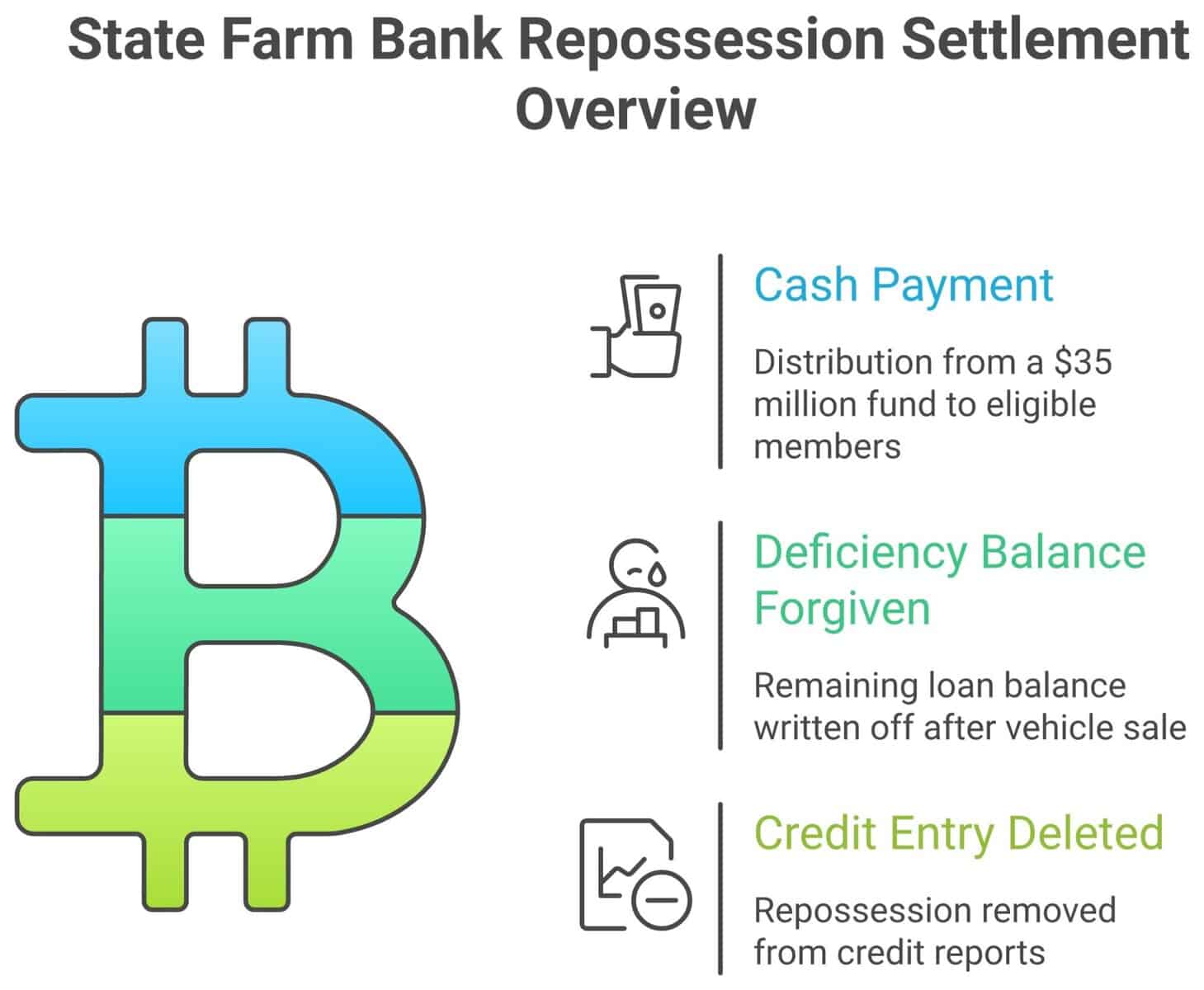
The settlement provides three forms of relief to eligible class members:
- Cash payments from a $35 million fund distributed to class members
- Deficiency balance write-offs — alleged remaining balances on repossessed accounts may be forgiven
- Negative credit entry deletion — certain negative marks tied to these repossessions may be removed from your credit reports
The credit deletion benefit alone can be significant. A repossession can stay on your credit report for up to seven years according to the CFPB, dragging down your score and affecting your ability to get future loans or housing. Having that entry deleted is real, tangible relief.
Tax Warning: The settlement website specifically notes that “relief provided under this settlement, including money and debt reduction, may be subject to tax.” If you receive a debt write-off, the IRS may treat it as taxable income. Talk to a tax advisor before assuming you can spend the full amount.
How to Get Your Share — You May Not Need to Do Anything
This is where the settlement is unusually favorable for class members: you are automatically enrolled. According to the official settlement notice, if you do nothing, you will receive whatever benefits you’re entitled to under the settlement — and you give up your right to separately sue the defendants over these same claims.
✓ If You Do Nothing
- Automatically receive cash payment
- Receive deficiency write-off (if applicable)
- Receive credit entry deletion (if applicable)
- Settlement handles everything
→ If You Want to Exclude Yourself
- Receive no money or benefits
- Preserve your right to sue separately
- Only option if you have a large individual claim worth pursuing
- Must act by the deadline in the notice
You can also object to the settlement or request to speak at the court hearing if you believe the terms aren’t fair. All deadlines are in the notice mailed to class members.
Important: The settlement is not yet final. The court must approve it, and it could be appealed after that. Payments and benefits will only be distributed after final court approval and the resolution of any appeals. Be patient — this can take months.
Who Are the Companies in This Settlement?
Key Terms Defined
State Farm Bank FSB: The banking subsidiary of State Farm — the well-known insurance company — which issued auto loans and other consumer credit products. State Farm closed its bank in 2020, transferring many accounts to US Bancorp.
Afni Inc.: A debt collection company based in Bloomington, Illinois, that allegedly acquired or managed consumer accounts from State Farm Bank.
EMVLP LLC / EMVLP II LLC / Twenty-One Eighty-Five LLC: Entities that held or managed portfolios of consumer loans originally associated with State Farm Bank.
Deficiency balance: The amount a borrower still owes after their repossessed property is sold — the difference between the sale price and the outstanding loan balance plus fees.
What This Means for You
If you had a car loan through State Farm Bank that ended in repossession, this is worth your attention. Many people in that situation were left with deficiency balances still being collected — sometimes years later — and negative credit marks that followed them. This settlement directly addresses both.
I’d also say this: repossession is one of the most emotionally brutal parts of financial hardship. You’re already struggling, and then you lose your transportation — usually the thing that lets you get to work and dig out. The law exists to protect you in that moment, and when lenders skip those protections, they should be held accountable. That’s what this case is about.
If you received a mailed notice and believe you were part of one of these repossession transactions, visit the settlement website to understand your specific options: sfbnoticeclass.com.
Key Takeaways
- State Farm Bank, Afni Inc., and three related entities settled for $110 million over alleged defective repossession notices
- Class members automatically receive cash, potential debt write-offs, and credit entry deletions — no claim filing required
- You can exclude yourself if you want to preserve the right to sue separately — but you’d give up all settlement benefits
- Debt write-offs and cash payments may be taxable — consult a tax advisor
- Settlement is pending court approval — benefits paid only after final approval and any appeals
Bottom Line: State Farm Bank and Afni Inc. have agreed to pay $110 million to settle allegations they failed to send legally required notices when repossessing borrowers’ property. If you had a loan with these entities and your collateral was repossessed, you’re likely automatically enrolled to receive cash, potential debt forgiveness, and negative credit entry deletions — without filing anything. Visit sfbnoticeclass.com to confirm your eligibility and understand the deadlines. The settlement still requires court approval, so be patient — but don’t ignore this if it applies to you.
Frequently Asked Questions
Do I need to file a claim to get money from this settlement?
No — according to the official settlement notice at sfbnoticeclass.com, class members who do nothing will automatically receive their benefits, including cash payments, debt write-offs, and credit entry deletions. You only need to take action if you want to exclude yourself, object to the settlement, or speak at the court hearing.
What is the deadline to opt out of the State Farm repossession settlement?
The specific deadline is provided in the notice mailed to class members. Visit sfbnoticeclass.com for current deadlines. Missing the opt-out deadline means you remain in the class and give up your right to separately sue the defendants.
How much money will each class member receive?
The settlement includes a $35 million cash fund, but individual payment amounts depend on the number of eligible class members and the specific facts of each account. The full $110 million value also includes debt write-offs and credit entry deletions, which vary by person. Exact per-person amounts are not yet publicly disclosed.
Who is Afni Inc. and why are they part of this settlement?
Afni Inc. is a debt collection company that allegedly acquired or managed consumer loan accounts originally associated with State Farm Bank FSB. The lawsuit alleges that both the original lender (State Farm Bank) and the companies that later held those accounts (including Afni and the EMVLP entities) sent defective repossession notices to borrowers.
Is the settlement money taxable?
Potentially yes. The settlement notice specifically warns that “relief provided under this settlement, including money and debt reduction, may be subject to tax.” Cash payments and forgiven debt may both be treated as taxable income by the IRS. Consult a tax advisor for guidance on your specific situation before counting on the full amount.
Dealing With Debt? Understanding your options is the first step. See how all your debt relief options compare — including ones most sites won’t tell you about. The Find Your Path quiz gives a recommendation based on your actual numbers, and the Scam-O-Meter checks any company’s complaint history before you sign. Federal Reserve research shows bankruptcy filers recover faster than those who don’t file.



