

Quick Answer: Credit Counseling of Arkansas is a nonprofit credit counseling agency based in Fayetteville, Arkansas. To evaluate whether they’re right for you, I’d encourage you to check their complaint history with the CFPB, read consumer reviews, and review their IRS Form 990. Here’s how to do each of those.
Before You Read This: I want to be upfront about what this page is and isn’t. I’m not rendering a verdict on Credit Counseling of Arkansas. This is a research guide — I’m showing you where to look so you can reach your own conclusions based on current information.
If you find something in the public record that concerns you, post it in the comments below. If you’re evaluating their enrollment agreement or a debt management plan proposal, use my free Contract Decoder tool.
If you represent Credit Counseling of Arkansas and something here is inaccurate, contact me and I’ll review it promptly.
Each weekday I send one short email: one story that caught my attention, why it might matter to you, and one manageable thing you can do with it. A couple of minutes, and a dad joke.
In the latest issue (Nov 6): Owed money on an Amazon return? Check by Dec. 1
Free. I sell nothing. Unsubscribe any time.
If you have inside information you feel you need to share with me privately: don’t. Whatever you want to share should be posted in the comments — by you, with your name attached. I’m not willing to be anyone’s conduit for information they won’t stand behind themselves.
The most valuable thing on this page may not be what I’ve written — it’s the comments section below. People who’ve actually worked with Credit Counseling of Arkansas share their experiences there. I’d encourage you to read them and add your own.
Who Is Credit Counseling of Arkansas?
An educated consumer is our best customer.— Sy Syms
New here? My Ultimate Consumer Guide to Checking Out a Debt Relief Company walks through how to vet any debt relief or credit counseling agency before you enroll.
Credit Counseling of Arkansas (CCOA) is a nonprofit 501(c)(3) credit counseling agency. Rather than repeat what they say about themselves here, I’d encourage you to read their website and their publicly filed IRS Form 990 — that way you’re seeing it directly from primary sources, not filtered through me.
Step 1: Check Their Credentials
Before anything else, verify they have the credentials they claim. Here’s what to check:
- COA Accreditation: The Council on Accreditation sets standards for nonprofit human service organizations. Check whether they hold current COA accreditation.
- US Trustee Approval: Credit counseling agencies that provide pre-bankruptcy counseling must be approved by the US Trustee Program. Check the current DOJ/US Trustee approved agency list for your state to confirm their approval status.
- BBB Profile: Check their Better Business Bureau profile — look at the rating, years in business, and especially the complaint history and how they responded to each one.
A Note on BBB Grades: A high BBB grade doesn’t necessarily mean a company is right for you — it means they respond to complaints filed through the BBB. Read the actual complaint text and the company’s responses. That’s the useful part. See my full guide to what BBB letter grades actually mean →
Step 2: Check Consumer Complaints
The Consumer Financial Protection Bureau maintains a public database of complaints filed against financial companies. You can search for Credit Counseling of Arkansas directly:
Search Credit Counseling of Arkansas’s complaint history in the CFPB database →
When you’re reading complaints, look for:
- What the complaints are about — program fees, creditor payment processing, communication problems?
- How the company responded — did they resolve issues or just close them?
- Whether the same issue appears repeatedly — a pattern matters more than a single complaint
- The ratio of complaints to the number of clients they serve — an active agency will have more complaints in raw numbers
Step 3: Read What Others Have Experienced
Credit Counseling of Arkansas doesn’t appear to have a Trustpilot profile, but there are other places to find consumer experiences:
How to evaluate reviews of nonprofit credit counselors: Look beyond the star rating. What matters most is whether reviews describe actual outcomes — debts paid on schedule, creditors participating as promised, fees as quoted — versus just praising a helpful counseling session. Outcome reviews tell you far more than experience reviews.
- BBB reviews: The BBB profile includes both ratings and complaint text — read the actual complaints, not just the summary
- Google reviews: Search “Credit Counseling of Arkansas reviews” — Google reviews tend to be more candid and include more outcome-focused accounts
- Consumer forums: Sites like Reddit’s r/personalfinance often have threads from people who’ve worked with specific agencies. Search by name and by “CCOA cares.”
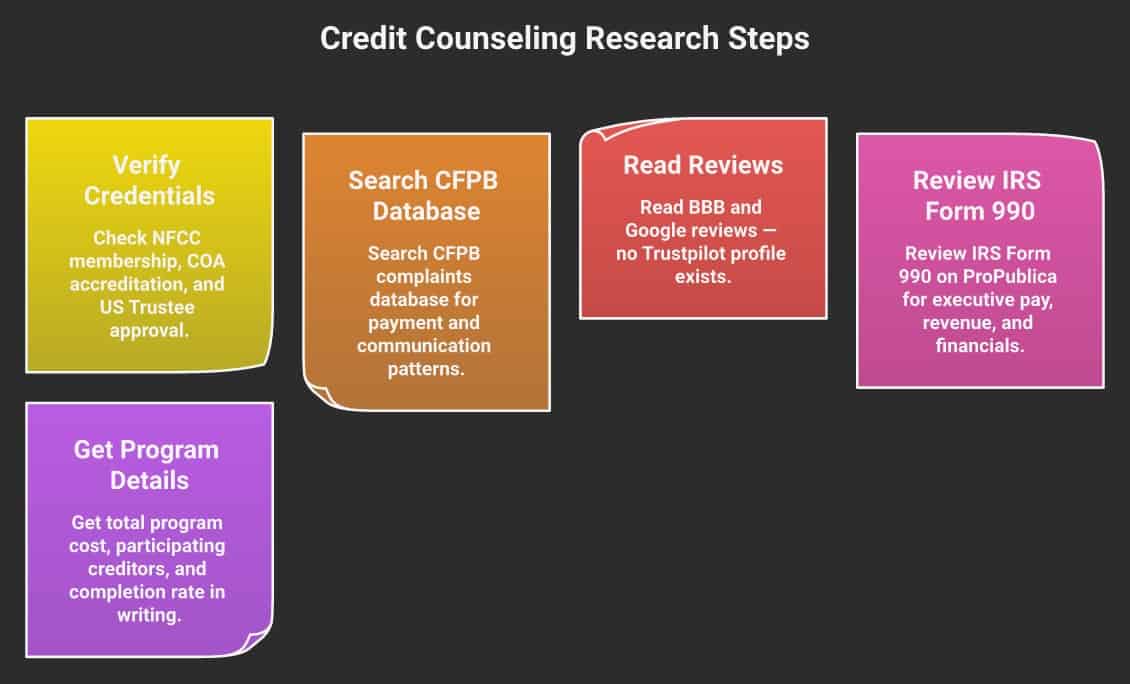
Step 4: Read Their IRS Form 990
As a nonprofit, Credit Counseling of Arkansas (EIN 71-0772094) is required to file an IRS Form 990 annually — and those filings are public. This is one of the most underused research tools available to consumers.
Find Credit Counseling of Arkansas’s Form 990 filings on ProPublica’s Nonprofit Explorer →
When you open a 990, here’s what to look for:
- Executive compensation — What does leadership earn? Is it proportionate to the organization’s size and mission?
- Revenue vs. expenses — Are they running surpluses or consistent deficits? Multiple deficit years can signal financial instability.
- Program service revenue — How much of their income comes from client fees versus grants, donations, or creditor fair share payments?
- Mission alignment — Read their description of program services. Does what they say they do match how they describe their activities to the IRS?
- Conflict of interest policy — Part VI asks whether the organization has a conflict-of-interest policy and how it’s enforced
Why This Matters: Nonprofit status means they don’t pay corporate taxes — it doesn’t mean they’re automatically trustworthy or that their fees are low. The 990 is your window into how they actually operate. I ran a nonprofit credit counseling organization myself, and the 990 was always the first document I’d look at when evaluating a peer agency.
Step 5: Ask the Right Questions Before You Enroll
Before signing anything: Run their enrollment agreement through my free Contract Decoder tool. Paste it in and get a plain-English breakdown of what you’re agreeing to.
Before you commit to a debt management plan, get clear answers — in writing — to these questions:
- What is the total cost — monthly fees plus any enrollment fee — over the full length of the program?
- Which creditors do they have established relationships with, and which don’t participate in DMPs?
- What happens to my accounts that aren’t included in the program?
- What are the consequences if I miss a payment or need to pause the program?
- How is my monthly payment held — in a trust account — and what happens to it if I cancel?
- What percentage of people who enroll complete the program successfully?
Before You Commit: A debt management plan isn’t right for everyone. Run your situation through my Find Your Path tool to see whether a DMP, debt settlement, bankruptcy, or another option fits your situation better. Understanding the retirement cost most people never calculate is worth doing before you enroll in any multi-year program.
Key Takeaways
- Verify COA accreditation and US Trustee approval are currently active
- Read CFPB complaints for patterns — payment processing and counselor communication are common issues in this industry
- No Trustpilot profile — use BBB reviews and Google reviews as alternatives
- The IRS Form 990 via ProPublica reveals executive pay, financials, and mission alignment
- Get total program cost and completion rate in writing before you enroll
- The comments section below contains real experiences from real clients — read them
Want the full research playbook? My Ultimate Consumer Guide to Checking Out a Debt Relief Company covers every tool and source in this guide — plus detailed walkthroughs for reading BBB profiles and searching federal court records on CourtListener.
Frequently Asked Questions
Is Credit Counseling of Arkansas a nonprofit?
Yes. Credit Counseling of Arkansas is a nonprofit 501(c)(3) organization based in Fayetteville, Arkansas. Nonprofit status means they can accept tax-deductible donations and don’t pay corporate taxes — but it doesn’t mean their services are free. Verify their current fee schedule directly with them.
How do I file a complaint against Credit Counseling of Arkansas?
You can file a complaint with the CFPB at consumerfinance.gov/complaint, with the Arkansas Attorney General’s consumer protection division, and with the BBB. Filing with the CFPB creates a public record and triggers a required company response.
Is Credit Counseling of Arkansas accredited?
Credit Counseling of Arkansas has been affiliated with NFCC membership and COA accreditation. Verify their current status directly through COA’s website — accreditation status can change.
What is a debt management plan and how does it work?
A debt management plan (DMP) consolidates your unsecured debts into a single monthly payment that the agency distributes to your creditors. Creditors often reduce interest rates for enrolled clients. Programs typically take three to five years to complete. There’s usually a monthly fee, and you’ll generally need to close the credit accounts enrolled in the plan.
Should I use Credit Counseling of Arkansas to get out of debt?
That depends entirely on your situation. A debt management plan works well for some people and isn’t the right fit for others. I’d encourage you to run your situation through my Find Your Path tool before committing to any program — and to understand the full cost including any impact on long-term savings.
Share Your Experience with Credit Counseling of Arkansas
If you’ve worked with Credit Counseling of Arkansas — as a client, a former employee, or someone who looked into them and decided not to enroll — I’d encourage you to share your experience in the comments. Your perspective helps others make a more informed decision.
To share your experience: Scroll to the bottom of this page — the comments box is there.
Before You Sign Anything: Run any debt relief contract through the free Contract Decoder to spot hidden fees and unfair terms. Check the company’s complaint history with the Scam-O-Meter.
Compare Your Real Options: Most debt relief companies won’t tell you about all your options — especially the ones they can’t profit from. Credit counseling has a 21-27% completion rate. Settlement resolves about 1% of enrolled debts fully. Chapter 7 bankruptcy generally ends in a discharge for individual filers in more than 99% of cases, excluding cases dismissed or converted (U.S. Courts) — and protects your retirement. Take the Find Your Path quiz for a recommendation based on your actual numbers.
Browse all Credit Counseling & Debt Management reviews, or see the full Company Reviews directory.



