

Quick Answer: CuraDebt is a for-profit debt settlement company headquartered in Hollywood, Florida. They negotiate unsecured debts on behalf of consumers. This guide shows you exactly where to research them before signing anything.
I get asked about CuraDebt regularly — people want to know if they’re legitimate and whether debt settlement is a smart move for their situation. The short answer is that whether any debt company is right for you depends on facts you can look up yourself. Here’s how I’d research CuraDebt — and any debt settlement company — in about an hour.
Disclosure: I have no financial relationship with CuraDebt. I have not been paid to write this guide. If CuraDebt would like to correct any factual information here or share their perspective, they can reach me directly at getoutofdebt.org. This guide is designed to help you do your own research — not to tell you what to decide.
Who Is CuraDebt?
CuraDebt Systems, LLC is a for-profit debt settlement company. According to their BBB profile, they’re based in Hollywood, Florida. They are a member of the American Fair Credit Council (AFCC), the industry trade group that sets voluntary standards for debt settlement companies. For current information about their specific programs, fees, and services, visit curadebt.com directly.
Each weekday I send one short email: one story that caught my attention, why it might matter to you, and one manageable thing you can do with it. A couple of minutes, and a dad joke.
In the latest issue (Nov 6): Owed money on an Amazon return? Check by Dec. 1
Free. I sell nothing. Unsubscribe any time.
What debt settlement actually means: During a debt settlement program, you stop paying your creditors while saving money in a dedicated account. The company then negotiates lump-sum settlements. This process typically takes two to four years. Your credit score will drop significantly. Creditors may sue you while you’re in the program. This is the reality of how debt settlement works — not specific to CuraDebt, but true of the category as a whole.
Step 1: Check Their Credentials
Before anything else, verify three things: industry membership, state licensing, and their BBB profile.
AFCC Membership
CuraDebt is a member of the American Fair Credit Council, and they publish their AFCC disclosures on their website. AFCC membership means the company has agreed to voluntary best practices, including prohibitions on collecting advance fees before settling debts. This is meaningful but not a guarantee of performance — it’s a starting point, not an endpoint.
State Licensing
Debt settlement companies must be licensed in most states where they operate. Here’s how to verify:
- Search your state’s financial regulator website for “CuraDebt” or “CuraDebt Systems LLC”
- The AFCC maintains a state licensing map at their website
- Your state Attorney General’s office can tell you if a company is registered to operate in your state
- If a company can’t show you a current license in your state, that’s a red flag
BBB Profile
CuraDebt’s BBB profile is at: BBB — CuraDebt Systems, LLC (Hollywood, FL)
When reading BBB profiles, look at three things: the complaint count relative to years in business, how the company responds to complaints, and whether complaints show a pattern (same issue repeating) versus isolated incidents.
How to read BBB data: A company with 50 complaints over 20 years is very different from one with 50 complaints in 2 years. Always divide complaint counts by years in business to get a complaint rate. Also read the company’s responses — a company that ignores complaints or gives boilerplate answers tells you something important about how they handle problems.
Step 2: Search the CFPB Complaints Database
The Consumer Financial Protection Bureau’s complaint database is one of the most useful research tools available — and it’s completely free. Every complaint filed against a company is publicly visible, along with the company’s response.
Search CuraDebt complaints here:
CFPB Complaint Search: “CuraDebt” — Last 3 Years
- Look at complaint categories: Are they billing disputes? Settlement failures? Communication problems? Lawsuits while enrolled?
- Read the narratives: Consumers can share what happened in their own words. These tell you more than summary statistics.
- Check the company responses: Did CuraDebt respond? Did they resolve the issue? Did they dispute the facts?
- Look for patterns: If ten people describe the same problem, that’s a pattern — not a coincidence.
CFPB filing tip: If you have a problem with CuraDebt or any debt company, you can file a complaint at consumerfinance.gov/complaint. The CFPB forwards it to the company, requires a response, and adds it to the public record. This is one of the most effective tools consumers have.
Step 3: Read Their Trustpilot Reviews — But Read Them Carefully
CuraDebt has reviews on Trustpilot at: Trustpilot — CuraDebt Reviews
Here’s what to actually look for when reading reviews — because not all reviews are equally useful:
- Read the early reviews, not just the recent ones: New enrollees often post glowing reviews after signing up. Look for reviews from people who have completed or are mid-way through their program.
- Search for the word “lawsuit”: Some debt settlement clients are sued by creditors during their program. How frequently does this appear in reviews? What did the company do?
- Look for reviews mentioning fees: What percentage do they charge? When are fees collected? Do reviewers feel the fees were explained upfront?
- Pay attention to negative reviews: What’s the company’s response? Do they acknowledge problems or deflect?
Review credibility note: Companies can solicit reviews right after enrollment, when customers are most optimistic. Someone six months into a debt settlement program — watching their credit score drop and getting collection calls — has a very different experience to report than someone who just signed the paperwork. Seek out reviews from people describing their actual settlement outcomes.
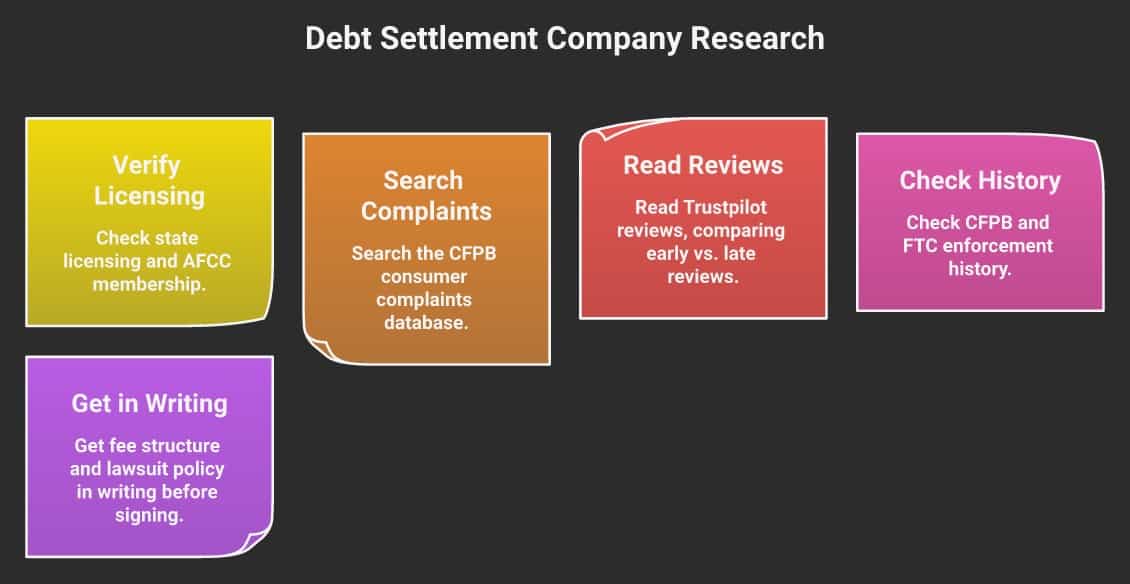
Step 4: Check Their Legal and Enforcement History
For-profit debt settlement companies are subject to enforcement from federal and state regulators. Here’s where to look:
- CFPB Enforcement Actions: Search the CFPB’s enforcement action database for “CuraDebt” and related names
- FTC Actions: The FTC publishes all enforcement cases — search for the company and its principals. The FTC’s Telemarketing Sales Rule prohibits collecting advance fees in debt settlement.
- Florida AG and Office of Financial Regulation: Search “CuraDebt Florida attorney general” — Florida has consumer protection enforcement in the debt relief space.
- Federal Court Records: CourtListener searches 1.3 billion federal court documents for free — search for cases where CuraDebt is a party. For the official PACER system, see my guide to using PACER.gov.
The debt settlement risk nobody talks about: During a debt settlement program — which can take two to four years — your enrolled accounts go delinquent and your credit score drops significantly. Creditors may sue you during this period. The company typically can’t prevent lawsuits, and some lawsuits result in wage garnishment. Whether this risk is acceptable depends on your income, assets, and how aggressively your creditors historically pursue judgments.
Free Tool — Wage Garnishment Calculator: Worried about your paycheck being seized? The free Wage Garnishment Calculator shows exactly how much creditors can legally take in your state — and some states prohibit garnishment entirely. Calculate My Risk →
Step 5: Questions to Ask Before You Enroll
If you contact CuraDebt — or any debt settlement company — get answers to these questions in writing before signing anything:
Ask About Fees
- What is your fee percentage? (Industry standard is 15–25% of enrolled debt)
- When are fees collected — before or after settlement?
- Are there monthly maintenance fees on the dedicated account?
- What happens to my fees if a creditor sues me and I have to drop out?
Ask About the Process
- How long will my program take given my specific debt load?
- Which creditors do you have existing settlement relationships with?
- What happens if a creditor sues me while I’m enrolled?
- Do you provide legal representation if I’m sued?
The lawsuit question is critical: Many consumers don’t realize that debt settlement companies generally cannot stop creditors from suing you. During the settlement period — often 24 to 48 months — creditors who don’t want to settle can pursue a judgment. Get a straight answer in writing about what CuraDebt does and doesn’t do if you’re sued while enrolled.
Key Takeaways
- CuraDebt is a for-profit debt settlement company, AFCC member, based in Hollywood, FL
- Check the CFPB complaint database — it’s free, detailed, and shows company responses
- Read Trustpilot reviews from mid-program and post-program clients, not just new enrollees
- Verify state licensing before engaging with any debt settlement company
- Get fee structure, lawsuit policy, and program timeline in writing before signing
- Debt settlement significantly damages your credit score during the program — plan for this
Before You Decide: Know All Your Options
Debt settlement is one option. It’s not the only one, and it’s not right for everyone. Here’s how I’d think about it:
If debt settlement doesn’t fit your situation, there are other paths worth understanding:
- Bankruptcy: Chapter 7 takes about 90 days, stops all collection immediately, and — contrary to popular belief — your credit rebounds faster than most people expect. I filed bankruptcy in 1990. It was the right decision. Read my bankruptcy overview for the full picture.
- Nonprofit credit counseling / Debt Management Plan: Keeps your accounts current, reduces interest rates, takes 3–5 years. No credit damage during the program. Fees are low but there’s a hidden cost: the opportunity cost of not saving for retirement during that time.
- Do nothing strategically: If you have no assets and limited income, creditors may have nothing to collect even if they sue. This isn’t a permanent solution, but understanding your actual legal exposure matters.
Use my Find Your Path tool to get a personalized breakdown of which options fit your specific situation.
I want people to have all the information so they can make an informed decision that is right for them.— Steve Rhode
Share Your Experience
Have you worked with CuraDebt? Your experience — positive or negative — helps other people make better decisions. Share it in the comments below, or send me a question directly. I read everything.
If you had a negative experience and want to take action, remember you can:
- File a complaint with the CFPB at consumerfinance.gov/complaint
- File with your state Attorney General’s consumer protection division
- File with the BBB (though BBB complaints carry less weight than CFPB filings)
- Consult with a consumer law attorney — many take debt collection cases on contingency
Before signing anything: Run their contract through my free Contract Decoder tool. Paste it in and get a plain-English breakdown of what you’re agreeing to.
Frequently Asked Questions
What is CuraDebt?
CuraDebt is a for-profit debt settlement company based in Hollywood, Florida. They negotiate unsecured debts on behalf of clients who are experiencing financial hardship. They are a member of the American Fair Credit Council (AFCC). Verify their current programs and fees directly at their website before enrolling.
How do I file a complaint against CuraDebt?
You can file with the CFPB at consumerfinance.gov/complaint, with your state attorney general, and with the BBB. The CFPB complaint is the most powerful — it triggers a required company response and becomes part of the public record. State AG complaints can trigger regulatory attention if a pattern emerges.
Is CuraDebt a legitimate company?
CuraDebt is a registered for-profit company with an AFCC membership and a BBB profile. Whether they’re the right company for your situation — and whether debt settlement itself makes sense for your finances — is what the research process in this guide helps you evaluate. Legitimacy and fit are two different questions.
Will debt settlement hurt my credit score?
Yes, significantly. During a debt settlement program, your enrolled accounts go delinquent, which damages your credit score. Settled accounts show as “settled for less than the full amount” on your credit report and can stay there for years. Plan for this reality before enrolling — it’s not a surprise outcome, it’s a structural feature of how settlement works.
What is the difference between debt settlement and a debt management plan?
A debt management plan (DMP) lowers interest rates, but you still repay the full balance over three to five years, and five years of those payments can cost $400,000+ in lost 401(k) contributions and employer match, which is why it is worth pricing bankruptcy before choosing a DMP or debt settlement. Debt settlement stops payments to creditors while you save toward negotiated lump-sum payoffs, which damages your credit but can resolve debt faster if your creditors cooperate. The right choice depends on your specific situation. Use my Find Your Path tool to compare.
Does CuraDebt offer any guarantee?
No ethical debt settlement company can guarantee specific settlement amounts or timelines — creditors make their own decisions. Be very skeptical of any company that promises specific results. What you can verify is their AFCC membership (which requires transparent disclosure), their track record via CFPB complaints, and their reputation via reviews from clients who completed the program.
Before You Sign Anything: Run any debt relief contract through the free Contract Decoder to spot hidden fees and unfair terms. Check the company’s complaint history with the Scam-O-Meter.
Compare Your Real Options: Most debt relief companies won’t tell you about all your options — especially the ones they can’t profit from. Credit counseling has a 21-27% completion rate. Settlement resolves about 1% of enrolled debts fully. Chapter 7 bankruptcy generally ends in a discharge for individual filers in more than 99% of cases, excluding cases dismissed or converted (U.S. Courts) — and protects your retirement. Take the Find Your Path quiz for a recommendation based on your actual numbers.
Browse all Debt Settlement Companies reviews, or see the full Company Reviews directory.



