
Quick Answer: If your insurance company denied an ER visit by reclassifying it as a mental health condition like “panic disorder,” you have the right to appeal — and you should. The No Surprises Act and state insurance regulations protect you from being penalized for seeking emergency care in good faith. If the appeal fails and you’re stuck with a bill you can’t pay, you have options including financial hardship programs, negotiation, and in extreme cases, bankruptcy protection.
When someone thinks they’re having a heart attack, they go to the ER. The fact that insurance companies punish them after the fact for having the wrong diagnosis is the system working exactly as designed — to deny claims.— Steve Rhode
The part the headline left outEach weekday I send one short email: one story that caught my attention, why it might matter to you, and one manageable thing you can do with it. A couple of minutes, and a dad joke.
In the latest issue (Nov 13): The shelf price isn't always what you pay
Free. I sell nothing. Unsubscribe any time.
You went to the emergency room because something felt terribly wrong. Maybe your chest was tight, your heart was racing, you couldn’t breathe. You did the right thing — you sought emergency care. And now your insurance company is telling you it was “just” a panic attack, and they’re denying an $11,000 bill.
This is happening to thousands of Americans, and it’s one of the cruelest intersections of our healthcare and insurance systems. You’re being financially punished for seeking care during what you genuinely believed was a medical emergency. And the denial adds a layer of shame: not only are you stuck with a massive bill, but you’re being told your emergency wasn’t real.
It was real. Your fear was real. And your rights are real too.
Why ER Claims Get Denied as “Mental Health”
Key Insight: Insurance companies use retrospective review — meaning they judge your ER visit based on the FINAL diagnosis, not what you were experiencing when you walked in. A panic attack can present with chest pain, shortness of breath, numbness, and dizziness — symptoms identical to a heart attack. But once the ER rules out cardiac issues, the insurer retroactively reclassifies the visit.
This practice is under increasing legal scrutiny. The “prudent layperson” standard — which is law in most states — says that ER coverage should be based on what a reasonable person would believe was happening, not what the final diagnosis turned out to be.
Step 1: Appeal the Denial (You Have This Right)
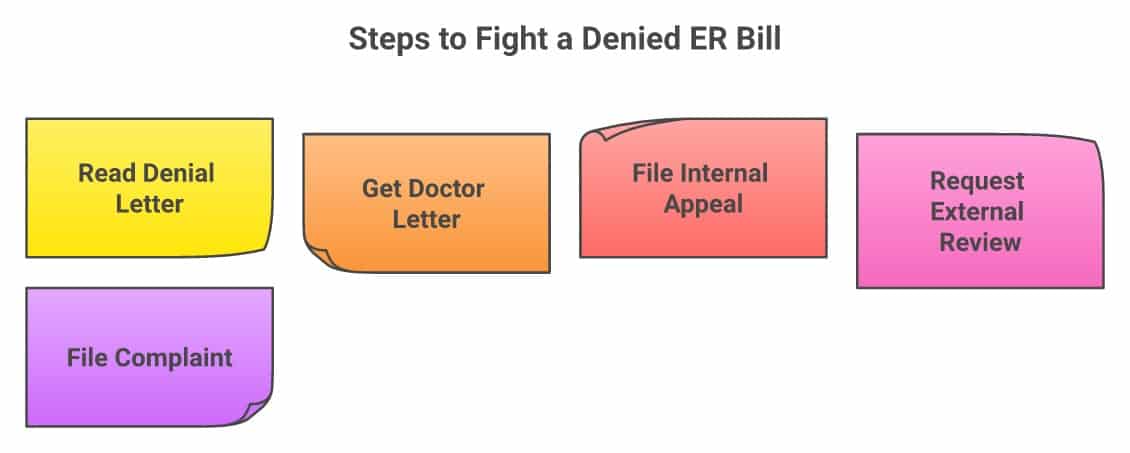
Every insurance denial comes with appeal rights. Use them. Here’s how:
Internal Appeal
- Read the denial letter carefully — it must tell you the specific reason for denial and your appeal rights
- File within the deadline — typically 30-180 days depending on your plan (the letter will specify)
- Get your ER doctor’s support — ask the treating physician to write a letter explaining why the symptoms warranted emergency evaluation
- Cite the prudent layperson standard — your symptoms (chest pain, shortness of breath, etc.) would cause any reasonable person to seek emergency care
- Include your medical records — document what you were experiencing, not just the final diagnosis
External Review
If the internal appeal fails, you have the right to an external review by an independent third party. This is required under the ACA for most health plans. The external reviewer isn’t employed by your insurance company and makes an independent determination.
File a Complaint With Your State Insurance Department
Every state has an insurance commissioner or department that handles consumer complaints. Filing a complaint creates a paper trail and puts regulatory pressure on the insurer. Some states have specifically addressed retroactive ER denials through legislation.
Resource: Find your state insurance department at NAIC.org. Many have consumer assistance programs that will advocate on your behalf — for free.
Step 2: Know Your Legal Protections
The No Surprises Act
The federal No Surprises Act (effective January 2022) protects patients from surprise billing for emergency services. While it primarily addresses out-of-network billing, its provisions reinforce that emergency services should be covered when a prudent layperson would seek care.
State Prudent Layperson Laws
Most states have laws requiring insurers to cover ER visits based on the presenting symptoms, not the final diagnosis. If your state has this law, your appeal should explicitly reference it.
Mental Health Parity Act
Ironically, if the insurer IS classifying your visit as mental health, the Mental Health Parity and Addiction Equity Act requires them to cover mental health emergencies at the same level as physical health emergencies. They can’t have it both ways — denying coverage by calling it mental health while also providing less coverage for mental health.
Warning: Don’t pay the bill in full while you’re appealing. Paying can be interpreted as accepting the charges. Instead, call the hospital billing department, explain you’re appealing the insurance denial, and ask them to hold the account.
Step 3: If You’re Stuck With the Bill
If the appeal fails and you’re facing a bill you can’t pay, the debt is the symptom of a broken system — not a reflection of your character. Here are your options:
Hospital Financial Assistance (Charity Care)
Nonprofit hospitals are legally required to have financial assistance programs. Even for-profit hospitals often have them. If your income is below 200-400% of the federal poverty level, you may qualify for reduced or eliminated bills. Ask the billing department for a financial assistance application.
Negotiate the Bill
Hospital billing departments will often accept 40-60% of the original bill if you can pay a lump sum. Even payment plans can be negotiated interest-free. The key: talk to billing, not collections.
Medical Debt and Your Credit Report
As of 2023, medical debt under $500 no longer appears on credit reports, and paid medical collections are removed. This means smaller ER bills may not even affect your credit. For larger bills, the major credit bureaus give a one-year grace period before reporting.
Bankruptcy Protection
For truly overwhelming medical debt, Chapter 7 bankruptcy can eliminate it entirely in 90-120 days. Medical debt is the leading cause of bankruptcy filings in America — there is no shame in using a legal tool designed for exactly this situation. Your retirement accounts are fully protected.
The Bigger Picture: Debt Is the Symptom
Here’s what I want you to understand: the system that denied your claim is working as designed. Insurance companies profit by collecting premiums and denying claims. The ER charged $11,000 for tests that cost them a fraction of that. The fact that YOU end up holding the bill for seeking emergency care is not a personal failure — it’s a system failure.
That doesn’t make the bill disappear. But it should remove the shame. You sought care during a scary moment. That was the right thing to do. Now deal with the financial aftermath using the tools available to you — appeal, negotiate, and if necessary, use the legal protections that exist for exactly this kind of situation.
Key Takeaways
- Always appeal a denied ER claim — the prudent layperson standard is on your side
- Get your ER doctor to support the appeal — their documentation of your symptoms matters more than the final diagnosis
- File with your state insurance department — regulatory pressure works
- Don’t pay the full bill while appealing — ask the hospital to hold the account
- If stuck with the bill — negotiate, apply for financial assistance, or consider bankruptcy for large amounts
- The Mental Health Parity Act is your friend — if they call it mental health, they must cover it equally
The Bottom Line
Going to the ER when you thought something was wrong was the right call. The insurance denial is the system’s problem, not yours. Appeal it. Fight it. And if you end up with a bill you can’t pay, know that medical debt has more solutions than almost any other kind of debt — from charity care to negotiation to bankruptcy. Don’t let a broken system make you feel broken.
Frequently Asked Questions About Denied ER Bills
Can insurance deny an ER visit for panic attack?
Insurance companies frequently attempt to deny or reduce ER claims when the final diagnosis is a panic or anxiety disorder rather than a cardiac event. However, most states have prudent layperson laws requiring coverage based on the symptoms that prompted the visit — not the final diagnosis. If chest pain, difficulty breathing, or other serious symptoms sent you to the ER, the coverage determination should be based on what a reasonable person would do with those symptoms.
How do I appeal a denied ER claim?
Start with an internal appeal to your insurance company within the deadline stated in your denial letter (usually 30-180 days). Include a letter from your ER physician describing your presenting symptoms, reference your state’s prudent layperson standard, and attach your medical records. If the internal appeal fails, request an external review by an independent third party — this is your legal right under the ACA.
What is the prudent layperson standard?
The prudent layperson standard says that ER coverage decisions should be based on what a reasonable person without medical training would believe was happening based on their symptoms — not what the diagnosis turned out to be after testing. Most states and federal law require insurers to apply this standard when evaluating ER claims.
Can I negotiate an ER bill I can’t pay?
Yes. Hospital billing departments routinely negotiate bills. Ask for an itemized statement first (errors are common), then request a reduction. Many hospitals accept 40-60% of the billed amount as payment in full. All nonprofit hospitals are legally required to have financial assistance programs — ask for an application. Always negotiate with the hospital billing department directly, not with a collections agency.
Can medical debt be discharged in bankruptcy?
Yes, medical debt is fully dischargeable in Chapter 7 bankruptcy. Medical bills are unsecured debt — the same legal category as credit card debt. If medical debt is overwhelming your finances, bankruptcy eliminates it in 90-120 days while protecting your retirement accounts, and your credit score typically recovers within 12-18 months.
Dealing With Debt? Understanding your options is the first step. See how all your debt relief options compare — including ones most sites won’t tell you about. The Find Your Path quiz gives a recommendation based on your actual numbers, and the Scam-O-Meter checks any company’s complaint history before you sign. Federal Reserve research shows bankruptcy filers recover faster than those who don’t file.



