

Quick Answer: Debt consolidation cannot stop a wage garnishment that’s already in effect. Once a court has ordered garnishment, only a few things can halt it: filing bankruptcy (which triggers an automatic stay the same day you file), paying the judgment in full, negotiating a settlement the creditor accepts, or successfully challenging the judgment in court. Consolidation works only if you use it to pay off the debt before the creditor sues — after the court order, it’s too late.
Related: what to do if the state says you were overpaid unemployment.
Each weekday I send one short email: one story that caught my attention, why it might matter to you, and one manageable thing you can do with it. A couple of minutes, and a dad joke.
In the latest issue (Nov 9): Check your power bank and your French press
Free. I sell nothing. Unsubscribe any time.
Expert Context: I’ve helped people deal with wage garnishment since 1994, and I filed bankruptcy myself in 1990 — which stopped a garnishment on my own wages. The reason consolidation doesn’t work after a judgment is simple: a consolidation loan is a financial tool. Garnishment is a legal tool. You can’t stop a court order with a credit product. You need a legal response — and the most powerful one available to consumers is the automatic stay that bankruptcy provides.
If your wages are already being garnished, consolidation is a door that’s already closed. Here’s which doors are actually open.
Free Tool — Wage Garnishment Calculator: Worried about your paycheck being seized? The free Wage Garnishment Calculator shows exactly how much creditors can legally take in your state — and some states prohibit garnishment entirely. Calculate My Risk →
Before Garnishment: Consolidation Can Help (If You Act Fast)
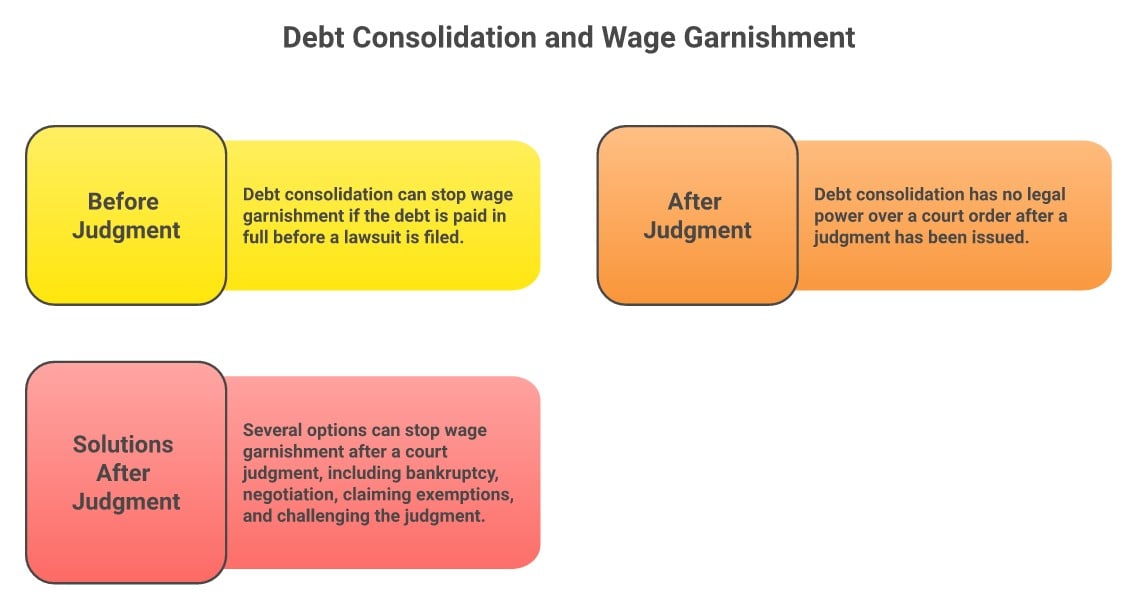
If a creditor is threatening to sue but hasn’t yet, a consolidation loan that pays the debt in full removes the grounds for a lawsuit. No lawsuit means no judgment. No judgment means no garnishment. This is the only scenario where consolidation prevents garnishment.
But timing is everything. Once the creditor files a lawsuit and wins a judgment, the court order exists regardless of whether you later consolidate other debts. The judgment creditor has legal authority to garnish — and a new loan from a consolidation company doesn’t undo that authority.
After Garnishment: What Actually Works
I wrote a comprehensive guide on this: How to Stop a Wage Garnishment — Your Options, Including the One That Works Immediately. Here’s the summary:
Bankruptcy (Automatic Stay)
Filing Chapter 7 or Chapter 13 triggers an automatic stay that legally stops ALL collection activity — including garnishment — the same day you file. This is the only option that works immediately and with legal force. I used it in 1990. New York Fed research found that within a year of filing, Chapter 7 filers had higher credit scores and more access to new credit than people who had fallen seriously behind and didn’t file.
Negotiate Settlement
You can contact the creditor (or their attorney) and offer a lump sum to settle the judgment for less. If they accept, the garnishment stops. But they’re under no legal obligation to negotiate.
If your wages are currently being garnished, start with the crisis guide for what to do right now.
Claim an Exemption
Federal law protects Social Security, VA benefits, and some other income from garnishment. Some states protect additional income — Texas, Pennsylvania, North Carolina, and South Carolina prohibit private wage garnishment entirely. Use our free wage garnishment calculator to see how much can legally be taken.
Challenge the Judgment
If you were never properly served, if the debt isn’t yours, or if the statute of limitations had expired, you may be able to vacate the judgment. This requires a motion in court — usually with an attorney.
Common Belief: “A debt consolidation company can negotiate to stop my garnishment.”
The Reality: Debt consolidation companies have no legal authority to stop a court-ordered garnishment. They can only offer to pay off the underlying debt — which the judgment creditor may or may not accept. Meanwhile, the garnishment continues. The only legal mechanism that immediately halts garnishment is the bankruptcy automatic stay.
You can’t stop a court order with a credit product. You need a legal response — and the most powerful one available to consumers is bankruptcy’s automatic stay.— Steve Rhode
Calculate Your Exposure: Use the free Wage Garnishment Calculator to see exactly how much can be taken from your paycheck. Then take the Find Your Path quiz to see which option — including bankruptcy — fits your specific situation.
Need help right now? Ask Steve directly — describe your garnishment situation and I’ll help you think through your options.
The Bottom Line
If you’re searching for this because your wages are already being garnished and someone told you consolidation would fix it — I’m sorry, but that’s not how it works. A court order doesn’t care about your new loan. What does work: bankruptcy stops garnishment the same day you file. I know because I’ve been there. If garnishment is taking 25% of your paycheck and making it impossible to survive, the fastest path to relief may be the one nobody wants to talk about. But I’ll talk about it — because I’ve lived it, and the research proves it works. Take the Find Your Path quiz and see what’s right for YOUR numbers.
Related: Wage Garnishment: The Complete Guide to Your Rights and Options — all your options in one place.
Free Tool — Statute of Limitations Checker: Dealing with old debt? The free Statute of Limitations Checker tells you if the collection clock has expired in your state — including the zombie debt and clock-restarting traps collectors use. Check My Status →
Frequently Asked Questions
Can I get a consolidation loan if my wages are already being garnished?
Probably not. Garnishment appears on your credit report and significantly reduces your income — both of which make lenders unlikely to approve a consolidation loan. Even if you could get one, paying off the judgment creditor with a consolidation loan doesn’t stop the garnishment order — the creditor has to agree to release it after receiving payment.
Does debt settlement stop wage garnishment?
Settlement can stop garnishment only if the judgment creditor agrees to accept a reduced payment and release the garnishment order. They’re under no obligation to do so. If they do agree, get the terms in writing before sending any money. Read more in my complete guide to stopping wage garnishment.
How long does it take bankruptcy to stop garnishment?
The automatic stay goes into effect immediately upon filing — the same day. Your attorney notifies the employer and creditor, and garnishment must stop. In Chapter 7, the entire case typically resolves in 90-120 days.
Can they garnish Social Security or VA benefits?
Generally no. Federal law protects Social Security, SSI, VA benefits, and federal student aid from garnishment by private creditors. However, the federal government can garnish for unpaid taxes, child support, and federal student loans. Check our garnishment calculator for details.
What states don’t allow wage garnishment?
Texas, Pennsylvania, North Carolina, and South Carolina prohibit private creditor wage garnishment. If you live in one of these states and a private creditor is garnishing your wages, they may be violating state law. Contact your state attorney general or a consumer law attorney.
Dealing With Debt? Understanding your options is the first step. See how all your debt relief options compare — including ones most sites won’t tell you about. The Find Your Path quiz gives a recommendation based on your actual numbers, and the Scam-O-Meter checks any company’s complaint history before you sign. Federal Reserve research shows bankruptcy filers recover faster than those who don’t file.



