
Quick Answer: The Government Accountability Office (GAO) confirmed in a March 2026 report that the Department of Education stopped checking whether student loan servicers are keeping accurate records or giving borrowers correct information. Four of five servicers were already failing accuracy standards before oversight stopped. The agency cut 46% of its Federal Student Aid staff — and GAO says borrowers now risk being overbilled, placed in wrong repayment plans, or given bad information when they call for help. Education disagreed with GAO’s recommendation to resume oversight.
Expert Context: I’ve tracked federal student loan program changes since their creation — including watching multiple administrations change the rules mid-stream. When I wrote about this servicer oversight gap last month, I was working from early reports and congressional testimony. Now the GAO has done the deep audit, and the numbers are worse than I expected.
Last month I flagged that nobody was checking whether your student loan servicer has accurate records. Now the Government Accountability Office has done a full investigation — and what they found should concern every federal student loan borrower in the country.
Table of Contents
Each weekday I send one short email: one story that caught my attention, why it might matter to you, and one manageable thing you can do with it. A couple of minutes, and a dad joke.
In the latest issue (Nov 9): Check your power bank and your French press
Free. I sell nothing. Unsubscribe any time.
What the GAO Found
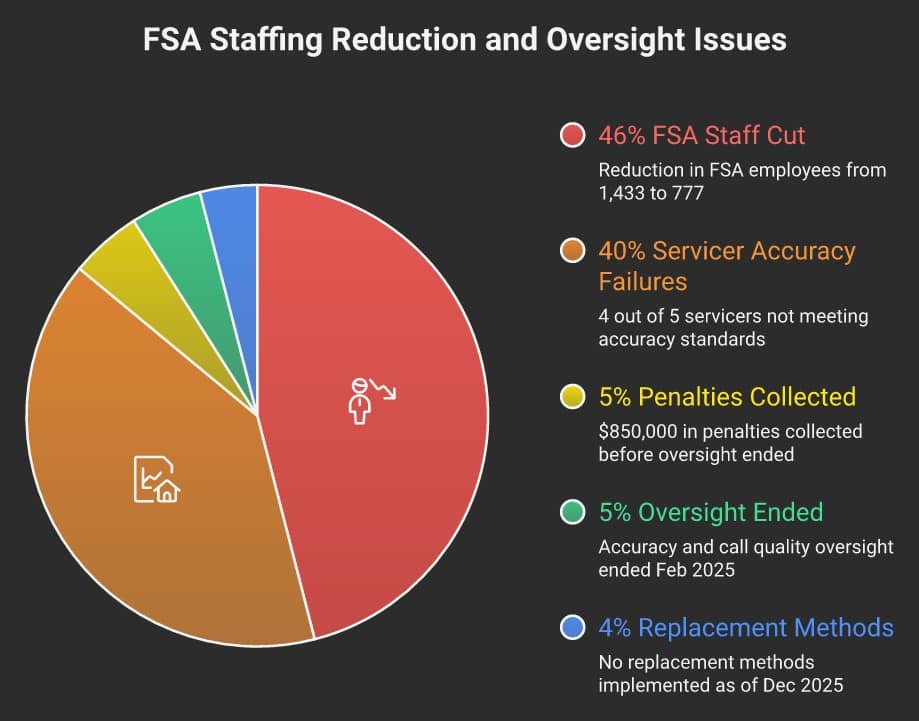
The GAO report (GAO-26-108534), published March 5, 2026, examined what happened after the Department of Education’s Office of Federal Student Aid (FSA) lost nearly half its workforce. Between January and December 2025, FSA’s full-time staff dropped from 1,433 to 777 — a reduction of 656 people.
In February 2025, FSA stopped assessing student loan servicers on two critical metrics:
- Accuracy: Whether servicers were keeping correct records for borrowers — comparing servicer data against FSA’s own systems
- Call quality: Whether servicers were giving borrowers complete and accurate information when they called for help
The reason? Not enough staff to do it, according to agency officials.
Most Servicers Were Already Failing
Here’s the part that makes this worse. In the two quarters FSA actually monitored these metrics under the new contracts, four out of five servicers failed to meet the accuracy performance standard. Two servicers were hit with the maximum 5% penalty for accuracy failures. FSA collected roughly $850,000 in financial penalties.
Then they stopped looking.
The Claim: The Department of Education says it uses “a variety of robust methods” to oversee servicers and that the accuracy and call quality metrics aren’t necessary.
The Reality: GAO reviewed every alternative method Education cited — data quality assessments, cross-system validation, audits, surveys, SOC 1 reports — and concluded none of them are substitutes for directly assessing accuracy and call quality. Education’s own independent auditor flagged a “material weakness” in student loan data reliability as recently as January 2026, and found that controls over SOC reports “were not operating effectively.”
What This Means for Borrowers Right Now
Without accuracy oversight, GAO says borrowers could be:
- Placed in the wrong repayment plan
- Billed for incorrect amounts
- Denied refunds they’re owed (one servicer wasn’t processing refunds for 90% of borrowers in a sample before it got caught)
- Given wrong information about forgiveness options, repayment plans, or account status when they call
And servicers now have less incentive to maintain quality because there are no financial consequences for getting it wrong.
Warning: If you have federal student loans, do not assume your servicer’s records are correct. Log into StudentAid.gov and check your loan details, repayment plan, and payment history yourself. If something looks wrong, document it and file a complaint with the CFPB — don’t rely on your servicer to catch their own errors.
The Timing Could Not Be Worse
The One Big Beautiful Bill Act (Public Law 119-21) is sunsetting existing income-driven repayment plans and creating a new Repayment Assistance Plan starting July 2026. This will force millions of borrowers to transition to new plans. Servicers will need to accurately record those transitions, communicate new payment amounts, and handle a massive volume of borrower inquiries.
GAO specifically flagged this: the servicers who were already failing accuracy checks are about to handle the most complex repayment plan changes in the history of the federal student loan program — with no one checking whether they’re doing it right.
Education Disagrees — GAO Pushes Back
In what I find to be a remarkable exchange, the Department of Education told GAO it “does not concur” with the recommendation to resume assessing servicer accuracy and call quality. Education’s written response argued these metrics “do not meaningfully measure servicer performance.”
GAO’s response was blunt: the alternative methods Education described “are not a substitute for directly assessing servicer accuracy and call quality and holding servicers accountable for their performance.” GAO also pointed out that Education’s own auditor — not some outside critic — keeps finding material weaknesses in the data.
Key Detail: Before oversight stopped, accuracy monitoring directly led to a servicer being caught not processing payment refunds on time. The servicer developed a corrective action plan and fixed the problem. That kind of catch-and-fix loop no longer exists.
What You Should Do
- Check your own records: Log into StudentAid.gov and verify your loan balances, repayment plan, and payment history
- Keep your own documentation: Save every communication from your servicer — emails, letters, screenshots of account pages
- Watch for the July 2026 repayment changes: When the new Repayment Assistance Plan rolls out, verify every detail of your transition
- File complaints when something is wrong: The CFPB complaint database and FSA Feedback Center create paper trails even if enforcement is limited
- Talk to a student loan-focused nonprofit counselor if you’re confused about your options — not a company selling “student loan relief” services
Not Sure Where You Stand? If you’re carrying student loan debt alongside other debts, the Find Your Path tool can help you see all your options — including ones nobody mentions.
Key Takeaways
- GAO confirmed the Department of Education stopped oversight of student loan servicer accuracy and call quality in February 2025 due to staff cuts
- 4 of 5 servicers were failing accuracy standards before monitoring stopped — $850,000 in penalties had been collected
- FSA staff was cut from 1,433 to 777 (46% reduction) between January and December 2025
- Education disagreed with GAO’s recommendation to resume oversight — GAO pushed back
- Major repayment plan changes hitting millions of borrowers in July 2026 make this gap especially dangerous
The Bottom Line
If you have federal student loans, the government entity responsible for making sure your servicer has the right information about your account has effectively stopped checking. That’s not my opinion — it’s what the Government Accountability Office concluded after a nine-month investigation. The servicers who were already getting it wrong are about to handle the biggest repayment plan transition in the program’s history, with no one looking over their shoulder. You need to be your own watchdog now. Check your records, document everything, and don’t assume your servicer has it right — because the people whose job it was to verify that aren’t doing it anymore.
Frequently Asked Questions
Does this mean my student loan servicer has wrong records?
Not necessarily — but the risk is higher. Four of five servicers were failing accuracy standards when they were last checked. Without ongoing oversight, there’s no systematic way to catch and correct errors. Check your own records at StudentAid.gov.
Can I still file a complaint about my student loan servicer?
Yes. File complaints with both the CFPB (consumerfinance.gov/complaint) and the FSA Feedback Center (studentaid.gov/feedback-center). These create official records even if enforcement capacity is reduced.
What repayment plan changes are coming in July 2026?
The One Big Beautiful Bill Act sunsets existing income-driven repayment plans (including ICR and PAYE) and creates a new Repayment Assistance Plan. A new Standard repayment plan with terms of 10-25 years based on loan amount will also be available. Millions of borrowers will need to transition to these new plans.
What happened to the SAVE plan?
In December 2025, Education announced a proposed settlement that would end the SAVE plan and give more than 7 million enrolled borrowers a limited time to select a new repayment plan.
Why did the Department of Education disagree with GAO?
Education argued that servicer accuracy and call quality metrics “do not meaningfully measure servicer performance” and that it uses other methods like data quality assessments and audits. GAO responded that none of these alternatives directly assess accuracy or call quality, and that Education’s own auditor keeps finding problems with student loan data reliability.
Dealing With Debt? Understanding your options is the first step. See how all your debt relief options compare — including ones most sites won’t tell you about. The Find Your Path quiz gives a recommendation based on your actual numbers, and the Scam-O-Meter checks any company’s complaint history before you sign. Federal Reserve research shows bankruptcy filers recover faster than those who don’t file.



