

Quick Answer: Union members facing financial pressure from strikes, lockouts, or contract disputes are prime targets for debt relief scams. Money pressure measurably narrows thinking in the moment — researchers put it down to worry consuming the mental bandwidth you need to weigh options — and that makes workers more susceptible to high-pressure sales tactics, false promises of quick fixes, and companies using union-branded names to build instant trust. Knowing how this works is the first step to protecting yourself.
Part of the Workers & Debt Hub: This post is one piece of my complete Workers, Debt & Power guide — research-backed financial strategies for union members, from work stoppage survival to why bankruptcy might be the strongest labor move you can make.
Expert Context: I ran a nonprofit credit counseling organization and watched debt settlement marketing corrupt good intentions from inside the industry. I’ve also been the person fielding calls from desperate workers during strikes — people who signed up for debt relief programs they didn’t need because they were scared and someone made a convincing promise. The combination of financial stress and targeted marketing is a trap I’ve seen close on thousands of people.
When your paycheck stops and the bills don’t, you become the most profitable customer the debt relief industry could ask for. Not because your debt is complicated. Because your fear makes you easy to sell to.
Each weekday I send one short email: one story that caught my attention, why it might matter to you, and one manageable thing you can do with it. A couple of minutes, and a dad joke.
In the latest issue (Nov 9): Check your power bank and your French press
Free. I sell nothing. Unsubscribe any time.
This isn’t speculation. Research published in the Proceedings of the National Academy of Sciences found that financial stress imposes a cognitive load that impairs decision-making — the mental equivalent of staying awake for 24 hours straight. When you’re worried about making rent on strike pay, you’re not in the best position to evaluate a slick pitch from a company called “Union Debt Assistance” that promises to cut your debt by 75%.
And that’s exactly what these companies are counting on.
Why Financial Pressure Makes You Vulnerable
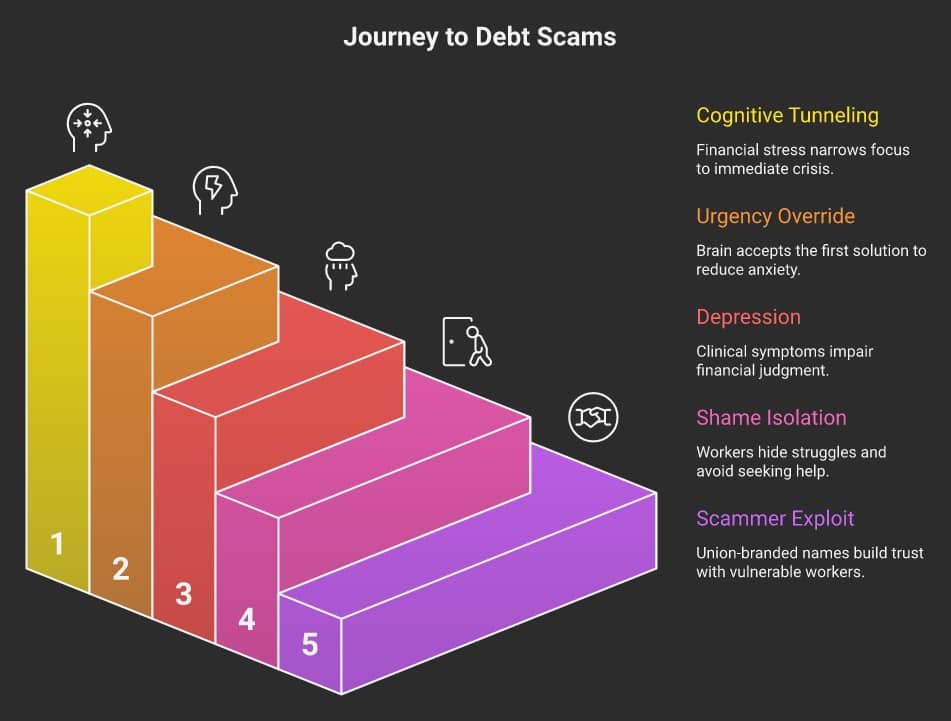
Understanding why you’re vulnerable isn’t about blaming yourself — it’s about recognizing the playbook being used against you. Financial stress changes how your brain works in three specific ways that scammers exploit:
1. Cognitive Tunneling
When money is scarce, your brain narrows its focus to the immediate crisis. Researchers call this “tunneling” — you become hyper-focused on paying this month’s mortgage and lose the bandwidth to evaluate whether a debt relief company’s claims make sense. The fine print disappears because your brain literally can’t allocate attention to it.
2. Urgency Overwhelms Analysis
Debt relief scammers know that a worker on week three of a strike doesn’t have time to research five companies. They create artificial urgency: “This program is only available this month.” “We can only take 50 more clients.” “If you don’t act now, your credit will be destroyed.” These are lies — but when you’re already in crisis mode, urgency feels real.
Free Tool — Scam-O-Meter: Considering a debt relief company? Run your situation through the free Scam-O-Meter — it checks for official FTC, FBI, CFPB, and SEC warning signs before you hand over any money. Check for Red Flags →
3. Depression Impairs Financial Judgment
When I ran the Myvesta Foundation, we screened 136 people in debt crisis and 49% screened positive for depression symptoms on the CES-D — an elevation over the general population that I now state as a range of roughly two to five times, after correcting a comparison I had wrong for years. Depression doesn’t just make you sad. It impairs decision-making, making you more likely to choose debt solutions based on emotional relief rather than financial outcomes.
“Psychiatrists commonly report problem debt as a source of severe anxiety and psychological distress.”
— John Gathergood, Debt and Depression: Evidence on Causal Links and Social Stigma Effects (2011)
Free Tool: Not sure if financial stress is affecting your judgment? Take our Debt Stress Test — it combines the clinically validated PHQ-9 depression screening with financial questions to give you an honest picture. Two minutes, completely private.
Free Tool — Debt Stress Test: Is your debt causing more than financial damage? This free 2-minute screening interleaves financial questions with the PHQ-9 depression screening questions doctors use. In a 2001 study of 136 debt-crisis clients, 49.3% screened positive for depression symptoms — a screen, not a diagnosis — so find out where your own debt stress stands. Take the Free Screening →
The Union-Branded Scam Playbook
The debt relief industry has figured out that union members trust their union. So they’ve built companies designed to look like union resources — when they’re nothing of the sort.
Here’s a real example: A company called CPC Marketing, Inc. operates under at least six different names, each one targeting a specific group of workers:
- Union Debt Assistance — targets union members broadly
- Debt Free Teacher — targets educators (AFT/NEA members)
- Debt Free First Responder — targets firefighters, EMTs, police
- Financially Free Nurse — targets healthcare workers
- Veteran Debt Assistance — targets military veterans
- Divorce Debt Solutions — targets people going through divorce
None of these companies are affiliated with any union, professional association, or veterans’ organization. They’re all lead generators — they collect your personal financial information and sell it to debt settlement companies. You think you’re contacting a union resource. You’re actually handing your Social Security number to a marketing firm.
Warning: The FTC reported in July 2025 that it halted a debt relief operation that falsely impersonated banks, credit card companies, and government agencies — specifically targeting seniors and veterans. The Accelerated Debt scheme alone cost consumers approximately $100 million. These aren’t small operations.
How a Work Stoppage Creates the Perfect Storm
During a strike or lockout, every condition that makes someone vulnerable to a scam intensifies:
What Workers Experience
- Income drops to strike pay ($200-525/week)
- Bills continue at full amount
- Health insurance may lapse
- Savings deplete within weeks
- Credit card balances climb
What Scammers Exploit
- Urgent need for “any solution”
- Shame about falling behind
- Trust in union-sounding names
- Isolation from normal routines
- Fear of permanent financial damage
The timing is ruthless. Debt relief ads spike during major strikes. Google Ads for terms like “debt help during strike” and “union worker debt relief” get more expensive during labor actions because more companies are bidding on them. Your crisis is their opportunity.
The Pitch: “We can reduce your debt by 50-75% and get you debt-free in 18 months.”
The Reality: The FTC warns that legitimate debt settlement typically resolves only a fraction of accounts, takes 3-4 years (not 18 months), damages your credit during the process, and can result in tax liability on forgiven debt. The companies promising 75% reductions in 18 months are selling a fantasy — and charging fees for it before delivering any results, which violates FTC rules.
What Your Brain Is Doing (And Why It Matters)
Here’s something most financial advice ignores: debt stress doesn’t just make you worried. It changes how your brain processes information.
When you’re under financial pressure, your brain shifts resources away from analytical thinking and toward threat response. You become better at spotting immediate dangers and worse at evaluating long-term consequences. This is exactly backward for financial decision-making, where the best choices require ignoring short-term pain to protect long-term outcomes.
This is why I tell every worker who comes to me during a strike: don’t make any major financial commitments in the first 30 days. Your brain isn’t in evaluation mode — it’s in survival mode. Survival mode accepts the first solution that reduces anxiety, even if that solution costs you more in the long run.
Free Tool: Curious about how debt stress affects your thinking patterns? Take the Your Brain on Debt quiz — it shows you the specific cognitive patterns that debt activates and how they influence your financial decisions.
How to Protect Yourself (and Your Fellow Members)
If you’re a union member under financial pressure, here’s how to avoid becoming a target:
- Never respond to “union” or profession-branded debt companies. No legitimate debt relief company needs to put “union” or “teacher” or “nurse” in its name. That’s marketing, not affiliation
- Never pay upfront fees. Under FTC rules, debt relief companies cannot charge fees before settling or reducing your debt. If they ask for money before delivering results, it’s illegal
- Call your union first. Your local or international may have a financial hardship program, EAP counseling, or vetted referrals. Use them before Googling “debt help”
- Wait 30 days before committing. No legitimate program needs an answer today. If they pressure you with deadlines, that’s a red flag — not an opportunity
- Run any company through the Scam-O-Meter — it checks BBB ratings, CFPB complaints, and state licensing in one step
What to Do Instead
- Start with triage. Read our Work Stoppage Financial Triage Guide — it tells you exactly what to pay, what to pause, and how to request hardship forbearance from every creditor
- Take the Find Your Path quiz. It walks through your specific numbers and matches you with the debt relief option that actually fits your situation — no sales pitch, no affiliate links
- Talk to someone who doesn’t profit from your decision. Use our Ask Steve chat to get a real assessment from someone who’s been helping workers with debt since 1994 — and who’s been through bankruptcy himself
- Consider bankruptcy — seriously. New York Fed research found that within a year of filing, Chapter 7 filers had higher credit scores and more access to new credit than people who had fallen seriously behind and didn’t file. A free consultation with a bankruptcy attorney costs nothing and may reveal options you didn’t know you had
For Union Leaders: This Is an Organizing Issue
If you’re a shop steward, local president, or staff rep, member financial vulnerability isn’t just a personal problem — it’s a bargaining power problem.
Research across six countries proves that personal debt suppresses strike activity and reduces union membership. Every member who falls for a debt relief scam — and ends up deeper in debt with fees they can’t recover — is a member who’s less likely to support collective action next time.
Protect your members by:
- Adding financial scam warnings to pre-strike materials — include the red flags above in your strike preparation packets
- Sharing vetted financial resources — the tools on this page are free, independent, and have no financial interest in what your members decide
- Making financial readiness part of contract campaign prep — a financial readiness checklist before a strike vote builds stronger collective action
Key Takeaways
- Financial stress causes measurable cognitive impairment that makes workers vulnerable to debt relief scams
- Companies like “Union Debt Assistance” and “Debt Free Teacher” use union-branded names but are lead generators selling your information to debt settlement firms
- The FTC says no legitimate debt relief company can charge upfront fees — if they ask for money before results, it’s illegal
- 49.3% of 136 debt-crisis clients Myvesta tested in 2001 screened positive for depression symptoms — a screen, not a diagnosis — and depression can impair financial decision-making
- Never make major financial commitments in the first 30 days of a work stoppage — your brain is in survival mode, not evaluation mode
- Union leaders should treat member financial vulnerability as a bargaining power issue, not just a personal problem
The Bottom Line
If you’re reading this during a strike or after a layoff, I want you to hear something clearly: the debt anxiety you’re feeling right now is real, it’s biological, and it’s being weaponized against you by companies that make money from your panic. You are not failing. You are being targeted. I filed bankruptcy in 1990 when my own business collapsed, and I remember exactly what it feels like to be desperate enough to grab the first rope someone throws — without checking whether it’s attached to anything. The free tools on this page exist because nobody should have to make financial decisions under that kind of pressure without someone in their corner who doesn’t profit from the answer. Take the Debt Stress Test. Talk to us through Ask Steve. And give yourself permission to wait 30 days before signing anything — because you deserve to make this decision with a clear head, not a frightened one.
Part of the Scam Protection Hub: This post is one piece of my complete Debt Relief Scams: 10 Red Flags to Spot Before You Pay guide — everything you need to identify and avoid debt relief fraud.
Part of the Debt Scam Alert Hub: This post is one piece of my complete Debt Relief Scams guide — the red flags to know, how to research any company, and what the FTC and CFPB data show about the most common fraud patterns.
Part of the Workers & Debt Hub: This post is one piece of my complete Workers, Debt & Power guide — research-backed financial strategies for union members, from work stoppage survival to why bankruptcy might be the strongest labor move you can make.
Frequently Asked Questions
How can I tell if a debt relief company is affiliated with my union?
Call your union directly and ask. No legitimate union-affiliated financial program needs to advertise through Google Ads or cold calls. If a company uses “union,” “teacher,” “nurse,” or “first responder” in its name, check whether your actual union or professional association endorses it. In most cases, these names are marketing tactics by lead generation companies with no union connection whatsoever.
Is it normal to feel like I can’t think straight about money during a strike?
Completely normal — and scientifically documented. A 2013 Science study found money pressure measurably narrows reasoning in the moment, and that the gap eased once the pressure did. Combined with the depression symptoms that often travel with debt — in a 2001 Myvesta screen, 49.3% of 136 debt-crisis clients screened positive for depression symptoms, and that is a screen, not a diagnosis — your brain may be working differently right now. This doesn’t mean you’re weak or stupid. It means you should delay major financial decisions until the acute stress passes, and use free tools like the Debt Stress Test to get an objective picture of where you stand.
What should I do if I already signed up with a debt relief company?
First, check whether you’ve paid any upfront fees. Under FTC rules, debt relief companies cannot charge fees before settling or reducing your debt. If you paid before they delivered results, you may be entitled to a refund — and the company may be operating illegally. Second, review what you signed. Use our Contract Decoder to identify problematic clauses. Third, file a complaint with the CFPB and your state attorney general if anything looks wrong.
Why do scams increase during strikes and economic downturns?
Because financial distress creates demand for quick solutions, and scammers supply the illusion of one. During the 2008 recession, debt relief scams surged. The same pattern repeats during major strikes, layoffs, and economic disruptions. The FTC halted a major debt relief scam in July 2025 that had stolen approximately $100 million from consumers — primarily targeting seniors and veterans who were financially vulnerable.
Can my union protect me from debt relief scams?
Your union can help by including financial scam warnings in pre-strike materials, sharing vetted resources, and connecting members to legitimate financial counseling through EAP programs. But ultimately, the best protection is knowing the red flags: no upfront fees (it’s the law), no “union” branding that isn’t endorsed by your actual union, no pressure to sign immediately, and no promises of reducing debt by 50-75% in 18 months. Use the Scam-O-Meter to verify any company before sharing personal information.
Dealing With Debt? Understanding your options is the first step. See how all your debt relief options compare — including ones most sites won’t tell you about. The Find Your Path quiz gives a recommendation based on your actual numbers, and the Scam-O-Meter checks any company’s complaint history before you sign. Federal Reserve research shows bankruptcy filers recover faster than those who don’t file.



