
Quick Answer: 17 federal debt relief lawsuits were filed this week (March 17–March 24, 2026). This briefing organizes the alleged conduct by risk category — compliance talking points for debt relief company staff and counsel to use when reviewing current practices.
17 new federal debt relief lawsuits were filed this week. Below is a compliance analysis organized by risk category — concrete talking points for compliance teams and outside counsel reviewing what regulators and plaintiffs are pursuing right now.
Get the Daily 10 AM Debt Briefing
Each weekday I send one short email: one money story that caught my attention, why it might matter to you, and one manageable thing you can do with it. A couple of minutes, and a dad joke.
In the latest issue (Oct 15): The ones who need the Social Security raise the most keep the least of it
Free. I sell nothing. Unsubscribe any time.
Weekday news — free, no spam, unsubscribe anytime.
Compliance Analysis: What These Cases Signal This Week
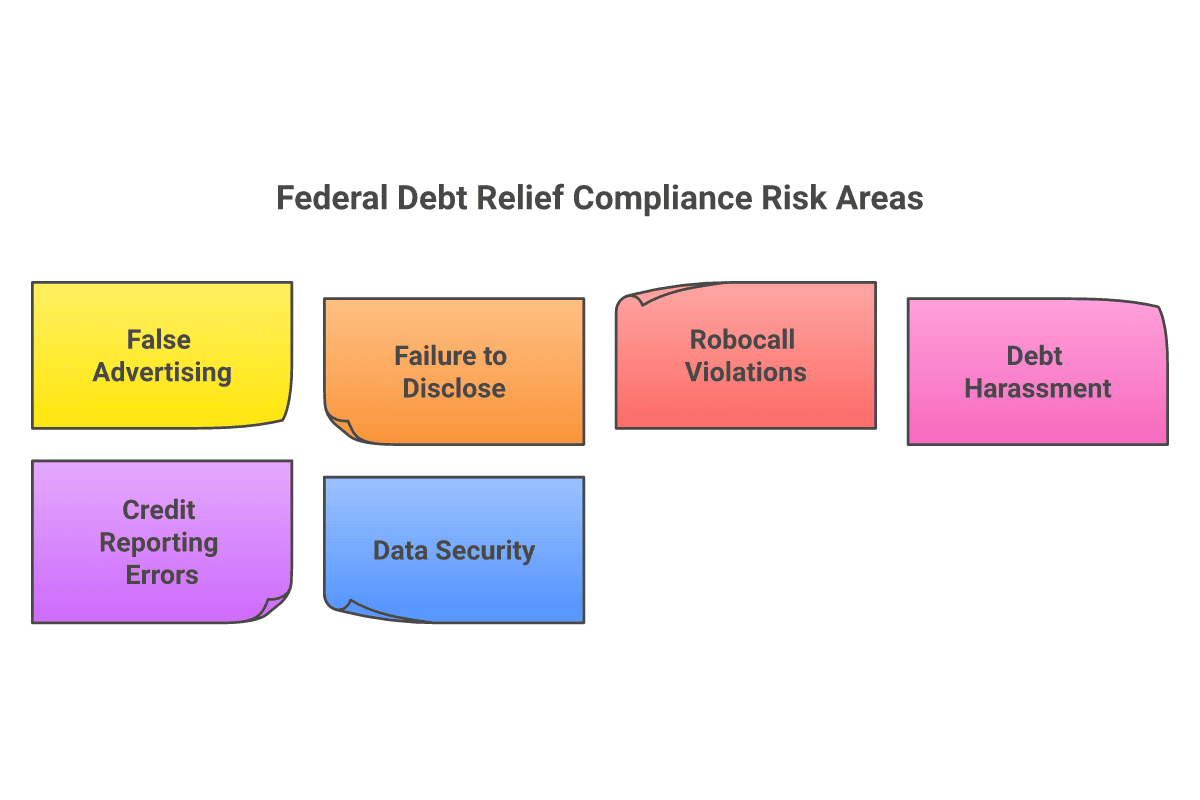
False or Misleading Advertising (Result Guarantees, Timeline Claims, Savings Promises)
Two cases this week spotlight deceptive marketing — but through distinct channels. In Garcia v. Freedom Debt Relief (C.D. Cal., 2:26-cv-03077), the class action alleges that affiliate marketers working on Freedom Debt Relief’s behalf sent spam emails using spoofed domains, forged headers, and hidden Unicode characters specifically designed to evade spam filters. Separately, Purscelley v. Optima Tax Relief (C.D. Cal., 2:26-cv-02989) alleges violations of California Business & Professions Code § 17529.5, California’s anti-spam statute, claiming Optima Tax engaged in deceptive marketing through unlawful commercial email practices.
Additionally, Brindley v. Optimal Debt Solutions (S.D. Fla., 9:26-cv-80282) alleges violations of the Credit Repair Organizations Act (CROA), the Arizona Credit Repair Organization Act, the Arizona Consumer Fraud Act, and claims for breach of contract and breach of fiduciary duty — a combination that typically signals allegations that the company overpromised results or misrepresented its services.
Regulatory basis: FTC Act § 5 (unfair or deceptive acts), CROA (15 U.S.C. § 1679 et seq.), CAN-SPAM Act, Cal. Bus. & Prof. Code § 17529.5, state consumer fraud statutes.
Compliance talking points: – Audit your affiliate and lead-generation partners now. If a third party sends emails on your behalf using spoofed domains or forged headers, the liability flows upstream. Contracts should include explicit anti-spoofing provisions, and your compliance team should periodically test-purchase leads to verify the marketing is clean. – Review all result-oriented language in advertising and enrollment scripts. Any claim that implies guaranteed savings amounts, specific timelines, or certain outcomes should be documented, substantiated, and approved by compliance before use. – Treat CROA compliance as a baseline, not an afterthought. If your service touches credit repair even tangentially, ensure you are providing the required three-day cancellation notice, the written disclosure of consumer rights, and that no fees are collected before the promised service is fully performed.
Failure to Make Required Disclosures (TSR, CROA, State)
The Brindley v. Optimal Debt Solutions complaint (S.D. Fla., 9:26-cv-80282) invokes CROA alongside Arizona’s state-level Credit Repair Organization Act. While the full complaint text is pending, the tagging of both CROA and breach of fiduciary duty strongly suggests the plaintiff alleges that required pre-contract disclosures were either missing or inadequate, and that the company failed to honor the statutory cancellation window.
Regulatory basis: CROA (15 U.S.C. §§ 1679b, 1679c, 1679d), TSR (16 C.F.R. § 310.4), applicable state credit repair and debt-settlement statutes.
Compliance talking points: – Map every state where you enroll clients and confirm you are delivering the correct state-specific disclosures. Arizona, for example, has its own credit repair statute with requirements that layer on top of federal CROA obligations. – Confirm that your enrollment workflow physically prevents fee collection until after the cancellation period expires and required disclosures have been acknowledged in writing. A signed disclosure buried in a click-through agreement may not satisfy the “conspicuous” standard courts apply. – Calendar a quarterly disclosure audit that compares your current forms against both federal and state requirements, especially when you operate across multiple jurisdictions.
Robocall / TCPA / Do Not Call Violations
In Rogers v. EFPTR LLC (filed 2026-03-17), the class action alleges that Eastern Financial Partners placed robocalls using pre-recorded messages to consumers on the National Do Not Call Registry, in violation of the Telephone Consumer Protection Act (TCPA). The complaint specifically references pre-recorded message content and calls to numbers registered on the DNC list.
Regulatory basis: TCPA (47 U.S.C. § 227), FCC regulations (47 C.F.R. § 64.1200), TSR § 310.4(b)(1)(iii)(B) (Do Not Call provisions).
Compliance talking points: – Scrub all outbound call lists against the National DNC Registry at least every 31 days, as required by the TSR, and maintain written records of each scrub. Retain these records for at least 24 months. – If you use any pre-recorded or artificial voice messages, confirm you have express written consent meeting the TCPA’s “clear and conspicuous” standard — a general terms-of-service checkbox is almost certainly insufficient after recent FCC guidance tightening one-to-one consent requirements. – Audit your dialer vendors. If a third-party dialer is placing calls on your behalf, their TCPA compliance failures are your TCPA compliance failures. Vendor contracts should include indemnification clauses and require evidence of DNC scrubbing.
Debt Collection Harassment and Failure to Verify Debt
Gevigier v. Reliant Capital Solutions (M.D. Fla., 8:26-cv-00756) alleges that Reliant sent four collection letters attempting to collect a debt belonging to someone named “Holly” — not the plaintiff. The complaint invokes both the FDCPA and Florida’s FCCPA, and the case is tagged for false representations and threatening language. Separately, Taylor v. Chebat (M.D. Fla., 8:26-cv-00734) alleges both FCRA and FDCPA violations, with tags indicating failure to verify debt, excessive interest, and false representations.
Multiple additional cases this week name prominent debt buyers — Midland Credit Management (two new suits: 2:26-cv-03004 and 3:26-cv-01679), LVNV Funding (1:26-cv-02294), Portfolio Recovery Associates (5:26-cv-00659), Resurgent Capital Services (1:26-cv-00101), and National Credit Adjusters (5:26-cv-01334). While the full complaints are not yet public, the volume of filings against debt buyers underscores persistent FDCPA exposure across the industry.
Regulatory basis: FDCPA (15 U.S.C. § 1692 et seq.), FCCPA (Fla. Stat. § 559.55 et seq.), Regulation F (12 C.F.R. § 1006).
Compliance talking points: – Implement identity-matching protocols before the first communication. The Gevigier allegations — collecting from the wrong person entirely — represent one of the most avoidable FDCPA violations. Require a minimum two-point match (name plus one additional identifier) before any letter is generated. – Build a documented verification workflow that can be demonstrated in litigation. Under § 1692g, once a consumer disputes a debt, collection activity must cease until verification is mailed. Ensure your system timestamps the dispute, pauses the account, and logs the verification mailing. – Review interest and fee calculations for every portfolio you service. The Taylor complaint’s “excessive interest” tag is a reminder that debt buyers must be able to substantiate every dollar they claim, including post-charge-off interest, and that state usury laws may cap what can be collected regardless of the original contract terms.
Free Tool — Debt Collector Rights Lookup: Being contacted by a debt collector? The free Debt Collector Rights Lookup shows your state-specific protections — statute of limitations, garnishment limits, and what collectors are legally prohibited from doing. Look Up Your Rights →
Credit Reporting Errors and FCRA Furnisher Obligations
Laccinole v. Advantage First Financial (C.D. Cal., 2:26-cv-02994) is a class action alleging that the company pulled consumer credit reports without a permissible purpose, specifically to market debt relief services. This is a § 1681b permissible purpose claim — one of the more straightforward FCRA violations to prove when the consumer had no pre-existing relationship with the company. Taylor v. Chebat also raises FCRA claims alongside its FDCPA allegations, suggesting inaccurate furnishing or failure to investigate disputes.
Regulatory basis: FCRA (15 U.S.C. §§ 1681b, 1681s-2), Regulation V (12 C.F.R. § 1022).
Compliance talking points: – Never pull a credit report for marketing purposes unless you have a firm offer of credit or insurance that meets the FCRA’s prescreened offer requirements. Using credit data to identify prospects for debt settlement or credit repair services without a permissible purpose is a per-consumer statutory damages claim — and in a class action, the exposure multiplies rapidly. – If you furnish information to credit bureaus, ensure your ACDV (Automated Consumer Dispute Verification) response process is staffed and timely. The 30-day investigation window under § 1681s-2(b) is non-negotiable, and a pattern of “verified as reported” responses without genuine investigation invites both regulatory and private litigation. – Document the permissible purpose for every credit pull in a retrievable format. If you cannot produce the permissible purpose justification years later in discovery, assume a court will find there was none.
Data Security and Unauthorized Data Sharing
Aiken v. Credit Freedom and Restoration Corporation (E.D. Pa., 2:26-cv-01782) is a class action alleging that a cyberattack — described as the “Loki” attack — compromised Social Security numbers and credit card data of approximately 30,000 customers. The complaint is tagged for data breach and unauthorized third-party disclosure.
Regulatory basis: FTC Act § 5 (unfair practices), Gramm-Leach-Bliley Act Safeguards Rule (16 C.F.R. § 314), state data breach notification statutes, state consumer protection acts.
Compliance talking points: – Treat the revised FTC Safeguards Rule as your minimum standard. If you handle consumer financial data — and every debt relief company does — you must have a written information security program, a designated qualified individual overseeing it, encryption of customer data at rest and in transit, access controls, and continuous monitoring. These are not aspirational; they are regulatory requirements with enforcement teeth. – Conduct penetration testing and vulnerability assessments at least annually, and more frequently if you process sensitive data like SSNs. The “Loki” attack reference suggests an exploit
Not Legal Advice: This compliance analysis is for educational purposes only and does not constitute legal advice. Companies should consult qualified legal counsel regarding their specific practices and regulatory obligations.
Related: FDCPA violation examples.
Frequently Asked Questions
What federal debt relief lawsuits were filed this week (March 17–March 24, 2026)?
17 federal debt relief lawsuits were filed this week (March 17–March 24, 2026). The cases raised compliance issues in: false or misleading advertising (result guarantees, timeline claims, savings promises), failure to make required disclosures (tsr, croa, state), robocall / tcpa / do not call violations. See the full case list and compliance analysis above.
Who is this compliance briefing for?
This weekly briefing is designed for debt relief company executives, compliance officers, and outside legal counsel. It summarizes what regulators and plaintiffs are pursuing so compliance teams can review their own practices against current enforcement trends.
The Daily Money Brief — Free, at 10 AM
Money you may be owed, scams to dodge, and the fine print decoded — the consumer money news that affects your wallet, every weekday.
What is the Telemarketing Sales Rule (TSR) for debt relief companies?
The FTC’s Telemarketing Sales Rule prohibits debt relief companies from collecting advance fees before settling or reducing a customer’s debt. Violators face FTC enforcement, CFPB action, and private class actions. The rule applies to outbound telemarketing and certain inbound calls.
How can debt relief companies avoid TCPA violations?
To avoid TCPA liability, debt relief companies should: obtain express written consent before using autodialers or pre-recorded messages; maintain an internal Do Not Call list; honor DNC requests within 30 days; and audit lead sources to ensure consent covers the specific company calling.
Where can I see all federal debt relief lawsuits?
The full Federal Debt Relief Case Tracker at https://getoutofdebt.org/federal-debt-relief-lawsuits/ lists every federal debt relief lawsuit covered. Updated weekly with new filings from PACER via CourtListener.
This Week’s Cases (March 17–March 24, 2026)
- Vanessa Almazan v. Midland Credit Management, Inc., Case No. 2:26-cv-03004 (2026-03-24)
- Gibbs v. Resurgent Capital Services, L.P., Case No. 1:26-cv-00101 (2026-03-24)
- Stacey Lee v. National Credit Adjusters, LLC, Case No. 5:26-cv-01334 (2026-03-24)
- Daly v. SoFi Bank, N.A., Case No. 4:26-cv-40089 (2026-03-24)
- Pirc v. Upgrade, Inc., Case No. 5:26-cv-02521 (2026-03-24)
- Gevigier v. Reliant Capital Solutions LLC, Case No. 8:26-cv-00756 (2026-03-23)
- Laccinole v. Advantage First Financial, LLC, Case No. 2:26-cv-02994 (2026-03-23)
- Sartor v. Portfolio Recovery Associates, LLC, Case No. 5:26-cv-00659 (2026-03-23)
- Washington, III v. LVNV Funding LLC, Case No. 1:26-cv-02294 (2026-03-23)
- Brindley v. Optimal Debt Solutions, Case No. 9:26-cv-80282 (2026-03-23)
- Llanes v. Midland Credit Management, Inc., Case No. 3:26-cv-01679 (2026-03-23)
- Psomas v. Midland Credit Management Inc, Case No. 3:26-cv-00857 (2026-03-23)
- Purscelley v. Optima Tax Relief LLC, Case No. 2:26-cv-02989 (2026-03-23)
- Garcia v. Freedom Debt Relief, LLC, Case No. 2:26-cv-03077 (2026-03-23)
- Taylor v. Chebat, Case No. 8:26-cv-00734 (2026-03-20)
- Aiken V. Credit Freedom and Restoration Corporation, Case No. 2:26-cv-01782 (2026-03-19)
- Eastern Financial Partners (EFPTR LLC) Sued for Robocalls to Do-Not-Call Numbers (2026-03-18)
Dealing With Debt? Understanding your options is the first step. See how all your debt relief options compare — including ones most sites won’t tell you about. The Find Your Path quiz gives a recommendation based on your actual numbers, and the Scam-O-Meter checks any company’s complaint history before you sign. Federal Reserve research shows bankruptcy filers recover faster than those who don’t file.