

Quick Answer: Medical billing errors are common — the federal government’s own audits find improper charges on nearly half of Medicare claims. If you received a hospital bill that seems too high, you have the legal right to request an itemized bill, dispute errors, negotiate the balance, and apply for charity care at nonprofit hospitals. If the debt is already in collections, you still have options — including state protections that may prevent wage garnishment entirely. Here’s how to fight back, step by step.
Update (April 2026): Maine just passed LD 2129 blocking wage garnishment and home liens on medical debt — new developments that affect what I wrote below.
Expert Context: I’ve been helping people navigate debt since 1994 — including thousands of cases where medical bills were the trigger. What I’ve learned: most people pay medical bills they don’t fully owe because they don’t know the system is designed to be negotiated. Hospitals expect pushback. The price on your bill is an opening position, not a final answer.
If you just opened a hospital bill that made your stomach drop, you’re not alone. In 2024, 36% of U.S. households carried medical debt, and 14.6% were contacted by a debt collector for medical bills in the past year alone. (See also: illegal debt collection threats.)
Each weekday I send one short email: one money story that caught my attention, why it might matter to you, and one manageable thing you can do with it. A couple of minutes, and a dad joke.
In the latest issue (Oct 9): Does Financial Literacy Make Financial Sense?
Free. I sell nothing. Unsubscribe any time.
But here’s what nobody tells you when that bill arrives: you have more power than you think. Federal law, state protections, and the hospital’s own financial assistance policies are all working in your favor — if you know how to use them.
Your Hospital Bill Is Probably Wrong — Here’s Why
Medical billing is complicated by design. Between your provider, your insurance company, and the billing department, errors are not the exception — they’re the norm. CMS found a 7.66% improper payment rate on Medicare Fee-for-Service claims in FY2024, totaling $31.7 billion in incorrect charges. And that’s just Medicare, where billing is relatively standardized. Private insurance billing errors may be even more common.
The most common errors I see people overpaying for:
The Daily Money Brief — Free, at 10 AM
Money you may be owed, scams to dodge, and the fine print decoded — the consumer money news that affects your wallet, every weekday.
- Upcoding — You received a basic service but were billed for a more expensive one. A 15-minute office visit coded as a comprehensive exam.
- Duplicate charges — The same test, medication, or procedure appears twice on your bill.
- Unbundling — Services that should be billed together at a lower rate are split into separate, higher charges.
- Wrong patient information — A different patient’s charges end up on your bill, or your insurance details were entered incorrectly.
- Balance billing after the No Surprises Act — You received emergency care at an out-of-network facility and were billed the full rate instead of the in-network rate you’re legally owed.
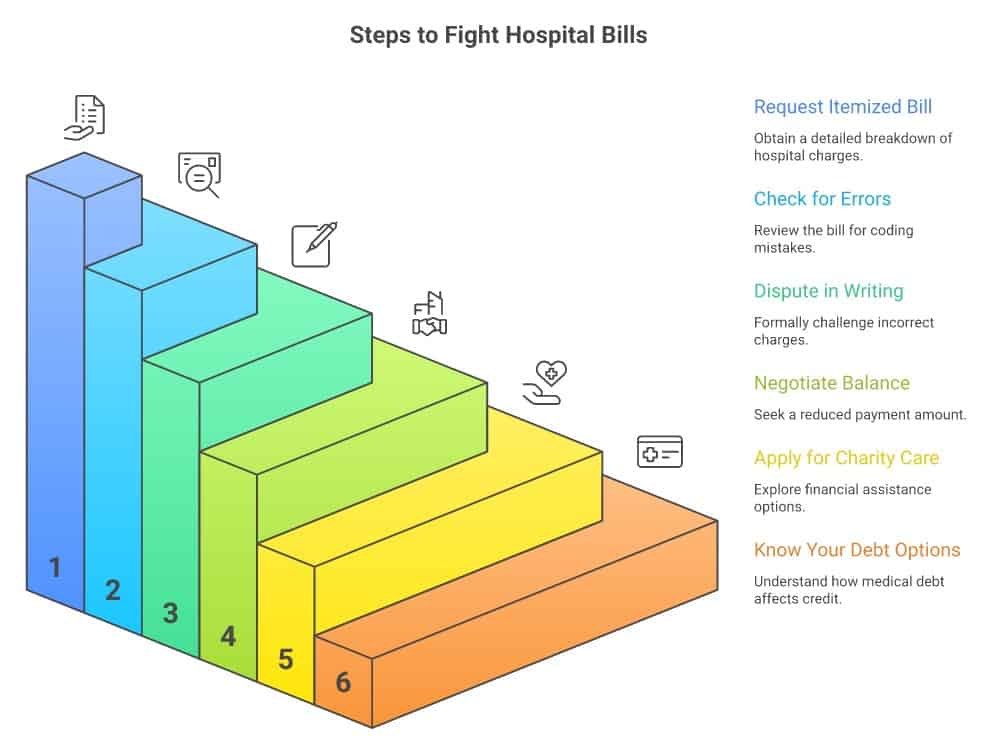
Step 1: Request an Itemized Bill
This is the single most important step, and most people skip it. That summary statement with one big number? That’s not a real bill. You need the line-by-line breakdown.
Under the No Surprises Act, hospitals must provide an itemized bill upon request. They cannot charge you for this, and they must deliver it within 30 days. If you were uninsured or self-pay, there is also a separate federal $400 and 120-day dispute window for bills that run well over a good faith estimate.
Do not pay anything until you have the itemized bill. Once you’ve paid, getting money back is exponentially harder than negotiating before payment. Request the itemized bill in writing — email is fine — and keep a copy of your request.
When you receive the itemized bill, look for:
- Services you didn’t receive or don’t recognize
- Duplicate line items (same CPT code appearing twice)
- Charges for the wrong date of service
- Operating room or anesthesia time that seems inflated
- Supplies billed individually (gauze, gloves, syringes) when they should be included in the facility fee
Step 2: Dispute the Errors
If you find errors — and statistically, you probably will — dispute them in writing. Call the billing department first to understand what each charge represents, but follow up with a written dispute that creates a paper trail.
The federal government has a formal dispute process through CMS that applies even if you don’t have Medicare. For surprise bills specifically, the No Surprises Act gives you the right to federal arbitration if your final bill exceeds the Good Faith Estimate by $400 or more.
In your dispute letter, include:
- Your name, date of birth, account number, and date of service
- The specific charges you’re disputing and why
- A request that the hospital correct the bill and resubmit to your insurance if applicable
- A statement that you are not refusing to pay — you are requesting accurate billing
Step 3: Negotiate the Balance
After errors are corrected, you may still owe more than you can afford. This is where most people freeze. They either ignore it (which leads to collections) or drain savings to pay it (which can be equally destructive).
Here’s what to know: hospitals negotiate. They do it every day with insurance companies, and they’ll do it with you.
Ask for the Medicare rate. Hospitals accept Medicare payments that are often 40-60% less than what they bill uninsured or out-of-network patients. You can ask the billing department: “What would Medicare pay for these services?” That number is your negotiating floor. Many hospitals will match or come close to it if you ask.
Negotiation strategies that work:
- Ask for a prompt-pay discount. Many hospitals offer 20-40% off if you can pay in full within 30 days.
- Request a payment plan with no interest. Most hospitals offer these, and federal law prohibits extraordinary collection action while you’re on an active payment plan at a nonprofit hospital.
- Mention financial hardship directly. This triggers the hospital’s obligation to screen you for financial assistance (see next section).
Step 4: Apply for Charity Care (Most People Don’t Know This Exists)
This is the option almost nobody tells you about. If you were treated at a nonprofit hospital — and roughly 60% of U.S. hospitals are nonprofit — federal law requires them to have a Financial Assistance Policy. It’s not optional. It’s a condition of their tax-exempt status under IRS Section 501(r).
The myth: “Charity care is only for people with no income.”
The reality: Many hospital charity care programs cover patients earning up to 300-400% of the federal poverty level. For a family of four in 2026, that could mean household income up to $124,800. Even if you don’t qualify for a full write-off, you may qualify for a significant discount.
What the law requires nonprofit hospitals to do:
- Maintain a written Financial Assistance Policy and make it available online and in paper form
- Screen you for financial assistance eligibility before taking any collection action
- Not charge charity-care-eligible patients more than the “Amount Generally Billed” — essentially the Medicare rate
- Translate the policy for any significant language group in their community
To apply: ask the billing department for the hospital’s Financial Assistance Application. If they act like it doesn’t exist, it does — it’s required by federal law. You can also search the hospital’s name plus “financial assistance policy” online.
Step 5: If the Bill Is Already in Collections
Even if a collector is calling, your options aren’t gone. They’re different, but they’re real.
Medical debt credit reporting has changed. As of April 2023, the three major credit bureaus voluntarily removed paid medical debt from credit reports entirely, extended the reporting waiting period to one year, and stopped reporting unpaid medical collections under $500. This means a medical bill in collections may not affect your credit at all.
Your rights under the FDCPA:
- Request debt validation in writing within 30 days of first contact
- Send a cease-and-desist letter to stop collection calls
- Dispute the debt if you believe the amount is wrong
Step 6: When You Truly Cannot Pay — Your Debt Options
Sometimes the bill is accurate, charity care doesn’t cover enough, and you simply cannot pay. This is where my experience helping people with debt since 1994 matters most, because the advice most people give at this point is incomplete.
Your actual options:
Payment Plan
- No interest at most hospitals
- No credit impact
- Protected from collections
- Could take years
- Money unavailable for retirement
Judgment-Proof Status
- Collectors can’t garnish if income is exempt
- SSI/SSDI/VA benefits fully protected
- No action needed on your part
- Status can change if income changes
- Debt still technically exists
Bankruptcy
- Medical debt fully dischargeable
- Stops all collection activity immediately
- Protects retirement accounts entirely
- Credit recovers faster than most people think
- Stays on credit report 7-10 years
- Attorney fees ($1,500-3,500 typical)
I know the word “bankruptcy” feels heavy. I filed Chapter 7 myself in 1990. What I learned: the shame narrative around bankruptcy is manufactured. Your creditors — including hospitals — already factored non-payment into their business model. They’re businesses making calculated risks, not moral judges.
And here’s the math nobody runs: if you spend five years paying down a $30,000 medical bill at $500/month, that $30,000 in retirement contributions you didn’t make could cost you over $200,000 in retirement value. Bankruptcy eliminates the debt and protects your retirement accounts entirely under ERISA.
State Protections You May Not Know About
Some states provide additional protection against medical debt collection:
- Texas, North Carolina, Pennsylvania, South Carolina — fully ban private creditor wage garnishment, which means medical debt collectors cannot garnish your wages at all
- Colorado — moving to ban medical debt wage garnishment entirely (HB26-1267), cap payment plans at 4% of weekly net income, and prohibit collection on bills older than 3 years
- Multiple states — require hospitals to screen for financial assistance before pursuing collection
Check your state’s specific protections. The GOOD Statute of Limitations Checker can help you understand your state’s time limits on medical debt collection.
Key Takeaways
- Federal audits find improper charges totaling $31.7 billion on Medicare claims alone — your bill may contain errors
- Request an itemized bill before paying anything — hospitals must provide one within 30 days under federal law
- Ask for the Medicare rate — hospitals routinely accept 40-60% less from Medicare than they bill patients
- Nonprofit hospitals are legally required to have charity care programs — many cover incomes up to $124,800 for a family of four
- Medical collections under $500 no longer appear on credit reports; paid medical debt is removed entirely
- Four states fully ban wage garnishment for medical debt; more are following
- If you truly can’t pay, bankruptcy discharges medical debt completely and protects retirement accounts
The Bottom Line
A hospital bill is not a verdict — it’s an opening negotiation. You have the legal right to see every charge, dispute errors, negotiate the balance, and apply for financial assistance. If the debt is beyond what you can manage, your options include charity care write-offs, state wage garnishment protections, and bankruptcy that eliminates the debt while protecting your retirement. The system is designed to be negotiated. Use it.
Related: Maryland LifeBridge Health settlement.
And if the hospital has already sent the bill to a collector while you were still disputing it, start here: what to do in the first 48 hours after a medical bill goes to collections.
Free Tool — Wage Garnishment Calculator: Worried about your paycheck being seized? The free Wage Garnishment Calculator shows exactly how much creditors can legally take in your state — and some states prohibit garnishment entirely. Calculate My Risk →
Frequently Asked Questions
Free Tool — Statute of Limitations Checker: Dealing with old debt? The free Statute of Limitations Checker tells you if the collection clock has expired in your state — including the zombie debt and clock-restarting traps collectors use. Check My Status →
How do you argue down medical bills?
Start by requesting an itemized bill and checking for errors — duplicate charges, upcoding, and unbundled services are common. Then ask the billing department for the Medicare rate, which is typically 40-60% less than the sticker price. Request a prompt-pay discount if you can pay quickly, or ask for a no-interest payment plan. Mention financial hardship to trigger charity care screening at nonprofit hospitals.
What do you do when you can’t pay a hospital bill?
Apply for the hospital’s Financial Assistance Program — nonprofit hospitals are legally required to have one under IRS Section 501(r). If you don’t qualify for charity care, negotiate a payment plan with no interest. If the debt is unmanageable, check whether you’re judgment-proof (collectors can’t garnish SSI, SSDI, or VA benefits), and consider bankruptcy, which fully discharges medical debt and protects retirement accounts.
What is the golden rule of medical billing?
Never pay a medical bill without first requesting and reviewing the itemized version. The summary statement hospitals send is not a detailed bill — it’s a total without context. The itemized bill shows every charge by CPT code, which is the only way to identify errors, duplicates, and overcharges. Federal law requires hospitals to provide this within 30 days at no cost.
Can medical debt be discharged in bankruptcy?
Yes — medical debt is classified as unsecured, non-priority debt, which means it is fully dischargeable in both Chapter 7 and Chapter 13 bankruptcy. In fact, a peer-reviewed study in the American Journal of Public Health found that 66.5% of all U.S. bankruptcies involve medical debt as a contributing factor. Bankruptcy also triggers the automatic stay, which immediately stops all collection calls, lawsuits, and wage garnishments.
Do medical bills affect your credit score?
Less than they used to. As of April 2023, the three major credit bureaus removed paid medical debt from credit reports entirely, extended the reporting waiting period to one year, and stopped reporting unpaid medical collections under $500. Unpaid medical debt over $500 that is more than one year old can still appear on your report, but the impact is significantly reduced compared to previous years.
What states protect you from medical debt wage garnishment?
Texas, North Carolina, Pennsylvania, and South Carolina fully ban private creditor wage garnishment, which means medical debt collectors cannot garnish your wages in those states regardless of amount. Colorado is advancing HB26-1267 to specifically ban medical debt garnishment. Several other states limit the percentage of wages that can be garnished or require hospitals to screen for financial assistance before pursuing collection.
Related: If you live in Virginia, the Virginia’s Medical Debt Protection Act adds new protections starting July 2026 — including a 3% interest cap and a ban on arrest over hospital debt.
Dealing With Debt? Understanding your options is the first step. See how all your debt relief options compare — including ones most sites won’t tell you about. The Find Your Path quiz gives a recommendation based on your actual numbers, and the Scam-O-Meter checks any company’s complaint history before you sign. Federal Reserve research shows bankruptcy filers recover faster than those who don’t file.
Surprise bills from out-of-network providers have their own rules — see what to do if you got a bill from an out-of-network doctor.
Related: Got a ground ambulance bill instead? Unlike an out-of-network doctor, ground ambulances aren’t covered by the No Surprises Act — see what still protects you and what doesn’t.



