

Quick Answer: The debt snowball pays off smallest balances first for psychological wins. The debt avalanche targets highest interest rates first to save money. Both methods assume you will maintain intense discipline for 3-5 years — and neither includes the option that eliminates the debt entirely: bankruptcy. I have helped people with debt since 1994 and filed Chapter 7 myself. Here is the comparison that includes all three options, rated on the four factors that actually determine your long-term financial outcome.
Expert Context: Dave Ramsey popularized the debt snowball. The math community prefers the avalanche. Neither camp mentions bankruptcy as an option in the same conversation — and that omission costs people hundreds of thousands of dollars in retirement savings. I filed Chapter 7 in 1990 and ran a credit counseling agency for 12 years. I have seen all three paths play out over decades.
If you are comparing the debt snowball vs. the debt avalanche, you have probably been told these are your two choices. They are not. There is a third option that every comparison chart leaves out — and it wins on every factor that matters for your long-term financial health.
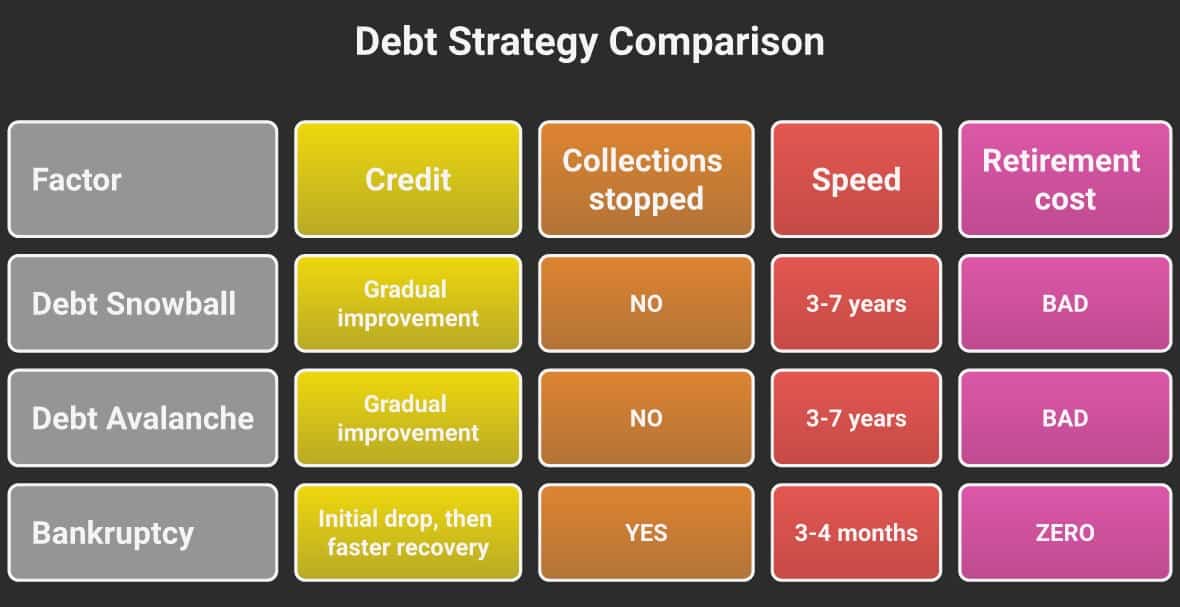
The Three Methods — Honestly Compared
| Factor | Debt Snowball | Debt Avalanche | Bankruptcy |
|---|---|---|---|
| Credit Impact | Gradual improvement as balances drop | Gradual improvement as balances drop | Initial drop, faster recovery (most filers above 650 within 18 months) |
| Collections / Lawsuits | Nothing stops — creditors can still sue during repayment | Nothing stops — creditors can still sue during repayment | Automatic stay stops ALL collection immediately at filing |
| Speed to Debt-Free | 3-7 years depending on total debt | 3-7 years depending on total debt | 3-4 months from filing to discharge |
| Retirement Cost | BAD — every dollar toward debt is a dollar not in retirement | BAD — same retirement cost, slightly less interest paid | GOOD — retirement accounts fully protected, contributions resume immediately |
The math nobody runs: If you are paying $600/month toward debt for 4 years using snowball or avalanche, that is $28,800 in payments. But the real cost is the $28,800 that did not go into retirement. At historical average returns, those contributions would have grown to over $200,000 by retirement. Bankruptcy eliminates the debt in months and lets you redirect that $600/month to retirement immediately. The snowball and avalanche both cost you retirement — bankruptcy does not.
Every weekday I read the enforcement actions, filings and fine print the outlets skip, and turn them into the one or two moves that actually improve your position — a rate worth moving for, a fee you can refuse, a deadline to beat before it costs you.
I write Your Money Actually most weekdays — actionable money information you will not find anywhere else, and the small decisions that compound. It is free, I sell nothing, and I take no money from any company I write about.
How the Debt Snowball Works
The snowball method, popularized by Dave Ramsey, ranks debts from smallest balance to largest. You make minimum payments on everything except the smallest debt, throwing all extra money at it. When it is paid off, you roll that payment to the next smallest. The theory: quick wins create momentum.
Where Snowball Works
- Psychological momentum from early wins
- Simple to follow — no interest rate math
- Works well for people who need visible progress to stay motivated
Where Snowball Fails
- Ignores interest rates — you pay more in total interest
- Requires 3-7 years of sustained discipline
- Does not stop collection calls, lawsuits, or garnishment
- Every month of payments is a month not contributing to retirement
- If you lose your job in year 2, the progress resets
How the Debt Avalanche Works
The avalanche method ranks debts from highest interest rate to lowest. You attack the most expensive debt first, saving the most money on interest over time. The theory: math beats emotion.
Where Avalanche Works
- Saves the most money on interest (mathematically optimal)
- Faster total payoff than snowball in most scenarios
- Appeals to people motivated by numbers over feelings
Where Avalanche Fails
- Slow early progress if the highest-rate debt is also the largest balance
- Requires the same 3-7 years of sustained discipline
- Same vulnerability to life disruptions (job loss, medical emergency, divorce)
- Same retirement cost as snowball — years of contributions diverted to debt
- Does not stop collection activity during repayment
What Both Methods Leave Out
“The snowball and avalanche debate is like arguing over which route to drive across the country when there is a flight available. Both get you there eventually — if nothing goes wrong. But one option gets you there in months instead of years, and you keep your retirement.”
Here is what Dave Ramsey’s snowball framework and the avalanche math community both leave out of the conversation:
The Daily Money Brief — Free, at 10 AM
Money you may be owed, scams to dodge, and the fine print decoded — the consumer money news that affects your wallet, every weekday.
- Depression: Myvesta’s research found 49% of people in debt counseling showed depression symptoms. Debt and depression feed each other in a clinical loop — telling a depressed person to maintain intense financial discipline for 5 years is not a plan — it is a setup for failure.
- Life happens: Job loss, medical emergency, divorce, car breakdown. Any disruption during a multi-year repayment plan can erase months or years of progress. Bankruptcy takes 3-4 months — the window for disruption is tiny.
- Creditors do not wait: While you are snowballing or avalanching, your creditors can still sue you, garnish your wages, and levy your bank accounts. Bankruptcy’s automatic stay stops all of this the moment you file.
- The shame tax: Both methods keep you in a state of debt for years, reinforcing the shame narrative. Bankruptcy provides a clean break and the psychological relief that comes with resolution.
Free Tool — Debt Stress Test: Is your debt causing more than financial damage? This free 2-minute screening interleaves financial questions with the PHQ-9 clinical depression tool used by doctors worldwide. 49% of debt counseling clients show depression symptoms — find out if your debt stress has crossed that line. Take the Free Screening →
When Each Method Is the Right Choice
Choose Snowball If
- Total debt is under $10,000
- You need quick wins to stay motivated
- Income is stable and debt-to-income ratio is manageable
- You can still contribute to retirement while paying down debt
Choose Avalanche If
- Total debt is under $15,000
- You are motivated by math over milestones
- High-rate debt (25%+ APR) is costing you significantly
- Income is stable with margin for unexpected expenses
Consider Bankruptcy If
- Total unsecured debt exceeds what you can pay in 3 years
- You are being sued or facing garnishment
- Retirement contributions have stopped to make debt payments
- Debt is causing depression, relationship strain, or health problems
- A life disruption (job loss, medical crisis, divorce) caused the debt
Notice the pattern: snowball and avalanche work for moderate, manageable debt with stable income. For everything else — which is most people searching for debt repayment strategies at 2am — bankruptcy deserves to be in the conversation. The fact that it is excluded from every “snowball vs. avalanche” comparison is not an accident. It is a blind spot built into the shame narrative around debt.
Key Takeaways
- The snowball vs. avalanche debate excludes the option that wins on every factor: bankruptcy
- Both methods take 3-7 years and cost $200,000+ in lost retirement contributions
- Neither stops creditors from suing or garnishing wages during repayment
- 49% of people in debt show depression symptoms — multi-year discipline plans fail most of them
- Bankruptcy takes 3-4 months, protects retirement entirely, and stops all collection activity
- Snowball and avalanche make sense for small, manageable debt — not for crisis-level debt
- The shame that keeps bankruptcy out of this conversation is the most expensive financial mistake people make
The Bottom Line
The debt snowball and debt avalanche are fine tools for moderate debt in stable circumstances. But the debate between them distracts from the option that changes everything: bankruptcy eliminates debt in months, protects your retirement, stops collection activity, and lets you start rebuilding immediately. If your debt is beyond what you can pay in 3 years, or if repayment is coming at the cost of your retirement, health, or relationships, the snowball vs. avalanche question is the wrong question. The right question is whether you should be paying this debt at all.
Frequently Asked Questions
Is the debt snowball or avalanche better?
The avalanche saves more money on interest. The snowball provides faster psychological wins. In practice, the difference is small — both take 3-7 years and require intense sustained discipline. The real question is whether either method is appropriate for your debt level. For debt under $15,000 with stable income, either works. For larger amounts, both carry a hidden retirement cost exceeding $200,000 that makes bankruptcy worth serious consideration.
Why does Dave Ramsey not recommend bankruptcy?
Dave Ramsey frames bankruptcy as a moral failure and a last resort. His approach works for many people with moderate, manageable debt. But his framework does not account for the retirement opportunity cost of multi-year repayment, the depression research showing 49% of people in debt struggle with the sustained motivation his plan requires, or the fact that bankruptcy credit scores often recover faster than expected. His advice serves people well in some situations — it fails people in others.
Does bankruptcy actually help your credit score?
It hurts initially and recovers faster than most people expect. The bankruptcy appears on your credit report for 7-10 years, but the score impact peaks at filing and improves from there. Most Chapter 7 filers report scores above 650 within 12-18 months — often faster than someone grinding through a 4-year snowball or avalanche plan with closed accounts and high utilization ratios.
What if I only have $10,000 in debt?
For $10,000, snowball or avalanche are reasonable approaches if you have stable income and can maintain retirement contributions while making payments. At that debt level, the retirement opportunity cost is smaller and the payoff timeline is shorter — typically 1-2 years. Bankruptcy is technically available for any amount of unsecured debt, but the attorney fees ($1,500-3,500) make it less cost-effective for smaller balances unless you are also facing lawsuits or garnishment.
Can I use the snowball method during Chapter 13 bankruptcy?
Chapter 13 has its own court-supervised repayment structure — you do not choose snowball or avalanche. The court sets your payment amount based on disposable income, and the trustee distributes payments to creditors according to legal priority (secured debts, priority debts, then unsecured debts). The advantage over DIY repayment: the plan is legally binding on creditors, the amount is based on what you can actually afford, and at the end of 3-5 years, remaining qualifying debt is discharged.
Dealing With Debt? Understanding your options is the first step. See how all your debt relief options compare — including ones most sites won’t tell you about. The Find Your Path quiz gives a recommendation based on your actual numbers, and the Scam-O-Meter checks any company’s complaint history before you sign. Federal Reserve research shows bankruptcy filers recover faster than those who don’t file.



