

Quick Answer: The standard advice says invest if your expected return exceeds your debt interest rate, and pay off debt if it does not. That math is correct and incomplete. It ignores the third option — bankruptcy — which eliminates the debt AND protects your investments simultaneously. I have run the numbers from both sides of this equation since 1994. Here is the full math, including the calculation nobody else makes.
Expert Context: I have been helping people navigate debt decisions since 1994. I filed Chapter 7 bankruptcy in 1990 when my own math broke. What I learned: the invest-vs-pay-off-debt question has a hidden third answer that changes the entire calculation — and nobody in the personal finance world includes it because it involves the word they are afraid to say.
Should you invest or pay off debt? Every personal finance site gives you the same framework: compare your debt interest rate to your expected investment return. If your credit card charges 22% APR and the S&P 500 historically returns 10%, pay off the card. If your mortgage is 3.5% and the market returns 10%, invest.
That logic is fine for people with manageable debt and stable income. For everyone else — and if you are searching this question, you might be in that category — it misses the most important variable: what happens to your retirement if you spend years paying off debt instead of investing?
Each weekday I send one short email: one money story that caught my attention, why it might matter to you, and one manageable thing you can do with it. A couple of minutes, and a dad joke.
In the latest issue (Oct 9): Does Financial Literacy Make Financial Sense?
Free. I sell nothing. Unsubscribe any time.
The Standard Math (What Everyone Tells You)
The textbook rule: If your debt interest rate is higher than your expected investment return after taxes, pay off the debt. If your investment return (after taxes) exceeds your debt interest rate, invest.
Credit card at 22% APR vs. market at 10% → pay off the card.
Mortgage at 3.5% vs. market at 10% → invest (and deduct the mortgage interest).
Student loan at 6% vs. market at 10% → depends on risk tolerance.
This calculation is technically correct. It is also dangerously incomplete for anyone with significant unsecured debt, because it assumes a timeline of years and ignores what those years cost you.
The Calculation Nobody Makes: The Retirement Opportunity Cost
Here is what the invest-vs-pay-off debate leaves out:
The Daily Money Brief — Free, at 10 AM
Money you may be owed, scams to dodge, and the fine print decoded — the consumer money news that affects your wallet, every weekday.
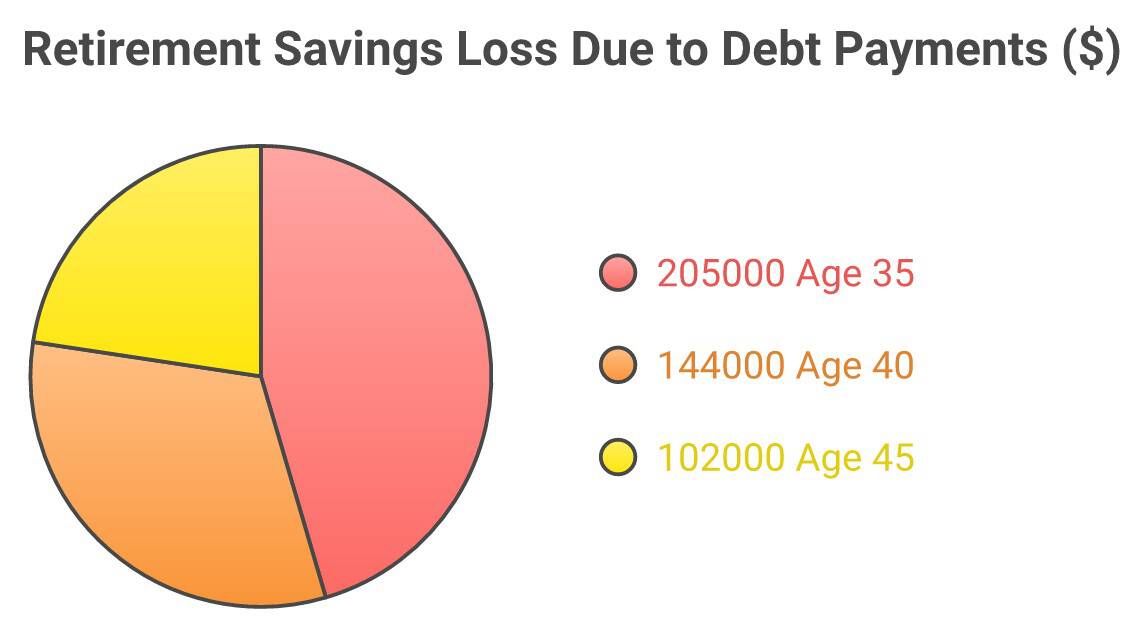
If you are 40 years old and divert $600/month from retirement to debt payments for 4 years, you miss $28,800 in contributions. At a conservative 7% annual return, compounded monthly, to age 65, that $28,800 would have grown to approximately $144,000. If you are 35, the number is about $205,000. If you are 45, it is about $102,000.
This is the real cost of choosing debt repayment over investing — and it is a cost that compounds silently for decades. Nobody feels it today. Everyone feels it at retirement.
The Third Option: Eliminate the Debt and Keep Your Investments
This is where the conversation gets uncomfortable for the personal finance world.
If your unsecured debt (credit cards, medical bills, personal loans) is significant enough that paying it off would take 3+ years and require pausing retirement contributions, bankruptcy may be the mathematically optimal choice. Not because it is easy or shame-free — but because it is the only option that solves both sides of the equation simultaneously.
What bankruptcy does to your investments: Nothing. ERISA-qualified retirement accounts — 401(k), 403(b), pension, most IRAs — are fully exempt in bankruptcy. You keep every dollar. The debt is discharged in 3-4 months. You resume retirement contributions immediately. The compounding clock does not stop.
Compare the three paths for someone with $40,000 in credit card debt, age 42, earning $65,000:
| Path | Time to Resolution | Total Cost | Retirement Impact |
|---|---|---|---|
| Pay off debt (avalanche) | 4-5 years at $900/mo | ~$48,000 (principal + interest) | $180,000+ lost retirement value |
| Invest instead (minimum payments) | 12+ years to payoff | ~$85,000 (interest compounds on debt) | Better, but debt stress persists |
| Bankruptcy + invest | 3-4 months | ~$2,500 (attorney fees) | $0 impact — retirement protected |
The numbers are not close. Bankruptcy costs $2,500 and three months. Debt repayment costs $48,000 and five years — plus $180,000 in retirement opportunity cost. The “invest instead” path costs $85,000 in interest and a decade of financial stress.
When to Invest Instead of Paying Off Debt
Investing while carrying debt makes sense in a narrow set of circumstances:
- Your employer offers a 401(k) match — always capture the match, even with debt (it is an immediate 50-100% return)
- Your debt interest rate is below 6% (mortgage, some student loans) — market returns likely exceed this over time
- Your total unsecured debt is under $10,000 — the retirement opportunity cost is small
- You have an emergency fund of 3-6 months — without this, unexpected expenses will land on credit cards and restart the cycle
When to Pay Off Debt Instead of Investing
- Your debt interest rate exceeds 10% (most credit cards) — no reliable investment consistently beats 22% APR
- Total debt is moderate ($10,000-25,000) and you can pay it off in 1-2 years without pausing retirement
- The debt is causing stress that affects your work, health, or relationships — the psychological value of being debt-free is real
When Neither Answer Is Right
If your unsecured debt exceeds $25,000, or if paying it off requires more than 2-3 years AND pausing retirement contributions, the invest-vs-pay-off-debt framework is the wrong framework. You are optimizing within a broken equation. The right question is not “should I invest or pay off debt?” — it is “should I be carrying this debt at all?”
Bankruptcy is not the answer for everyone. But for anyone whose debt repayment plan costs more in lost retirement than the debt itself, it deserves to be in the calculation.
Key Takeaways
- The standard invest-vs-pay-off-debt calculation ignores the retirement opportunity cost of multi-year repayment
- Diverting $600/month from retirement for 4 years costs about $144,000 in retirement value (age 40 to 65)
- Bankruptcy eliminates debt in 3-4 months while protecting 100% of ERISA retirement accounts
- Always capture your employer 401(k) match — even with debt, the guaranteed return is unbeatable
- For debt under $10K with stable income, the standard comparison works fine
- For significant unsecured debt requiring 3+ years of payments, bankruptcy may be the mathematically optimal path
The Bottom Line
The invest-or-pay-off-debt question has a third answer that the personal finance industry avoids: eliminate the debt entirely through bankruptcy while keeping your retirement intact. The math is not subtle — years of diverted retirement contributions cost more than the debt itself. If your repayment timeline exceeds 2-3 years and requires pausing retirement contributions, you are optimizing within the wrong framework. Step outside it.
Correction, September 27, 2026: I re-ran the compounding math on this page. At a 7% return compounded monthly, diverting $600 a month for 4 years costs about $144,000 by age 65 if you start at 40 (it was listed as $216,000), and about $205,000 if you start at 35 (it was listed as over $300,000). I also updated the IRA bankruptcy cap to the current $1,711,975. The chart on this page has been updated to match.
Frequently Asked Questions
Should I invest or pay off credit card debt?
If your credit card charges 20%+ APR, pay it off first — no reliable investment consistently beats that rate. But if paying it off requires years of payments that replace retirement contributions, the real cost is the lost retirement value, which can exceed $200,000. For significant credit card debt, bankruptcy eliminates it in months while protecting your retirement accounts entirely under ERISA.
Should I stop contributing to my 401k to pay off debt?
Never stop contributing enough to capture your employer match — and never cash out the account to pay debt. The compounding math on why cashing out a 401(k) to pay off debt is almost always wrong shows why a single $40K withdrawal can cost $300K+ in retirement wealth. — that is an immediate 50-100% return. Beyond the match, it depends on your debt level. For moderate debt you can clear in 1-2 years, temporarily reducing contributions may make sense. For larger debt requiring 3+ years of paused contributions, the retirement opportunity cost exceeds the debt itself and bankruptcy deserves consideration.
Does bankruptcy protect my 401k and IRA?
Yes — ERISA-qualified accounts, including 401(k), 403(b) and pension plans, are exempt in both Chapter 7 and Chapter 13 bankruptcy with no dollar cap. Traditional and Roth IRAs are protected up to $1,711,975 in bankruptcy (as adjusted April 1, 2025; the cap is adjusted every three years), and money rolled over from an employer plan like a 401(k) does not count toward that cap. For most people, retirement savings are not at risk in bankruptcy.
What is the retirement opportunity cost of paying off debt?
It depends on your age and the amount diverted. At age 40, diverting $600/month for 4 years means missing $28,800 in retirement contributions. At a 7% annual return, compounded monthly, to age 65, that $28,800 grows to approximately $144,000. At age 35, the same diversion costs about $205,000 in retirement value. This is the hidden cost of multi-year debt repayment that no comparison chart includes.
Is it better to have savings or be debt-free?
Both — and bankruptcy makes that possible simultaneously. It eliminates qualifying unsecured debt while protecting your savings and retirement accounts. Without bankruptcy, you often have to choose: drain savings to pay debt (leaving you vulnerable to emergencies) or carry debt while saving (paying interest that erodes your net worth). Bankruptcy removes the forced choice for people whose debt level makes repayment a multi-year burden.
Part of the Invest vs. Debt Hub: This post is one piece of my complete Should You Invest or Pay Off Debt? guide — what the research says about when to invest, when to pay off debt, and how bankruptcy changes the calculation.
Dealing With Debt? Understanding your options is the first step. See how all your debt relief options compare — including ones most sites won’t tell you about. The Find Your Path quiz gives a recommendation based on your actual numbers, and the Scam-O-Meter checks any company’s complaint history before you sign. Federal Reserve research shows bankruptcy filers recover faster than those who don’t file.



