

Quick answer: Using crypto to pay off debt is not a financial strategy — it’s a desperation move that statistically makes debt worse. The same psychological state that makes it feel rational (feeling trapped, nothing left to lose) is the same state that produces gambling-level losses. I’ve watched it destroy people who were already hurting. There are better paths that don’t require a lucky streak.
I filed personal bankruptcy in 1990 and spent more than a decade running Myvesta, one of the largest nonprofit credit counseling organizations in the country. I’ve sat across from thousands of people in debt — and I’ve watched the crypto Hail Mary play out the same way every time. I’m not saying this to shame anyone. I’m saying it because I want you to make a decision that actually gets you out, not deeper in.
“When you feel trapped by debt, the appeal of a quick escape makes complete sense. That feeling isn’t weakness — it’s math. The math just doesn’t work the way you’re hoping.”
I understand the logic. You’re carrying $30,000 in credit card debt. Your minimum payments barely cover the interest. You’ve been grinding for two years and you’re essentially in the same place. Then someone in a Reddit thread mentions they turned $5,000 into $50,000 on Ethereum in six months. Suddenly crypto doesn’t feel like gambling — it feels like the only rational move.
Each weekday I send one short email: one money story that caught my attention, why it might matter to you, and one manageable thing you can do with it. A couple of minutes, and a dad joke.
In the latest issue (Oct 16): The check that looks like a scam may be real
Free. I sell nothing. Unsubscribe any time.
That mental shift is the thing I want to talk about, because it’s the part nobody warns you about.
Why Crypto Feels Like a Solution When You’re in Debt
Debt causes depression. That’s not a figure of speech — it’s research. A study from my own organization screened 136 people seeking debt help, and 49% screened positive for depression symptoms — an elevation over the general population that I now state as a range of roughly two to five times, after correcting a comparison I had wrong for years. That’s not a coincidence. Financial stress rewires how your brain evaluates risk.
The Daily Money Brief — Free, at 10 AM
Money you may be owed, scams to dodge, and the fine print decoded — the consumer money news that affects your wallet, every weekday.
When you’re depressed and financially trapped, conventional wisdom stops making sense. “Just make a budget” feels insulting. “Cut your expenses” assumes you have room to cut. “Build an emergency fund” sounds like a joke when you’re behind on rent. The reasonable, slow, grinding path feels unbearable — because grinding for five years while depressed is genuinely unbearable.
So the brain starts looking for exits. Crypto is an exit that feels logical instead of reckless, because you’ve seen people succeed at it. It feels like a skill play, not a gamble. It has vocabulary and communities and YouTube tutorials. You can tell yourself you’re doing research while you’re doing it.
What the research says about risk tolerance and debt: People in financial distress demonstrate measurably higher risk tolerance than people who are financially stable — not because they’re less intelligent, but because the baseline is already bad. When things are already terrible, a 50% chance of losing sounds better than a 100% chance of continuing the grind.
This is exactly why I wrote this piece. The logic that makes crypto feel smart when you’re in debt is the same logic that makes it dangerous.
The Numbers Nobody Shows You
Let’s do what I always do: run the actual math.
Here’s the scenario that plays out most often. You put $5,000 — maybe borrowed on a credit card — into a crypto position. The market drops 40%. You now have $3,000 in crypto and $5,000 in new debt, plus whatever you had before. You can either sell at a loss or hold and wait. While you hold, your existing debt continues growing at 26% annually. Every month the math gets worse.
The double-loss math:
Debt at 26% APR + Crypto loss of 40% = You need crypto to gain 60%+ just to break even — and your debt kept growing the entire time you waited. You’re not starting from the same place you were. You’re starting from a worse place.
The people who made money on crypto mostly bought before 2017, held through multiple crashes, and had the financial stability to not touch it. That profile doesn’t describe someone who is in debt and needs money now.
How This Is Different From Day Trading (And How It’s the Same)
I’ve written separately about using day trading to escape debt and the peer-reviewed data on that is devastating — about 97% of day traders lose money over time. Crypto has some structural differences worth understanding.
How crypto differs from day trading
- No broker commissions on most platforms
- 24/7 market — you can theoretically react faster
- Higher volatility — bigger moves happen more often
- No pattern day trader rule (you can trade with small accounts)
How crypto is exactly the same
- You are trading against algorithms and professionals
- Higher volatility cuts both ways — bigger losses too
- 24/7 trading means 24/7 anxiety and sleep disruption
- Tax treatment on gains is complex and often unexpected
The 24/7 availability sounds like an advantage. In practice, it means you can watch your position drop at 3am and make panicked decisions with no sleep. The people I’ve seen try this describe it the same way problem gamblers describe gambling — they couldn’t stop checking, couldn’t stop adding more, couldn’t stop believing the next move would fix everything.
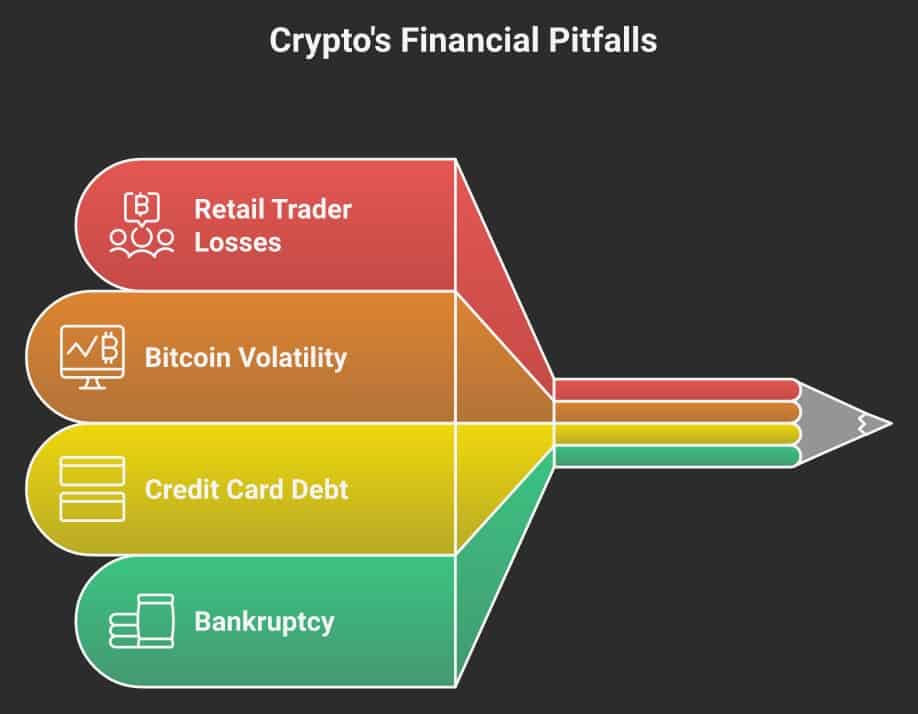
The Connection Nobody Talks About: Crypto and Compulsive Behavior
There’s a reason debt counselors, financial therapists, and addiction researchers have started drawing lines between problem gambling and high-risk trading. The dopamine loop is functionally the same: variable rewards, near-misses, the illusion of control, chasing losses.
If you’re in debt because of a period in your life when the math broke — a job loss, a medical crisis, a relationship ending, a period of depression — that’s not the same as being someone whose brain is wired for compulsive risk-taking. You can use the standard debt solutions and they’ll work.
But if the pattern in your debt history involves repeated high-risk decisions, chasing losses, or a feeling that you need to make everything right with one big win — that’s worth paying attention to. Not as a moral failing. As information about what’s actually going on and what kind of help will actually work.
Not sure what’s driving your debt? Take the free debt assessment — it takes about 3 minutes and helps identify whether your situation is best addressed by a financial solution, an emotional one, or both.
What Actually Works (When You’re Desperate Enough to Consider Crypto)
I want to be honest about something: if you’re at the point where crypto feels rational, the traditional advice isn’t going to land. “Make a budget” is not the answer when you’re in crisis. So let me give you the crisis-appropriate version.
First: the feeling that you need to fix everything fast is the thing making your decisions worse. Debt doesn’t actually get worse fast enough to justify the risk you’d take on with crypto. A 26% interest rate sounds terrifying, but on $20,000 of debt that’s about $433 a month in interest — terrible, but survivable while you figure out your actual options.
Myth: “I need to make a big move now or the debt will spiral out of control.”
Reality: Debt grows at a predictable, calculable rate. The urgency you feel is real, but it’s not matched by the actual math. You have more time to make a smart decision than your anxiety is telling you.
Second: the options that actually resolve debt fast — and I mean fast, as in weeks, not years — do exist. Chapter 7 bankruptcy is the most complete one. It can discharge most unsecured debt in three to four months. It doesn’t require a lucky streak. It doesn’t require the market to cooperate. Your retirement accounts are protected. And the research is clear: people who file bankruptcy come out in better financial shape than comparable people who don’t.
The Federal Reserve study you’ve probably never heard about: A Federal Reserve Bank of Philadelphia study found that people who received Chapter 7 bankruptcy relief were significantly more likely to be employed, had lower rates of financial distress, and recovered faster than similar people who did not get bankruptcy relief. The “fresh start” is real — not a metaphor.
Other options worth understanding: debt settlement (faster than you think, more damage than you think), debt management plans (slower than bankruptcy, but no court filing), and in some cases simply stopping payments and letting debts go to statute of limitations if you’re judgment-proof anyway.
None of these require the crypto market to behave. All of them have known outcomes. All of them are actually designed for the situation you’re in.
Part of a series: This post is part of my Should You Invest or Pay Off Debt? research hub — where I cover the math, psychology, and scams around investing while in debt.
Free Tool — Statute of Limitations Checker: Dealing with old debt? The free Statute of Limitations Checker tells you if the collection clock has expired in your state — including the zombie debt and clock-restarting traps collectors use. Check My Status →
Key Takeaway
Crypto feels like a logical escape from debt because desperation changes how your brain calculates risk. But the math doesn’t support it: most retail crypto traders lose money, your debt accrues interest while you wait for a recovery, and a loss puts you in a worse position than you started. The real question isn’t “could I get lucky?” — it’s “what actually resolves this?” Bankruptcy, debt settlement, and other established options are slower than a bull run but they don’t require luck. They require a decision.
FAQ
Can I use crypto gains to pay off debt without it being a bad idea?
If you already own crypto and it has appreciated significantly, selling it to pay down high-interest debt is a rational move — and a different situation entirely from buying crypto specifically to solve a debt problem. Paying off a 26% credit card with existing crypto profits is smart math. Buying new crypto in hopes of creating those profits is the situation I’m describing above.
What if I only invest what I can afford to lose?
When you’re in significant debt, the phrase “money I can afford to lose” usually means money you can’t actually afford to lose — money that was going to a minimum payment, an emergency, or food. If you’re genuinely debt-free or have a substantial emergency fund and want to take a small speculative position in crypto, that’s a different conversation. But if you’re asking this question while carrying high-interest debt, the honest answer is that you don’t have money you can afford to lose right now.
Is crypto debt dischargeable in bankruptcy?
Debt you took on to fund crypto trading is generally dischargeable in bankruptcy just like any other unsecured debt — with one significant exception. If you borrowed money or used a credit card specifically to buy crypto shortly before filing, a bankruptcy trustee may scrutinize that as potential fraud or abuse. Debts run up right before a bankruptcy filing are always subject to closer review. If you’ve already taken on crypto-related debt, talk to a bankruptcy attorney about the timing before you file.
What’s the difference between using crypto to pay off debt and investing to pay off debt?
The math is the same. Whether you’re buying crypto, day trading stocks, or playing options, you’re betting that volatile assets will outperform the certain cost of your debt’s interest rate. For most people in debt, the interest rate on their debt is higher than the risk-adjusted expected return on volatile assets. The right framework is: if the expected return on your investment (adjusted for risk of loss) doesn’t reliably beat your debt’s interest rate, the debt paydown is the better investment.
I already lost money on crypto trying to pay debt. What do I do now?
First — you’re not uniquely foolish for this. Thousands of people in debt have made the same move for the same reasons. The loss doesn’t have to compound. Stop the position if you haven’t already (chasing losses makes it worse), and look at your total debt picture now including whatever you added. If you’ve crossed into territory where the total is genuinely unmanageable, a bankruptcy consultation is free with most attorneys and worth understanding before you decide anything else. You can rebuild from here. Many people have.
Bottom Line
Using crypto to escape debt is a desperation play that makes statistical sense to you precisely because desperation is affecting your judgment. (Tempted by the newer version of this pitch — letting an AI grow a small stake into a fortune? I put real money on that promise and showed the math first.) The same urgency and hopelessness that makes it feel logical is the signal that you need a real debt solution, not a lucky break. Chapter 7 bankruptcy and debt settlement aren’t exciting — but they’re designed to actually work. Crypto requires the market to cooperate. Real debt solutions only require a decision.
Dealing With Debt? Understanding your options is the first step. See how all your debt relief options compare — including ones most sites won’t tell you about. The Find Your Path quiz gives a recommendation based on your actual numbers, and the Scam-O-Meter checks any company’s complaint history before you sign. Federal Reserve research shows bankruptcy filers recover faster than those who don’t file.



