

Quick answer: Capital Health patients whose data was exposed in a 2023 breach can file a claim for compensation from a $4.5 million class action settlement. The deadline to file is April 6, 2026. If you received a notice, go to capitalhealthdatabreachsettlement.com and file — this money has been set aside specifically for you.
I filed personal bankruptcy in 1990, and for 12 years after that I ran Myvesta, a nonprofit credit counseling organization with 70 employees. I’ve worked with people in debt since 1994. One pattern I’ve seen over and over: the people who are most vulnerable to financial devastation from a data breach are the people who are already dealing with medical debt. When your Social Security number gets exposed and someone uses it to open fraudulent accounts in your name, you’re not just dealing with a healthcare bill anymore — you’re dealing with a whole new layer of debt that’s not even yours. That’s why I want every Capital Health patient who received a notice to read this and file a claim before the April 6, 2026 deadline.
“A data breach that exposes your Social Security number doesn’t just compromise your privacy — it hands someone else the keys to your financial life at exactly the moment when you’re least equipped to fight back.”
What Happened with the Capital Health Data Breach
Capital Health is a hospital and healthcare network serving patients in New Jersey and the surrounding region. In 2023, the organization experienced a data breach that exposed the personal information of patients in its system. That breach became the subject of a class action lawsuit, and Capital Health has agreed to a $4.5 million settlement to resolve the claims.
Claiming money you are owed is one good day. What you do over the following year is what actually changes your position.
In the latest issue (Nov 6): Owed money on an Amazon return? Check by Dec. 1
Each weekday I send one short email: one story that caught my attention, why it might matter to you, and one manageable thing you can do with it.
Free. I sell nothing. Unsubscribe any time.
The settlement doesn’t require Capital Health to admit wrongdoing. What it does require is that affected patients get the opportunity to be compensated for the exposure of their data. A court has preliminarily approved the settlement, and class members now have a window to file claims before the deadline closes.
What data was exposed in the Capital Health breach:
- Full names
- Social Security numbers
- Medical records and health information
- Financial account information
- Other personal identifying information
If you received a breach notice from Capital Health, your information was involved. Don’t wait — the claim deadline is real and final.
Why This Matters More Than a Typical Data Breach
I want to be direct about something that most coverage of healthcare data breaches misses entirely: the people who get hurt most by these breaches are the ones who can least afford it.
Think about who uses a hospital. People who are sick. People who are already dealing with the financial shock of a medical event. People who may be behind on bills, facing collection calls from the hospital itself, or already struggling to keep their credit intact while managing care costs.
Now someone has their Social Security number.
In my years working with people in debt, I’ve seen what identity theft does to someone who is already financially fragile. It’s not just the fraudulent accounts — it’s the time lost disputing them, the credit damage, the collection calls for debts you never incurred, and the exhausting process of proving to creditors that you didn’t open that credit card. When you’re already dealing with $15,000 in medical bills, adding $8,000 in fraudulent credit card debt on top of it isn’t just an inconvenience. For many people, it’s the difference between surviving their financial situation and drowning in it.
Who Is Eligible to File a Claim
The class members in this settlement are people whose personal information was exposed in the Capital Health data breach. If you received a notice from Capital Health informing you that your information was involved in the breach, you are almost certainly a class member and you should file a claim.
You may also be eligible even if you didn’t receive a notice, if you were a Capital Health patient during the period covered by the breach. If you’re uncertain, the settlement website at capitalhealthdatabreachsettlement.com can help you determine your eligibility.
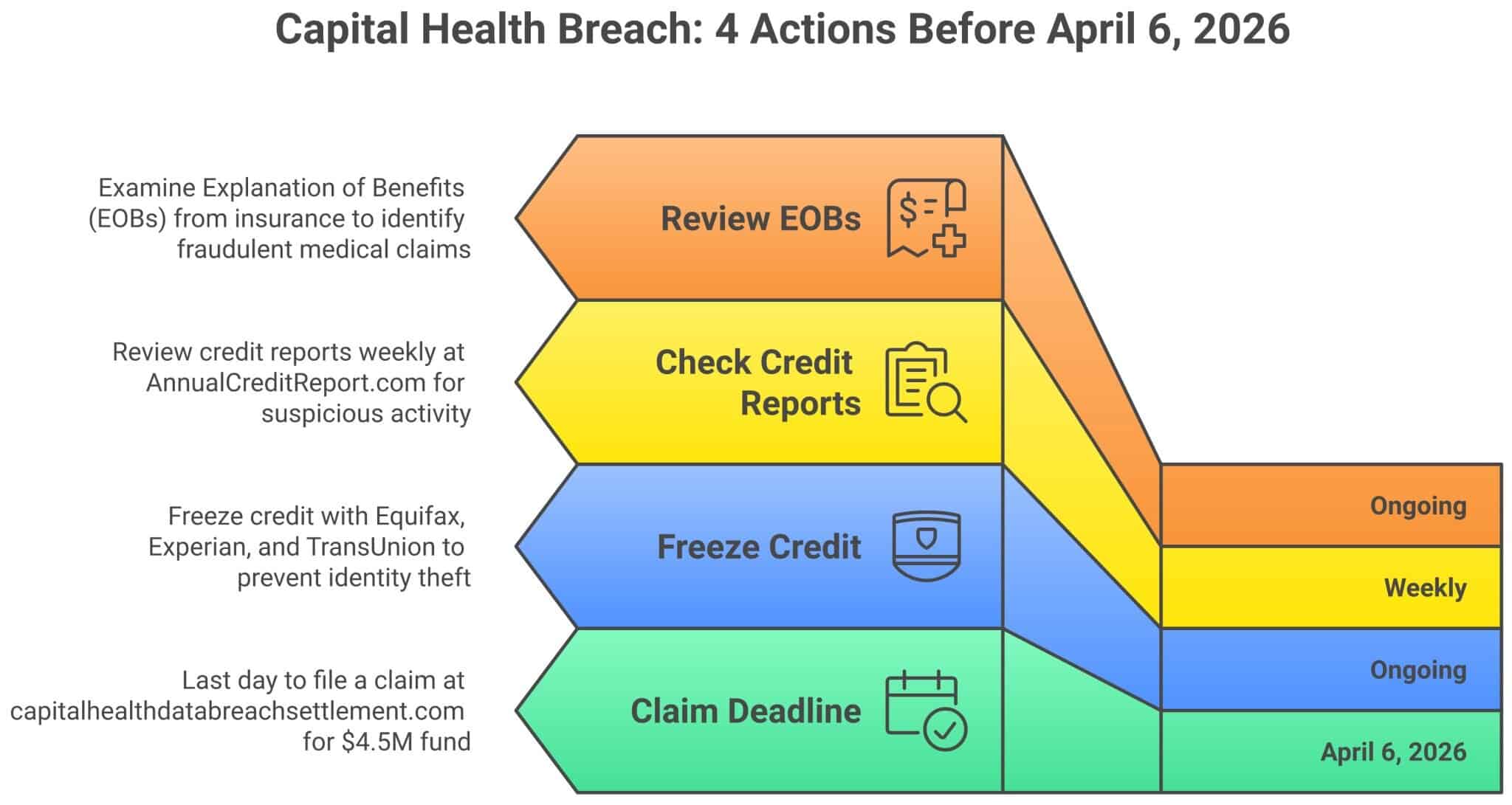
Claim Deadline: April 6, 2026
This is a hard deadline. Once it passes, you cannot file a claim and you will not receive any compensation from the settlement, even if your data was exposed. File now at capitalhealthdatabreachsettlement.com.
What Compensation Is Available
Data breach settlements typically offer multiple tiers of compensation based on what you can document. The Capital Health settlement follows this structure:
Three compensation tiers:
- Basic cash payment — All class members who file a valid claim are typically eligible for a baseline payment, even without documenting specific losses. The amount per person depends on how many claims are filed total.
- Reimbursement for documented out-of-pocket losses — If you can document losses directly connected to the breach — fraudulent charges, credit monitoring costs, bank fees, or costs from resolving identity theft — you can typically claim reimbursement up to a specified cap. Save every receipt and bank statement related to anything suspicious since you received the notice.
- Time spent dealing with breach-related issues — Many settlements compensate class members for documented time spent responding to the breach: disputing fraudulent accounts, dealing with credit bureaus, placing fraud alerts, or working to restore your identity. Keep a log of your time.
Check the official settlement website for the exact amounts and documentation requirements.
How to File Your Capital Health Data Breach Claim
- Go to capitalhealthdatabreachsettlement.com — the official settlement website managed by the claims administrator
- Find your unique claim ID number from the notice you received, or use the lookup tool on the site
- Fill out the claim form completely and accurately
- If you are claiming documented losses beyond the basic payment, attach supporting documentation (bank statements, receipts, correspondence with credit bureaus)
- Submit before April 6, 2026 — online filing is fastest, but check the site for mail-in options if needed
- Keep a copy of your submitted claim confirmation
Protecting Yourself After the Breach
- Place a fraud alert with one of the three credit bureaus (Equifax, Experian, TransUnion) — they’re required to notify the other two, and lenders must take extra steps to verify your identity before opening new accounts
- Consider a credit freeze — stronger than a fraud alert; locks your credit file so new accounts can’t be opened without your explicit unfreeze. Free at all three bureaus under federal law.
- Monitor your credit reports — you can pull free reports weekly at AnnualCreditReport.com; look for accounts you don’t recognize
- Watch your Explanation of Benefits statements — medical identity theft can also appear as false claims billed to your insurance; review every EOB from your insurer
- Document everything suspicious — keep a log of dates, times, amounts, and actions taken; this documentation could increase your settlement compensation
If you find fraudulent accounts: File a report with the FTC at IdentityTheft.gov — the site generates a personalized recovery plan and a report you can use with creditors. Also file a police report with your local department. These two documents are your primary tools for disputing fraudulent debts.
Myth: “Data breach settlements pay out pennies. It’s not worth the trouble to file.”
Reality: The payout depends entirely on documented losses and claim volume. Class members with documented identity theft losses, fraud monitoring costs, or time spent cleaning up the breach can receive substantially more than the baseline amount. And the baseline isn’t nothing — it’s money that was set aside for you. Not filing is the only guaranteed way to receive zero.
Myth: “If something bad was going to happen with my data, it already would have.”
Reality: Stolen data — especially Social Security numbers — is often held or sold and used months or even years after a breach. The risk doesn’t expire when the news cycle moves on. Place a credit freeze now regardless of whether you’ve seen any fraudulent activity yet.
Key Takeaway
Capital Health patients whose data was exposed in the breach have until April 6, 2026 to file a compensation claim from the $4.5 million settlement. Go to capitalhealthdatabreachsettlement.com to file. In parallel, place a credit freeze at all three bureaus to protect against future identity theft. This is especially important if you are already carrying medical debt — the last thing you need is fraudulent accounts on top of legitimate ones.
FAQ
Do I have to have experienced identity theft to file a Capital Health data breach claim?
No. The basic tier of compensation in most data breach settlements — including this one — is available to all class members whose data was exposed, regardless of whether you’ve experienced any documented harm. The theory behind the settlement is that the exposure itself is a harm that entitles you to compensation. If you have experienced identity theft or financial losses you can connect to the breach, you can claim additional compensation by documenting those losses.
What if I didn’t receive a notice from Capital Health? Am I still eligible?
You may be. Notices are sent to the addresses Capital Health has on file, which may not be current for everyone. If you were a patient at Capital Health during the period covered by the breach, check the settlement website at capitalhealthdatabreachsettlement.com to look up your eligibility. Don’t assume a missing notice means you’re not eligible.
How much will I receive from the Capital Health settlement?
The per-person payout for the basic tier depends on how many valid claims are filed — the $4.5 million total fund is divided among claimants after attorneys’ fees and administrative costs. The fewer people who file, the more each claimant receives. Class members with documented losses can potentially claim significantly more. The settlement website has the specific amounts and caps for each compensation tier.
Is it safe to use the settlement website, capitalhealthdatabreachsettlement.com?
Yes. The official settlement website is managed by the court-appointed claims administrator. That said, be aware that data breach settlements also attract scammers who set up lookalike sites or send phishing emails. Always navigate directly to capitalhealthdatabreachsettlement.com by typing it into your browser rather than clicking links in unsolicited emails. Legitimate settlement administrators will not ask for your full Social Security number or payment information to process a claim.
I’m already struggling with medical debt. Does this settlement help with that?
The settlement compensates you for the data breach specifically — it doesn’t reduce or address your Capital Health medical bills directly. But here’s why it still matters to you: if you’re financially fragile and your data has been exposed, the settlement money can help cover real costs if identity theft occurs. More importantly, use the settlement as a trigger to place a credit freeze now. If you’re carrying medical debt and your Social Security number has been exposed — as in the Stellantis breach that exposed SSNs publicly —, you are exactly the kind of person identity thieves target. Protecting your credit from fraudulent accounts is essential when you’re already working to manage legitimate debt. I cover all of your debt options at my debt options overview.
Related: Maryland LifeBridge Health settlement.
Bottom Line
If your data was exposed in the Capital Health breach, you have a legal right to compensation from a $4.5 million settlement. The deadline is April 6, 2026. Filing takes about 15 minutes at capitalhealthdatabreachsettlement.com. Not filing means walking away from money that was set aside specifically for you. File your claim. Freeze your credit. Those two steps cost you nothing but time and they protect you against real financial harm.
Dealing With Debt? Understanding your options is the first step. See how all your debt relief options compare — including ones most sites won’t tell you about. The Find Your Path quiz gives a recommendation based on your actual numbers, and the Scam-O-Meter checks any company’s complaint history before you sign. Federal Reserve research shows bankruptcy filers recover faster than those who don’t file.



