
Quick Answer: SSI recipients face a hidden debt trap: the $2,000 asset limit that has been frozen since 1989 means paying off debt can actually cost you your benefits if you’re not careful. (If your debt situation also involves a chronic illness that reduced your income, chronic illness and debt — what to do first covers that broader picture.) Paying debt with a lump sum, receiving a settlement, or inheriting money can push your countable resources above $2,000 — triggering benefit suspension. Understanding this rule before you act can protect both your benefits and your financial future.
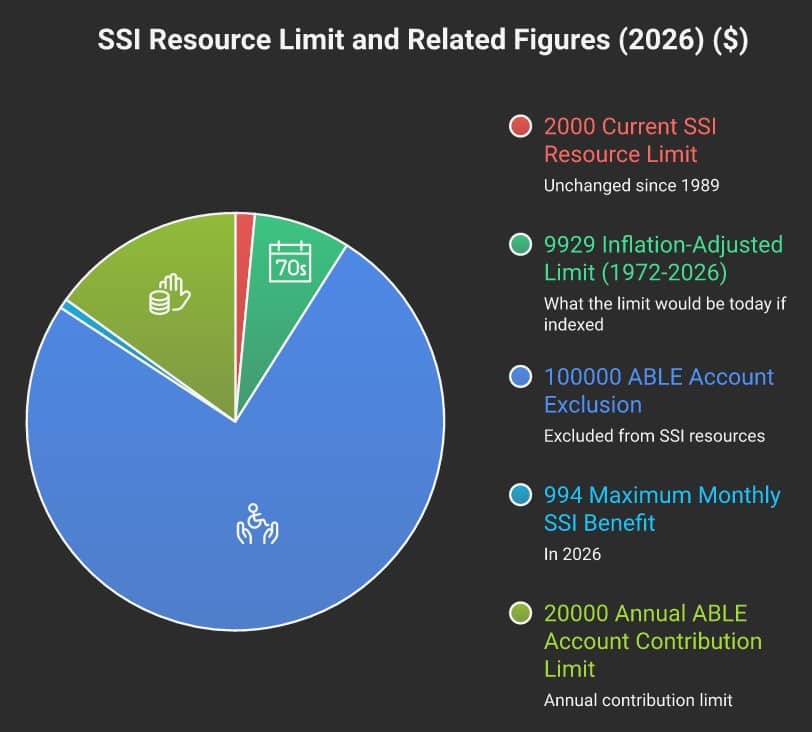
Expert Context: I’ve been helping people navigate the intersection of government benefits and debt since 1994. Over the years, I’ve watched people do everything “right” — receive a small settlement, pay off their credit cards, try to clear their slate — and then get hit with a benefits suspension because nobody told them about the $2,000 asset limit trap. This isn’t a bug in the system. It’s a feature that’s been frozen in place since January 1, 1989, and it catches people off guard every single day.
If you’re on SSI and you have debt, you need to understand one rule before you touch a single dollar: the SSI resource limit. Because the way the rules work, trying to pay off your debt the “normal” way can end your benefits — sometimes for months.
Key Terms Defined
SSI (Supplemental Security Income): A needs-based federal program for disabled, blind, or elderly people with limited income and resources. Unlike SSDI, SSI has strict asset and income limits. Source: SSA.gov
Each weekday I send one short email: one money story that caught my attention, why it might matter to you, and one manageable thing you can do with it. A couple of minutes, and a dad joke.
In the latest issue (Oct 14): Do you want the money back you left behind?
Free. I sell nothing. Unsubscribe any time.
SSDI (Social Security Disability Insurance): An insurance program based on your work history. SSDI has no asset limit — you can have $1 million in the bank and still qualify. The only financial test is whether you’re earning above the Substantial Gainful Activity threshold.
Countable Resources: Things you own that SSA counts toward the $2,000 limit — cash, bank accounts, stocks, bonds, a second vehicle. Your home, one car, and household items are excluded.
ABLE Account: A tax-advantaged savings account that lets people with disabilities save up to $100,000 without it counting toward the SSI resource limit. Source: SSA ABLE Spotlight
The Trap: Why Paying Off Debt Can Suspend Your SSI
Here’s the paradox that trips people up: the debt you owe does not reduce the assets you have in SSA’s eyes.
Let me make that concrete. Say you have $5,000 in a savings account and $4,900 owed on a credit card. Most people would look at that and say “I have $100.” SSA looks at that and says “you have $5,000.” The outstanding debt is invisible to their resource counting — a rule confirmed by SSA Ruling 81-37.
That $5,000 puts you $3,000 over the resource limit. If SSA discovers it, your benefits can be suspended until you spend down to under $2,000.
The fix — paying off the credit card — actually works. But only if you do it correctly and in the right sequence.
The Daily Money Brief — Free, at 10 AM
Money you may be owed, scams to dodge, and the fine print decoded — the consumer money news that affects your wallet, every weekday.
The Myth: “I owe more than I have, so I don’t really have any assets — I’m under the $2,000 limit.”
The Reality: SSA counts what you own, not what you net. Your debts don’t reduce your countable resources until you actually pay them. A $5,000 bank account is a $5,000 resource even if you owe $4,900 on a credit card. You must pay the debt first, then you’re under the limit.
What Happens When You Receive a Lump Sum
This is where it gets particularly dangerous — and where I’ve seen the most people get caught.
If you receive a lump sum — a legal settlement, an inheritance, a gift, a debt settlement payment — SSA treats it as unearned income in the month you receive it. In the following month, any unspent portion becomes a countable resource.
That means you have until the last day of the month you receive the money to spend it down to under $2,000. Not 30 days. Not one calendar month. The end of the calendar month it arrived.
If you receive a $10,000 personal injury settlement on October 15th, you have until October 31st to get your countable resources below $2,000. If you don’t, your November SSI check is suspended. The suspension continues — without time limit — until your resources drop back below the threshold.
Important: Suspension is not the same as termination. You don’t lose your eligibility status, and you don’t have to reapply. Once your resources drop back under $2,000, your benefits automatically restart. But you lose every month you’re over the limit — that money is gone.
SSDI Is Different — No Asset Limit At All
If you’re on SSDI — not SSI — the asset limit doesn’t apply to you. SSDI is an insurance program based on your work history and FICA contributions. You can have $1 million in the bank and still receive SSDI without any issue. And if a collector is actively threatening to garnish your benefits, start with my crisis guide on Social Security collector threats. If you also get SNAP, subsidized rent or Medicare help, a Social Security cost-of-living raise counts as income there too, and I walk through what the 2027 COLA can cost you in those programs.
The only financial test for SSDI is whether you’re earning above the Substantial Gainful Activity threshold — $1,620/month in 2026 for non-blind recipients.
Many people receive both SSI and SSDI at the same time (called “concurrent benefits”). When that happens, the SSI asset rules still apply — SSDI income counts against your SSI payment dollar-for-dollar, reducing it, but the $2,000 resource limit remains in force for the SSI portion.
Legal Ways to Spend Down (SSA-Approved)
If you’re over the $2,000 limit — or about to receive a lump sum — here are the SSA-approved ways to get your resources down before the deadline. All of these must be for your own benefit, documented, and reported to SSA by the 10th of the following month.
- Pay off existing debts — credit cards, medical bills, loans (keep the receipts)
- Pay off or buy a vehicle in your name (one car is excluded from resources)
- Pay off or pay toward your home (your primary home is fully excluded)
- Prepay rent, utilities, or insurance premiums for the current period
- Pay for medical or dental care not covered by Medicaid
- Home repairs, accessibility modifications, assistive technology
- Educational expenses — tuition, books, computer equipment
- Prepay funeral and burial expenses (up to $1,500 in burial funds is separately excluded)
- Legal fees, including estate planning
- Give money to family or friends (triggers a transfer penalty — benefit ineligibility period)
- Buy things for other people’s benefit
- Sell assets for less than fair market value (transfer penalty, up to 36 months)
The ABLE Account: A Genuine Game-Changer That Most People Miss
If there’s one thing I wish more people on SSI knew about, it’s the ABLE account. Established by the Achieving a Better Life Experience Act of 2014, ABLE accounts let people with disabilities save money above the $2,000 limit without losing benefits.
Up to $100,000 in an ABLE account is completely excluded from SSI’s resource calculation. You can contribute up to $20,000 per year from any source (more if you’re employed), and distributions for qualified expenses — which include housing, food, transportation, healthcare, and basic living expenses — are not counted as SSI income.
As of January 1, 2026, the eligibility age expanded significantly. The disability must have begun before age 46 (up from the previous before-age-26 rule). If you or someone you know was previously ineligible because of age, it’s worth checking again.
ABLE accounts are offered through state programs. The ABLE National Resource Center has a state-by-state comparison tool.
Tool: Not sure which debt option is right for your situation? Take my free Find Your Path quiz — it walks through your specific income, assets, and goals and points you toward the approach most likely to help you without risking your benefits.
Bankruptcy Is Often the Cleanest Option for SSI Recipients
For SSI recipients with unsecured debt — credit cards, medical bills, personal loans — Chapter 7 bankruptcy is often the cleanest and most benefit-safe path available. Before diving into bankruptcy specifically, it’s also worth understanding what collectors can and cannot take from disability recipients — many SSI/SSDI recipients are already judgment-proof, and some decide to file anyway simply for the peace of mind of closing the door on old debt — a decision I walk through in I’m in My 70s, Judgment-Proof, and Ready to File Bankruptcy. Here’s why bankruptcy still matters:
First, Social Security benefits are excluded from the Chapter 7 means test under 11 U.S.C. § 101(10A). If your only income is SSI or SSDI, you automatically pass the means test. No calculation needed.
Second, SSI and SSDI payments are protected from the bankruptcy trustee by Social Security Act Section 207 (42 U.S.C. § 407), which prevents benefits from being subject to “execution, levy, attachment, garnishment, or other legal process, or to the operation of any bankruptcy or insolvency law.”
Third, because SSI recipients are limited to $2,000 in countable assets, there’s usually nothing for a bankruptcy trustee to take. A Chapter 7 discharge eliminates unsecured debt cleanly without touching your benefits or your protected assets. (Federal law protects retirement accounts in bankruptcy too — relevant if you have any retirement savings alongside your benefits.)
One important note: keep Social Security funds in a dedicated, separate bank account. Once back pay or lump-sum Social Security payments are commingled with other funds, they can be harder to trace and protect in a bankruptcy proceeding. The separate account maintains the paper trail that proves the source of the funds.
Free Tool — Bankruptcy Means Test: Wondering if you qualify for Chapter 7 bankruptcy? The free Bankruptcy Means Test checks eligibility based on your state, household size, and income — including state exemptions. Check My Eligibility →
What to Do Before You Make Any Move
If you’re on SSI and dealing with debt, the sequence matters enormously. Here’s how to approach it without risking your benefits:
- Know your current resource count. Add up all countable assets — bank accounts, cash, any non-excluded property. Compare to $2,000 ($3,000 for couples).
- If you’re already over the limit, you need to spend down before SSA notices — or contact an SSI/SSDI advocate or attorney immediately.
- If you’re about to receive a lump sum (settlement, inheritance, insurance payment), call an SSI attorney before it arrives. Plan your spend-down strategy in advance.
- Consider opening an ABLE account if you don’t have one. Any funds in an ABLE account (up to $100,000) are completely safe from the resource calculation.
- If your debt is primarily unsecured, talk to a bankruptcy attorney about Chapter 7. It may be the cleanest path — and far safer than trying to spend down while navigating creditor pressure.
- Report everything on time. Any lump sum or change in resources must be reported to SSA by the 10th of the following month. Failure to report can mean repayment demands — or worse.
Key Takeaways
- The SSI resource limit is $2,000 per individual — frozen since 1989 (it would be ~$10,000 today if indexed to inflation)
- Debt you owe does NOT reduce your countable resources — SSA counts what you own, not your net worth
- Lump sums (settlements, inheritances, gifts) must be spent down by the last day of the receipt month or your benefits are suspended
- SSDI has no asset limit — only SSI does
- ABLE accounts let you save up to $100,000 without it counting toward the $2,000 limit
- Chapter 7 bankruptcy is often the safest debt option for SSI recipients — benefits are excluded from the means test and protected by federal law
The Bottom Line
If you’re on SSI and you’re lying awake worrying about debt, I want you to know that the rules protecting you are stronger than the rules trapping you — but only if you know which is which. The $2,000 asset limit is a real trap, and it catches good people who are simply trying to do the right thing. But you have options: the spend-down rules are workable, ABLE accounts are underused and genuinely powerful, and Chapter 7 bankruptcy was practically designed for people in your situation. You don’t have to choose between your benefits and getting out of debt. You just need to know the sequence. I’ve helped people find their way through this since 1994 — the path forward exists, and it starts with understanding the rules before you move a single dollar.
Related: Wage Garnishment: The Complete Guide to Your Rights and Options — all your options in one place.
Free Tool — Wage Garnishment Calculator: Worried about your paycheck being seized? The free Wage Garnishment Calculator shows exactly how much creditors can legally take in your state — and some states prohibit garnishment entirely. Calculate My Risk →
Frequently Asked Questions
What counts as a resource for SSI purposes?
Countable resources include cash, bank accounts, stocks, bonds, a second vehicle, and most real property other than your primary home. Excluded resources — things that don’t count toward the $2,000 limit — include your primary home, one car used for transportation, household goods, burial funds up to $1,500, and up to $100,000 in an ABLE account. A complete list is at SSA’s resources page.
Can I use a settlement or inheritance to pay off debt without losing SSI?
Yes — but the timing is critical. A lump sum counts as income in the month you receive it, then becomes a resource starting the following month. You must spend it down to under $2,000 by the last day of the calendar month you received it. Paying off documented debts is an SSA-approved spend-down method — just keep all receipts and report the transaction to SSA by the 10th of the following month.
If the lump sum you are expecting is an inheritance, it is worth understanding how that money actually arrives. What wealthy families are told about the $124 trillion wealth transfer explains why beneficiary designations, not wills, decide where most of it goes — and how fast it can land, which for SSI is the whole game.
What is an ABLE account and how does it help?
An ABLE account is a tax-advantaged savings account for people with disabilities. Up to $100,000 in an ABLE account is completely excluded from SSI’s resource calculation. You can contribute up to $20,000 per year (more if employed), and withdrawals for qualified expenses don’t count as SSI income. As of January 1, 2026, eligibility expanded to people whose disability began before age 46. Find a state plan at the ABLE National Resource Center.
Does filing bankruptcy affect SSI or SSDI benefits?
No. Social Security benefits — including SSI and SSDI — are excluded from the Chapter 7 means test and protected from the bankruptcy trustee by federal law (42 U.S.C. § 407). SSI recipients typically have little to no nonexempt assets for a trustee to pursue, making Chapter 7 a very clean option. Keep Social Security funds in a separate bank account to maintain clear documentation of their protected source.
Does SSDI have the same $2,000 asset limit as SSI?
No. SSDI has no asset or resource limit whatsoever — it’s an insurance program based on your work history, not your financial need. You can have significant savings and still receive SSDI. The $2,000 resource limit applies only to SSI. If you receive both SSI and SSDI (concurrent benefits), the SSI rules still apply to your SSI portion.
Dealing With Debt? Understanding your options is the first step. See how all your debt relief options compare — including ones most sites won’t tell you about. The Find Your Path quiz gives a recommendation based on your actual numbers, and the Scam-O-Meter checks any company’s complaint history before you sign. Federal Reserve research shows bankruptcy filers recover faster than those who don’t file.